
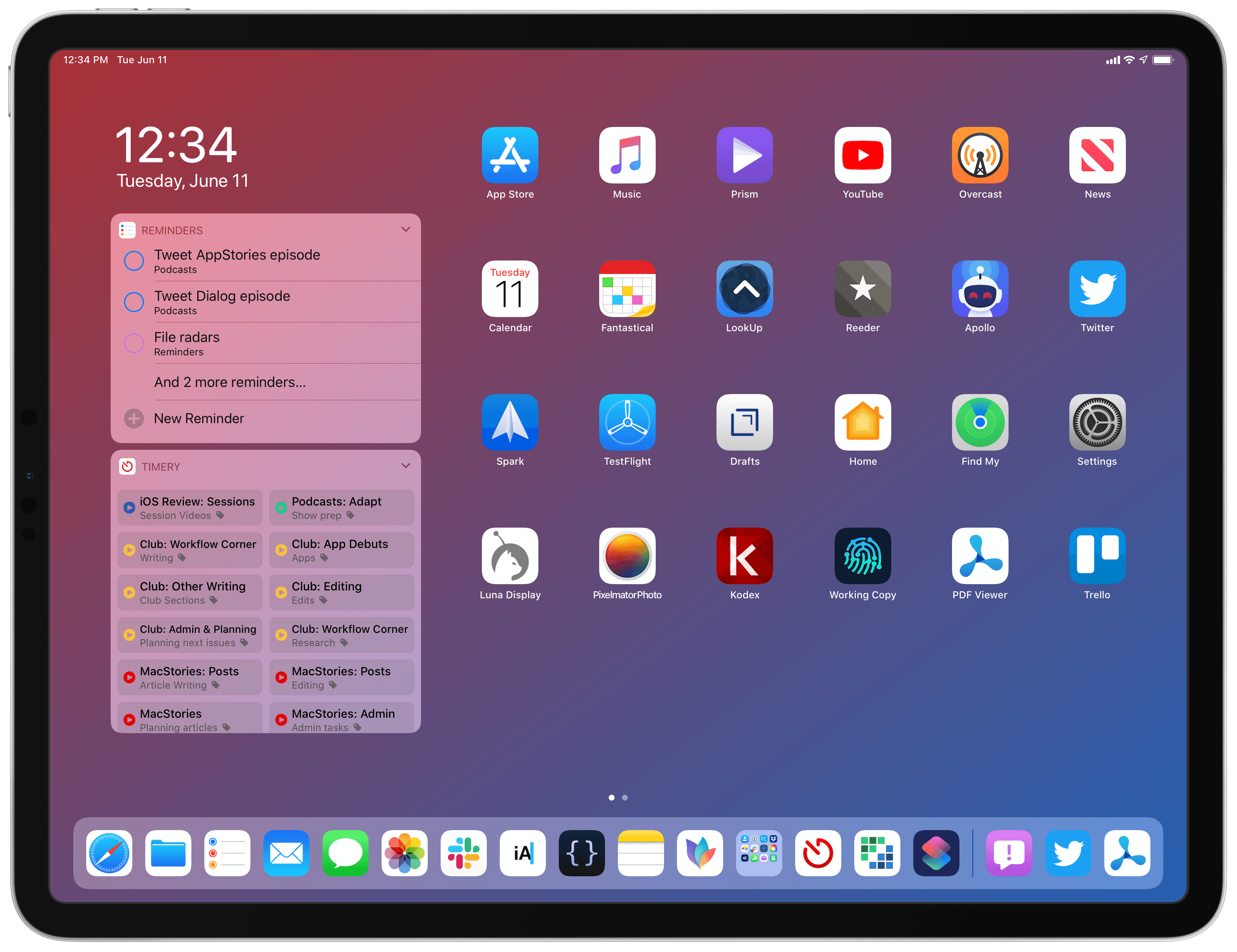
When I published my Beyond the Tablet story a few weeks ago, I was optimistic we’d get a handful of iPad-related features and optimizations at WWDC. I did not, however, foresee an entire OS designed specifically around iPad. And the more I think about it, the more I see iPadOS as a sign of Apple’s willingness to break free from old assumptions and let the iPad be what it’s best at: a portable computer inspired by the Mac, but based on iOS.
WWDC 2019 App-tacular
 John
This week, Federico and John are joined by MacStories colleague Alex Guyot in San Jose where they talk about the upcoming Notes, Reminders, Apple Watch, and Shortcuts updates coming in the fall.
Connected, Episode 246: The Ultimate Dark Mode Is a Crash→
Live from WWDC in San Jose, Federico, Myke and Stephen review their WWDC predications and prizes are awarded after an intervention. Then, iPadOS, Shortcuts and the Mac Pro are discussed before Federico’s surprise is unveiled for the world to see.
Live from San Jose, our extra-special live episode, featuring my long-awaited surprise. You can listen below (and find the show notes here).
Sponsored by:
- Astropad Studio: Turn your iPad into a professional graphics tablet.
- MacStadium: Get two months for the price of one on a Mac mini subscription.
- Instabug: The Most Comprehensive Feedback Platform for Mobile Apps
Craig Federighi: The AppStories Interview
AppStories Episode 114 - Craig Federighi: The AppStories Interview
0:00
0:00
0:00
This week, Federico and John are in San Jose attending WWDC where Federico sat down with Craig Federighi, Apple’s Senior Vice President of Software Engineering to talk about Apple’s new developer tools like Catalyst and SwiftUI, as well as iPadOS.
Dialog Season 1, Episode 2: A Conversation with John Gruber
Today, we published the second episode of Dialog Season 1 (called ‘Writers and Writing’) featuring the first part of a conversation with Daring Fireball’s John Gruber.
You can find the episode here or listen through the Dialog web player below.






I’d like to provide some context around this interview as John Gruber was one of the first names I thought of when my colleague John pitched the original idea for Dialog months ago.
When I started MacStories 10 years ago, Daring Fireball was one of my main sources of inspiration: I was incredibly fascinated by the idea that a single person – more than a blogger, a writer – could share his opinions about Apple and technology on a website that was so clearly attached to his name. Gruber’s columns and original in-depth software reviews were the blueprints upon which I modeled my writing for MacStories: at the time, I felt that, even though English was not my primary language, I could at least try to do the same, but for iPhone apps and the modern age of the App Store and iOS developers.
Of course, as I shared for our tenth anniversary coverage in April, MacStories’ style and scope changed throughout the years: I realized I didn’t want to run a single-person website anymore and we expanded to newsletters and, most recently, podcast production. However, two of the underlying principles that I observed in Daring Fireball a decade ago still inspire my work and MacStories to this day: MacStories is a website by Federico Viticci and Friends (it’s right there in the logo), and I want to publish longform, personal opinion columns in addition to news, app reviews, and links.
John Gruber and Daring Fireball created a framework for other independent online writers to follow in the late 2000s, particularly in the Apple community. From this very website to 512 Pixels or Six Colors, I genuinely believe we owe a lot to John Gruber’s experiments with online ads, sponsors, memberships, and merch – ideas that, in many ways, he pioneered over 15 years ago when it was uncommon and, to an extent, perhaps even frowned upon – to try and monetize an “indie site” on the open web.
In this week’s episode of Dialog, we asked John to tell the story of his first experiences as a writer (and later editor-in-chief) of the school newspaper at Drexel, where he majored in computer science. That intersection of programming and in-depth, opinionated writing ended up shaping John’s entire career as a freelancer, documentation writer at Bare Bones Software, and, finally, independent writer at Daring Fireball. In addition to contextualizing John’s experiences as a newspaper columnist and editor in the early 90s, in the interview we covered topics such as the role of luck and privilege, how Daring Fireball’s beginnings can be traced back to Apple’s renaissance with the iPod, and, of course, the business of writing online and how he sees the influence of Daring Fireball over the indie Apple community.
I’m happy we were able to interview John for this first season of Dialog, and I like how the entire conversation turned out. It’s inspiring to hear the backstory of Daring Fireball and the core ideas at the foundation of one of the most successful indie websites on the Internet. In Part 2 of this interview, out next week, we’ll continue to dig deeper into the business of Daring Fireball, how John makes a distinction between linked posts and regular columns, his podcast The Talk Show, and, of course Markdown.
If you haven’t subscribed to Dialog yet, now’s a good time to do so. You can listen to the first part of our interview with John Gruber here, and subscribe to Dialog so you’ll instantly receive Part 2 when it drops next week.
Adapt, Episode 2: iOS 13 Wishes, HomeKit Experiments, and Writing in Apple Notes→
Ryan tries new HomeKit options on his iPad, Federico writes and publishes an article from Notes, then the guys share their top two iOS 13 wishes for iPad.
In the second episode of Adapt, Ryan explains how he tackled my HomeKit challenge, I go over my approach for writing a MacStories post in the Notes app, and we share our top wishes for iOS 13 on iPad. We also answer some listener questions.
You can listen below (and find the show notes here), and don’t forget to send us questions using #AskAdapt and by tagging our Twitter account.
Connected, Episode 245: Totes Ricky→
With less than a week to the WWDC keynote, the guys make their predictions.
On this week’s episode of Connected and ahead of our live show in San Jose next week (we have a handful of tickets left), we share our final WWDC predictions. The results will be adjudicated live at the Hammer Theater next week. You can listen below (and find the show notes here).
Sponsored by:
- ButcherBox: Thoughtfully sourced meat delivered directly to your door
- KiwiCo: Change the way your kid plays, with KiwiCo! Get your first crate free!
- Hullo: A simple, natural pillow designed for comfort. Try it for 60 days.
Timery for Toggl Plus a Dialog Sneak Peek
AppStories Episode 113 - Timery for Toggl Plus a Dialog Sneak Peek
0:00
0:00
0:00
This week, Federico and John talk about one of their favorite new iOS apps: Timery, a client app for Toggl’s time tracking service. They also preview Dialog, a new seasonal podcast from MacStories featuring weekly, in-depth conversations with special guests about the impact of technology on creativity, society, and culture, which debuts on May 28th.
Connected, Episode 244: This Is Not Propaganda→
Myke keeps dropping his phone, Apple keeps releasing new MacBook Pros for Stephen to talk about, and Federico has published a magnum opus on the state of the iPad and iOS 12.
On last week’s episode of Connected, we discussed the updated MacBook Pros, the themes behind my iPad story, and more. You can listen below (and find the show notes here).
Sponsored by:
- Backblaze: Unlimited cloud backup for Macs and PCs for just $6/month.
- Freshbooks: Online invoicing made easy.
- TextExpander, from Smile: Try the new release with the visual editor. Get 20% off your first year.