

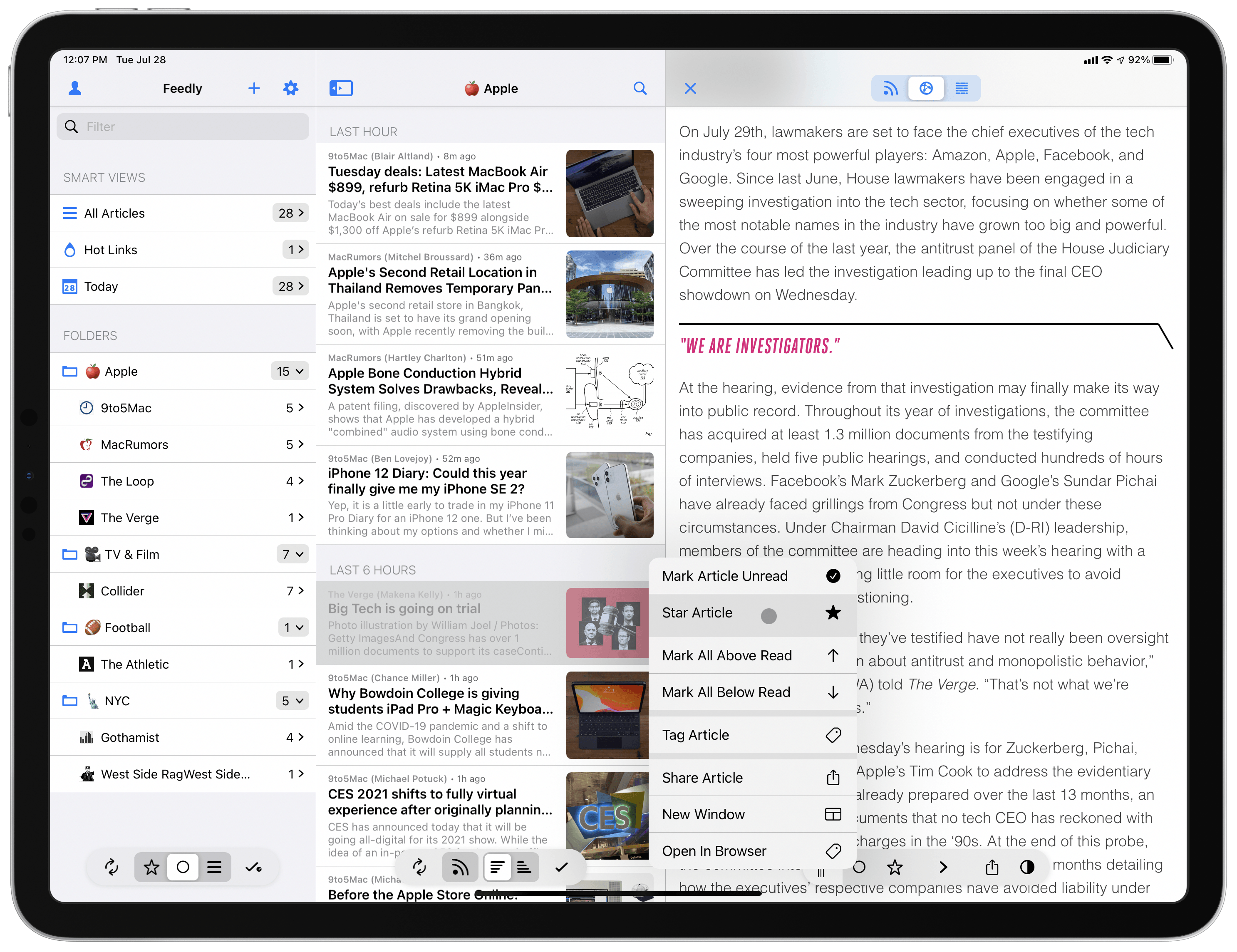
When I imagine the quintessential RSS user, I think of someone who wants full control of their web reading experience. They don’t want to leave news curation up to an algorithmic service like Apple News, or a social media platform like Twitter or Facebook. They also care about tools like filtering controls, and tweaking the reading experience to their preferences. For such a user, Fiery Feeds may be a natural choice due to its abundance of supported RSS services and settings to tweak, along with some key pro features. Today, Fiery Feeds is better prepared to meet the needs of that kind of user thanks to a pair of important additions: full-text search and saved searches. Throw in optimized iPad pointer support, plus a new native article rendering option, and the latest Fiery Feeds update is a compelling one.
 It’s a Bigger iPadOS Year Than It Seems
WWDC 2020 was, by and large, a Mac-heavy event. The big surprise that was macOS Big Sur’s redesign, alongside the introduction of Apple Silicon, helped set the stage for an exciting future for the Mac. I’ve been itching to write about that future ever since the conference ended, but haven’t had the chance yet, and...
Soor 2 Review: Magic Mixes and Release Alerts Elevate the Beautiful Apple Music Client
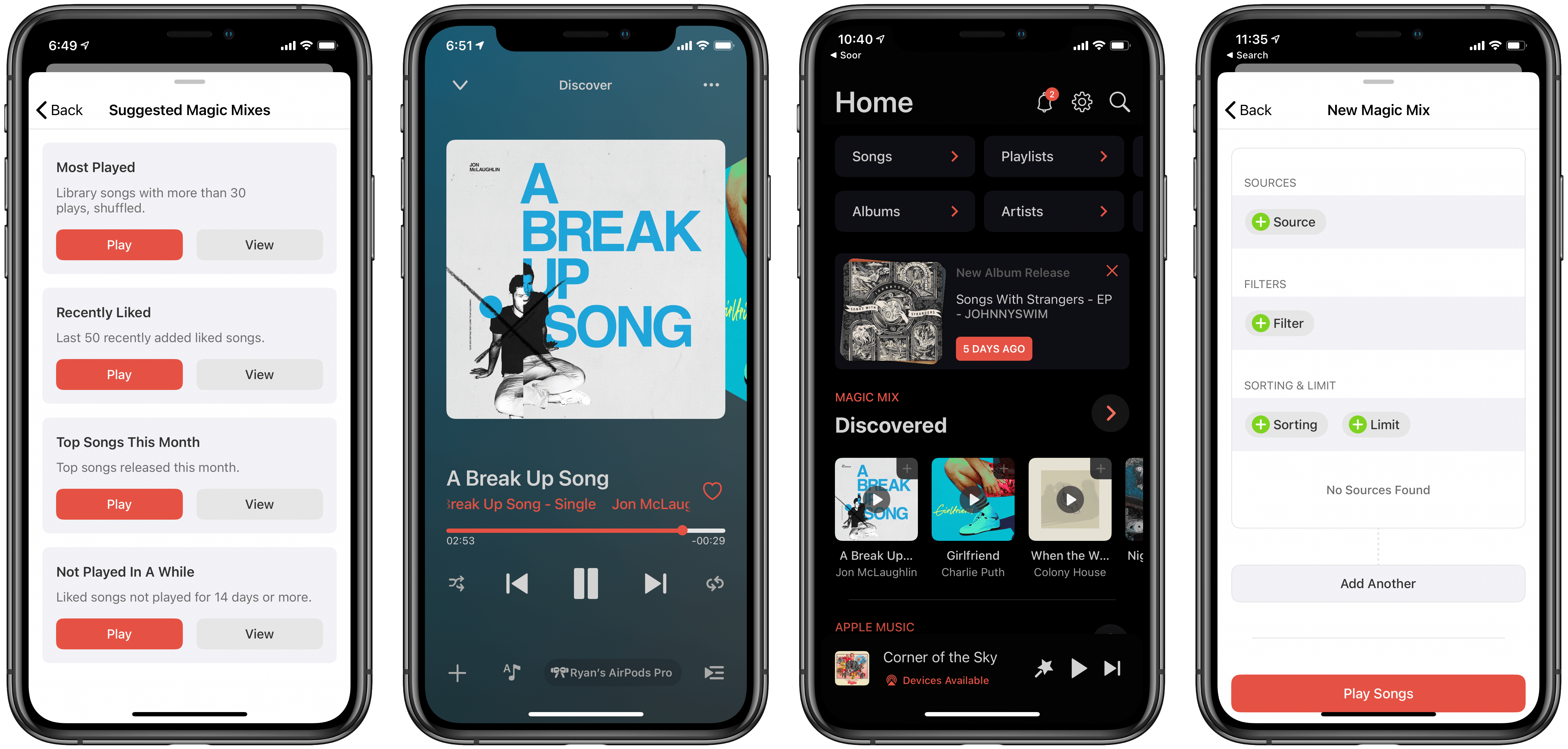
Following the debut of Apple’s MusicKit API, which enables third parties to build apps and web experiences that directly integrate with Apple Music, 2019 was a big year for third-party Apple Music clients on the App Store. We’ve written about several of these apps, but the earliest and highest profile debut of the year was Soor, a meticulously designed client that distinguishes itself with a fully customizable Home view for displaying only the content sections you care about – choosing from things like Recently Added, Playlists, Recently Played, New Releases, For You, and more. Federico reviewed the launch version of Soor and found a lot to like about its unique approach, but he ultimately was disappointed by the absence of certain functionality that’s readily available in Apple’s first-party Music app.
In the nearly 18 months since launch, Soor has improved in significant ways. I adore the throwback Cover Flow-inspired playback screen, where you can smoothly swipe through a horizontal row of artwork, and time-synced lyrics are now available via a tight Musixmatch integration. There are still certain functions you’ll need to pop into Apple’s Music app for, sometimes due to Apple Music API limitations that Soor’s developer can do nothing about, and other times because the app simply doesn’t offer certain features yet – AirPlay 2, for example, is still unsupported. Overall though, for my uses at least, Soor covers enough core Apple Music functionality that there’s very little I need the first-party client for. The biggest absent feature on my wishlist is an iPad app, which I’m glad to see is on the roadmap, especially since iPadOS 14 will soon offer a much-improved first-party Music app.
Soor’s improvements have made it a truly compelling alternative to the first-party Music app, and today’s 2.0 update continues that trend by offering two big new features: magic mixes and release alerts. The latter is a nice addition, but the real pillar of this update is magic mixes.
Apple Commits to 2030 Carbon Neutrality Across Full Business→
Every year Apple releases a new environmental report showing the company’s progress in environmental efforts, and alongside the release of this year’s report, the company has announced a new commitment for the decade ahead:
Apple today unveiled its plan to become carbon neutral across its entire business, manufacturing supply chain, and product life cycle by 2030. The company is already carbon neutral today for its global corporate operations, and this new commitment means that by 2030, every Apple device sold will have net zero climate impact.
“Businesses have a profound opportunity to help build a more sustainable future, one born of our common concern for the planet we share,” said Tim Cook, Apple’s CEO. “The innovations powering our environmental journey are not only good for the planet — they’ve helped us make our products more energy efficient and bring new sources of clean energy online around the world. Climate action can be the foundation for a new era of innovative potential, job creation, and durable economic growth. With our commitment to carbon neutrality, we hope to be a ripple in the pond that creates a much larger change.”
Achieving carbon neutrality for its corporate operations was a nice milestone for the company, but this new commitment appears far more challenging. Apple works with third-party suppliers and manufacturers all around the world to build its devices, and fulfilling this new goal depends a lot on those third parties. It will be interesting to see over the next decade all of the different actions that will be taken to find success in carbon neutrality, but the report of Apple including fewer accessories in the box with new iPhone purchases certainly seems like it would help.
The Developer Debrief on WWDC 2020
Weeks removed from Apple wrapping up its first all-virtual WWDC, many of us are still digesting what the conference’s announcements mean for the future of our favorite products.
Federico, John, and I have all shared various takeaways from the conference, and I’m sure we’ll have a lot more to report as we continue using the betas this summer and review Apple’s OS updates this fall. But our perspective is limited to our profession as journalists, so we also wanted to hear from the people this conference was really built for: developers.
WWDC has grown into an exciting conference for Apple users all around the globe, but its core identity is still ultimately an event for app developers. As a result, I wanted to speak with a variety of developers to get their reactions to the conference. These included:
- Becky Hansmeyer, creator of Snapthread and YarnBuddy
- Charlie Chapman, creator of Dark Noise
- David Smith, creator of Watchsmith, Sleep++, and many more apps
- James Thomson, creator of PCalc and Dice
- Kaya Thomas, creator of We Read Too and Sr. iOS Engineer at Calm
- Simon Støvring, creator of Scriptable, Data Jar, and Jayson
My sincere thanks to these developers for taking the time to share their thoughts, and for their years of valuable contributions toward making Apple’s app ecosystem as strong and robust as it is today.
Interview questions for each developer ranged from the things that most excited them at the conference to surprises and disappointments, their read on how in-touch Apple is with the developer community, the current evolution of software development, and each developer was also generous enough to share a sneak peek at new technologies they’re working to implement in their apps.
Dark Noise 2 Review: Sound Mixing, New Noises, iPad Cursor Support, and More
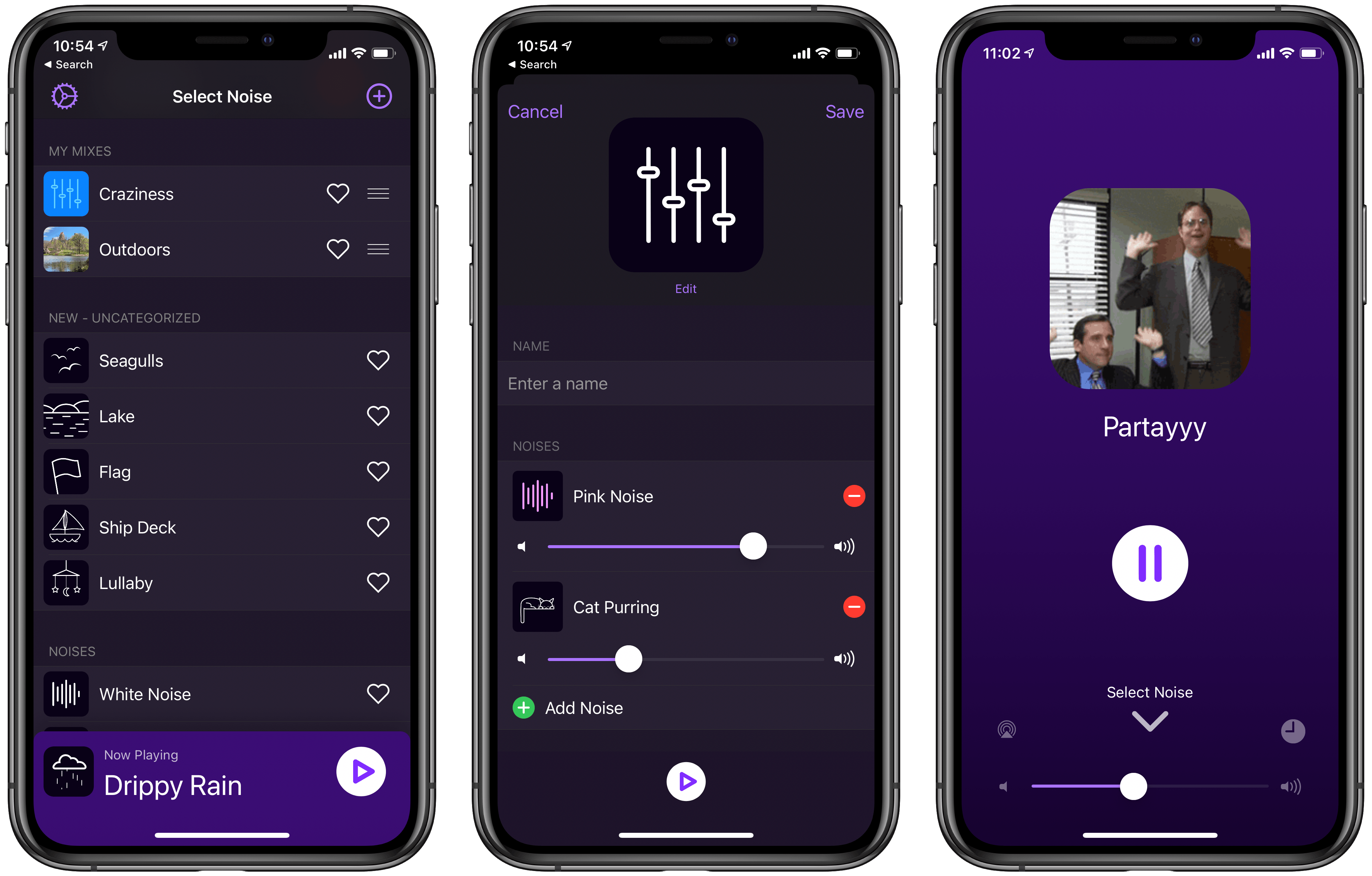
Last summer developer Charlie Chapman launched Dark Noise, an ambient noise app for iPhone and iPad that’s packed with delightful design details and key system integrations. My initial review praised how Chapman was able to take an otherwise standard utility app and build a standout experience which, from day one, raised itself above a crowded market of competitors.
The main reasons I loved Dark Noise from the start had little to do with the app’s basic utility: playing ambient noise. The app has always had a good selection of noise options, but nothing in the sound department made it truly special to me. It was the other areas of the app experience, everything surrounding that basic utility of ambient noise playing, that was so great. Icon animations, buttery smooth panel transitions, haptic feedback, strong iPad support, alternate app icons, Shortcuts support, a customizable widget, and more all made for a compelling product.
One of my only disappointments with Dark Noise was the inability to mix different noises together. Each noise could only be played in isolation, never more than one at a time, which proved a disadvantage compared to other ambient noise apps I’d used that enabled mixing different noises to create a custom soundscape. I’m happy to say that Dark Noise 2, released today, adds this functionality at last.
In Dark Noise 2 not only can you mix different sounds to create custom noises, but there are also eight new sound options to choose from, iCloud sync has been added for syncing your favorite sounds and custom mixes, and there’s optimized support for the iPadOS cursor. It’s a big release that retains the design elegance Dark Noise has had from day one, but expands the app’s usefulness in key ways.
App Debuts
Unread The RSS reader Unread shipped an update this week that added new read-later service integrations, email actions, and some hardware keyboard improvements. One of Unread’s unique strengths is how optimized it is for touch input, employing swipe gestures throughout the app’s entire interface. Certain swipes can be user-configured to perform different actions, and...
Widget Adaptation: My Early Thoughts on iOS and iPadOS 14’s Widgets
Widgets are the feature of iOS 14, iPadOS 14, and macOS 11 that I initially felt largely indifferent about, but now I’m actually pretty excited. Widgets in previous OS versions have always been useful to me, but I never had the thought that they needed a big refresh. So when Craig Federighi debuted the new...
Apple Partners with Historically Black Colleges and Universities to Create New Coding Centers→
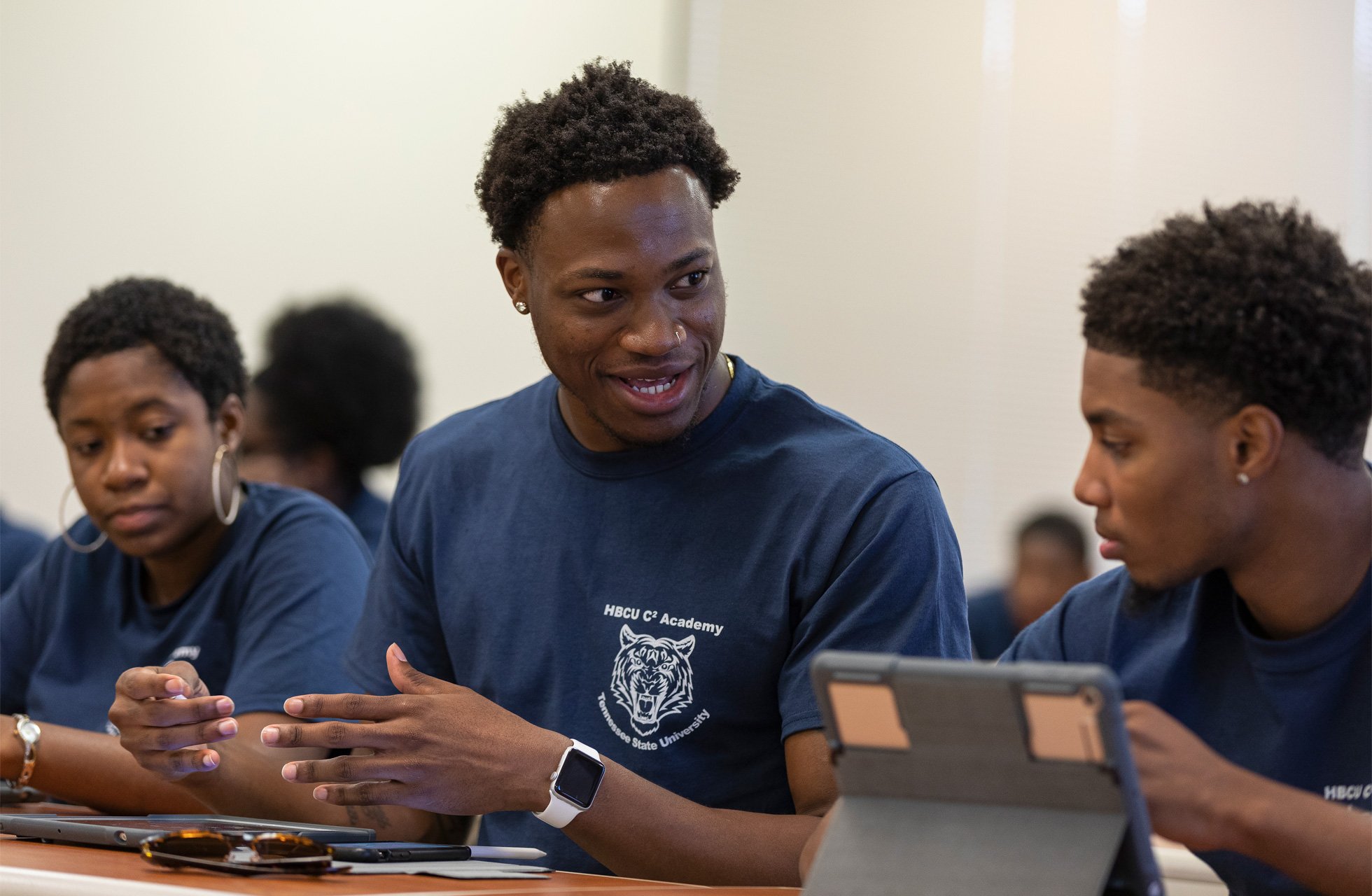
Today Apple announced an expansion of its initiative of partnering with Historically Black Colleges and Universities (HBCUs) to create hubs for training the next generation of coders. 10 new HBCU coding centers are being added throughout the US, from which nearly 500 teachers and community leaders will soon participate in “a virtual Community Education Initiative Coding Academy that Apple is hosting for all initiative partners.” During this training:
Educators will learn the building blocks of coding with Swift, Apple’s easy-to-learn coding language. Participants will work in teams to design app prototypes to address real community challenges. After completing the coding academy, educators will begin to integrate the coding and creativity curricula into their communities by launching coding clubs and courses at their schools, hosting community coding events, and creating workforce development opportunities for adult learners.
This announcement comes as Apple just last week shared updates to its lineup of coding resources for students, educators, and families alike, demonstrating the company’s investment in developing coding initiatives across all age groups. The move also follows Tim Cook’s open letter in June addressing racism in America and subsequent creation of a new $100 million Racial Equity and Justice Initiative by the company. The executive leading this initiative, Lisa Jackson, commented on today’s HBCU news saying:
“Apple is committed to working alongside communities of color to advance educational equity,” said Lisa Jackson, Apple’s vice president of Environment, Policy and Social Initiatives. “We see this expansion of our Community Education Initiative and partnership with HBCUs as another step toward helping Black students realize their dreams and solve the problems of tomorrow.”
These last couple months have seen many companies express a desire to work toward pursuing racial equality and justice, but true change takes more than just words, so I’m glad to start seeing the early fruits of Apple’s new commitments.