


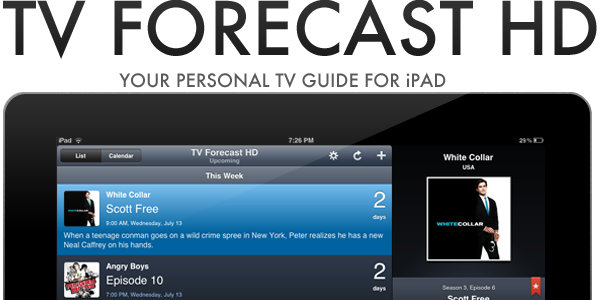
If you are anything like me, you probably don’t watch much live TV anymore; instead just watching a few shows a week on TV and the rest via an online catch-up service. If that sounds like you as well, you may be interested in a new iPad app that makes it easier to track when your favorite shows are airing on TV. The app, TV Forecast HD, is developed by Big Bucket Software (also the developer behind The Incident) and is an entirely redesigned version of TV Forecast, which is currently available for the iPhone. Jump the break for the full review of TV Forecast HD, which has just been made available today.
Apple Files Another ITC Complaint Against HTC, Wants Import Ban On Several Devices
A new patent complaint (filed last Friday and discovered by Bloomberg today) with the International Trade Commission reveals that Apple is looking to block the sale of several HTC devices that they claim infringe on Apple patents.
This latest ITC complaint is actually Apple’s second complaint against HTC and Florian Mueller of FOSS Patents comments: “I take it that Apple is sceptical of the outcome of that ongoing ITC investigation and, therefore, wants a second try with potentially stronger patents.”
Exact details of the complaint are not yet known – we will update this post with anything news worthy if and when further details arise.
[Bloomberg via BGR, Additional Information: FOSS Patents]
Mozilla: Update For Firefox 5 “Coming Soon” To Fix Crashing Issue On Lion
Lion users trying to use Firefox 5 have seen the browser crash when loading a website that uses downloadable fonts, but a fix will be “coming soon” according to the Mozilla team. The bug in question has only been affecting users on OS X 10.7 Lion and as a result there will be a Mac-only update that will bump up the Firefox build number to 5.0.1.
According to Christopher Blizzard, the Mozilla Web platform director, they had alerted Apple to the problem in Lion but Apple did not fix the problem in the GM build released on July 1. Consequently Mozilla has “changed the font APIs that [they’re] using to newer versions which appear to fix the problem. He notes that the bug is serious enough that it is causing “severe crash problems” for Firefox 5 users on Lion.
Mozilla will also be updating Firefox 3.6 to completely disable downloadable web fonts when the browser runs on Lion because of a similar issue. Blizzard also ntoes that under Lion, 3.6 also has “scrollbar rendering issues” and urges users still running that version (which is set to enter ‘retirement’ soon) to upgrade to Firefox 5. If you are already on Lion, you can help Mozilla test the fix by downloading the latest build from the Aurora channel that already includes the fix.
[Via MacWorld]
Apple May Be Looking For A Second iPad Manufacturer

Apple is apparently looking for a second manufacturer for its next generation iPad to assist Foxconn who is currently the sole manufacturer of iPads. Taiwanese-based manufacturers Quanta Computer and Pegatron Technology are currently the frontrunners according to DigiTimes and its sources.
Sources say Pegatron, which has reportedly won the iPhone 5 manufacturing tenders, is a more likely candidate for the orders. DigiTimes suggests that part of the reason Apple is seeking a second manufacturer is concerns over their reliance on Foxconn which was highlighted in May when one of their factory buildings saw an explosion and led to limited production for a number of days.
According to DigiTimes, the manufacturer chosen could start manufacturing iPads with the launch of a rumoured iPad HD product that some are suggesting will launch this Fall.
[Via DigiTimes]
Could WiTricity Be The Technology Behind A “New Way Of Charging” iPhones?
MacRumors decided to do some digging after a report in the Wall Street Journal last week claimed that Apple was experimenting with “a new way of charging” for the 2012 iPhone and found something interesting. Initially, many had suggested that the WSJ report could refer to something as obvious as induction charging, which was featured in the Palm Pre. Whilst induction charging is ‘new’ in that it doesn’t require a cable, it still requires the device to be placed on a charging mat.
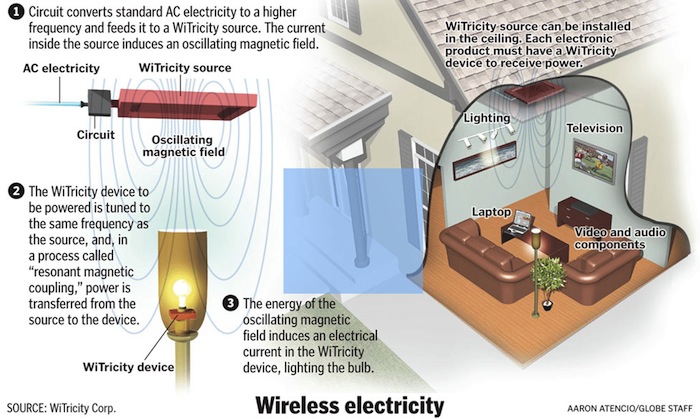
However, after a bit of research, MacRumors found WiTricity – a company developing a far more ambitious form of wireless charging. Founded in 2007 and based on the research done at MIT, it is undertaking work to enable power to be transferred over fairly significant distances compared to induction charging (at this stage they have reached a few meters).
The magnetic fields of two properly designed devices with closely matched resonant frequencies can couple into a single continuous magnetic field. Prof. Soljačić’s team showed how to use this phenomenon to enable the transfer of power from one device to the other at high efficiency and over a distance range that is useful for real-world applications
MacRumors uncovered WiTricity because Apple has an international patent application (Wireless power utilization in a local computing environment) that makes specific mention of the technology and research done by the MIT researchers in their original paper:
Apple describes a scenario where your iMac could be the source of this resonance power to provide a virtual charging area in front of your computer. Keyboards, mice and even mobile electronic devices like the iPhone or iPad could be charged simply by being in a 1 meter proximity to your computer
It should be made clear that Apple (and other technology companies) apply for hundreds of patents and whilst this is an interesting discovery when coupled with the WSJ report, it does not confirm the implementation of the WiTricity technology in a future iPhone. That said, jump the break for an interesting TED talk by WiTricity CEO, which includes a demo using a (slightly hacked) iPhone and some other devices being powered by WiTricity technology.
[Via MacRumors]
The App Store Turns Three After A Number Of Recent Milestones
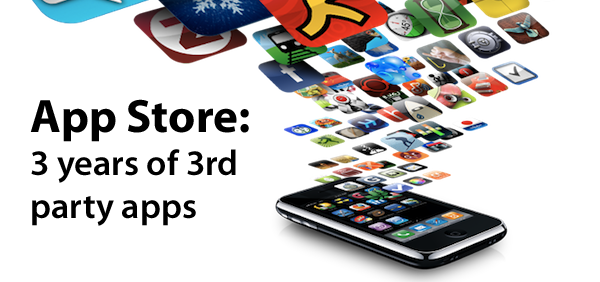
Today marks the third anniversary of the launch of the (iPhone) App Store which launched on July 10, 2008. It launched simultaneously with what was then called the iPhone OS 2.0 software (now dubbed iOS 2.0) and was subsequently followed by the release of the iPhone 3G the next day, which came with iOS 2.0 and thus the App Store pre-installed.
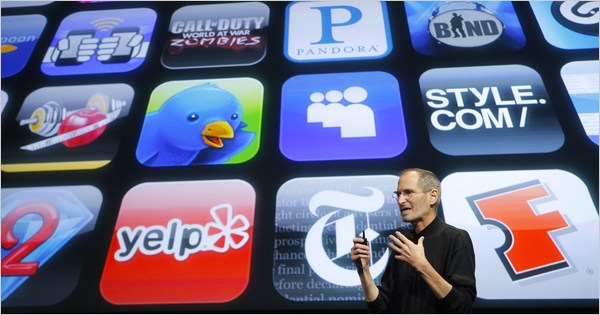
The availability of third-party applications and an ‘App Store’ on the iPhone was certainly one of the most demanded features of the iPhone after it was revealed and launched in 2007. Whilst it hasn’t been revealed when exactly Apple decided to open up the iPhone to third-party apps (or if they had always planned for it), Steve Jobs was quoted in the New York Times shortly after revealing the iPhone in January 2007, as saying:
We define everything that is on the phone. You don’t want your phone to be like a PC. The last thing you want is to have loaded three apps on your phone and then you go to make a call and it doesn’t work anymore. These are more like iPods than they are like computers.
Since the launch of App Store, it has become one of the defining successes for the iPhone and Apple more broadly – becoming a cornerstone feature being used in a number of advertising campaigns. Most notable is the ‘There’s an App for that’ ad campaign which highlighted the wide array of apps available to consumers (jump the break to relive the first of those).
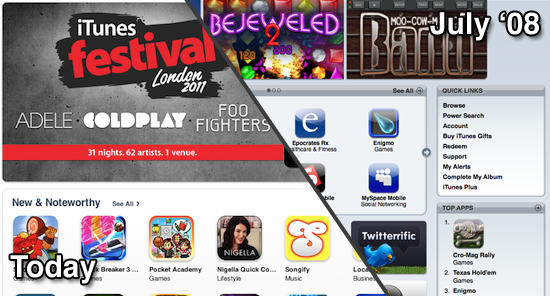
Over the past few months, the App Store has hit a number of milestones that reveals how successful it has been over the past three years. Just in the past week, Apple revealed that there had been 15 billion apps downloaded from the App Store. Recently it was also revealed that there are now over 500,000 apps available in the App Store (100,000 of which are iPad apps) – virtually a hundred-fold increase from the 500 apps that were available at the launch of the App Store in July of 2008. Apple has also been very keen to note at their WWDC conferences that they are paying out significant amounts of money to developers; at last count it was over $2.5 billion. The question is, where will the App Store be in a year from now, let-alone another three years? The pace at which it has grown is truly mind-boggling.
[Sources: New York Times, TechCrunch, Engadget, Wikipedia]
Apple Reveals Over 15 Billion Apps Have Been Downloaded From The App Store
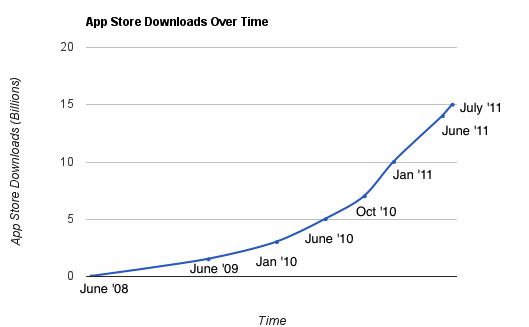
Apple just issued a press release that reveals over 15 billion apps have been downloaded from the App Store. Apple notes that it has more 425,000 apps, including 100,000 native iPad apps. It comes just six months after the App Store hit 10 billion downloads in January this year.
More than 15 billion apps have been downloaded from the revolutionary App Store and more than 425,000 apps are available, including more than 100,000 native iPad apps, to consumers in 90 countries. Users of the more than 200 million iOS devices around the world can choose from an incredible range of apps in 20 categories, including games, business, news, education, sports, health, reference and travel. Apple has paid developers over $2.5 billion to date.
In the press release, a few people who run some of the most popular apps are quoted singing the praises of the App Store and the opportunities it has allowed, including Ge Wang from Smule, Mark Rein of Epic Games and Nicholas Callaway of Callaway Digital Arts. Phil Schiller, Apple’s senior VP of Worldwide Product Marketing says in the press release:
In just three years, the revolutionary App Store has grown to become the most exciting and successful software marketplace the world has ever seen. Thank you to all of our amazing developers who have filled it with over 425,000 of the coolest apps and to our over 200 million iOS users for surpassing 15 billion downloads.
As Business Insider points out, these statistics reveal that, averaged out, each iOS device owner has download 75 apps - any way you cut it, that is an impressive figure. Similarly, AllThingsD notes that just last month at WWDC, Apple revealed that 14 billion apps had been downloaded, meaning roughly a billion apps have been download in just a month.
WSJ: iPhone 5 Is Thinner And Lighter, iPhone 6 May Have New Way Of Charging
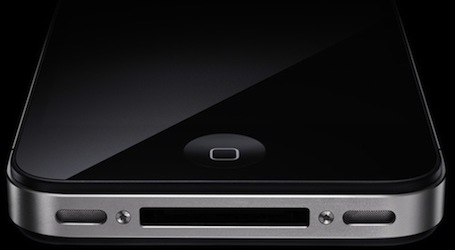
Late yesterday night The Wall Street Journal published an article which included some rumors about the next two iPhones. Interestingly it noted that this years iPhone refresh would be thinner and lighter with an 8MP camera (up from 5 MP), whilst the company focuses on a more ambitious 2012 iPhone, even including experimenting on a “new way of charging” the iPhone.
These people said the new iPhone is expected to be similar to the current iPhone 4, but thinner and lighter with an improved eight-megapixel camera.
Whilst the WSJ doesn’t have any specific details on this new way of charging the device, one potential technological possibility is using induction charging. If it did use such a technology it would not be the first smartphone to use it, back in 2009 Palm revealed their Pre smartphone which came with an optional inductive charger accessory. Yet two years later, inductive charging has not been used on a widespread basis, if Apple adopted it in a future iPhone it could spur such widespread adoption. It would also achieve somewhat of a philosophical goal that Apple has had in removing cables wherever possible.
Curiously, the WSJ suggests that the release of the iPhone 5 was pushed to Fall instead of its usual June announcement because the device simply wasn’t ready yet. It also warns that if their manufacturer, Foxconn, cannot improve their production yield, the device may be further delayed. The WSJ’s source also noted that Apple had been working on an edge-to-edge screen that could possibly debut on a second, less-expensive, iPhone.
[Via The Wall Street Journal]
Judge Denies Apple’s Attempt For Injunction Against Amazon Over ‘Appstore’ Name
 Reuters
is reporting that a Californian judge has denied Apple’s attempt to quickly stop Amazon from using the term ‘Appstore’, which they have been using for their Android app download service. Apple had earlier this year filed a trademark lawsuit that claimed Amazon was improperly using the ‘App Store’ name in a way that will “confuse and mislead customers”. Amazon had claimed that the term was generic and therefore not protectable.
Whilst the full trial is set to take place in October of next year, this decision was in response to Apple’s request of an injunction against Amazon from using the name. In her decision, U.S. District court Judge Phyllis Hamilton said she did not agree with Amazon’s claim that it was “purely generic” but similarly found that Apple had not established “a likelihood of confusion” required to get an immediate injunction against Amazon’s service.
If the injunction had been successful, Amazon would have had to nearly immediately ceased using the name for their service. Neither Apple nor Amazon responded to Reuter’s requests for comment on the news on the injunction. This trial has attracted the attention of other players in the smartphone app market including Microsoft, Nokia and HTC, all of whom have filed complaints against Apple’s attempt to file a trademark for the term ‘App Store’.
[Via Reuters]