Posts tagged with "macbook air"

Apple Releases Faster MacBook Air with New Keyboard and Increased Storage Starting at $999 and Doubles Storage on Base-Model Mac minis

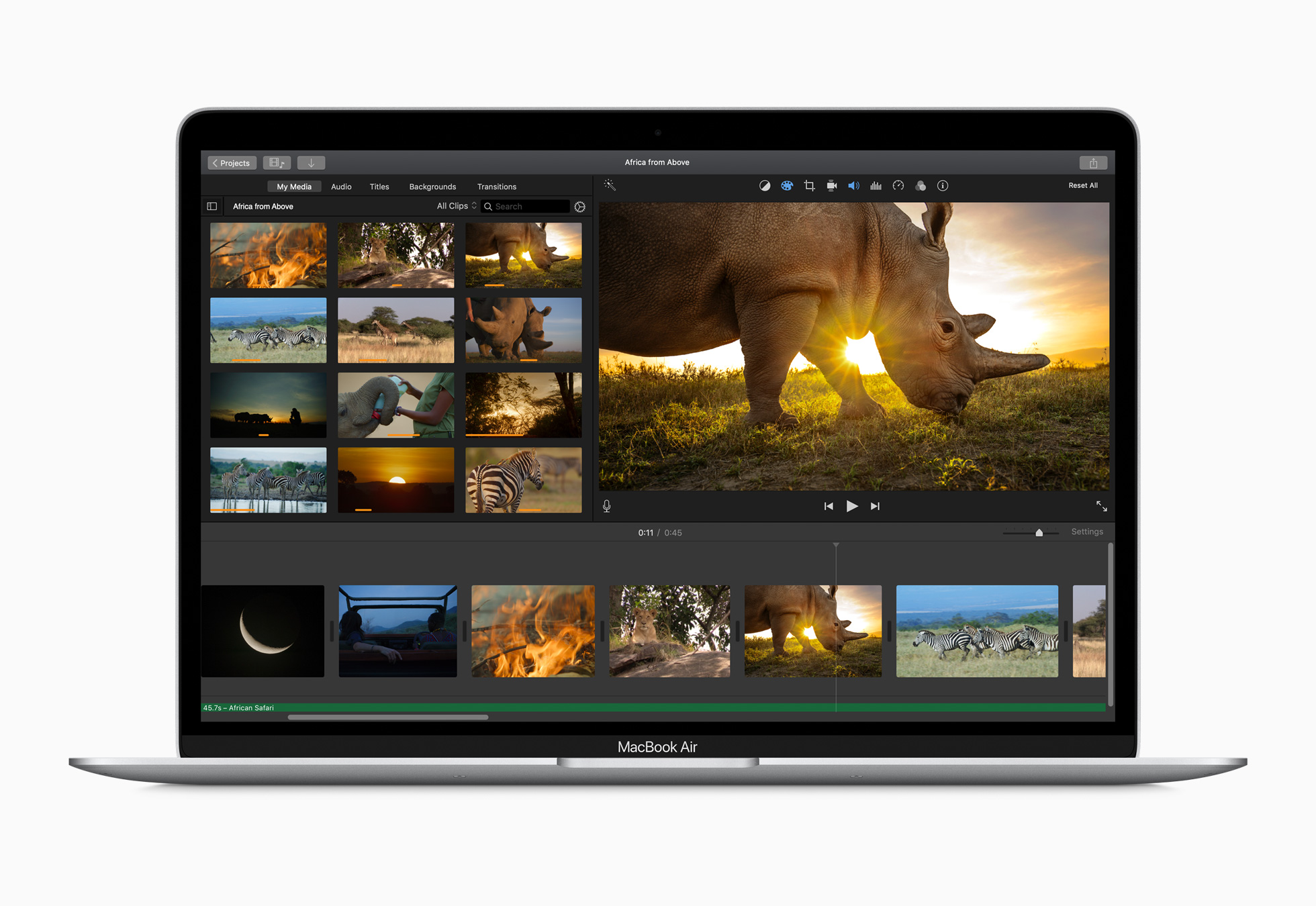
Apple has released a new, faster MacBook Air with an updated keyboard and more storage at a lower price. The company also released a minor update to the storage of base-model Mac minis.

According to a press release from the company, the new Air features a 1.2GHz quad-core Core i7 that, with Turbo Boost, can achieve speeds up to 3.8GHz. This is the first time the Air has included a quad-core processor. The laptop also features Intel Iris Plus Graphics, which Apple says are 80% faster than previous models.

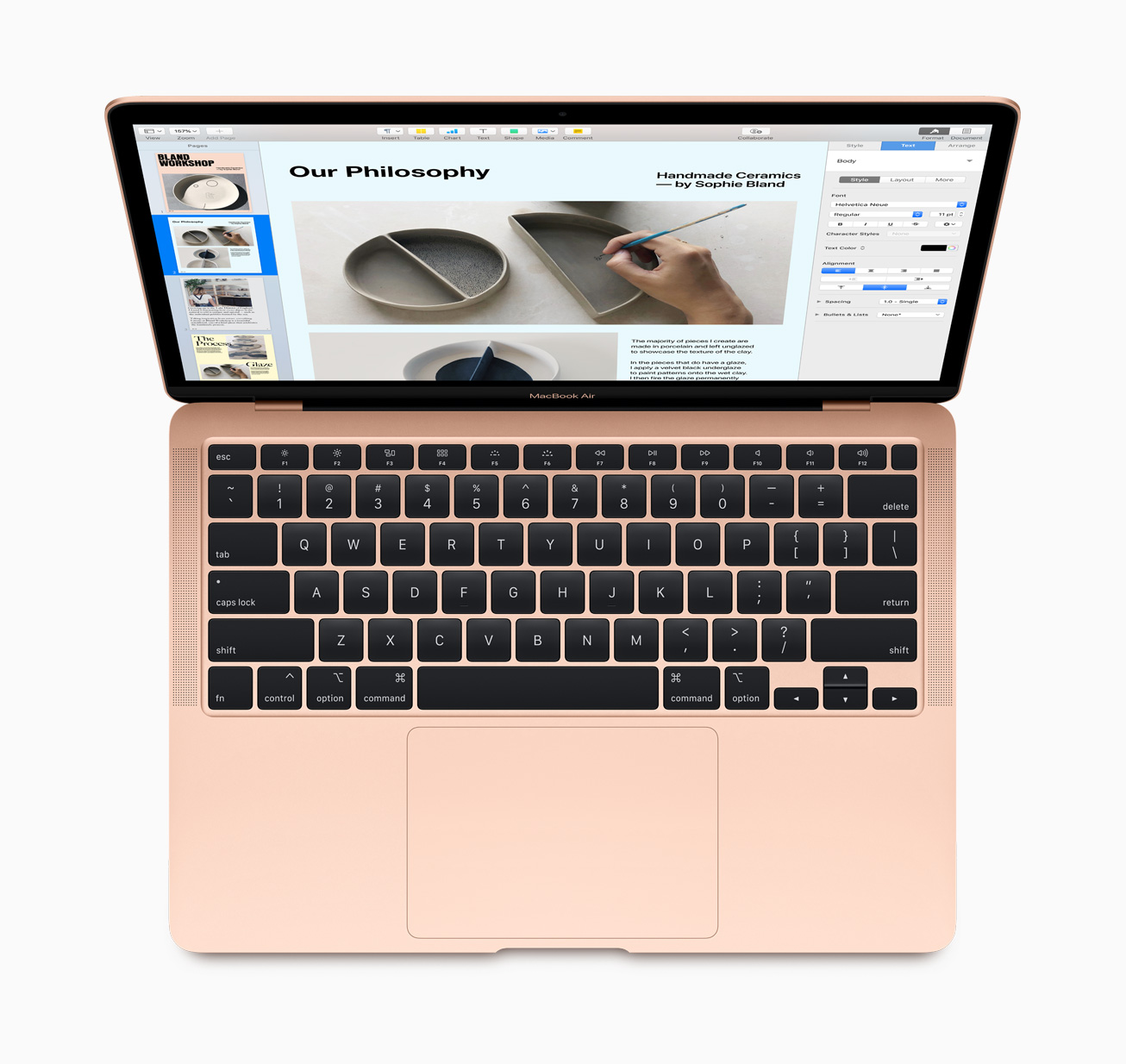
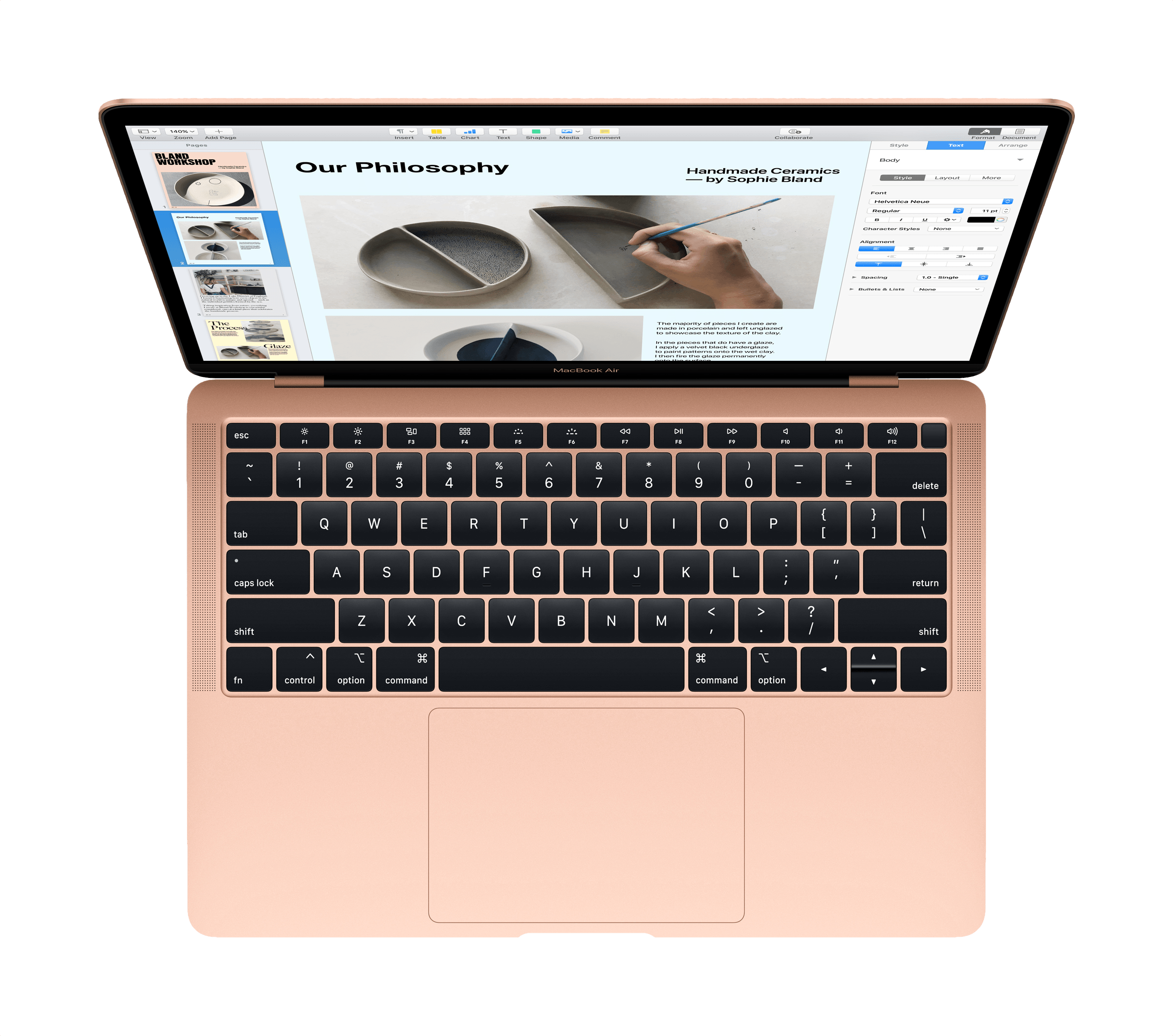
The Air’s keyboard has been updated too with a scissor switch-based Magic Keyboard that has 1 mm of key travel and an inverted-T layout of the arrow keys.

The Air's keyboard now uses scissor switches and an inverted-T layout for its arrow keys.

The Air’s keyboard now uses scissor switches and an inverted-T layout for its arrow keys.

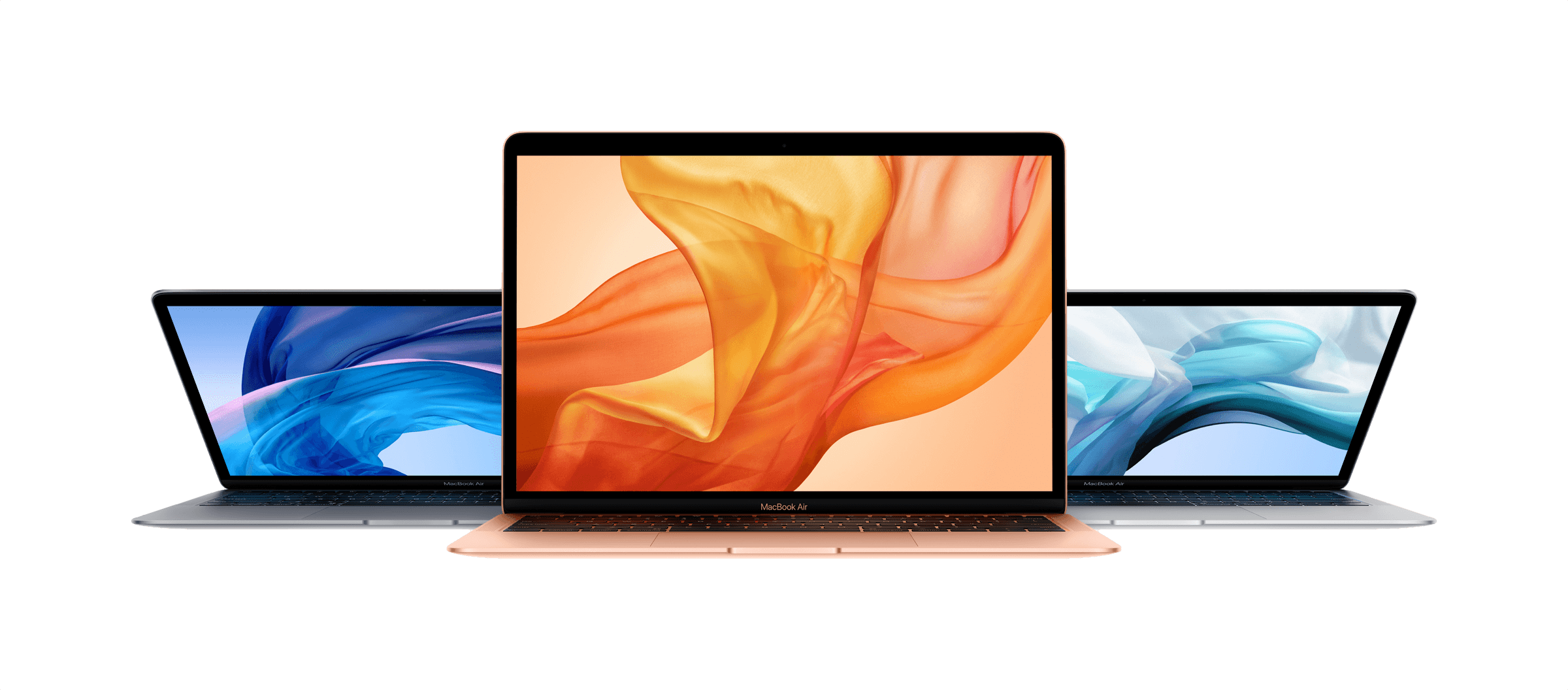
The Air, which is available in gold, silver, and space gray, starts at $999, a $100 drop from prior models. Thankfully, Apple has also increased the base storage of the entry-level model from 128GB to 256GB SSD storage, a capacity that will make it easier for users to store photos and other media locally without resorting to external solutions. The new Air can also be configured with up to 2TB of storage, which is twice as much as could be previously configured, and is equipped with Apple’s T2 Security Chip, which ensures a secure boot process and handles Touch ID information.

Apple’s press release highlights the following features too:

  • A three-mic array for more clear voice capture for FaceTime calls with friends and family.
  • The industry-best Force Touch trackpad for precise cursor control and multi-touch navigation.
  • Thunderbolt 3 ports for data transfer, charging and video output in a single connector.
  • Support for up to a 6K external display, a first for the MacBook Air.
  • Advanced stereo speakers for immersive, wide stereo sound for activities like watching Apple TV+ content or playing games in Apple Arcade.

The new Airs can be ordered on apple.com starting today.

Finally, the base configurations of the Mac mini received a small update today. The $799 model now comes with 256GB of storage and the $1,099 configuration has a 512GB SSD.

The MacBook Air has been difficult to recommend because of its previous-generation keyboard. With a new keyboard, increased storage, faster CPU and graphics, all at a lower price-point, the MacBook Air looks like the Mac that will meet most people’s needs.


MacBook Air and Mac mini Review Roundup: Welcome Updates to Apple’s Mac Lineup

Tomorrow, Apple will begin delivering new MacBook Airs and Mac minis to customers around the world. It’s been a long time since either computer was updated; too long many would say. John Gruber of Daring Fireball asked around about the period between updates:

Behind the scenes last week in New York, I asked a few folks from Apple for any sort of hint why these two Macs — the MacBook Air and Mac Mini — went so long between updates. One thing I was told is that Apple wants to focus on “meaningful updates”. The days of “speed bump” updates are largely over. The value just isn’t there.

That may not be a message that long-time Mac users want to hear, but it’s consistent with recent history and seems to be supported by the reviews published today. Regardless of the backstory though, both new Macs are substantial updates that have received generally favorable reviews.

Read more


Jony Ive Reflects on the Design of the New iPad Pros, Apple Pencil, and MacBook Air in a New Interview

Jony Ive, Apple’s Chief Design Officer, sat for an interview with David Phelan of The Independent to talk about designing Apple products in general and the new iPad Pros, Apple Pencil, and MacBook Air in particular.

On redesigning successful products Ive said:

Because when a product has been highly regarded there is often a desire from people to see it redesigned. I think one of the most important things is that you change something not to make it different but to make it better.

If you are making changes that are in the service of making something better, then you don’t need to convince people to fall in love with it again. Our sense of habit and familiarity with something is so developed, there is always that initial reaction that is more of a comment on something being different rather than necessarily better or worse. In my experience, if we try very hard to make material improvements, people quickly recognise those and make the sort of connection they had before with the product.

Ive also revealed that the original iPad was designed to be used primarily in a portrait orientation, while the new iPad Pros have no orientation:

So, in the new iPad Pro, one of the things we’ve been wanting to get to for a long time is a sense that the product is not oriented in a primary and then, therefore, in a secondary way.

The first iPad had a very clear orientation which was portrait. It had the ability to be used in landscape, I think very well, but it was pretty clear how the product was designed. And I think with the first iPad you had the sense that it was a product made up of distinct and somewhat separate components.

What I think marks the new iPad Pro as particularly special is it doesn’t have an orientation. It has speakers all the way around the perimeter. By getting rid of the Home Button and developing Face ID, the tablet is able to work in all of these different orientations.

On the Apple Pencil, Ive describes how its design abstracts away the underlying technical complexity to focus the user on the task at hand:

I think the way it just snaps onto the side, well, that’s a nice example of a sort of that magical feeling. It’s unexpected, we don’t quite understand how it’s working and even more incomprehensible is the fact that it’s also charging. You can see how that’s aligned with this idea that you can just pick the product up and use it without thought.

Actually, you’re using it with tremendous thought, but it’s based on what you want to be doing rather than wondering if you’re holding the tablet the right way up.

Phelan’s interview is full of many other wonderful insights and tidbits about the products Apple revealed earlier this week in New York and should be read in its entirety.

Permalink

The New MacBook Air: The MacStories Overview

This morning Tim Cook took the stage at the Brooklyn Academy of Music’s Howard Gilman Opera House to announce a brand new revision of the MacBook Air. This is the first significant redesign in years for Apple’s most popular line of Macs, and features huge improvements across the board.

The new machine marks the debut of a Retina display on the MacBook Air, which Cook said has been the most requested feature by far. Among other changes, the size and weight of the enclosure have also been decreased, two Thunderbolt 3 ports line one edge, screen bezels have been reduced, and new color options are available.

Read more


Yep, Apple’s ‘Stickers’ Ad Gave MacBook Sticker Sellers a Huge Boost

When Apple published their new ‘Stickers’ ad for the MacBook Air last week, I presumed it would be a boon for sellers of MacBook stickers and decals. So earlier this week I decided to reach out to a few sellers of MacBook stickers and decals to see what kind of impact the ad from Apple has had on their store visits and sales.

Now this was not an in-depth investigation and the result is probably what you would have guessed: visits and sales rose dramatically last week when Apple’s ad was released. It was the universal reaction I got from the sellers I talked to.

One of the sellers that was willing to give me more detailed information was Benjamin Clark from The Decal Guru. They saw a quadrupling of orders for MacBook decals since the airing of Apple’s ad. In terms of unique visitors they saw an increase from a steady 500 per day (prior to the ad) to 4,500 at its highest last week.

Read more


Stickers Are Front and Center in Apple’s New MacBook Air Ad

Apple today posted a new ad for the MacBook Air, and it has a very different style to what we’ve seen in recent MacBook ads. Titled ‘Stickers’, this short and simple ad, filmed mostly with stop-motion, focuses on the back of the MacBook Air’s display where it is covered in dozens of different stickers. The ad features music from Hudson Mohawke and ends with the slogan “The notebook people love”.

You can view the full advert below, on Apple’s website or on their YouTube channel.

Read more


Apple Refreshes MacBook Air With Faster Processor, Cuts Prices In Some Countries

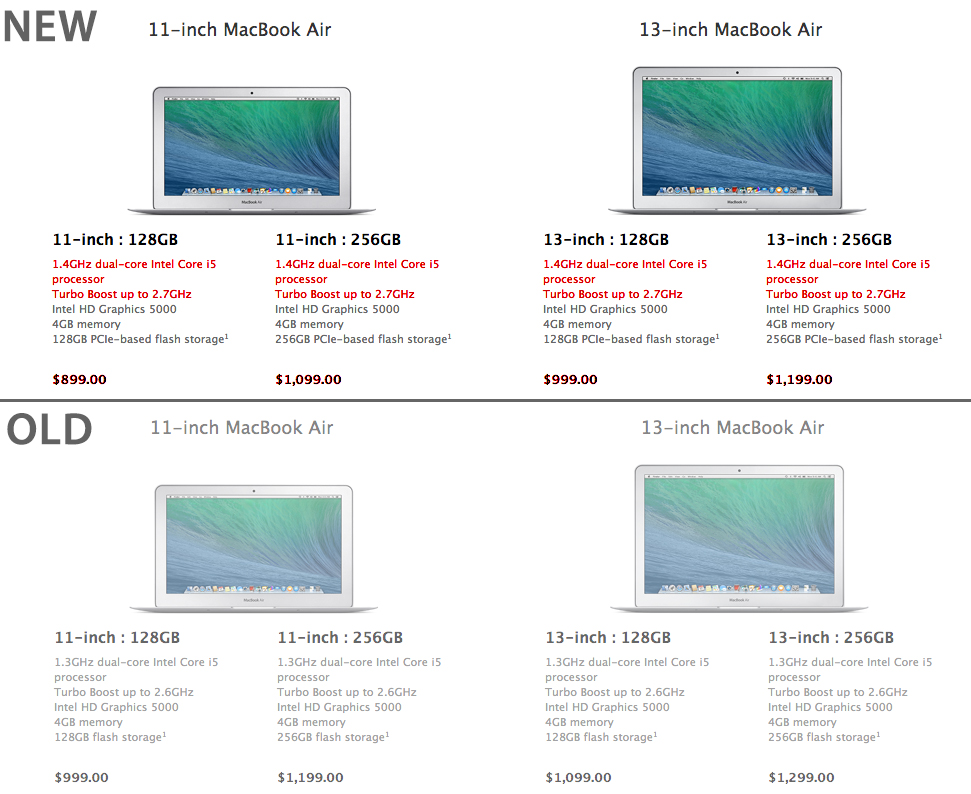
Apple this morning refreshed their MacBook Air models with the latest generation of Intel’s Haswell processors. The new processors give the MacBook Air a slight speed bump, taking them from 1.3GHz to 1.4GHz (and Turbo Boost from 2.6GHz to 2.7GHz). The refreshed models are otherwise the same, offering 128GB or 256GB storage, 4GB of RAM and Intel HD Graphics 5000. Built to order machine options are also unchanged, with upgrades of 8GB of RAM, 512GB storage and a 1.5GHz i7 Processor available.

“With MacBook Air starting at $899, there’s no reason to settle for anything less than a Mac,” said Philip Schiller, Apple’s senior vice president of Worldwide Marketing. “Macs have never been more popular, and today we’ve boosted the performance and lowered the price of MacBook Air so even more people can experience the perfect everyday notebook.”

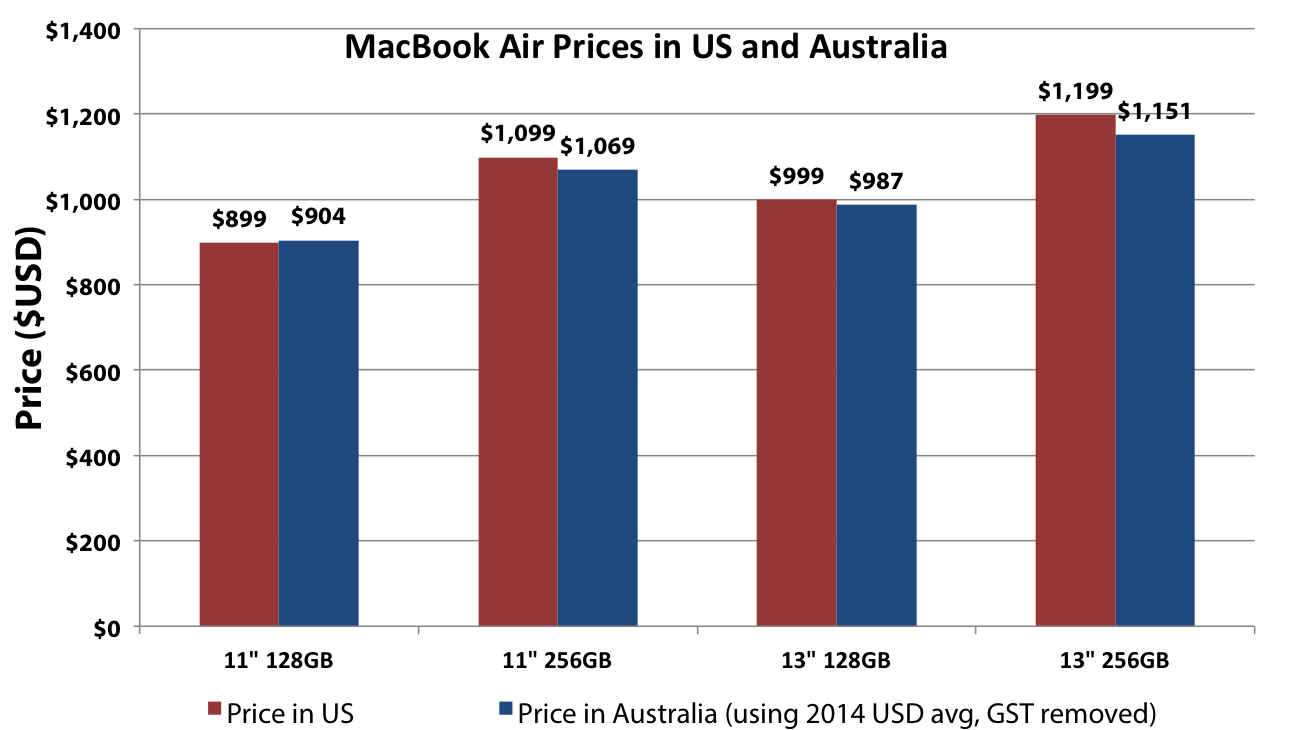
The four preconfigured models have all taken a $100 price cut in the United States - but those price cuts have not translated to every region, with Australia being one region where the prices of the models stay the same. But that can be explained by the recent weakness in the Australian dollar. The below graph illustrates the comparison between US prices and Australian prices, after converting the Australian prices to a 2014 average of the US Dollar and removing GST (which are included in the Australian prices).

The new MacBook Air models are available for purchase now. You can read Apple’s press release here.


Here’s to Another Five Years

Apple wasn’t a brand that my friends and I conversed about in high school, our infatuation being PCs that weren’t Dell and graphics cards and the latest processors and Counter Strike. Apple was a part of my life insofar that they were the guys who made the cool MP3 players. I had an iPod video, and later an iPod touch, but I knew nothing of Steve Jobs. Macs were also unknown to me, but later I would realize that I used an iMac G3 with the weird puck mouse a few times in middle school. In my junior and senior years one of my classmates had the first iPhone, but it was just an iPod with a phone[1].

It wasn’t until after I graduated that Apple became a thing. No one knew it at the time, but 2008 was the last year that Apple would offer the polycarbonate MacBook in black. I remember having this sort of sudden fascination with it: how simple[2] it was, how different it was. This would be my college laptop, despite being in a price range that was out of budget and running an operating system that I wasn’t familiar with.

When the sales tax holiday came around, I made the decision to go all-in. I purchased the fully loaded MacBook in black, complete with an incredible 2.4 GHz Core 2 Duo processor[3], 4 GBs of memory, and 250 GBs of storage. Being my first laptop, I also purchased an AirPort Extreme so I could have Wi-Fi in the house. The Apple Store was accommodating between me and my overprotective bank, letting me use their phone behind the counter since my Nextel Motorola had no reception.

While the purchase itself was an experience, it wasn’t until I got home that I fully began to appreciate what I had in my hands. Out of the box the laptop was charged and ready to use. There was a prompt to sign up for MobileMe, but otherwise the laptop had no stickers or bloatware. Everything about it was perfect[4].

My MacBook, which I would come to call the BlackBook, had an unbelievable impact on how I thought about computers. It didn’t have the most powerful guts, but it had a great keyboard and trackpad, and the display was pretty good. I thought the MagSafe Power Adapter was brilliant, the magnetic connector certainly saving my bacon plenty of times in the classroom as the cord was sometimes yanked by a wild knee. The sleep indicator light became a reassuring delightful detail. All of those little details really added up.

The BlackBook would be the computer that soldiered on. A hard drive died, a replacement solid state drive died[5], and I upgraded the memory to an unrecommended six gigabytes, keeping it current. I replaced the battery in its third year and I’m probably due for another replacement. The fan started making noises in its fourth year but it never ceased to function so I tolerated it. It didn’t run Mountain Lion, but it did run Lion and that was good enough until Mavericks[6] was announced.

Thinking back, the black model was a good choice. Unlike the white MacBooks, cracks that developed in the surrounding bezel didn’t show as well. The black never did end up looking dirty, although fingerprints were constantly a problem. The oils from my wrists have stained the plastic making the black appear blacker and slick. It stood out from the crowd and it continues to look impressively modern. The keyboard, the trackpad, and the quality of the laptop itself far exceeded my expectations. The keys still feel just as good as they did when I first bought it. The trackpad’s button no longer has that new-click-feel, but it still works just as it always has.

I’ve repaired a lot of laptops of all shapes and sizes for spare cash in college. In 2013, no one else does two finger scrolling well. Apple was getting it right in 2008.

It was because of the BlackBook that I would eventually find myself watching Apple Keynotes in the back of the classroom while the professor was lecturing, and it was because of the BlackBook that I started creating my own WordPress site which eventually led to this one. Little did I know that I would end up using the laptop for an extended four years in college, and it was the machine I would continue to use for a year afterwards. Needless to say that it has been a significant part of my young adult life.

As much as I don’t want to give it up it’s finally showing its age. I will open up the case and blow the dust out and replace the fan. I’ll reapply thermal compound to the processor and reassemble the heat sink so that the laptop runs cooler. It still has life in it.

But it’s time to say goodbye. Five years is a long time to own a computer, and it’s impressive how well the BlackBook withstood the test of time. Apple is moving forward and I’m ready to embrace the latest they have to offer. Needless to say that Apple has made me a fan for life.

Today I’m using a new Mac, the latest MacBook Air, and it’s even more wonderful than the first. It has backlit keys that adjust to ambient lighting and new function keys I’m not used to and an even better display. There’s no button on the trackpad and my headphones finally work with the combination headphone + microphone port. It has USB3 and Thunderbolt, significantly faster interfaces than USB2 and FireWire. And the battery life is amazing[7]; I can use my laptop for two or three days without having to charge it. It’s never gotten hot, and I haven’t heard the fan even after watching hours of streaming video from my favorite websites. Being my first aluminum Mac, I can’t help but appreciate what a marvel of engineering this is.

Here’s to another five years.


  1. But it was just an iPod with a phone. Oh my god how naive!  ↩
  2. I dismissed the Powerbook because I thought the keyboard looked weird and because the lid wasn’t magnetic. Because latches were so passé in 2008. The other alternatives were PCs that were running Windows Vista and underpowered netbooks.  ↩
  3. Apple then released the aluminum MacBook in October that had an Nvidia chipset instead of the basic Intel chipset. Thus I learned a hard lesson in Apple release cycles.  ↩
  4. The computer I had throughout high school was a Compaq desktop that my uncle had picked out and my grandmother then purchased when she visited in the summer of 2004. It was also quite the beast, having a 2.5 GHz Celeron D processor, one gigabyte of memory, and 40 GBs of storage. This was when ribbon cables were still the norm. It’s fitting that a Compaq was my first computer as Tim Cook is now the CEO of Apple. What a coincidence.  ↩
  5. The MacBook had a first revision Serial ATA interface for the hard drive, so I couldn’t take full advantage of a SSD. However, the read and write speeds are still so much faster than a mechanical drive that it was like breathing new life into the machine. And to think today’s MacBook Airs have PCIe-based flash storage.  ↩
  6. OS X Mavericks fixes all of the things that didn’t work quite right in Lion.  ↩
  7. I swear that the battery on this MacBook Air lasts longer than my iPad. I can’t wait for this to be the standard.  ↩