Posts tagged with "google"

Google Docs Can Now Preview Apple Pages Files

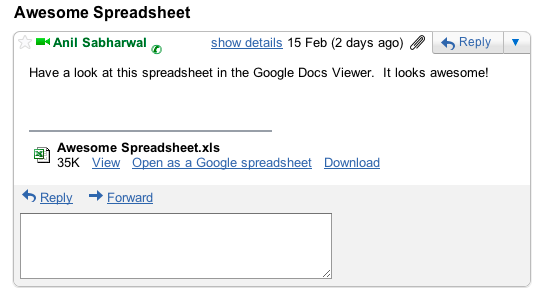
Good news for Mac users who rely on Google Docs for their document management needs: the popular online service added support today for 12 more file types – most notably including Apple’s Pages and Adobe’s Illustrator and Photoshop. The full list of supported files below:

  • Microsoft Excel (.XLS and .XLSX)
  • Microsoft PowerPoint 2007 / 2010 (.PPTX)
  • Apple Pages (.PAGES)
  • Adobe Illustrator (.AI)
  • Adobe Photoshop (.PSD)
  • Autodesk AutoCad (.DXF)
  • Scalable Vector Graphics (.SVG)
  • PostScript (.EPS, .PS)
  • TrueType (.TTF)
  • XML Paper Specification (.XPS)

The Docs online viewer has thus become a full-featured solution to preview the most popular file formats. In December, Google brought desktop document editing to the iPad.


“Apple Doesn’t Understand The Internet”

“Apple Doesn’t Understand The Internet”

Nadav Savio on the differences between Google and Apple:

It’s been said that Google doesn’t get ‘social’ and, though I think that is vastly overstated, there is truth there. Similarly, I’d say that Apple doesn’t understand the internet. Well I have a simple theory about it. There’s a cliché that everyone’s greatest strength is also their greatest weakness, and I believe that applies as well to organizations as to people.

Take Apple. They make amazing, holistic products and services and one of their primary tools is control. Fanatical, centralized control. Control over the design, over the hardware, over the experience. And that’s exactly the opposite of the internet, which is about decentralization and messy, unfiltered chaos.

It sounds good in theory, but the more I think about it, the more I don’t get the connection between the Internet and Apple as a company. Apple is not a web company. They make hardware and the software that runs on it. They make money out of hardware that, yes, is connected to the Internet. But the Internet as a service, not as a “population”. So where’s the line between “Apple doesn’t understand” and “unfiltered chaos”?

Maybe Apple doesn’t understand the people on the Internet, or they simply don’t care enough.

Permalink

Google Launches Official Translate App for iPhone

A few minutes ago Google announced the availability of the official Translate app for iPhone. Built on top of the HTML5 webapp  that’s been around for quite some time now, the native application allows you to “speak to translate” in 15 different languages with output translation supported up to 50 languages. You can listen to your own translations spoken out loud by the app , enable full-screen mode to get a larger view of the translated text (that’s quite useful) and even check on single words dictionary entries from within the app. The interface design resembles most of Google’s apps for iOS – nothing exceptional to note there. It’s got a clean and minimal UI.

Google Translate for iPhone is a better version of the popular mobile-optimized webpage packed into a useful package for iOS that comes with a few additional features. It’s a free download in the App Store. Full list of supported languages below. Read more


Gmail’s Priority Inbox Comes To The iPhone

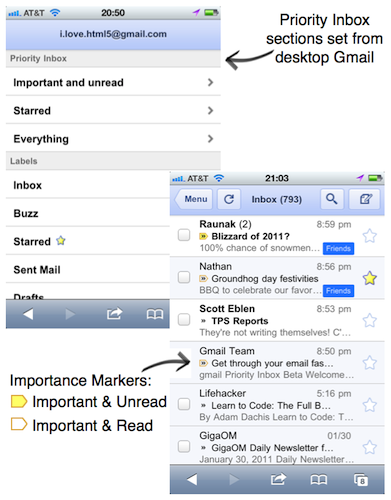
Great news from the Google Mobile team today: the Gmail webapp for iPhone has now Priority Inbox support built-in. Priority Inbox for mobile will import all the sections you have created on the desktop and it will also display the “important and read” or “important and unread” markers you’ve got used to see in Gmail.

Now, once you set up Priority Inbox in the desktop version of Gmail, you’ll see Priority Inbox sections when you visit gmail.com from your phone’s browser and click on the ‘Menu’ screen. You’ll also see importance markers in your inbox, so you can quickly identify which messages are important.

The new feature is available to Android and iOS devices. iOS 3 or later is required.


iOS, Android and RIM Deadlocked in US Smartphone Market Share

Nielson has revealed its latest statistics on smartphone ownership in the US and there is some fascinating information contained in the report. 31% of all mobile consumers in the US owned a smartphone as of December last year. Ethnic and racial minorities also dominated ownership of smartphones with Asian/Pacific Islanders and Hispanics having 45% smartphone penetration, African-Americans also had higher numbers at 33% whilst White Americans were at a much lower 27%.

The smartphone war between RIM’s BlackBerry, Apple’s iPhone and Google’s Android operating system was also at dead heat by the end of 2010. Apple was just ahead at 28% of the mobile operating system share but has been sitting steady at around that rate for a year. RIM’s BlackBerry OS market share continued diving and was at 27% and Google’s Android continued steaming upwards reaching it’s highest share of 27%.

Read more


Google Shopper for iPhone Now Available

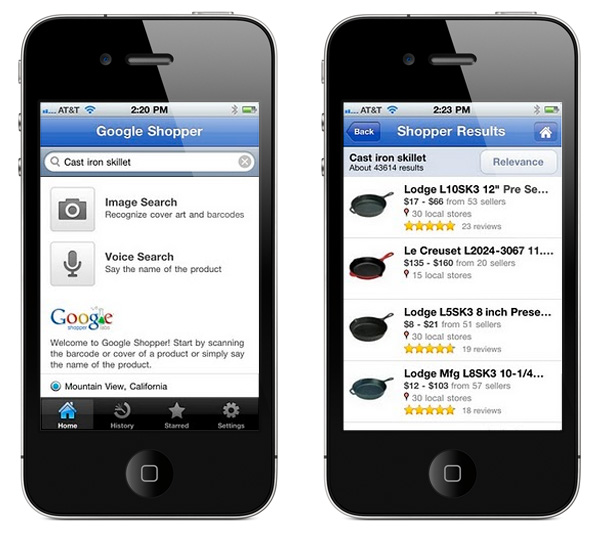
Back in November, Google announced their Shopper app for Android. Millions of Android users have downloaded it and now it’s time for us iOS users to get a taste. Thats right, Google Shopper is now available for iPhone.  The Google Mobile Blog has just posted a formal introduction to the app. In case you didn’t know, Shopper turns your iPhone into a shopping assistant so you can learn more about products and read relevant user reviews, compare prices at online and local stores, and save and share products for later consideration.

Shopper checks your searches by cover art, barcodes, typing or voice search then after you get your results you can choose a specific product that you like. It also lets you compare prices from other retailers and even locate nearby shops that sell your product. Some retailers will even provide inventory information so you can check and see if your trip across town will be worth it. Read more


Google’s OS X Software Deployment Solution Now Open Source

As noted by The Register, Google has open sourced its enterprise-class Mac OS X software deployment solution, Simian. The software can distribute applications and software updates across a network of a dozens or thousands of Macs, it can handle security patches and optional installations, it even provides a way to deal with updates issued by Apple. Simian is entirely based on OS X, as Google decided to move to Apple’s operating system after the vulnerabilities found in its previous Windows-based environment that allowed a Chinese hacker to enter Google’s internal secure network in 2009.

The tool uses a client based on Munki, a set of Mac deployment tools previously open sourced under an Apache 2.0 license. Munki lets you install software that uses not only the Apple package format but also Adobe CS3/CS4/CS5 Enterprise Deployment packages, and you can drag and drop disk images as installer sources. What’s more, it can be configured to install Apple Software Updates, either from Apple’s servers or your own.

Last, Simian is built on top of Google’s own App Engine, an infrastructure that allows to deploy and manage online applications. More information about Simian are available here.


Android Gains 22% Of Tablet Market, Becomes #1 Smartphone Platform by Shipments

According to two different reports surfaced this morning, Google’s Android mobile operating system has gained 22% of the tablet market share and has become the world’s leading smartphone platform with 33.3 million shipments in Q4 2010.

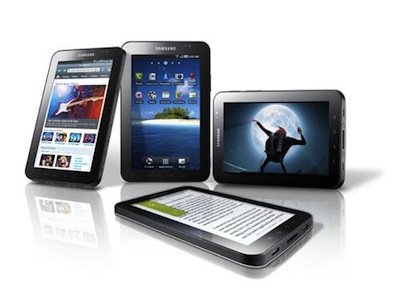
The first report, as noted by The Loop, details how Android-based tablets grabbed 22% of the market in the fourth quarter of 2010, and while the iPad is still “dominant”, the Samsung Galaxy Tab drove sales of tablets running Google’s OS.

Strategy Analytics sees continued growth for Android-based tablets in 2011 with the release of Motorola’s Xoom and other high-profile devices. The company expects that as more Android devices hit the market, media developers in the United States and elsewhere will increasingly support the devices with content.

Read more


A Beautiful Google Analytics Widget for OS X

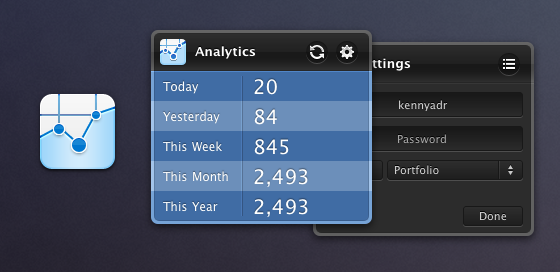
Created by designer Adrian Kenny and developer Adam Aganou, this one is a beautiful and unobtrusive widget for Google Analytics you might find useful if you’re the Dashboard kind of user. Once authorized with your Google account, it will display visits for the current day, the past day, week, month and year. It’s minimal and elegant. The icon is sweet and the color choice attractive.

There are many Google Analytics widgets out there, but none of them is as sexy as Adrian Kenny’s design. Free download here.