This Week's Sponsor:

HomeSnap

A Private, Read-Only Window Into Your HomeKit Home


Posts tagged with "apple"

New MacBook Airs Coming On Wednesday? [Updated]

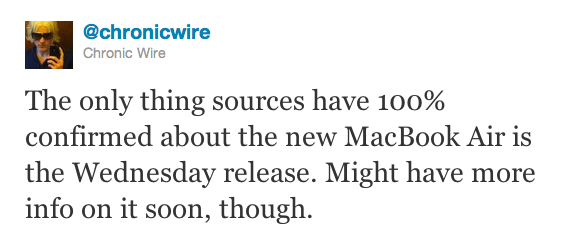
Following the screenshots detailing Nuance integration in iOS 5 through Apple internal settings, Chronic Wire reports new MacBook Airs may be coming out on Wednesday. Chronic had a good track record in the past pinpointing various Apple rumors and he seems certain the new line will launch this week, on June 15th. However, he didn’t post any tech specs of the new machines – though it looks fairly obvious that Apple will implement Sandy Bridge processors and Thunderbolt technology like in the iMac and MacBook Pro 2011 refreshes. Several reports in the past months pointed at Apple aiming at a June-July release for the popular ultra-thin laptops.

Meanwhile, 9to5mac also claims Apple will we holding retail store overnights on Tuesday for a Wednesday product launch, but they couldn’t confirm what the product could be. They don’t believe it’s the new MacBook Air family like Chronic Wire does, but it could be considering recent speculation.

We have since heard from a source that there are still some current generation MacBook Airs shipping to retail stores across the world into the next couple of weeks. Because of our own independent information, we doubt a new MacBook Air launch for Wednesday. It does make sense though based on the scheduled retail overnight.

Other products recently rumored for an update would be the Mac Pro Server, Mac mini server and Time Capsule/AirPort Extreme stations, which several bloggers believed would be unveiled by Apple at WWDC.

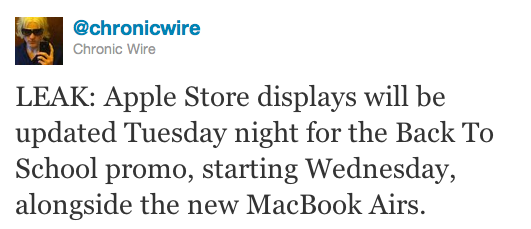
Update: Chronic Wire now reports Back to School promo material will be put in place during the retail overnights on Tuesday, with a launch on Wednesday alongside the new Airs. The Back to School 2011 promo was initially believed to be set for a WWDC announcement with possibility for students to get the usual iPod touch with the purchase of a new Mac, or a discount off a new iPad 2.

Update #2: MacRumors initially posted part numbers of what they claimed to be the four models supposed to become available this week. In a tweet, they later confirmed the numbers were for unlocked iPhones. Currently, Apple offers four MacBook Air models with 64 GB and 128 GB SSD options for the 11-inch, 128 GB and 256 GB for the 13-inch.


Apple Confirms “Extremely Small” Verizon iPad 2 Recall

Reports surfaced earlier today indicated Apple was in the process of recalling Verizon iPad 2 models that were being shipped from China (where they’re made) to the United States, leading to speculation that faulty units had been produced by Foxconn. In a brief note to All Things Digital, however, Apple has confirmed that they have recalled an “extremely small” number of Verizon iPad 2 due to a problem with device identifiers, otherwise known as ”mobile equipment identifiers” (MEIDs), which play a key role when setting up a new iPad for cellular data activation. Due to a problem with Verizon flashing the same MEID on different iPads, users could run into the impossibility of activating their device as it’s already registered on the carrier’s network.

Duplicate MEID numbers were flashed onto an extremely small number of iPad 2 units for the verizon 3G network,” an Apple representative said on Friday.

Although most of the small number of devices involved were still in the process of hitting the market, a few had already found their way into customers’ hands.

Some iPad 2 customers have reported receiving credits and free accessories as a compensation for the delay, although Apple hasn’t issued an official statement or policy in regards to this recall. It is also unclear what the company will do for those customers who have already got their hands on a Verizon iPad 2 with the wrong MEID, but it wouldn’t be a surprise if Apple contacted this small number of people to issue a full refund or send a new unit free of charge.


iCloud Communications Sues Apple Over iCloud Trademark

Yesterday in the US District Court in Arizona, iCloud Communications, LLC filed a suit against Apple for trademark infringement over the name iCloud.

iCloud Communications, LLC, claims that Apple’s new promotions of all things iCloud is damaging (seriously?) to iCloud Communications’ business. They also believe that Apple has taken their own name branding and associated it with Apple’s own (well, maybe). They are accusing Apple of offering services similar to the ones that they offer.

Read more


Apple Files Motion To Intervene In Lodsys Suit

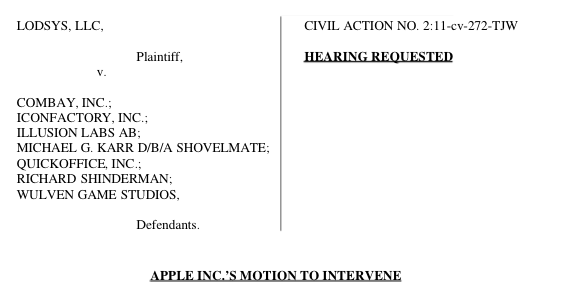
According to FOSS Patents, Apple has filed a motion to intervene in the proceedings between Lodsys and several app developers. Lodsys nine days ago filed a civil suit against several app developers including Iconfactory, Illusion Labs and Quickoffice in East Texas over patents it owns.

Whilst Lodsys can oppose Apple’s attempt to intervene in the case, FOSS Patents says that “Apple is fairly likely to be admitted as an intervenor”. In Apple’s proposed defence, it is argued that Apple’s existing license agreement with Lodsys covers the third party developers being sued – an argument Apple made with Lodsys in its letter to them. Contrary to what some might have presumed would happen, Apple does not claim any other defences such as disputing the validity of the patents – but the third party developers could still do so.

I’m reasonably optimistic that Apple will get to intervene. There appears to be precedent for that. Apple cites three interventions admitted in more or less comparable cases (Intel against Negotiated Data Solutions, Intel against U.S. Ethernet Innovations, and Microsoft against TiVo).

It isn’t clear what Apple’s relationship with the developers is (likely under a non-disclosure agreement) but more than likely is that Apple will help them with financial costs and perhaps even the potential risks. In its motion, Apple states that those developers being sued by Lodsys are “are individuals or small entities with far fewer resources than Apple and […] lack the technical information, ability, and incentive to adequately protect Apple’s rights under its license agreement”.

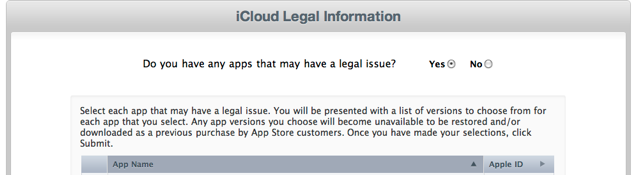
In its post, FOSS Patents also shares some screenshots of the developers iTunesConnect app management service which asks developers about potential legal issues with their apps. If a developer says “yes” to legal issues, that app will become “unavailable to be restored and/or downloaded as a previous purchase by App Store customers” through the new iCloud service.

If you want a full rundown of Apple’s motion to intervene, FOSS Patents has an excellent run down, along with questions that the motion does not answer. If you feel brave enough you can also read the official motion here.

[Via FOSS Patents]


UK Won’t Get iTunes Match, Cloud Until 2012

Those living in the United Kingdom will get to enjoy Spotify for a bit long as those living in the United States get to enjoy Apple’s iCloud and iTunes Match services between iOS 5 and Lion. Apple is still in the early stages of negotiations with the Performing Rights Society, who ensure composers, songwriters, and publishers all receive fair compensation for their works.

A music executive at one of the major record labels, who wished to remain unnamed, said: “Tentative talks have begun between the major labels and Apple in the UK. However, all talks are at the really early stages and no one expects to see the cloud music service live on this side of the pond until 2012.”

Even here in the United States, Apple still has yet to make deals with independent labels, and as with the initial launch of iTunes, Apple took their time as the rolled out their service to other countries. Mark Mulligan, VP and research director at Forrester Research, comments:

These types of negotiations take a long time… For one thing the UK arms of all the major record labels are biding their time and waiting to see how the service affects download sales in the US before they sign up to anything.

While the The Telegraph specifically exams licensing agreements in the UK, it’s likely that this situation holds true for the remainder of the world as well. For those in Europe, you’ll need to hang tight as Apple’s iCloud and the companion iTunes Match service go live. At the very least, iOS 5 doesn’t officially launch until this fall, so you just might not have to wait that long once iOS 5 devices start shipping.

[The Telegraph via MacRumors]


Apple Goes Shopping, Comes Back with Over 50 Domains

In a move to protect key terms and product features related to Monday’s Keynote that kicked off WWDC 2011, Apple decided to go domain shopping. Obviously you’d want to protect product names like Lion and iOS 5 from being abused, but Apple may have overdone it with their acquisition of over fifty domain names, including goodies like “macmailconversationview.com” and “pcfreeiphone.com”. Robin Wauters from TechCrunch was quick to point out that Apple still doesn’t own ipad.com or ipods.com, but what is Apple really afraid of?

You can tell Apple is clearly trying to protect their branding, but are they going too far? Do they have anything to worry about? I guess iTunes in the cloud is pretty important. But Mac gestures? Apple should definitely put a tutorial there.

Here’s some good examples of what Apple has picked up.

  • airplaymirroring.com
  • itunesinthecloud.com
  • macgestures.com
  • osxlionairdrop.com

For the full list, be sure to hit up the source link below.

[via Techcrunch]


“There Is No Chance” Cupertino Will Say No To Apple’s Spaceship Campus

Two days ago, Steve Jobs pitched Apple’s latest project to the Cupertino City Council: a massive, spaceship-like, 4-story new campus that would be located in the 98-acre ex-campus Apple acquired from HP last year. Designed with modern and green technologies in mind and entirely based on curved glass running around the whole structure, the new “mothership” would host 12,000 employees, come with a new auditorium, labs, office, and much more. When Steve Jobs presented the project, answering questions on environmental issues, energy and free Wi-Fi (the City Council asked whether Apple would provide Wi-Fi for everyone outside the campus, like Google does – Steve Jobs simply replied being Cupertino’s top taxpayer would be enough to contribute to the city), it was clear the City Council members were inclined to accept Jobs’ proposal, though no official announcement had been made there.

In a press conference responding to Steve Jobs’ campus proposal, Cupertino Mayor Gilbert Wong stated that “there’s no chance” the City Council is saying no, even if a public hearing will be necessary. However, Wong expressed his appreciation for Apple and Steve Jobs’ visionary attitude, confirming that when they have to deal with a large sales tax producer, they’re usually very accommodating to that company. Apple’s new campus should get done by 2015 if everything goes well.

Video of the press conference after the break. [via TechCrunch]
Read more


Apple Backs Down Over Subscription Rules

A few days ago Apple quietly modified its ‘App Store Review Guidelines’, and it has significantly reduced the requirements that apps, which deliver content, must abide by, effectively stepping down on their previous demands. In February this year it was revealed that Apple had imposed a deadline of June 30 for all publishers of iOS Apps that delivered subscription content to implement In-App Subscriptions. The requirements were that any app that sold content outside the App Store must also offer the same content to users through In-App Purchases and at the “same price or less than it is offered outside the App”.

Yet as MacRumors has published today, Apple has amended the App Store Review Guidelines to state as follows:

11.14 Apps can read or play approved content (specifically magazines, newspapers, books, audio, music, and video) that is subscribed to or purchased outside of the app, as long as there is no button or external link in the app to purchase the approved content. Apple will not receive any portion of the revenues for approved content that is subscribed to or purchased outside of the app

In plain English this means that content providers with an App Store presence are no longer forced to offer In-App purchases or subscriptions for content. But if they do choose to implement IAP or subscriptions they can offer the content at any price they wish – even if it is more than what they charge outside the App Store. The only requirement is that within an app, there cannot be an external link that redirects users to purchase content from outside the app.

It is unknown why Apple has decided to change tack on this issue, but a likely reason is that a number of publishers decided the 30% cut was too much to bear and had put pressure on Apple to redraw the guideline. Just a few days ago The Financial Times released its iPad webapp in order to sidestep the App Store and its overbearing terms. Similarly, earlier this year Time magazine had also ruled out using the subscription service because of the 30% revenue cut and customers ability to opt-out of giving them certain personal details .

Readability, which launched in February, was also set to offer iOS users an app that would tie into the Readability service, but because of the subscription rules they weren’t able to release the app. Similarly iFlowReader complained in mid-May that Apple’s subscription policy had shut them down because the 30% revenue cut would eat into their already small profit margin. The question now is whether these services and magazines will now re-embrace the App Store under these revised terms.

[Via MacRumors]


Apple to Reject Apps that Identify DUI Checkpoints

After four US Senators sent a letter to Apple’s Scott Forstall concerning apps that reveal DUI Checkpoints, Apple has updated their App Store Review Guidelines to reject apps that aid drunk drivers (and sober drives who just don’t want to be bothered by the delay) from evading the law. Senators Harry Reid, Charles Schumer, Frank Lautenberg and Tom Udall expressed grave concerns about apps that enabled those who drink and drive to escape law enforcement, and cited the apps as harmful to public safety. Apple’s new rules can be found in section 22.8:

Apps which contain DUI checkpoints that are not published by law enforcement agencies, or encourage and enable drunk driving, will be rejected.

If flashing your lights to alert oncoming drivers to a speed trap is against the law in the United States, why shouldn’t these iPhone apps be banned as well? This certainly opens up the opportunity for drunk drivers to break the law, but what about other iPhone apps that can check into police radio and point out speed traps? Just like with sexually explicit apps, this is going to be another hot topic of debate as Apple curates content on the App Store.

[via Autoblog]