Interesting numbers from the developers of one of the most unique iOS games in recent years that was later ported to other platforms. The last chart, iOS revenue by region, shows the importance of Japan, as also outlined by Apple in the Q3 2013 earnings call. I would love to have more details on revenue over time though – such as the impact of making an iPhone version or sales in the first two weeks of Google Play compared to the same period on the App Store.
Posts tagged with "app store"
Superbrothers: Sword & Sworcery EP Sales→
HEARD
HEARD appeared on the App Store at the end of June then suddenly disappeared without a trace. There was no blog post and no real explanation on Twitter — just a couple of Tweets asking to get in touch with so-and-so at the time. The whole thing was kind of strange, and I honestly believed the app had been acquired. The app looks to have been pulled due to a bug, and rather than risk poor app reviews, I surmise that the devs decided to pull it. The launch was quiet and there wasn’t too much to lose at the time. After several days, HEARD came back to the App Store with a small update. It’s here for good.
Correction: Apple pulled the application without warning after deciding the app didn’t need full background access. HEARD appealed and won their case, and the app returned to the App Store as it was originally introduced. My assumption was incorrect.
I was disappointed that I didn’t download the app right away after it disappeared (fearing I had missed the chance to try it), given that what it does is nothing short of intriguing. HEARD lets you save anything your iPhone has heard in the past five minutes. The idea that you can suddenly save a conversation to your iPhone that happened five minutes ago sounds magical. But then you start wondering if it’s even all that practical given that you’d likely want more than just five minutes if you’re intent on recording something.
HEARD is an app that runs in the background, its ability to record only limited to how much battery life you have left. By pressing a big red button, HEARD begins actively listening. There’s nothing to log into and no quirky settings to configure. Like you would see with apps like Skype or Voice Memos, HEARD changes the color of the status bar system wide to indicate that the app is listening. When you return to the app, pressing the button again saves whatever was buffered in the last five minutes to its library as a recording. You can then listen in, edit the file’s title, add tags, or delete it if you’re not happy with it. The app continues listening and the cycle begins anew.
That’s what makes HEARD kind of killer. It gives you the potential to record everything that happens. If your phone can hear it, it’s in the app’s buffer for at least five minutes.
While having this kind of power can certainly be useful, is it impractical? Sometimes. Obviously if you want to record a thirty minute meeting then you’re dead in the water unless you use another app. HEARD will let you turn off background audio to record audio snippets, but it only records as long as you hold down the button. If I can put myself in the mindset of the developer, what they’re trying to do is prevent you from accidentally recording something for so long that you run out of storage space. Personally I would like the option of not having to hold down that button, even if it meant I couldn’t leave the app if that’s the tradeoff the developers want to make. I want to use HEARD over Voice Memos and as my destination for everything, both for whatever stuff I happen to capture from the airwaves and stuff that I want to record intentionally.
I would love IFTTT integration. Just imagine saving a snippet and having it automatically end up in Evernote or another app. That’s my only want for this app going forward.
There are some aesthetic things I don’t like, particularly the ‘HEARING’ button in the center of the tab bar. I keep pressing it trying to pause and start recordings to no avail. As for recordings, those text boxes look a little dated. And the only real way to turn off background listening is to flip a switch in the settings or close the app from the multitasking bar (I feel there should be a way to pause background listening). For these things, the app does encourage feedback via a button in the settings.
Given the premise and despite being a sort of purposefully limited voice recorder, HEARD works. I felt this way when HEARD first disappeared, and I still feel this way today, that it’s something that was built for attracting attention from bigger fish in the pond, and I wouldn’t be surprised if someone did snap it up just for the idea. Yet, I do recommend at least trying out HEARD. It’s free, the limitation being that only things heard in the past few seconds can be saved. An in app purchase of $1.99 will unlock the full five minutes. Download it from the App Store.
Update 5:00 pm: @heardapp reached out to me on Twitter to point out an inaccuracy in my review of the app concerning the app’s sudden disappearance. I’ve embedded the tweets below and have updated the review.

@codyfink Apple approved HEARD. Then decided it didn’t need bkgnd access & pulled it, w/o a warning. We appealed. They decided in our favor.
— HEARD App (@HeardApp) July 26, 2013
EA And The App Store→
Jeffrey Grubb at VentureBeat:
The mobile-based future is here, and publisher Electronic Arts is reaping the rewards. EA reported today that it made more money through Apple’s App Store than any other retail distributor. That includes its own Origin digital-download service.
Here’s the thing: I don’t like EA’s shady practices (especially in Real Racing 3), I think that most In-App Purchase-based games should offer more value, but this is working for EA and others (see: Candy Crush Saga). And who’s to blame: consumers for being too credulous? EA and King? Apple? If anything, shouldn’t we be happy because Apple’s strategy is working out?
I, and thousands of old-school gamers like me, don’t like this modern idea of free-to-play games and nickel-and-diming players. I like to think that, eventually, Apple will start caring about quality games. But it’s when I read stories like EA’s that I conclude that, today, Apple doesn’t want to change In-App Purchases, at all.
iOS 7 and New Apps→
Gedeon Maheux:
I’m sure many users are expecting developers of popular applications to simply update interface elements, compile some code and easily drop a brand spanking new version of their app onto the App Store for free. There’s little doubt that the majority of iOS 7 updates to existing apps will be free (which will please Apple), but I suspect there will be a surprising number of developers who will use the launch of the new operating system to completely re-boot their app, and why not? The visual and interactive paradigms iOS 7 mark a natural breaking off point and a perfect opportunity to re-coup costs. Some existing paid apps might even adopt an iOS 7 only strategy which means they’ll have no choice but to charge again.
This makes sense. One more reason why Apple will need to clearly and strongly highlight iOS 7 apps on the App Store.
VLC for iOS Returns To The App Store
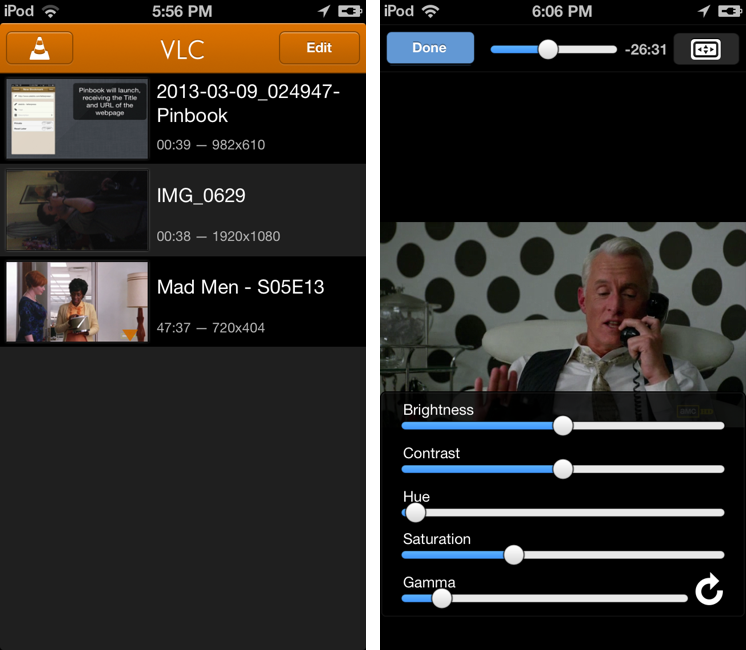
After a two-year absence, popular video player VLC is returning to the App Store with a new app for the iPhone and iPad. The new VLC for iOS will be available later today (it will start propagating at midnight in the various international App Stores) as a free download.
I’ve been able to test the new VLC for iOS for the past few weeks, and, in terms of visual appearances, the app isn’t too dissimilar from the old version that was available on the App Store in 2010. A main screen lists all your media with thumbnail previews, and you can tap on an item to start playback in a full-screen media player. However, in spite of a UI reminiscent of the old version, VLC has been completely rewritten to use modern audio and video output modules, multi-core decoding, and support for any file type supported by VLC on the desktop. In my tests, the app was able to quickly start playing any video file that I threw at it, such as .mp4 and .mkv files. Read more
Apple’s Answer on Upgrade Pricing→
David Smith wonders whether today’s release of Logic Pro X as a new app sold at full price is the best explanation of Apple’s stance on upgrade pricing to date:
I’d say that this is the best indication of Apple’s intentions and expectations for the App Stores going forward. I wouldn’t expect anything like upgrade pricing to appear in the Stores. It seems like the message is to either give your upgrades to your customers as free updates or to launch a new app and charge everyone again. Neither approach is perfect but I am now very confident that this is the going to be the situation for the foreseeable future.
This is an issue that I’ve long debated with my teammates and developer friends. As someone who’s used to seeing upgrade pricing in Mac apps sold outside of the Mac App Store, I would welcome the addition of built-in upgrade pricing to the App Store. However, on the other end of the spectrum, our Gabe Glick neatly summed up Apple’s possible motivations last year:
Developers and longtime computer users may be used to the shareware, time trial, pay-full-price-once-upgrade-cheaply-forever model of buying and selling software, but regular people, the mass market that Apple continues to court first and foremost, aren’t. Adding demos (“I thought this app was free, but now it’s telling me I have to pay to keep using it? What a ripoff!”) and paid upgrades (“Wait, I bought this app last year and now I have to pay again to keep using it? Screw that!”) would introduce a layer of confusion and make buying an app a more arduous process, which would result in people buying fewer apps.
Today’s release of Logic Pro X is just another data point and it may not necessarily be conclusive, but I believe it further suggests how Apple sees the process of releasing major upgrades to Mac apps. It’ll be interesting to see if Apple will ever do the same for its (cheaper) iOS apps, though.
The Next Five Years of App Store
A great man once said that we should look up at the stars, be curious, and keep asking questions. With the App Store now a five-year-old business, I would like – allow me to paraphrase that great man for a much more trivial endeavor – to look ahead and trying to imagine what the next five years of the App Store could look like. I already wrote my in-depth App Store retrospective last year, and I touched upon the changes introduced with iOS 6 back in September 2012. Now, it’s time to think about what’s next. The past can be functional to contextualizing the future, but eventually somebody has to think of that future. This is my humble, brief attempt.
The App Store will soon hit the impressive milestone of 1 million apps available for iPhone and iPad. In fact, I wouldn’t be surprised to know Apple is figuring out a way to time the announcement of 1 million apps with the release of iOS 7 (and possibly new iPhone hardware) this Fall. The App Store’s soon-to-be-millionaire catalogue pales in comparison to the iTunes Store’s music offerings, but it’s still impressive when considering that the modern concept of app was born only five years ago, whereas music goes, euphemistically, “a long way” back in human history.
I don’t think that the App Store’s growing catalog will ultimately change the nature of the Store itself: if you look back at the past 10 years of iTunes, you’ll see that, in spite of new releases and additions, the iTunes Store’s core mechanics haven’t changed much. Customers go to iTunes, they buy music, and they enjoy that content on their devices. With the App Store, I think we’ll keep seeing a front page, categories, charts, and a download/purchase mechanism that will go unchanged for the foreseeable future. Apple doesn’t need to alter the simplicity of the App Store model, but they must enhance it and modernize it.
I discussed many of my ideas for a better App Store in my piece from February, and I’ll revisit them today with a knowledge of the announcements Apple made with iOS 7. Read more
The Apps That Get Featured in the App Store→
Over the past few months, I’ve been researching the kinds of apps that get featured on the iOS App Store home page for different countries around the world. I’ve posted my initial findings as an online report with dynamic graphs and analysis.
This is a fantastic report with lots of data points for any developer trying to get their apps featured by Apple. Dave Addey’s highly interactive regional graphs and notes are very well done. Be sure to check out Dave Addey’s other works on his main blog.
The most interesting data point involves free vs. paid apps. It’s not really surprising in hindsight, but there’s a much higher number of apps that were free when they were featured compared to ones that had paid features. The exceptions seem to be books and productivity apps.
Apple Celebrates 5 Years of App Store With Free App Promotion, Timeline
Ahead of the App Store’s fifth anniversary on Wednesday, July 10, Apple has launched a new promotion that includes five “groundbreaking” iOS apps and five “landmark” iOS games; these apps will be available for free for a limited time to celebrate the first five years of App Store. Apple has posted an official page with links to download the apps and games on iTunes.
From the 500 apps available at launch in 2008 to the more than 900,000 at your fingertips today, it’s been a remarkably prolific five years for the App Store. To celebrate, we’re giving everyone five landmark games and five groundbreaking apps for a limited time. Plus, look back at the key moments that have made the App Store the world’s most innovative destination for apps.
The apps and games picked by Apple include Day One (a journaling application with an OS X counterpart that was named “Mac App of the Year” in 2012), award-winning game Badland, Infinity Blade II, Superbrothers: Sword and Sworcery EP, Over, and Traktor DJ. Read more