
Just before the annual holiday shutdown of the App Store, Apple has revised its App Store Review Guidelines to address new App Store functionality like Pre-Orders and clarify or expand a handful of existing guidelines, including the creation of apps from templates and how ’loot boxes’ and VPNs should be handled. Below is a summary of the major changes to the Guidelines. To see all the changes, check out Rich Hong’s App Store Review Guidelines gist on GitHub.
Apple Updates and Expands App Store Review Guidelines to Address Pre-Orders, Loot Boxes, VPNs, and More
 MacStories Weekly: Issue 110
My Must-Have Mac Apps, 2017 Edition
Feature of the Year
Pixelmator Pro’s Automatic Layer Naming
Machine learning was a common buzzword thrown about more often in 2017 than it was put to good use. Pixelmator Pro bucked that trend by using machine learning to automatically name images added in as new layers to the app. Drag in photos of a dog, a landscape, and a building and your layers will be named things like puppy, trees, and skyscraper. The feature is surprisingly accurate and a great time saver for organizing complex image projects.
Runner-Up
Todoist’s Task Syntax
There’s a learning curve with Todoist’s task syntax, but once you speak its language, you can become a master of sending tasks to the right projects with labels and proper due dates. As I think of something I need to do, it’s become second nature to summon Todoist’s input field and quickly type a task, complete with syntax, and receive the satisfaction of knowing it will be where I want it when I go back and look, instead of piling up unprocessed in an inbox.
Redesign of the Year
Pixelmator Pro
Pixelmator was my go-to image editor before the Pro version was released earlier this year and would have made my must-have list without the new Pro version. However, Pixelmator Pro is a full redesign of the app that does two things I absolutely love. First, it stashes tools in side panels where it’s easier to find them, eliminating the jumble of palettes used by the standard version. Second, its dark gray color scheme puts the focus on the image you’re working on, which makes it a delight to use.
Update of the Year
MindNode 5
I wasn’t a fan of mind maps, but something about MindNode 5 clicked with me. With an update this fall, the app got a new look, improved outline view, and many other features that together have made mind mapping feel as natural as typing a nested outline. The ability to quickly organize thoughts with only the keyboard in a way that looks good, without fiddling with settings, has made the app one of my favorite releases of the year.
Runner-Up
Bartender 3
Bartender is an essential tool for taming a wild menu bar full of apps. Even with Bartender though, it can be hard to find the app you’re looking for, which is why I was so happy to see that Bartender 3 added search support. In addition, the app has been built from the ground up with macOS High Sierra in mind, with a look that is right at home on a modern Mac.
Debut of the Year
Forecast
I wouldn’t normally pick a beta app as a Debut of the Year, but Forecast by Marco Arment is far more stable than the typical beta and was used in production by Arment and other podcasters for months before its public release. The app is lightning fast at encoding podcast episodes as MP3s and supports chapter markers, show art, and other little time savers that anyone who has produced a podcast will appreciate.
App of the Year
Ulysses
There’s no single app I use more than Ulysses. Despite a few eccentricities, the app handles the entire writing process with a simple, elegant design that belies the sophistication that underlies it. I especially like how Ulysses handles Markdown, its ability to hide distracting UI chrome from view, and the WordPress integration.
Runner-Up
iZotope RX Standard
There’s no doubt that you can produce a good-sounding podcast with free or inexpensive tools. iZotope RX, however, is one of my favorite apps of 2017 because it helped shorten the production time of AppStories while simultaneously making it sound better, which made it a good investment despite its hefty price tag.
Looking Ahead
As 2017 comes to a close, I’m on my Mac more than ever. A lot of that has to do with changes in how I work and what I do, which in turn is reflected in the tools I use. That seems incredibly obvious as I write it, but too often the discussion of apps and productivity winds up divorced from the work itself. After all, it’s the changes in my work and life that should affect the apps I use, not the other way around.
Although 2017 has seen a shift towards Mac apps, my overall approach remains a hybrid one. Nowhere is this more evident than on Friday mornings when I sit at my desk assembling MacStories Weekly – juggling Safari, PopClip, Ulysses, Byword, GitHub Desktop, Slack, and Airmail on my Mac, while switching periodically to Tweetbot, Photos, Workflow, Working Copy, Blink, and Pythonista on my iPhone. I enjoy working in both OSes and don’t see that changing anytime soon.
Perhaps it’s just a reflection of the exciting direction that iOS 11 has taken the iPad Pro, but the one thing that makes me slightly uncomfortable with my hybrid approach is that the Mac app ecosystem has stagnated in recent years. At the same time, even though the Mac app landscape is littered with a broken store and developer resources that lag behind their iOS counterparts, the iMac Pro, upcoming Mac Pro, and updated pro apps serve as a beacon of hope that the best days of macOS are not behind it.
I don’t have a crystal ball into the future of Mac apps, but I do know I can count on change. And with the introduction of new Mac hardware, I know I can also count on developers to push that hardware’s limits with apps I can’t wait to try in 2018 and beyond.
How Far Ahead of Apple Maps Is Google Maps?→
Another fantastic essay by Justin O’Beirne, this time focused on explaining one of Google Maps’ strongest advantages over Apple Maps: the ability to use data to create more data.
With “Areas of Interest”, Google has a feature that Apple doesn’t have. But it’s unclear if Apple could add this feature to its map in the near future.
The challenge for Apple is that AOIs aren’t collected—they’re created_. And Apple appears to be missing the ingredients to create AOIs at the same quality, coverage, and scale as Google.
This is a perfect example of Google’s institutional approach to data collection paying off in the long term, giving them a substantial lead over the competition. O’Beirne’s visual comparisons between Google Maps and Apple Maps are just brutal.
Yes, Apple Maps may be “prettier”, but when you’re going somewhere, or need to find a specific point of interest, I bet you don’t care about “pretty”. You just want your map to tell you where to go, or show you accurately where you’re meant to be. Google is objectively ahead here, and Apple Maps’ slow evolution is concerning. There’s an interesting parallel here between Apple Music and Apple Maps: both nicer iOS apps than Spotify and Google Maps, and both far behind in terms of intelligence of the service itself.
As I wrote earlier this year:
Speaking from personal experience, Google Maps has considerably improved in my area in the past year, while Apple Maps has remained essentially the same. Which isn’t to say that Apple Maps is bad – Google simply has an edge over local business information and they’re evolving at a faster pace than Apple. To me, Apple Maps looks and feels nicer; Google Maps seems smarter and it has modern features I’d like Apple to add.
Twitter Now Supports Third-Party Apps for Two-Factor Authentication→
https://twitter.com/TwitterSafety/status/943542421698125824
Earlier today Twitter announced that you’ll now be able to use a third-party app (such as Google Authenticator, Authy, or 1Password) for two-factor authentication instead of SMS. The company has updated their support document with instructions on how to set it up here.
This is great news as Twitter was the last service with 2FA that only supported sending codes via SMS. Switching from text messages to 1Password (which I use for one-time codes) was easy: in Twitter for iPad, I went to Settings ⇾ Account ⇾ Security, and enabled the ‘Security app’ toggle. I then selected to use another app to generate my codes and opened 1Password on my iPhone, where I hit Edit on my Twitter login item and scrolled to the OTP section. Here, I tapped the QR button, scanned the QR code Twitter was displaying on my iPad with the iPhone’s camera, and that was it.
Unless you specifically want to receive 2FA codes from Twitter via SMS, you should consider switching to a dedicated authentication app: these codes work independently from carriers and location, and they can be generated offline.
Connected, Episode 173: The Final Robin→
Round out 2017 with fake apps and an anti-wishlist.
In the final episode of Connected for 2017, we revisit the classic wish list with a twist: what are the things we’d like Apple to stop doing? You can listen here.
Sponsored by:
- Balance Open: Find out more about Balance Open and get $2 in Ethereum.
- TextExpander, from Smile: Communicate smarter with TextExpander. Get 20% off your first year when you tell them you came from this show.
- Incapsula: Secure and accelerate your website. Connected listeners get one month free.
Apple Addresses Reported iPhone Slowdowns After Software Updates→
There’s an age-old conspiracy theory that Apple intentionally slows down older iPhone models to compel upgrades to new ones. Every year around the time a new version of iOS releases – which also happens to be the time new iPhone models launch – users report that their old phones aren’t as speedy as before. While some of this felt downgrade is to be expected with new features introduced in major iOS versions, Apple today confirmed that there is in fact more to it than that – at least, in certain cases.
Earlier this week John Poole shared Geekbench results that seemed to indicate some level of throttling of iPhones after certain software updates. His charts showed that for an iPhone 6s, iOS 10.2.1 introduced a performance change, while for the iPhone 7, iOS 11.2 did the same. Seemingly in response to these tests, Apple has released a statement to Matthew Panzarino of TechCrunch that aims to make sense of the inconsistencies.
“Our goal is to deliver the best experience for customers, which includes overall performance and prolonging the life of their devices. Lithium-ion batteries become less capable of supplying peak current demands when in cold conditions, have a low battery charge or as they age over time, which can result in the device unexpectedly shutting down to protect its electronic components.
Last year we released a feature for iPhone 6, iPhone 6s and iPhone SE to smooth out the instantaneous peaks only when needed to prevent the device from unexpectedly shutting down during these conditions. We’ve now extended that feature to iPhone 7 with iOS 11.2, and plan to add support for other products in the future.”
Panzarino explains:
Basically, iPhones were hitting peaks of processor power that the battery was unable to power and the phones were shutting off. Apple then added power management to all iPhones at the time that would ‘smooth out’ those peaks by either capping the power available from the battery or by spreading power requests over several cycles.
While Apple’s lack of communication on this matter can certainly be viewed as a problem, ultimately the issue appears rooted in battery technology generally rather than in iPhones specifically. Lithium-ion batteries have certain limitations, which are exacerbated in certain conditions, and Apple made the decision to reduce peak performance in those conditions rather than leave users facing unexpected device shutdowns.
#MacStoriesDeals Holiday Edition 2017: The Best Deals for iPhone, iPad, and Mac Apps & Games

Every year, thousands of iOS and macOS app deals are launched for the holidays. At MacStories, we handpick the best deals for iOS and Mac apps and collect them in a single roundup with links to buy or share discounted products directly. You don’t have to be overwhelmed by app deals; we take care of finding the best ones for you.
Bookmark this post and come back to find updated deals starting today through the rest of the week. Updates will be listed as new entries at the top of each section.
For real-time updates, you can find us as @MacStoriesDeals on Twitter.
AutoSleep 5 Adds Automatic Apple Watch Sleep Tracking and Much More
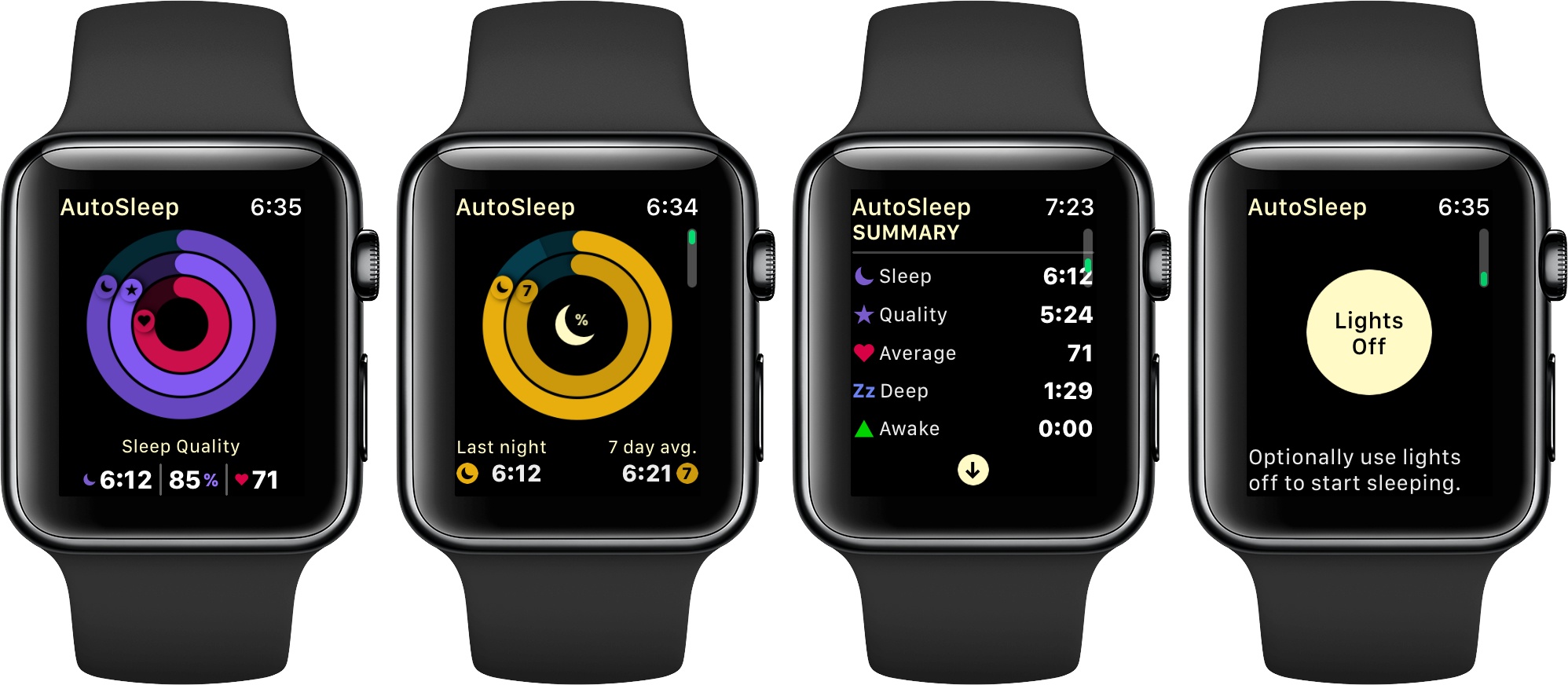
Slowly but surely, the Series 3 has changed my Apple Watch habits. I abandoned earlier models of the Watch for most tasks other than notifications and workout tracking because, with some notable exceptions, few apps worked well enough to be more convenient than pulling out my iPhone in most circumstances.
The Series 3 Watch is different. Not only is it faster, but the battery life is significantly better. The changes have caused me to rethink how I use my Apple Watch and look for new ways to use it. So when I heard AutoSleep, an app that Federico uses and has reviewed in the past, was getting a big update that includes enhanced Apple Watch functionality, I saw another opportunity to extend how I use my Series 3.
I haven’t been disappointed. AutoSleep 5 is a broad-based update that touches every aspect of the app, but what I like best is its Apple Watch integration, which has begun to give me new insight into my sleep patterns. Although I find the amount of data displayed in AutoSleep overwhelming at times, after spending several days with the app, I plan to stick with it as I try to adjust my schedule to get more rest each week.