
 MacStories Weekly: Issue 396
MacStories Unwind: Streaming Games at Home






This week on MacStories Unwind, Federico and I follow up on AppStories experiments with our thoughts on the Sony PlayStation Portal and the best ways to stream videogames from a console or PC on your home network.
Sponsored By:
- Kolide – It ensures that if a device isn’t secure it can’t access your apps. It’s Device Trust for Okta. Watch the demo today!
Links and Show Notes
- Gaming gear
- Wi-Fi gear
- Streaming software
- Also mentioned
MacStories Unwind+

We deliver MacStories Unwind+ to Club MacStories subscribers ad-free and early with high bitrate audio every week.
To learn more about the benefits of a Club MacStories subscription, visit our Plans page.
Access Extra Content and Perks
Founded in 2015, Club MacStories has delivered exclusive content every week for nearly a decade.
What started with weekly and monthly email newsletters has blossomed into a family of memberships designed for every MacStories fan.
Club MacStories: Weekly and monthly newsletters via email and the web that are brimming with apps, tips, automation workflows, longform writing, early access to the MacStories Unwind podcast, periodic giveaways, and more;
Club MacStories+: Everything that Club MacStories offers, plus an active Discord community, advanced search and custom RSS features for exploring the Club’s entire back catalog, bonus columns, and dozens of app discounts;
Club Premier: All of the above and AppStories+, an extended version of our flagship podcast that’s delivered early, ad-free, and in high-bitrate audio.
Monthly Log: November 2023
Bezel: The Best Way to Screen Capture Your iPhone From a Mac
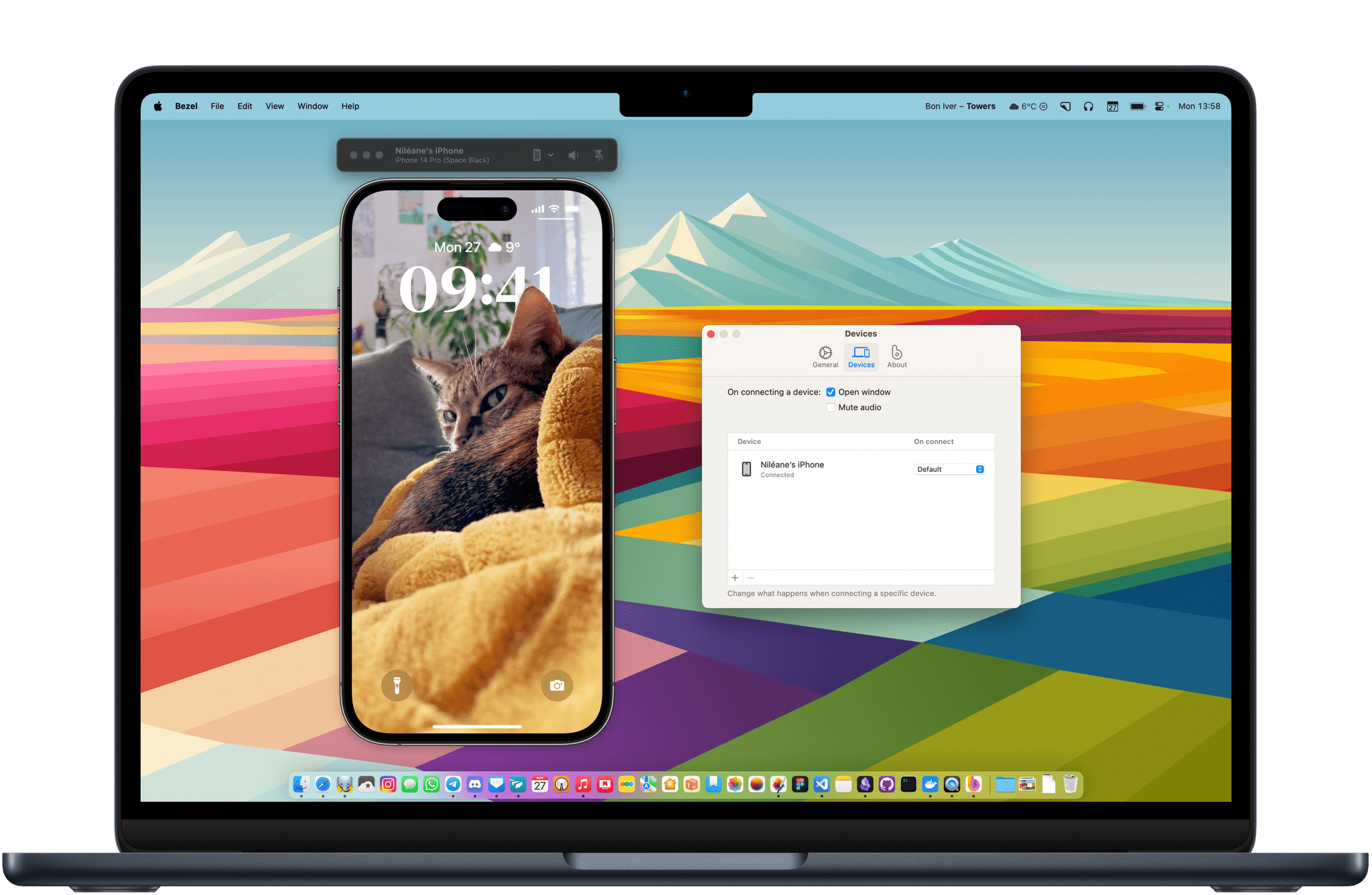
I have recently been working on a personal web project that involves a lot of testing on my iPhone. While I would usually just have my iPhone to the side on my desk to test my changes in real-time and take screenshots, I was looking for a solution to mirror my iPhone’s screen directly on my Mac’s desktop. This is where I stumbled upon Bezel.
Bezel is a fantastic utility from Nonstrict that allows you to start capturing your iPhone immediately after connecting it to your Mac. The app is both simple and extremely convenient.
To start using Bezel, all you need to do is allow the app to start at login. Then, plug in your iPhone when you want to start mirroring your screen. That’s it. Bezel will automatically display your iPhone on your desktop. Similar to Federico’s Apple Frames shortcut, the app will frame your iPhone’s display with a bezel that matches your iPhone model.
Access Extra Content and Perks
Founded in 2015, Club MacStories has delivered exclusive content every week for nearly a decade.
What started with weekly and monthly email newsletters has blossomed into a family of memberships designed for every MacStories fan.
Club MacStories: Weekly and monthly newsletters via email and the web that are brimming with apps, tips, automation workflows, longform writing, early access to the MacStories Unwind podcast, periodic giveaways, and more;
Club MacStories+: Everything that Club MacStories offers, plus an active Discord community, advanced search and custom RSS features for exploring the Club’s entire back catalog, bonus columns, and dozens of app discounts;
Club Premier: All of the above and AppStories+, an extended version of our flagship podcast that’s delivered early, ad-free, and in high-bitrate audio.
Apple Marks International Day of Persons with Disabilities with Video and Ebook

Sunday, December 3rd is International Day of Persons with Disabilities, and to mark the day, Apple has released a short film directed by Taika Waititi. The film, shot in New Zealand, stars a young girl and a menagerie of fanciful creatures searching for one of their voices. The narrative is told in rhyme in a style that’s reminiscent of a children’s book, which foreshadows the final scene of the video between a father and his daughter, which I won’t spoil. The narrator is Dr. Tristram Ingham, a physician from Taika Waititi’s hometown in New Zealand who has a rare form of muscular dystrophy and uses Personal Voice to narrate the film.

The video is a touching way of promoting Personal Voice, an important new accessibility feature of iOS 17, iPadOS 17, and macOS Sonoma. Users record 15 minutes of themselves speaking, which is processed privately, on-device, creating a facsimile of their voice. It’s an invaluable feature for anyone who is at risk of losing their voice as a result of a disease or disability.
As Apple explains in its press release, the voice that is created is stored locally on the device on which it is recorded but can be stored in iCloud and shared with up to three devices. If you choose to use iCloud, voice data is end-to-end encrypted. The device on which you record your voice must be password-protected, too.
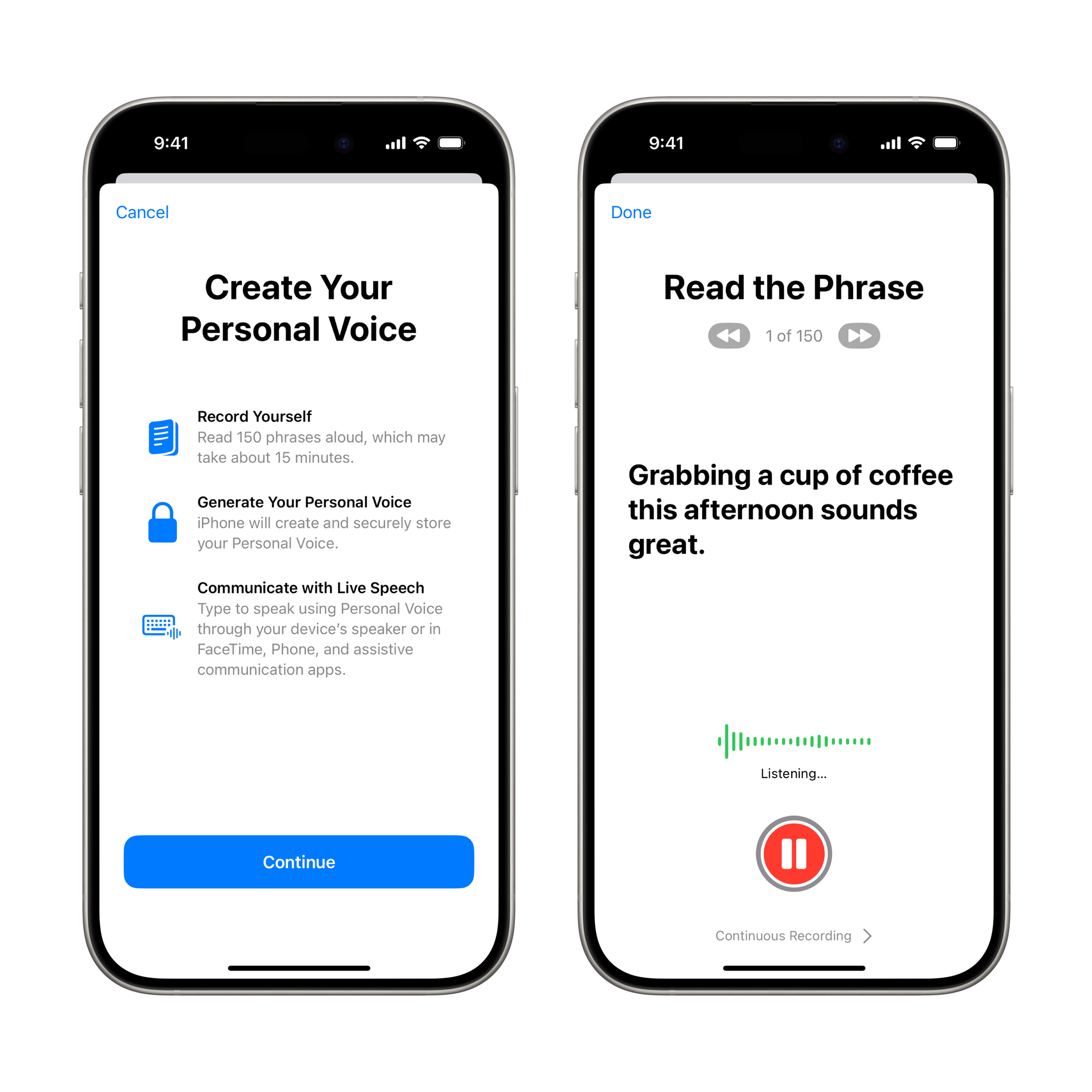
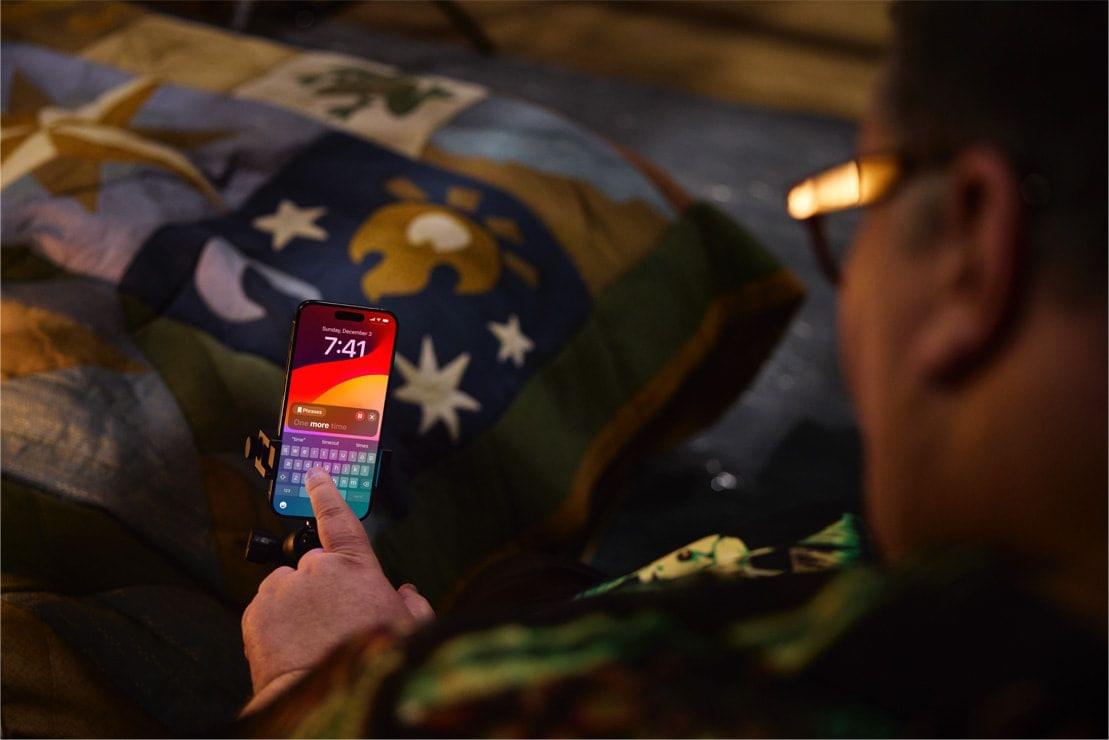
The film released today also highlights Live Speech, a feature of iOS, iPadOS, and macOS that allows users to type responses that are spoken aloud in a system-generated voice or your Personal Voice. You can learn more about setting up Personal Voice and using Live Speech from this Apple Support video on YouTube:
Alongside the video released today is a free ebook version of the story told in the video, which is designed to continue the conversation about voice loss and help people faced with losing their voices.
Access Extra Content and Perks
Founded in 2015, Club MacStories has delivered exclusive content every week for nearly a decade.
What started with weekly and monthly email newsletters has blossomed into a family of memberships designed for every MacStories fan.
Club MacStories: Weekly and monthly newsletters via email and the web that are brimming with apps, tips, automation workflows, longform writing, early access to the MacStories Unwind podcast, periodic giveaways, and more;
Club MacStories+: Everything that Club MacStories offers, plus an active Discord community, advanced search and custom RSS features for exploring the Club’s entire back catalog, bonus columns, and dozens of app discounts;
Club Premier: All of the above and AppStories+, an extended version of our flagship podcast that’s delivered early, ad-free, and in high-bitrate audio.
Apple Announces Apps of the Year
Today, Apple unveiled the winners of its annual App Store Awards in 10 categories. Earlier this month, Apple revealed almost 40 finalists across its award categories for their innovation and excellence.
As in the past, this year’s winners represent a broad cross-section of the App Store:
Apps

iPhone App of the Year: AllTrails, from AllTrails, Inc.
iPad App of the Year: Prêt-à-Makeup, from Prêt-à-Template.
Mac App of the Year: Photomator, from UAB Pixelmator Team.
Apple TV App of the Year: MUBI, from MUBI, Inc.
Apple Watch App of the Year: SmartGym, from Mateus Abras.
Games

iPhone Game of the Year: Honkai: Star Rail, from COGNOSPHERE PTE. LTD.
iPad Game of the Year: Lost in Play, from Snapbreak Games.
Mac Game of the Year: Lies of P, from NEOWIZ.
Apple Arcade Game of the Year: Hello Kitty Island Adventure, from Sunblink.
Cultural Impact

For the App Awards Cultural Impact category, Apple picked five apps and games, which the company chose for their “ability to drive positive change through apps and games:”
Pok Pok from Pok Pok
Proloquo from AssistiveWare*
Too Good To Go from Too Good To Go
Unpacking from Humble Bundle
Finding Hannah from Fein Games GmbH
As always it’s great to see some of the MacStories Team’s favorite apps on this list, including Pok Pok, Photomator, and SmartGym. Congratulations to the developers of all the winning apps and games.
Access Extra Content and Perks
Founded in 2015, Club MacStories has delivered exclusive content every week for nearly a decade.
What started with weekly and monthly email newsletters has blossomed into a family of memberships designed for every MacStories fan.
Club MacStories: Weekly and monthly newsletters via email and the web that are brimming with apps, tips, automation workflows, longform writing, early access to the MacStories Unwind podcast, periodic giveaways, and more;
Club MacStories+: Everything that Club MacStories offers, plus an active Discord community, advanced search and custom RSS features for exploring the Club’s entire back catalog, bonus columns, and dozens of app discounts;
Club Premier: All of the above and AppStories+, an extended version of our flagship podcast that’s delivered early, ad-free, and in high-bitrate audio.
Improving the Copy and Paste Prompts on iOS→
I couldn’t agree more with all the suggestions proposed by Matt Birchler, who envisions a more flexible permission flow for clipboard access on iOS that is entirely in line with Apple’s current privacy prompts for other personal data.
Apple could even hide the “always allow…” option until the user had allowed an app to see the clipboard like 5 times in a row. That would avoid giving full access to apps that you don’t want to give it to, and it even helps keep the number of apps with this always access down. After saying “allow paste” in Parcel 100+ times in the past few years and never hitting no, it might be safe to let me just say “always allow” at this point, but maybe an app where I paste once in a blue moon doesn’t need it.
They could go the other way as well: if you deny an app a few times in a row, there could be a new option the next time that asks if you want to block this app from the clipboard forever.
And as they’ve done recently with location, photos, and calendar access, it could make sense to occasionally show an alert that tells the user that this app has access to your clipboard and how often it’s used that access in the last X days.
I strongly disliked the redesigned clipboard prompts in the first version of iOS 16 (a perfect example of user experience dictated by security engineers rather than designers at Apple), and I was relieved when the company improved the system with per-app clipboard settings in 16.1. Still, these clipboard prompts feel antiquated, user-hostile, and not intelligent at all. For starters, they should be consistent – like Matt suggests – with Apple’s other privacy prompts. Second, they should learn from user habits in terms of granting access or reminding people to review their apps with clipboard access.
Third, I can’t believe it’s still not possible for third-party developers to make a proper clipboard manager for iOS and iPadOS – a software category that continues to thrive on macOS. I was writing about this stuff 13 (!) years ago, and it’s wild that nothing has changed.
Workflow Co-Founders Want to Bring AI to the Desktop→
When I read earlier this year that Ari Weinstein, one of the co-founders of Workflow before it was acquired by Apple, had left the company, I had a feeling he’d team up soon enough with Conrad Kramer, another Workflow co-founder. I was right. Alex Heath, writing for The Verge, has some initial details on Software Applications Incorporated, the new venture by Weinstein, Kramer, and Kim Beverett, another Apple vet you may remember from the original Siri Shortcuts demo at WWDC 2018:
In their first interview since leaving Apple to start something new, the trio tells me that their focus is on bringing generative AI to the desktop in a way that “pushes operating systems forward.” While they don’t have a product to show off yet, they are prototyping with a variety of large language models, including OpenAI’s GPT and Meta’s Llama 2. The ultimate goal, according to Weinstein, is to recreate “the magic that you felt when you used computers in the ’80s and ’90s.”
“If you turned on an Apple II or an Atari, you’d get this basic console where you could type in basic code as a user and program the computer to do whatever you wanted,” he explains. “Nowadays, it’s sort of the exact opposite. Everybody spends time in very optimized operating systems with pieces of software that are designed to be extremely easy to use but are not flexible.”
An example he gives: “Sometimes you’ve got a browser window open with a schedule on it, and you just want to say, ‘add this to my calendar,’ and somehow, there’s no way to do that… We think that language models and AI give us the ingredients to make a new kind of software that can unlock this fundamental power of computing and make everyday people able to use computers to actually solve their problems.”
They don’t have a product to show yet, but I’ll say this: if there’s anyone out there who can figure out how to turn generative AI into something more than a text prompt or writing assistant for Word and Notion – something that can be truly integrated with your computer, your data, and, well, your workflow, it’s this trio. I absolutely can’t wait to learn more about what they’re working on.
Also worth noting: the company’s website (great domain, too) is a delightfully retro, emulated browser version of Mac OS 8.
Apple Music Replay Is Out, but for a Deeper Look at Your Music Habits, Try Last.fm
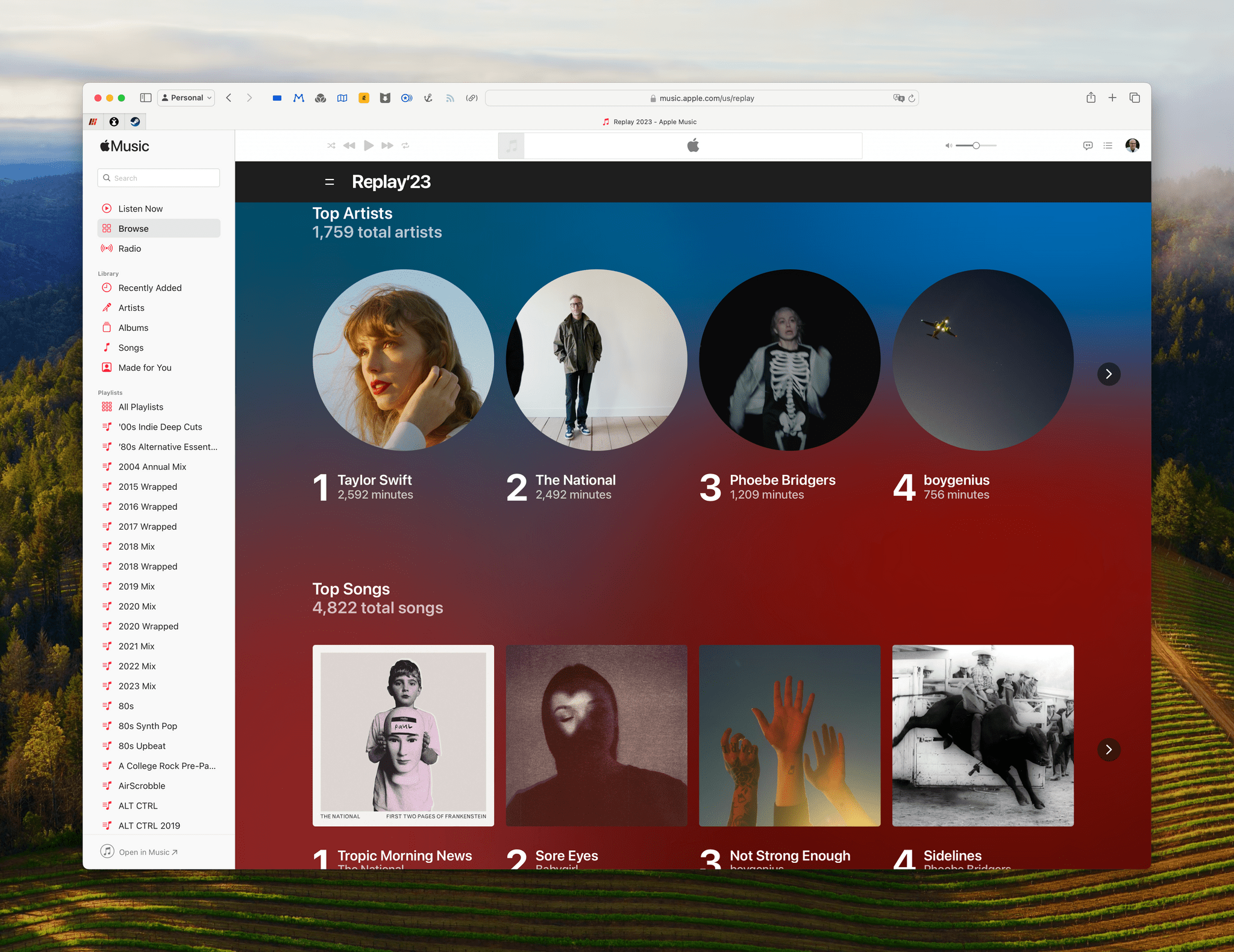
Yesterday, Apple released Apple Music Replay, its annual recap of Apple Music subscribers’ listening habits. The site is beautifully designed with images of artists coming to life with video when you’re not scrolling the page. Included this year are:
- A highlight reel
- Top artists
- Top songs
- Top albums
- Top genres
- Top playlists
- Top radio stations
- Listening milestones
As I scroll through my lists, there isn’t anything surprising here. I could have guessed my top artists, songs, and albums and put at least the top five or so in the correct order, which goes to the heart of what I and others have faulted Apple Music Replay for in the past.
The site looks great, and the listening milestones, which explain things like the fact that I crossed 25,000 minutes of listening in early August, are interesting, but they don’t go deep enough. I’d like to know things like which of the artists that I didn’t listen to prior to 2023, did I listen to the most in 2023? What’s a favorite album or band from years ago that I rediscovered? How did the genres I listened to evolve over the course of the year? Which artists took off in my regular rotation compared to past years? There are a million questions that could be answered by Apple Music that aren’t, and that’s a shame.
Spotify does a better job at surfacing interesting data with Wrapped, but if you’re like me and prefer other aspects of Apple Music, sign up for Last.fm, use one of the many excellent indie apps, like Marvis Pro, Soor, Albums, Longplay, Doppler, and Air Scrobble that support the service, and then enjoy your weekly, monthly, and annual reports in Last.fm’s app or on its website.
To view your own Replay 2023 statistics, visit replay.music.apple.com.
Access Extra Content and Perks
Founded in 2015, Club MacStories has delivered exclusive content every week for nearly a decade.
What started with weekly and monthly email newsletters has blossomed into a family of memberships designed for every MacStories fan.
Club MacStories: Weekly and monthly newsletters via email and the web that are brimming with apps, tips, automation workflows, longform writing, early access to the MacStories Unwind podcast, periodic giveaways, and more;
Club MacStories+: Everything that Club MacStories offers, plus an active Discord community, advanced search and custom RSS features for exploring the Club’s entire back catalog, bonus columns, and dozens of app discounts;
Club Premier: All of the above and AppStories+, an extended version of our flagship podcast that’s delivered early, ad-free, and in high-bitrate audio.