The iPad 2 Could Have Been The World’s Fastest Computer in 1985

The iPad 2 Could Have Been The World’s Fastest Computer in 1985

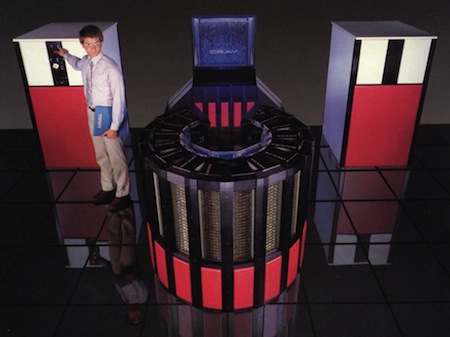
Jack Dongarra, researcher at Oak Ridge National Laboratory, conducted a study to determine the position of the iPad in the list of the world’s 500 fastest computers in history. Using the Linpack computing benchmark, “a linear algebra test that measures  the mathematical capabilities of computers”, he came to the conclusion that the iPad 2 would be the perfect rival for the four-processor version of the Cray 2 supercomputer, an eight-processor machine that was the world’s fastest computer in 1985.

To date, the researchers have run the test on only one of the iPad microprocessor’s two processing cores. When they finish their project, though, Dr. Dongarra estimates that the iPad 2 will have a Linpack benchmark of between 1.5 and 1.65 gigaflops (billions of floating-point, or mathematical, operations per second). That would have insured that the iPad 2 could have stayed on the list of the world’s fastest supercomputers through 1994.

The Cray 2 was an unusual computer even by the standards of its designer, Seymour Cray. About the size of a large washing machine, it was cooled by immersion in a liquid called Flourinert that had been developed by 3M, and that was occasionally used as a human blood substitute during surgery.

The obvious difference is that, whilst the Cray 2 required to be placed in a large room, the iPad 2 fits in your hands, it’s touch-based and runs thousands of different apps. To put things in context, Steve Jobs also left Apple in 1985.

Permalink

Time Inc. Has Chosen Not To Use Apple’s Subscriptions

Time Inc., one of the major magazine publishers in the US, has announced they’re not looking to implement Apple’s in-app subscriptions in future updates to their iPad magazines like Fortune, Sports Illustrated, or Time. The news comes after it was revealed last week the company had reached a deal with Apple to offer print subscribers free access to digital content on the iPad, breaking an impasse between the publisher and Apple, which wasn’t allowing apps to recognize a subscriber’s status and give out free content. It’s not clear at this point how Time Inc. will manage to keep their existing apps in the Store considering the developer’s deadline set for June 30.

AdAge reports Steve Sachs, Time Inc. exec VP for consumer marketing and sales, confirmed Time Inc. “has chosen” not to implement subscriptions, although the possibility of updating the magazine apps to use subscriptions in the future hasn’t been completely ruled out.

We have chosen not to do that,” Mr. Sachs said in an interview, “because when we look at who to partner with, the key parts of our principles include of course making sure that the look and feel of products is great for consumers and the ability to set pricing terms, but also receiving key consumer data about subscribers.”

“That is one of the major issues for us that we haven’t been able to agree on with Apple,” he said. Things could of course change eventually. “We’re not going to rule out having digital subscriptions down the road with iPad.

Clearly, Time Inc. couldn’t agree with Apple’s subscription terms, which require users to log in with their iTunes accounts, grant Apple a 30% cut off every recurring transaction and allow readers to opt-out from sharing personal information with the publisher – a key detail the publishing industry relies on to trigger targeted advertising. Today’s Time Inc. announcement follows a flood of recent reports that saw many US publishers jumping on Apple’s subscription system, like Hearst last week or Conde Nast today with the release of The New Yorker for iPad featuring monthly and annual in-app subscriptions.


Apple Already Running Nuance Tech in New Data Center, WWDC Announcement?

Following last week’s speculation of Apple negotiating a deal with voice-recognition company Nuance for future integration in iOS devices, TechCrunch reports today more details on the rumored collaboration between Apple and Nuance, which should be a major announcement at next month’s WWDC in San Francisco. According to the website, the partnership between the two companies goes as far as to allow Siri – previously purchased by Apple – to be integrated into iOS 5, using Nuance’s voice recognition technology in the backend. Siri, in fact, was based on Nuance’s tech while providing more information of its own, and since the acquisition last year Apple had to make sure Nuance would still license the software (they even hold multiple patents for it) to use in the future version of Siri – likely a native feature in iOS 5.

For this reason, TechCrunch speculates Apple may be already running Nuance’s tech on its servers in North Carolina, through the massive data center that should begin operations this Spring. With deals likely already inked ahead of the WWDC, Apple might want to pass information through their own cloud to make voice recognition faster for all users, scalable, and more secure.

In digging into the information about the relationship between the two companies, we had heard that Apple might actually already be using Nuance technology in their new (but yet to be officially opened) massive data center in North Carolina. Since then, we’ve gotten multiple independent confirmations that this is indeed the case. And yes, this is said to be the keystone of a partnership that Apple is likely to announce with Nuance at WWDC next month.

More specifically, we’re hearing that Apple is running Nuance software — and possibly some of their hardware — in this new data center. Why? A few reasons. First, Apple will be able to process this voice information for iOS users faster. Second, it will prevent this data from going through third-party servers. And third, by running it on their own stack, Apple can build on top of the technology, and improve upon it as they see fit.

Valued at over $6 billion, an acquisition of Nuance was quickly dismissed last week as an expense Apple wasn’t ready to consider, suggesting a partnership would make more sense in order to keep things running (in Siri and the future iOS integration) at a lower cost. The fact that Apple may be running Nuance’s tech on its own backend, however, seems to suggest that Apple has at least negotiated a way to get direct control of the service, which, again, should power the next version of Siri for iOS 5. TechCrunch speculates voice recognition will be one of the WWDC’s big announcements, although it’s unclear whether third-party developers will get immediate access through a series of APIs or not.

The WWDC kicks off on June 6, and Apple has already formally announced that they’ll unveil the future of iOS and OS X at the developer-oriented event. Voice recognition has long been in the rumors as a major new functionality of iOS 5 – alongside a new notification system, maps, and social services – which should be previewed next month and released this Fall at Apple’s usual September media event.


Palua for Mac Toggles Your Function Keys

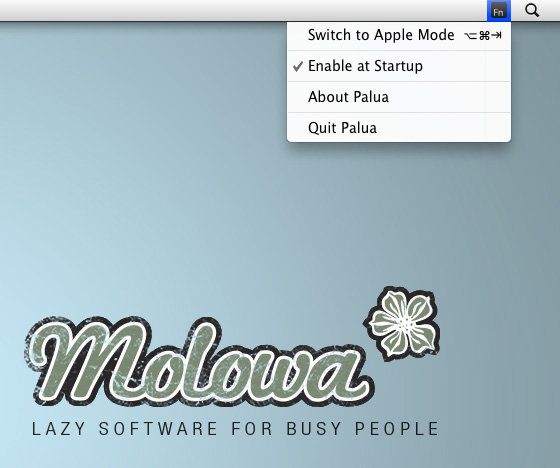
Defaulting to a variety of Apple keys for media, Exposé, and the Dashboard, the functions keys have to be continually activated by holding down the Function (fn) key on your keyboard. Function keys by default offer some powerful functionality; F8 is used to activate Spaces or Yojimbo; the F9 through F11 keys manage windows; and applications such as Photoshop can make extensive use of this top row for various functions. If you are going to be making use of the functions while working in a specific app, Palua for Mac allows you to toggle the function keys on and off so you don’t have to mash the fn key with each command. More interested in getting use out of those function keys than changing the volume? From the menubar or a simple ⌥⌘⇥ (option-command-tab) keystroke, Palua will activate and deactivate the function keys as needed when working in various projects. Used in combination with Keyboard Maestro, you could create some pretty powerful workflows where apps automatically launch and the function keys are activated for immediate use. Palua is available on the Mac App Store for only 0.99 cents, which can be purchased and activated at login so you’ll always have the function keys readily available with a quick keyboard shortcut.


Microsoft Azure Toolkit for iOS Now Available

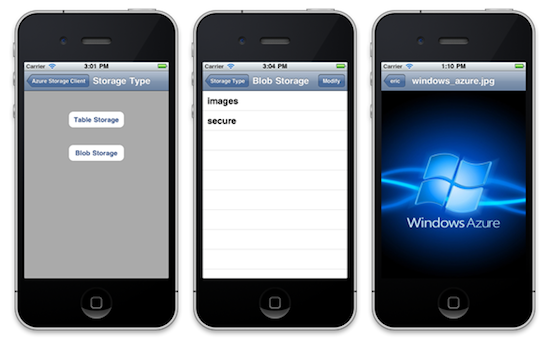
Following the release for Windows Phone 7 in March, Microsoft today announced the availability of the Azure toolkit for iOS, which can be downloaded now from GitHub. Similarly to Amazon Web Services, Microsoft’s Azure is a cloud platform hosted on the company’s servers that allows developers to build, host and scale web applications. Today’s iOS toolkit includes resources and services for developers to integrate Azure in their iPhone and iPad apps, including an Objective-C library to work with Azure services (such as storage and push notifications), documentation, a sample iOS app with full Azure storage integration, as well full source code for the aforementioned Objective-C library with Xcode project files. More details on Azure Toolkit for iOS can be found here.

Last March we released the Windows Azure Toolkit for Windows Phone 7, which provided a set of generic services for Windows Azure.  This toolkit was the first step in enabling developers to build native experiences on multiple platforms using Windows Azure.  As the next step in this process, today we’re pleased to announce the release of the Windows Azure Toolkit for iOS.  This toolkit contains resources and services designed to make it easier for iOS developers to use Windows Azure.

Downloads:

Microsoft has also release a Cloud Ready package to simply the process of setting up Azure services, and it has announced the release of an Android toolkit for next month. [via The Next Web]


iPhone and iPad Drive Softbank’s Profit Growth

As reported by The Wall Street Journal, Japanese mobile carrier Softbank (the third largest carrier in the country by number of subscribers) has announced record operating profit for the January - March quarter with net profit surging to Y47.41 billion from the Y1.85 billion posted last year. Thanks to high demand for iPhones and iPads, the carrier managed to move away from last year’s “unusual” profit loss, due to the adoption of 3G mobile services, and the discontinuation of 2G. Softbank is the only carrier that sells the iPhone in Japan, and the high demand for the device in a market otherwise saturated by alternative smartphones helped the company achieving record profit during the quarter.

The expansion of the smartphone market led by the iPhone and iPad was a huge factor that contributed to the growth,” said Softbank President and Chief Executive Masayoshi Son.

Softbank’s earnings also reported average revenue per user – also known as ARPU – rose to Y4,210 (from Y4,070) thanks to the iPhone’s growth in Japan. The iPhone became Japan’s best selling cellphone last October, and Softbank later announced a new promotion to give users an iPad for free upon subscribing to the carrier’s two-year data plan.


Queen Of England Demands An iPad

The Queen of England has apparently ordered her staff to buy her an iPad after the newly married Prince Will and his brother Prince Harry showed off theirs to her on a recent gathering at Buckingham Palace.

The Princes, the Queen’s grandsons, gave her a demo of how the iPad worked which, as a royal insider told The Sun, led her to be impressed and “particularly taken with how easy it was to use, the large screen and how light it was” The insider also notes that the Queen is fairly “switched on” for an 85 year old woman, saying “It was only a matter of time before she asked someone to go and get her one.”

“The Queen has a mobile phone as well as the iPods, so an iPad is the logical progression. She thinks it will be great to keep her entertained on all the long trips she has to make.”

The same royal insider says that the Princes think her reaction is hilarious, but also “love the fact that their gran wants an iPad and think she’s really cool”. The iPad won’t be the first Apple product that the Queen owns either, she previously bought a £169 silver iPod in 2005 and was given a new iPod by Barack Obama in 2009, which was loaded up with happy snaps from the Queen’s US visit in 2008.

[Via The Sun]


Flipboard Triples Usage and Doubles Users In Two Months

Flipboard, an iPad app that aggregates content from your social networks, has in the last two months seen close to a tripling in daily usage. An average day will now bring between 8 and 9 million “flips” compared to what was 3 to 4 million flips just two months ago – flips roughly equating to page views for a website.

The CEO, Mike McCue, revealed the information in a chat last week and pointed to a number of factors that he believes contributed to the increase in popularity. Foremost in his mind is the release of version 1.2 of Flipboard on March 10th which greatly improved speed and brought other general improvements to the app. Then, of course, was the release of the iPad 2 which not only brought more users but has also made Flipboard even faster with its improved A5 processor.

McCue did also mention that the number of users has doubled – likely for the same reasons, although he declined to comment on how many users they now have in total. Meanwhile, Flipboard is continuing their work on a Flipboard iPhone app which is slated for release sometime this summer. Quizzed on how the iPhone app might work by AllThingsD, McCue said that it is being designed as more of a “weekday tool” catered towards power users that will more directly utilise real-time news and conversations.

[Via AllThingsD]


The Pix And Stix Project Will Let You Rock Out On GarageBand “For Real”

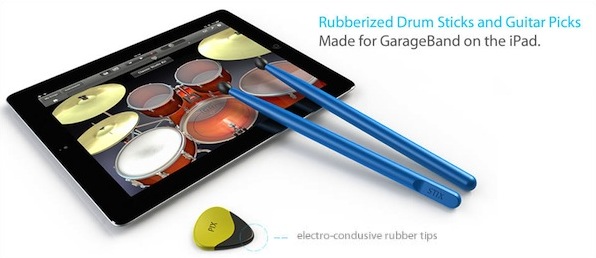
GarageBand is an app that everyone who owns an iPad should at least try out, regardless of your musical talent, it’s just a superb example of an app that is brilliantly designed and built for a touch screen. Yet for those that do end up using it for more than just the occasional mess around, you may find that although the iPad’s touchscreen is better than a mouse for playing the drums or guitar, it is still a little bit lacking for what you want.

Well luckily for those of you who do find that, some clever folks have decided to start manufacturing rubberized drumsticks and guitar picks for GarageBand on the iPad. They’ve been designed to work on the iPad’s touchscreen by implementing electro-conductive rubber tips, which will also mean it should be perfectly fine to use without smashing the iPad’s nice glass screen!

The designers of the Pix and Stix are running a Kickstarter-esque funding round, where they are selling a pair of drumsticks and a pick for $14.95 in order to reach a funding goal of around $8000. Just like Kickstarter, if they don’t get the required funding, you can also rest assured you won’t end up paying for them.  At this stage they think they will be selling the drumsticks and picks in the three colors of black, blue or gold metallic paint, although they note that these colors are subject to change.

If you recall the Wallee, which we discussed as one way to elevate your iPad last year, the Pix & Stix project is coming from those same people. So if you’re interested in helping these guys fund their newest project and get your own Pix and Stix, head over to the Pix and Stix website.

[Via Gizmodo]