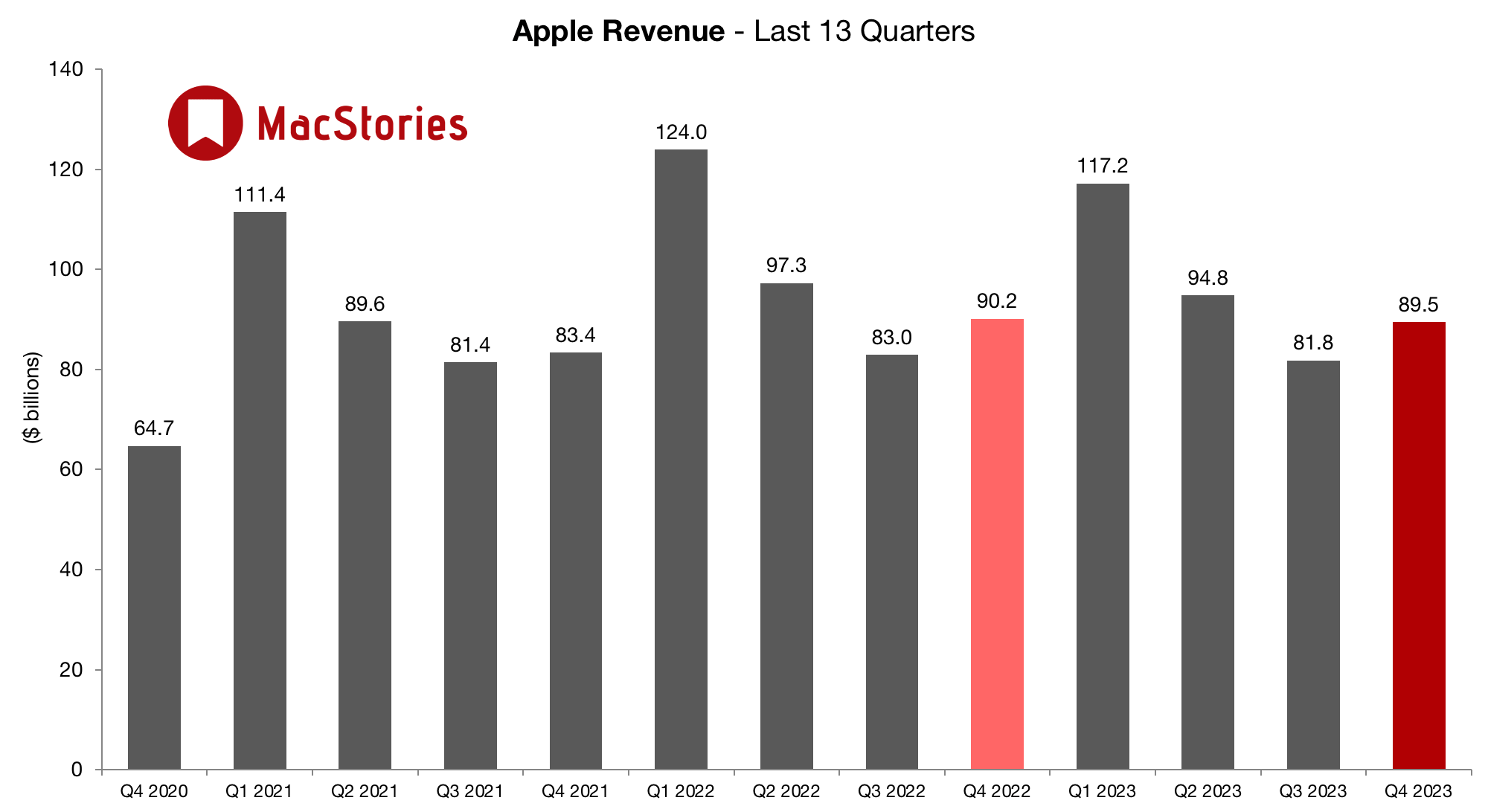
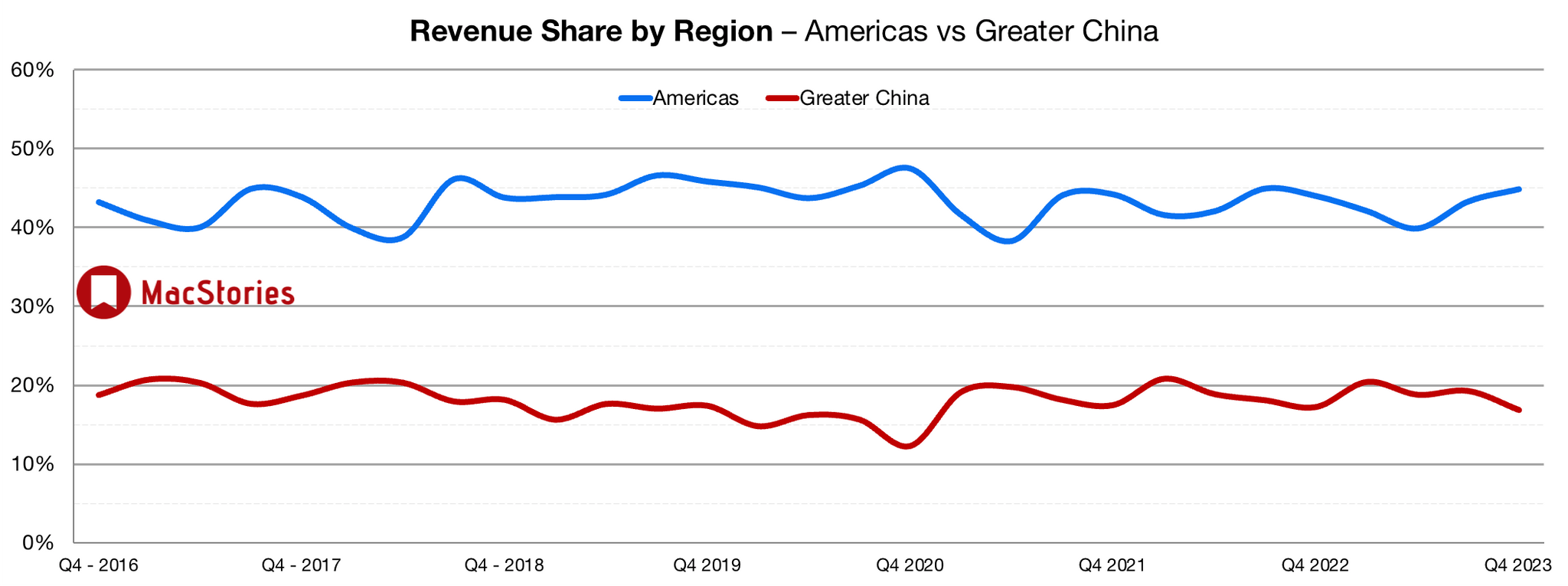
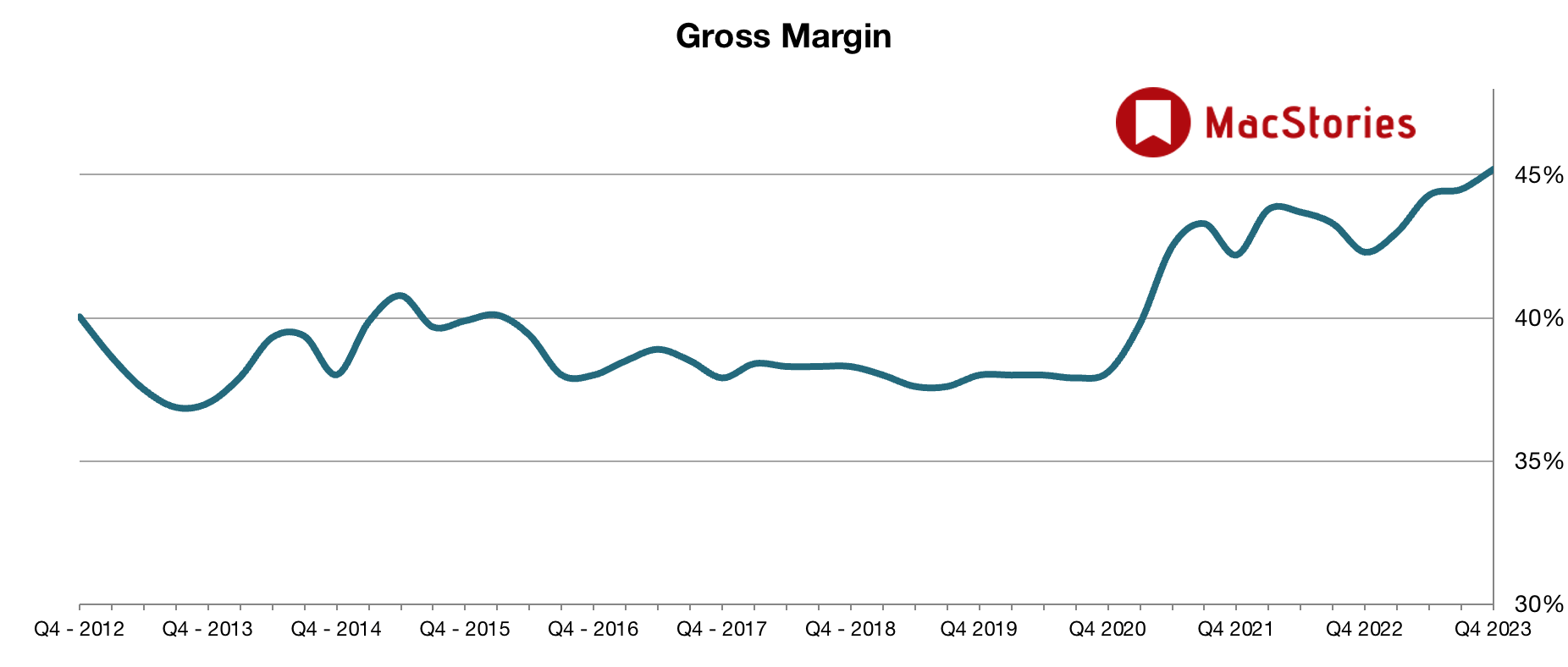
Today, Apple announced $81.8 billion in Q3 2023 revenue, a drop of 1% year-over-year that was likely driven by a soft global economy that has caused an industry-wide reduction in smartphone demand. The results mark the third consecutive quarter of revenue declines for the company. With so much of Apple’s quarterly earnings tied to the success of the iPhone, the results aren’t surprising. Going into today’s earnings call, the expectation was for a 1.6% drop in quarterly revenue.
We are happy to report that we had an all-time revenue record in Services during the June quarter, driven by over 1 billion paid subscriptions, and we saw continued strength in emerging markets thanks to robust sales of iPhone. “From education to the environment, we are continuing to advance our values, while championing innovation that enriches the lives of our customers and leaves the world better than we found it.
Despite a slightly down quarter year-over-year, Apple logged some impressive Services numbers.
Although today’s revenue decline is notable for being the third consecutive quarterly decline in several years, a better gauge of Apple’s longer-term fortunes will come later this year when it refreshes the iPhone lineup. With economies around the globe still recovering, it will be interesting to see if rumors of a hardware redesign of the iPhone are sufficient to offset what some speculate will be Apple’s most expensive smartphone ever.
Not long ago, I linked to an in-depth profile of Netflix Games published by The Ringer. It seems Netflix has been busy getting the word out to more publications because not long after The Ringer’s post, Ash Parrish of The Verge published a story about Netflix Games from the perspective of its in-house studio, Night School, and Ripstone, an outside game developer that created the recently-released game, The Queen’s Gambit Chess.
Netflix’s gaming philosophy right now resembles a kind of patronage system. Netflix supplies its studios with resources, and they’re free to pursue whatever artistic avenue they want. This approach isn’t too far off from how game subscription services work, bringing Netflix in line with products like Xbox’s Game Pass and Apple Arcade.
Last week also saw the release of Return to Monkey Island on the iPhone and iPad. The game, which was released on consoles and Steam last fall, marks the comeback of the classic point-and-click adventure series and its creator, Ron Gilbert.
TouchArcade, which is one of the few sites to review the iOS and iPadOS versions of Return to Monkey Island was impressed:
Having now played Return to Monkey Island on basically everything but PS5, it shines on a portable. The iOS versions have controller support as well as touch support as I mentioned above, but so do the Steam Deck and Switch versions. Given the game looks, runs, and plays brilliantly on all portables I tried it on, I recommend getting it wherever you enjoy playing games the most. There is no definitive portable version because they are all excellent. My favorite version is definitely the iPad version on my iPad Pro.
If you’re a 90s gamer with nostalgia for the Monkey Island series, Return to Monkey Island sounds like a great way to revisit the series on modern hardware.
Spaceplan.
I’ve never been a big fan of clicker games. I find them too mindless for my tastes, but last week, I stumbled upon an update to Spaceplan, a weird and wonderful potato-planet themed clicker by Jake Hollands that debuted in 2017. With the update, Spaceplan runs on modern screens, adds haptic feedback, and refreshes other game elements.
At the start of the game, you need to press a button repeatedly to collect energy that can be traded for items that collect the energy for you. The catch is that items cost progressively more in collected watts as the game goes on.
Apparently, there’s a conclusion to the game, although I haven’t reached it yet. What’s drawn me into Spaceplan is the simple graphics, hypnotic electronic soundtrack, and dialogue that help build a story around an incredibly simple mechanic. As it turns out, sometimes a little mindless fun is just what I need to unwind, and Spaceplan delivers that perfectly.
Jelly Car Worlds.
Finally, I wanted to call out an update to Jelly Car Worlds, an Apple Arcade title. Jelly Car Worlds is an excellent reimagining of the original Jelly Car, which debuted about a decade earlier on the App Store. The unique physics of this cross between a racing game and platformer are incredibly fun. Worlds added a level editor, which was refined with last week’s release. The update also added the levels from the original Jelly Car game. According to TouchArcade, future updates are planned to add levels from Jelly Car 2 and 3, which will make this a great way to experience those classic levels and inspire the design of new ones in the level editor.
Game On is a periodic roundup highlighting the biggest news in gaming on Apple’s platforms. From the iPhone and iPad to the Mac and Vision Pro, we’ll cover the big-name games on Apple devices, along with notable industry and developer news.
Today, Apple announced that it, along with Pixar, Adobe, Autodesk, and NVIDIA, have formed the Alliance for OpenUSD (AOUSD), to “promote the standardization, development, evolution, and growth of Pixar’s Universal Scene Description technology.”
OpenUSD is a 3D screen description technology invented at Pixar and open-sourced in 2016. The alliance’s new project, which will be housed in the Joint Development Foundation, an affiliate of the Linux Foundation, has invited other companies and organizations to join in the effort to develop OpenUSD, “a high-performance 3D scene description technology that offers robust interoperability across tools, data, and workflows.”
Mike Rockwell, Apple’s vice president of the Vision Products Group, was quoted in the press release as saying:
OpenUSD will help accelerate the next generation of AR experiences, from artistic creation to content delivery, and produce an ever-widening array of spatial computing applications. Apple has been an active contributor to the development of USD, and it is an essential technology for the groundbreaking visionOS platform, as well as the new Reality Composer Pro developer tool. We look forward to fostering its growth into a broadly adopted standard.
With big companies coalescing around a new standard, that’s one more point of potential friction that hopefully will be removed as creators begin building 3D experiences for the Apple Vision Pro and other devices.
This week, John has news from the animal kingdom and tries a new beverage while Federico struggles with text editors (again). Plus John has a surprise videogame hardware pick.
Sponsored By:
Kolide – It ensures that if a device isn’t secure it can’t access your apps. It’s Device Trust for Okta. Watch the demo today!
One of the perks of a Club MacStories+ or Club Premier membership is discounts on a long list of great apps and services. Today, we’re pleased to add four new Mac apps to the growing catalog of deals available to members:
Lasso is a Mac window manager that lets you move and resize windows using only your mouse. The app uses a simple grid system and keyboard shortcuts, plus it supports custom layouts, multiple displays, layout exporting and importing, and more.
Mission Control Plus is a Mac app that puts the ‘control’ back in Mission Control by letting you manage your windows in Mission Control, adding keyboard navigation, shortcuts, and more.
Batteries for Mac allows you to track all your devices’ batteries from your Mac and will notify you when your iPhone, iPad, AirPods, Beats headphones, and Bluetooth peripherals need recharging.
Sleeve 2 is the ultimate music accessory for your Mac. Sleeve sits on the desktop, displaying and controlling the music you’re currently playing using Apple Music, Spotify, and Doppler. The app is highly customizable, supports themes, and integrates with Last.fm.
Club MacStories+ adds to Club MacStories, with bonus content, a powerful web app to read Club articles on the web with advanced search and filtering, advanced RSS features, exclusive discounts, our Discord community, and ad-free, early access to MacStories Unwind, our fun weekly podcast that explores culture, media, and more.
Club Premier is the ultimate plan that includes all of Club MacStories, Club MacStories+, and the extended, ad-free AppStories+ podcast in a single package. It is the best value and the easiest way to access everything we do. It’s the MacStories all-access pass.
Developers will be able to submit their visionOS, iPadOS, and iOS apps for Vision Pro compatibility evaluations. Apple has included a checklist of steps developers should follow before submitting their apps. Once an app is ready, it can be submitted and will be tested on Vision Pro hardware, after which Apple says:
We’ll send you the evaluation results, along with any relevant screen captures or crash logs.
The second option is to apply to attend a lab in Cupertino, London, Munich, Shanghai, Singapore, or Tokyo. The labs are self-directed testing sites with Apple employees on hand to help with setup and troubleshooting.
Finally, developers can apply to borrow Vision Pro developer kit from Apple. The hardware loans also come with the following:
Help setting up the device and onboarding.
Check-ins with Apple experts for UI design and development guidance, and help refining your app.
Two additional code-level support requests, so you can troubleshoot any issues with your code.
All three programs are open now, so if you’re working on an app for Apple Vision Pro, you can start submitting compatibility evaluation requests and apply for a lab or developer kit today.
This week on MacStories Unwind, I endure smokey summer days with the help of an app, Federico discovers churros, and we check in on our favorite media of the first half of 2023.
The videogame industry is huge, surpassing movies and music by wide margins. Apple has seen a lot of success with mobile games, but it’s history with desktop gaming leaves a lot to be desired. However, one thing is clear. Apple wants to expand its presence in the videogame industry and sees Apple silicon as the key to its success.
While the jury’s still out whether the company’s ambitions will succeed, beginning today, we’ll be publishing periodic roundups highlighting the biggest news in gaming on Apple’s platforms. From the iPhone and iPad to the Mac and Vision Pro, we’ll cover the big name games coming to Apple devices, along with notable industry and developer news.
What the Golf? running on visionOS. Source: Unity.
This week, Unity announced a beta program for PolySpatial, a tool for visionOS developers that integrates with other Unity tools to help developers bring their Unity-based games to Apple Vision Pro. I wrote about the company’s announcement, which also revealed that Triband’s What the Golf? is being adapted for visionOS, earlier this week where you’ll find links to Unity’s blog post about PolySpatial and its beta program.
This week, I also covereda story by Lewis Gordon on The Ringer that takes an in-depth look at Netflix Games’ history and ambitions. It’s a fascinating look at a the video streaming company’s efforts to place a lot of small bets on mobile platforms like the iPhone and iPad, as well as console and PC gaming, in an effort to stay relevant to its subscribers.
Pokémon Sleep.
There was big game news this week too. Pokémon Sleep, a gamified sleep tracking app from The Pokémon Company that’s been in development since at least 2019 debuted on iOS and Android. According to Ash Parish at The Verge:
Sleep works by having you place your phone on your pillow after doing any of the fifty ‘leven million Pokémon-themedactivities you can do nowadays. (Back in my day, all we could do was catch ‘em all — all 151 of them — and we liked it!) The app purports to track your sleeping habits via your phone, and when you wake up in the morning, the app will tell you how well you slept and compare your sleeping style to that of other ‘mon.
If you think Pikachu might help you get a good night’s sleep, you can download the game from the App Store here.
What the Golf? running on visionOS. Source: Unity.
Today, as promised at WWDC, Unity launched a beta technology for visionOS developers called PolySpatial, which is designed to help developers bring their apps and games to the Vision Pro, which Apple has said will debut in early 2024.
Mike Rockwell, Apple’s vice president of the Vision Products Group, was quoted in Unity’s press release as saying that:
We know there is a huge community of developers who have been building incredible 3D experiences using Unity’s robust authoring tools, and we’re so excited for them to build apps for Apple Vision Pro. Unity-based apps and games run natively on Apple Vision Pro, so they have access to groundbreaking visionOS features including low latency pass-through and high-resolution rendering. This enables Unity developers to take full advantage of the powerful and unique capabilities of Apple Vision Pro. We can’t wait to see what incredible experiences are created.
Unity’s press release also revealed that Triband is bringing the studio’s game WHAT THE GOLF? to visionOS.
Unity kicked off the application process for developers who want to try the beta version of PolySpatial, saying:
Unity is excited to collaborate with Apple to bring familiar and powerful authoring tools for creating immersive games and apps for this new spatial computing platform, Apple Vision Pro. Your apps will get access to benefits such as pass-through and Dynamic Foveated Rendering, in addition to popular Unity features like AR Foundation and XR Interaction Toolkit.
With a deep integration between Unity’s new PolySpatial technology and visionOS, your apps can sit alongside other apps in the Shared Space. By combining Unity’s authoring and simulation capabilities with RealityKit’s managed app rendering, content created with Unity will look and feel at home.
Developers who are interested in Unity PolySpatial can learn more in the company’s blog post, which links to additional Unity and Apple development resources, and can sign up for the PolySpatial beta here.