Posts in news

Finally: Twitter Has Killed The Quick Bar

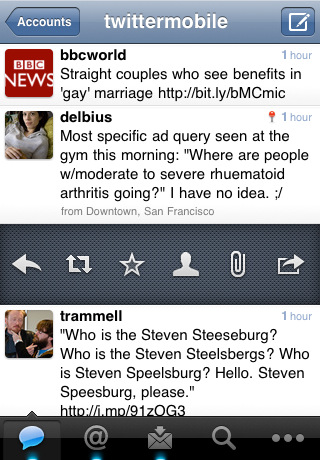
Following user criticism (an euphemism) and complaints from several aficionados of the official iPhone client, Twitter released an update to the iOS app today, and they have removed the Quick Bar. Kindly called “dickbar” by many users on Twitter in the past weeks, the bar used to appear along the top of the main timeline to show promoted and regular trends. We didn’t like it. Nobody liked it. And now it’s gone.

In an official blog post, Twitter explains:

Rather than continue to make changes to the QuickBar as it exists, we removed the bar from the update appearing in the App Store today. We believe there are still significant benefits to increasing awareness of what’s happening outside the home timeline. Evidence of the incredibly high usage metrics for the QuickBar support this. For now, we’re going back to the drawing board to explore the best possible experience for in-app notification and discovery.

Twitter also says the Quick Bar could have evolved into a full-featured notification system for mentions, direct messages, and more. I guess we’ll never know at this point, or perhaps in-app visual notifications will be implemented in other ways in the future. We’ll see.

The updated, Quick Bar-free Twitter app is available in the App Store now. The latest version also introduces bug fixes, and we hope the company is referring to the annoying DM bug here. The bug has been around for ages now, it was fixed in a previous update, then it mysteriously came back. It’d be nice to see that gone, too.


Google Is Developing A Facial Recognition App [Updated]

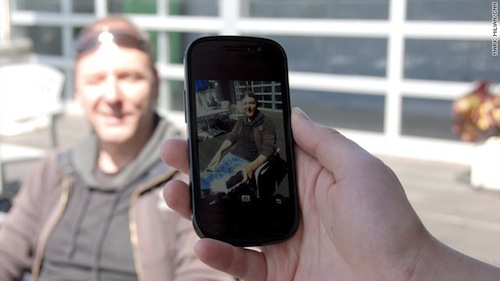
CNN reports today Google is working on a brand new facial recognition application for mobile devices, allowing users to snap pictures of their friends and automatically be redirected to a person’s public Google profile. The details on the availability of the app are scarce – the CNN report doesn’t specify whether this new app is being developed for Android or iOS devices – but it still provides insight into Google’s latest experiment that should revolutionize the way people interact with each other using mobile phones.

The app doesn’t have a name just yet, nor did any screenshots surface. But, as confirmed by engineering director Hartmut Neven, the project is being heavily tested at Google Labs with a specific focus on privacy concerns – which have always been an issue for a large company like Google that has access to millions of people’s data, email, profile information, and so forth. The app promises multiple scenarios of interactivity: a user could take a photo and automatically check out a person’s Google Profile (Google recently redesigned Profiles to make them more public and, looking forward, similar to Facebook) or browse photos shared on Facebook, Twitter and Flickr to see whether the algorithm developed by Google can recognize photos shared on social networks. However, Google told CNN that they’re looking to improve their privacy system and settings before the app is released.

Google acknowledges the nefarious ways someone could leverage facial-recognition technology. Many people “are rightfully scared of it,” Neven said. “In particular, women say, ‘Oh my God. Imagine this guy takes a picture of me in a bar, and then he knows my address just because somewhere on the Web there is an association of my address with my photo.’ That’s a scary thought. So I think there is merit in finding a good route that makes the power of this technology available in a good way.”

Neven and a Google spokesman described the facial-recognition app concept as “conservative” in relation to privacy.

It is very likely that Google will implement an opt-in system of sorts to allow users to tweak their privacy settings on various levels and enable the facial recognition software to have access to personal information. For example, Google could make sure that only “friends” or “friends of friends” can snap pictures and be redirected to a Google Profile in the browser, or the mobile app. Google isn’t new to image recognition technologies on mobile phones: their Goggles app, also available for iPhone, lets users take pictures of real-life objects and get relevant search results for the recognized product. The Goggles app can also recognize ads, and play Sudoku. Last year, Apple bought a Swedish company specialized in facial recognition and has been rumored to be willing to implement the technology in iOS since then. Apple also does facial recognition on the desktop with iPhoto, which can recognize contacts in photos and automatically sort people with the “Faces” interface.

Update: In an interesting twist of events, Google has reached out to claim that the CNN reporter “invented” the story about facial recognition linking to public, personal data. Engadget reports:

Google has reached out to clarify that there are no plans to introduce functionality of this sort yet, not without “a strong privacy model in place.” More importantly, however, the linking of facial recognition to personal data is described as “inventions of the reporter” rather than something the company’s actively pursuing.

Update #2: A CNN spokesperson sent us a statement about today’s Google story. CNN stands by their report, thus adding more questions as to whether or not Google is really building a mobile facial recognition product, but doesn’t want press or consumers to speculate about it just yet.

Google’s claims do not fit the facts of the situation. This interview was prearranged – on the record – and staffed by a Google PR rep, who raised no objections at the time and did not deny what the engineer said. Additionally, we have an audio recording of the interview, as does Google. We stand firmly behind Mark’s reporting.

Update #3: Just to put things in context, here’s what (former) Google CEO Eric Schmidt said about Google’s vision for search months ago:

Ultimately, search is not just the web but literally all of your information – your email, the things you care about, with your permission – this is personal search, for you and only for you.

We can suggest what you should do next, what you care about. Imagine: We know where you are, we know what you like.

A near-term future in which you don’t forget anything, because the computer remembers. You’re never lost.



Viber 2.0 Brings Free Text Messaging Between Users

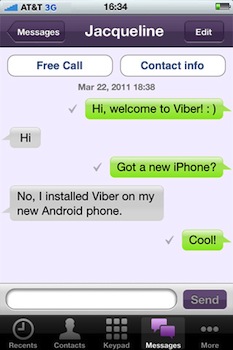
Viber, the iPhone app that lets you make free calls to other Viber users was today updated to version 2.0 and brings with it free text messaging. Admittedly there are a lot of free messaging apps in the App Store but the advantage of Viber is that it now offers both texting and calling in the same app and already has a user base of 10 million people.

The messaging service becomes one of the bottom tabs and will store all your messages in a very similar manner to that of the iPhone’s ‘Messages’ app and can effectively replace the need for SMS messages between any other friend or colleague - if you can convince them to download Viber.  There has also been some redesign of various screens in the app including the contacts interface which can now refine your contacts list to just display those who have Viber or those which you have “favorited”.

Finally the basic calling mechanism has been tweaked to give the user more information about the state of a call. When you first place a call the app enters a “Calling” state, once contact is made with the other person’s Viber app it will enter a “Ringing” state to let the user know that there is a connection.

[Via TechCrunch]


Apple Patent of the Day: Spaces for the iPad

PASpaces

PASpaces

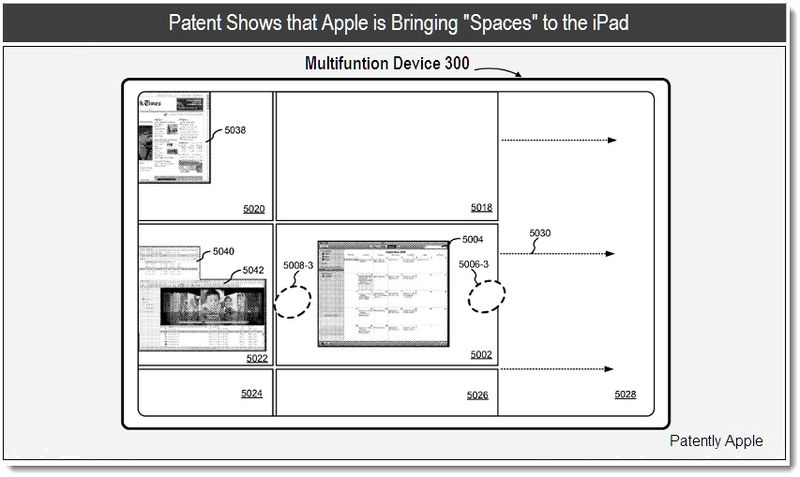
Spaces are crucial to my daily workflow on my MacBook (I never was a ⌘⇥ guy), and the prospect of using Spaces on my iPad as a virtual workspace is amusing. While Spaces will still exist in Lion alongside Mission Control, Spaces itself is sort of taking a backseat in terms of what we traditionally think of in Leopard and Snow Leopard.  The patent suggests that Apple has been toying with the idea of Spaces on the iPad – shown running a version of OS X in the patent files – and suggests that multitouch gestures could manipulate items on screen and bring Spaces into view. Just like the desktop, gestures have been submitted which give users the ability to push a window to an adjacent space by dragging applications to the edge of the screen, and to drag windows between virtual the virtual desktops. The gesture to open Spaces is noted as a pinching gesture at the corner of the display, a perfect choice in that it also mimics the hot corner features in OS X. The patent was filed in Q3 of 2009, and give us a little insight into how Apple may incorporate a new multitasking system in iOS. I don’t think the multitasking bar is as nimble as HP’s Card view when it comes to multitasking on webOS devices, and mulling over a patent like this reminds us that Apple may make some big changes in the next iteration of iOS.

[via Patently Apple]


Boxee To Bring iPad Support In May

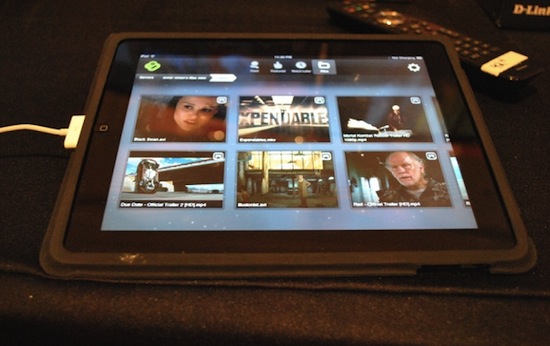
Boxee, the company that produces a media center for a variety of platforms and devices, has announced with a blog post that the upcoming firmware update will bring support for the iPad, among other features. Boxee is aiming for a new firmware release every 3 months, and the new one should come out in May. iPad support aside, the update will bring improvements to the browser, playback controls and localization in French, German, Hebrew, Italian, Spanish, Swedish.

The Boxee iPad app was initially announced last year and previewed at the CES 2011 in January. Allowing users to consume video on the go and send content to other Boxee devices, the app will also enable users to stream videos from a Mac or PC by installing a server application on their computers that will handle conversions for video formats not natively supported by the iPad. Other details on the integration with the iPad software and Boxee devices are still unknown, but we’re sure the developers are up to something great as the app has been in the works for months and it appears it’s almost ready for submission to Apple now.

You can read more at Boxee’s official blog and check out a demo video of the iPad app from CES 2011 below. A Boxee remote app for iPhone and iPod touch is already available in the App Store.
Read more


Apple Investigates Possibility Of Dual Camera System For 3D Photos

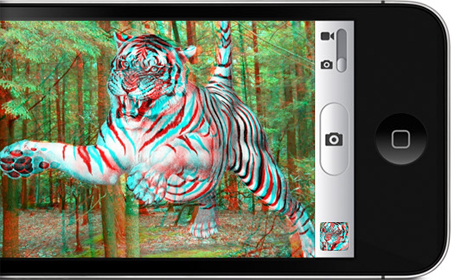
Patent applications from Apple made public this week show that they have considered adding an additional camera to a device such as the iPhone to enable users to shoot 3D photographs. AppleInsider discovered the patent, called “Systems and Methods for an Imaging System Using Multiple Image Sensors” which details how they would implement the dual-camera system for the capture of 3D images.

In particular it differentiates itself from current offerings, claiming that it is a “paradigm shift from the known software-based approaches” that “guess” at how to combine the two images into a single 3D photograph. Apple says that their approach would avoid creating images with artefacts by implementing a hardware-based approach for more accurate processing. Such a system would involve multiple sensors that determine the luma, chroma and depth of the two images to unify them into one.

Furthermore the patent describes how the system could also record video in 3D and only require a simple, one-time, calibration by the user. The Nintendo 3DS which has just recently been released resembles the aims of this patent with its feature of dual rear cameras to let users to take 3D photographs and play augmented reality games that render in 3D on the fly.

[Via AppleInsider]


iDroplets: Tiny Rubber Feet For Your iPad 2

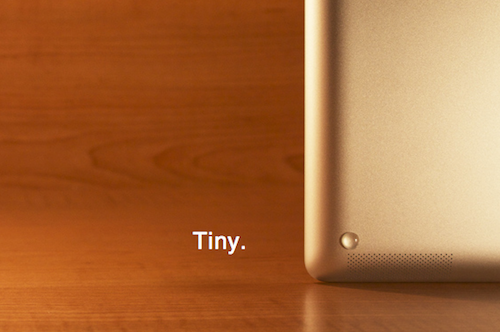
After using the iPad 2 for a while, I’ve noticed two things: the thinner and flat design makes for an incredibly better grip in my hands; second, it’s harder to pick it up from another flat surface (like a desk) than the original iPad and it tends to “slide” and move a little bit. Designer Morgan Allan Knutson apparently thought the same thing and created the iDroplets, a set of tiny rubber feet that attach to the iPad 2 with ease and also protect the edges of the device while it’s being used in typing mode with a Smart Cover.

The iDroplets cost $5 with free global shipping (as long as normal postage can reach your country) and we think it’s a pretty damn good idea. Sure you can do this by yourself if you buy four little rubber feet, but we like to support indie projects here at MacStories. So head over the (elegantly designed) product webpage, and order your iDroplets now.


Taiwanese LCD Maker To Ship 30 Million iPad 2 Screens

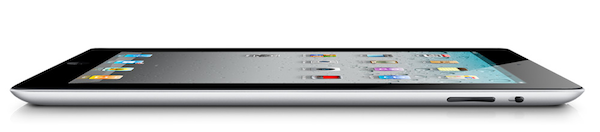
Following speculation about Apple facing supply constraints and  iPad 2 production issues due to the Japan earthquake and tsunami, Reuters reports this morning a story from The Economic Daily News which, citing no sources, claims Taiwan-based AU Optronics Corp – the world’s #4 LCD maker – has closed a multi-million dollar deal with Apple to ship iPad 2 displays this year.

AU could ship 30 million of the screens in a year, it said. The order will take up over half the capacity of its plant in Taichung, central Taiwan.

Apple ramping up production of the iPad 2 doesn’t come as a total surprise. The device went on sale on March 11 in the United States generating long lines at Apple Stores and authorized retailers allegedly selling around 1 million units in the first days; a similar scenario followed two weeks later in the 25 countries that got the iPad 2 on March 25th. In the past weeks, iPad 2 shipping times from the Apple online store jumped from 2-3 weeks, then to 4-5 weeks and they’ve now settled with a 3-4 weeks wait on the US Store.


Woman Tragically Dies After Senseless iPhone Theft

A very sad story today comes from Chicago Breaking News in which the theft of an iPhone has led to the tragic death of an innocent bystander. Sally Katona-King, a 68 year old Church Receptionist, was pushed down a flight of stairs at Fullerton Station after a thief stole a nearby commuter’s iPhone and was hastily running off. Sally was hospitalised after her fall and unfortunately died on Tuesday from what is presumed to be a cerebral haemorrhage.

Her son told reporters on Tuesday that Sally was a known in the community as a generous and altruistic woman helping those that were disadvantaged. “To die over an iPhone? It’s senseless,” her son said. Detective Cmdr. Garyu Yamashiroya said on Tuesday that the increased incidence of smart phone theft is “something that police departments across the country are trying to find solutions to.” The thief is still at large but police are hoping to identify them through local surveillance video.

[Via TUAW]