Posts in news

YouKu To Replace Pre-Installed YouTube App On Chinese iPhones?

Over in China, iPhones and iPod Touches don’t come with the in-built YouTube app because of that infamous ‘Great Firewall of China’. Like various other websites and social networking sites, YouTube is blocked in the country. But reports today suggest that YouKu, effectively China’s version of YouTube, may soon have an app that comes pre-installed on Chinese iOS devices, just as YouTube currently does in the rest of the world.

TechNode claims, based on information gathered from a trusted source, that the YouKu founder, Victor Koo, met with Steve Jobs over the possibility of having a YouKu app pre-installed on Chinese iPhones and other iOS devices. YouKu, like YouTube is for the rest of the world, is a pretty dominant and popular videa sharing site, allowing users to upload videos of unlimited length and even has licenses with over 1,500 television stations, distributors and film production companies which are a large part of the site.

Apart from the TechNode report, information on this is scarce, but the fact that YouTube is banned in China does lend credence to the possibility that Apple would want to build in another online video streaming app directly on their devices.

[Via TheNextWeb]


redsn0w Untethered Jailbreak Now Available For iOS 4.3.3

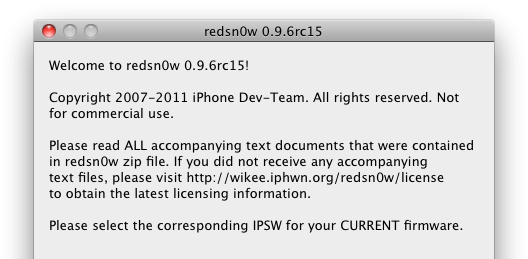
This week’s release of iOS 4.3.3 may have patched some of the location log concerns people had, but it did nothing in the way of patching the exploit used by the Dev-Team that allowed them to release PwnageTool and redsn0w, both of which can jailbreak nearly all iOS devices on 4.3.3. The key exploit, discovered by relative newcomer to the jailbreak scene, Stefan Esser (@ionic) was originally used to deliver an untethered jailbreak, but surprisingly still works despite two iOS updates.

The small work that is required to get the exploit to work on the new iOS version has been done and as a result there is a new PwnageTool and redsn0w available for download. Like the versions made available for the 4.3.1 jailbreak, it uses geohot’s limera1n bootrom in conjunction with Esser’s exploit. Unfortunately the iPad 2 has yet to be jailbroken by the team, but they do note on their blog that development is currently going ahead. However apart from that, every other device capable of running iOS 4.3.3 can use the 4.3.3 untethered jailbreak – this includes the iPhone 3GS and 4, iPod Touch 3G and 4G, iPad 1 and the Apple TV (2G).

For those curious, it is presumed that the first iOS update after the jailbreak was made available, 4.3.2, didn’t fix the exploit because it was compiled the day before the release of the jailbreak. Finally, a note of warning to those ultrasn0w unlockers to stay away from redsn0w and use a custom IPSW to update to 4.3.3.

redsn0w [OS X] [Windows]

PwnageTool (OS X Only) [Torrent] [Direct Download]

[Via Dev-Team Blog]


Rumor: Apple To Replace Intel Chips With ARM Processors On Laptops?

Could Apple transition from Intel processors to ARM processors within the next few years? A report by SemiAccurate yesterday suggests that, yes, Apple is planning to transition Intel processors off its laptop line in the not too distant future.

They suggest that the transition will take place once ARM has matured onto full 64-bit chips which is expected by mid-2013; likely using something akin to NVidia’s upcoming Denver chips. Furthermore they note:

At that point, Apple can move to ARM without worrying about obsoleting code with an [instruction set architecture] that is on the verge of changing, and no memory overhead worries either. Basically, it looks like the perfect time. Ironically, SemiAccurate’s moles tell us that the boys on infinite loop are planning to move laptops to ARM at about that time. Coincidence? Nope.

Apple isn’t a stranger to the ARM architecture; it has a heavy investment in it with its iOS platform of devices, strengthened recently by its acquisition of ARM designers P.A. Semi and Intrinsity. Whilst ARM has been known for their low power processors, in recent times there have been strong signs that ARM will move into high-performance computing as well – a suggestion strengthened by the announcement of 64-bit chips and NVidia’s “Project Denver”.

Despite the promise of ARM’s power, it still is, like yesterday’s 3D iPad rumor, a rumor that is at this point fairly far-fetched. Apple’s transition from PowerPC to Intel came with some serious amount of engineering and whilst that paid off, it also created compatibility issues. Similarly, if Apple made the transition to ARM processors they would not be able to run existing OS X applications without an emulation layer and it wouldn’t just be Apple that would have to do a lot of work to get everything working, developers too would feel the pain.

As MacRumors points out, SemiAccurate is not a frequent of source of Apple rumors, although the site does point out that they were correct in predicting Apple’s move away from NVidia GPUs in their computers. Meanwhile, earlier this year, at CES, Microsoft demoed an early build of Windows 8 running on ARM processors which does suggest that perhaps Apple and Microsoft have seen the potential in ARM and are willing to go through the hard yards and re-engineer their Operating Systems to run on the ARM architecture.

[Via MacRumors]


Preview: Fantastical, Upcoming Calendar App for Mac

How do you improve the default OS X calendar application? How do you set out to create an alternative that can be appealing to power users, and accessible for calendar novices at the same time? While beta testing Fantastical, an upcoming Mac app by Flexibits, I thought these were the questions the developers tried to answer with their latest creation. Like in Twitter clients, developing a third-party calendar isn’t an easy task: you have to make sure it will work with all those calendar protocols out there, but most of all you have to know you’ve got something on your hands that will stand out from the crowd – especially when Apple itself ships a full-featured iCal.app with OS X that does its job just fine for most users, and doesn’t require an additional purchase. As usual, though, I believe there’s plenty of room for alternatives if you’re willing to take a risk and believe in your product. And it shows when testing Fantastical: Flexibits believes in its new app so much they wrote “your Mac’s calendar will never be the same again” on the teaser website.

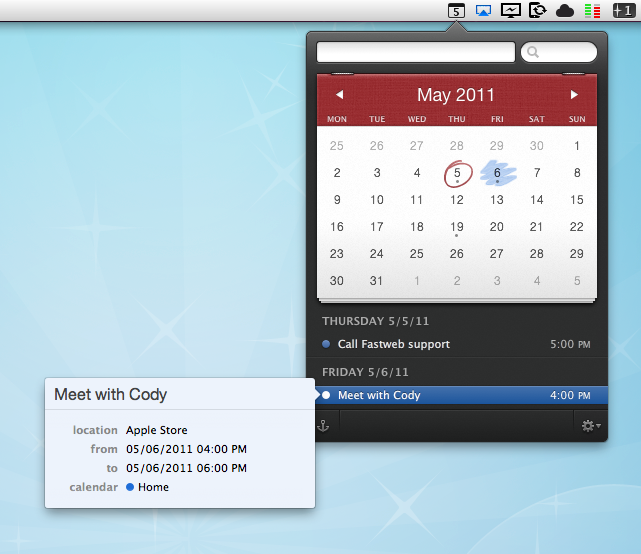
Indeed, Fantastical does some things the default Mac calendar client can’t even imagine. First off, it’s elegant, minimal and unobtrusive, yet beautiful to look at. I know the very own purpose of a calendar app isn’t that of letting you stare at it, but when compared to this or this you’ll notice the difference. User interface, however, is functional to Fantastical: it’s minimal because Fantastical wants to be simple to use, and it’s gorgeous for as much as it’s powerful inside. Fantastical uses a natural language parser that will let you write down events in plain English, and have the app correctly recognize the input in various fields. Example: Meet with Cody tomorrow at Apple Store, Viterbo 5 PM to 6 PM. Adding this sentence to a new iCal event does nothing. But writing it in Fantastical? It creates a new calendar event with “Meet with Cody” as the title, “tomorrow” as the relative date, “Apple Store, Viterbo” as the desired location, and 5 PM to 6 PM as the timeframe. It’s almost unbelievable how well this thing works and how deeply it improves the way I can add events using nothing but English. I don’t have to navigate with my keyboard and mouse, I just write and hit Enter to process the event and add it to my default calendar. Sure, I could still do things manually and adjust dates or location with the cursor, but since installing the first beta of Fantastical I haven’t found a reason why I should.

The language parser is the big feature of Fantastical, but there’s lots more. Without revealing too much right now (let’s save it for a final review, shall we?), I can say Fantastical’s huge advantage over several third-party calendar apps for OS X is that it works perfectly in conjunction with Apple’s iCal, which is responsible for keeping all your calendar configurations. You can start using Fantastical seconds after launch without doing anything, as the app fetches the accounts you’ve already set up in iCal. This means Google Calendar, MobileMe, CalDAV, Exchange, Yahoo Calendar – they all work out of the box. And if you want, you can make a calendar the default one so that adding new events will be as fast as hitting a shortcut, and write.

I wasn’t sure I was going to use Fantastical much initially, mainly because I didn’t think a replacement for the standard calendar interface was needed on a Mac. But after trying it, I have to say Fantastical is the calendar app to look forward to. You can sign up for updates here, and stay tuned for a complete review on MacStories soon. Read more



NYT Labs Create Tool To Donate Your iPhone Location Data

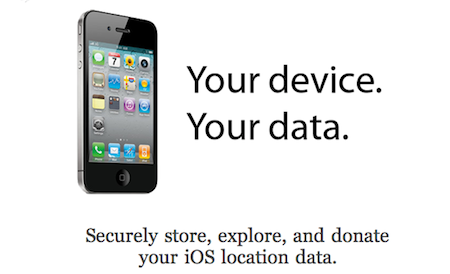
Apple may have fixed the iPhone’s location tracking issues with the recent iOS 4.3.3 update, but The New York Times’ Research and Development Lab thinks this location data is still valuable in the way it provides users and researchers an historical archive of devices’ cellular triangulation points and WiFi hotspot databases. The NYT Labs, the same folks behind innovative iPad news reader News.me, have developed and released a web application called OpenPaths that allows iPhone users to register and anonymously share their location database. The web tool, available here, is touted as a way to ”securely store, explore, and donate your iOS location data”, Nick Bilton at The New York Times Bits blog reports. While it’s unclear how the web app works with the latest iOS software update (which stops iOS devices from backing up the location database to a computer, but still keeps an unencrypted copy stored on device), OpenPaths apparently finds a way to obtain this location data and reorganize it in a beautiful interface that also enables you to navigate maps, set specific times of a day, and browse by date.

People who participate in the project are asked to upload location information from their phone, which is then made anonymous and added to a database with the data from every other upload. People can then browse their own location data on an interactive map. At a later date researchers will be able request access to the collection of location uploads.

As for privacy concerns in regards to OpenPaths, the website’s homepage explains how the system works:

Our upload system is completely anonymous. We store your location data separately from your user profile. It is only with your express permission, combined with a unique passcode that only you know and that openpaths does not store, that we release your data to whom you approve. You will always have control over how much of your information is shared.

The main focus of OpenPaths is that of enabling you to donate your data to researchers around the world working on problems like “disaster preparedness, traffic flow, urban planning, and disease transmission.” You can choose to grant researchers access to portions of your data, or skip the process entirely and keep everything for yourself for personal purposes. It’ll be interesting to see whether this NYT Labs project will gain traction in the next weeks, and if future iOS updates will break its functionality with further location database encryption. In the meantime, you can sign up for OpenPaths here.


Apple Reportedly In Talks With New Light Sensor Supplier For Next-Gen iPhone

A new report from Digitimes claims Apple has received a series of verification units for new ambient light sensors to (allegedly) implement in the next-generation iPhone, set to be announced in September according to speculation surfaced in the past weeks. The new supplier, Taiwanese-based company Capella, currently ships ambient light sensors to HTC, and may receive orders from Apple before the end of the year “at the earliest”, the publication says.

Capella, which ships over one million ambient-light sensors to HTC a month currently, has reportedly delivered its products to Apple for verification as the ambient-light sensors currently used by iPhone 4 have been criticized for some problems, said the sources, noting that Capella may received Apple’s orders before the end of the year at the earliest.

Capella shares, which are listed on Taiwan’s OTC market, suffered a major setback recently as sentiment for the stock was blunted by its decreased first-quarter gross margin.

The ambient light sensor is used in mobile devices, in conjunction with software, to determine the automatic screen brightness and optimal settings depending on external light conditions. The iPhone, for instance, has a panel in the system Settings application that allows users to turn auto-brightness on and off, as well as a slider to manually adjust brightness. The iPhone 4 and other Android devices were highly criticized last year for their hardware and software implementation of auto-brightness which, in most cases, doesn’t take in account light conditions at the sides of a device (the ambient light sensor is placed on iPhone’s front panel) and, due to a series of bugs, automatically locks brightness settings to the highest level, thus consuming large amounts of battery life.

The iPhone 5 is rumored to skip a WWDC announcement for a Fall 2011 release, but rumors surfaced online so far haven’t mentioned a new or improved usage of ambient light sensors in the new device.


Spotify 0.5 Goes Live with iPod Sync, New UI

Officially announced yesterday, Spotify began rolling out the promised 0.5 update for the desktop client a few minutes ago, featuring an updated UI and the much anticipated playlist and MP3 sync for iPod Classic, Shuffle, and Nano, alongside wireless sync for iOS and Android devices running the Spotify mobile application. The updated desktop client, available now for download here, comes with a slightly redesigned user interface that’s inspired by the latest iOS and OS X Lion builds: there’s lots of “linen background” going on, redesigned toolbar icons with a more flat look, new translucent buttons to reveal and expand the album artwork, as well as a general polish that clearly brings OS X graphical elements to mind. If you’re familiar with iOS and the latest Lion developer builds, you’ll feel right home with the new Spotify. I like the app’s new look.

Spotify 0.5 can sync playlists, local files and purchased tracks to an iPod (non-iOS) via USB or iOS device wirelessly. The interface to manage sync is quite simple and intuitive, as there’s a new Devices tab in the sidebar that lists all the iPhones or iPods you’ve connected to Spotify. Once connected, the app will display all your playlists, starred items and local files in a new window, allowing you to choose whether you want to sync “all music” to a device, or only specific playlists. Whilst iPhones and iPod touches get the possibility to sync anything as they’ll be able to stream songs later using the mobile app, classic iPods can only receive local files – meaning MP3s Spotify has found on your computer or songs you’ve purchased through the service’s new store. Songs and playlists that are not found will display a “Get Missing” button that takes you to the embedded web store. Tracks start at 50p, but Spotify is also offering MP3 bundles at a higher price.

Overall, Spotify 0.5 looks like a really solid update that shows the path the company has taken: becoming the ultimate music player on the desktop and mobile thanks to a combination of streaming, cache, purchases and sync. Check out more screenshots below. Read more


iPad Dominates The Competition In US Tablet Market

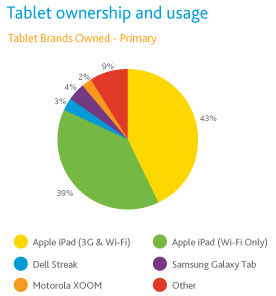
A Nielsen survey released today reveals the iPad has a commanding lead in the US tablet market, controlling a staggering 82%. This is despite the recent entrance to the market by Android tablets from Motorola, Samsung and others, which have comparatively trivial share of the tablet market.

In fact following Apple is Samsung with just 4% of the market despite its strong push late last year with the Galaxy Tab, and then there is Dell and Motorola with just 3% and 2% of the market. Yet all are overshadowed by the ‘Other’ category, this mishmash of various relatively unknown companies staggeringly has the same share of the market that Samsung, Dell and Motorola have combined.

The survey didn’t differentiate between the iPad 2 and original iPad but it did find that there is a fairly even split between WiFi-only models (43%) and WiFi+3G (39%) models. Also fascinating was that the survey found large proportions of tablet users would change their usage of other devices. In particular 35% of desktop computer and 32% of laptop users would use their computers less often or not at all after purchasing their tablet. E-readers and portable music players would also be used less or not at all following a tablet purchase by 27% of those surveyed.

Furthermore, the most frequently given reasons for using their computer less is mostly because the tablet is “easy to carry/take with you”, “ease of interface/OS” and the “fast start up/off” it provides to users. A final interesting note is that 43% of correspondents said that more than 1 person in their family/household is a user of the tablet device.

[Via Fortune]