Federico Viticci

10476 posts on MacStories since April 2009

Federico is the founder and Editor-in-Chief of MacStories, where he writes about Apple with a focus on apps, developers, iPad, and iOS productivity. He founded MacStories in April 2009 and has been writing about Apple since. Federico is also the co-host of AppStories, a weekly podcast exploring the world of apps, Unwind, a fun exploration of media and more, and NPC: Next Portable Console, a show about portable gaming and the handheld revolution.

This Week's Sponsor:

SoundSource

New Year, New Audio Setup: SoundSource 6 from Rogue Amoeba


Oasis Just Glitched the Algorithm

Beautiful, poignant story by Steven Zeitchik, writing for The Hollywood Reporter, on the magic of going to an Oasis concert in 2025.

It would have been weird back in Oasis’ heyday to talk about a big stadium-rock show being uniquely “human” — what the hell else could it be? But after decades of music chosen by algorithm, of the spirit of listen-together radio fracturing into a million personalized streams, of social media and the politics that fuel it ordering acts into groups of the allowed and prohibited, of autotuning and overdubbing washing out raw instruments, of our current cultural era’s spell of phone-zombification, of the communal spaces of record stores disbanded as a mainstream notion of gathering, well, it’s not such a given anymore. Thousands of people convening under the sky to hear a few talented fellow humans break their backs with a bunch of instruments, that oldest of entertainment constructs, now also feels like a radical one.

And:

The Gallaghers seemed to be coming just in time, to remind us of what it was like before — to issue a gentle caveat, by the power of positive suggestion, that we should think twice before plunging further into the abyss. To warn that human-made art is fragile and too easily undone — in fact in their case for 16 years it was undone — by its embodiments acting too much like petty, well, humans. And the true feat, the band was saying triumphantly Sunday, is that there is a way to hold it together.

I make no secret of the fact that Oasis are my favorite band of all time which, very simply, defined my teenage years. They’re responsible for some of my most cherished memories with my friends, enjoying music together.

I was lucky enough to be able to see Oasis in London this summer. To be honest with you, we didn’t have great seats. But what I’ll remember from that night won’t necessarily be the view (eh) or the audio quality at Wembley (surprisingly great). I’ll remember the sheer joy of shouting Live Forever with Silvia next to me. I’ll remember doing the Poznan with Jeremy and two guys next to us who just went for it because Liam asked to hug the stranger next to you. I’ll remember the thrill of witnessing Oasis walk back on stage after 16 years with 80,000 other people feeling the same thing as me, right there and then.

This story by Zeitchik hit me not only because it’s Oasis, but because I’ve always believed in the power of music recommendations that come from other humans – not algorithms – who would like you to also enjoy something. And to do so together.

If only for two hours one summer night in a stadium, there’s beauty to losing your voice to music not delivered by an algorithm.

Permalink

Back From Break: Automation, AI, and IKEA

This week, AppStories returns with details on the projects Federico and John worked on during their breaks.

On AppStories+, the importance of breaks and finding ways to unwind.


We deliver AppStories+ to subscribers with bonus content, ad-free, and at a high bitrate early every week.

To learn more about an AppStories+ subscription, visit our Plans page, or read the AppStories+ FAQ.


AppStories+ Deeper into the world of apps

AppStories Episode 450 - Back From Break: Automation, AI, and IKEA

0:00
47:48

AppStories+ Deeper into the world of apps

This episode is sponsored by:

  • Steamclock – We make great apps. Design and development, from demos to details.
  • Xsolla – ? Launch a high-performing branded Web Shop in minutes—or build a fully custom storefront without the hassle. Xsolla’s modular solution reduces platform fees, supports 1,000+ global payment methods, and ships with built-in LiveOps and customization tools—so every purchase puts more revenue back in your studio’s pocket.

Read more


Claude’s Chat History and App Integrations as a Form of Lock-In

Earlier today, Anthropic announced that, similar to ChatGPT, Claude will be able to search and reference your previous chats with it. From their support document:

You can now prompt Claude to search through your previous conversations to find and reference relevant information in new chats. This feature helps you continue discussions seamlessly and retrieve context from past interactions without re-explaining everything.

If you’re wondering what Claude can actually search:

You can prompt Claude to search conversations within these boundaries:

  • All chats outside of projects.
  • Individual project conversations (searches are limited to within each specific project).

Conversation history is a powerful feature of modern LLMs, and although Anthropic hasn’t announced personalized context based on memory yet (a feature that not everybody likes), it seems like that’s the next shoe to drop. Chat search, memory with personalized context, larger context windows, and performance are the four key aspects I preferred in ChatGPT; Anthropic just addressed one of them, and a second may be launching soon.

As I’ve shared on Mastodon, despite the power and speed of GPT-5, I find myself gravitating more and more toward Claude (and specifically Opus 4.1) because of MCP and connectors. Claude works with the apps I already use and allows me to easily turn conversations into actions performed in Notion, Todoist, Spotify, or other apps that have an API that can talk to Claude. This is changing my workflow in two notable ways: I’m only using ChatGPT for “regular” web search queries (mostly via the Safari extension) and less for work because it doesn’t match Claude’s extensive MCP support with tools; and I’m prioritizing web apps that have well-supported web APIs that work with LLMs over local apps that don’t (Spotify vs. Apple Music, Todoist vs. Reminders, Notion vs. Notes, etc.). Chat search (and, again, I hope personalized context based on memory soon) further adds to this change in the apps I use.

Let me offer an example. I like combining Claude’s web search abilities with Zapier tools that integrate with Spotify to make Claude create playlists for me based on album reviews or music roundups. A few weeks ago, I started the process of converting this Chorus article into a playlist, but I never finished the task since I was running into Zapier rate limits. This evening, I asked Claude if we ever worked on any playlists, it found the old chats and pointed out that one of them still needed to be completed. From there, it got to work again, picked up where it left off in Chorus’ article, and finished filling the playlist with the most popular songs that best represent the albums picked by Jason Tate and team. So not only could Claude find the chat, but it got back to work with tools based on the state of the old conversation.

Resuming a chat that was about creating a Spotify playlist (right). Sadly, Apple Music doesn't integrate with LLMs like this.

Resuming a chat that was about creating a Spotify playlist (right). Sadly, Apple Music doesn’t integrate with LLMs like this.

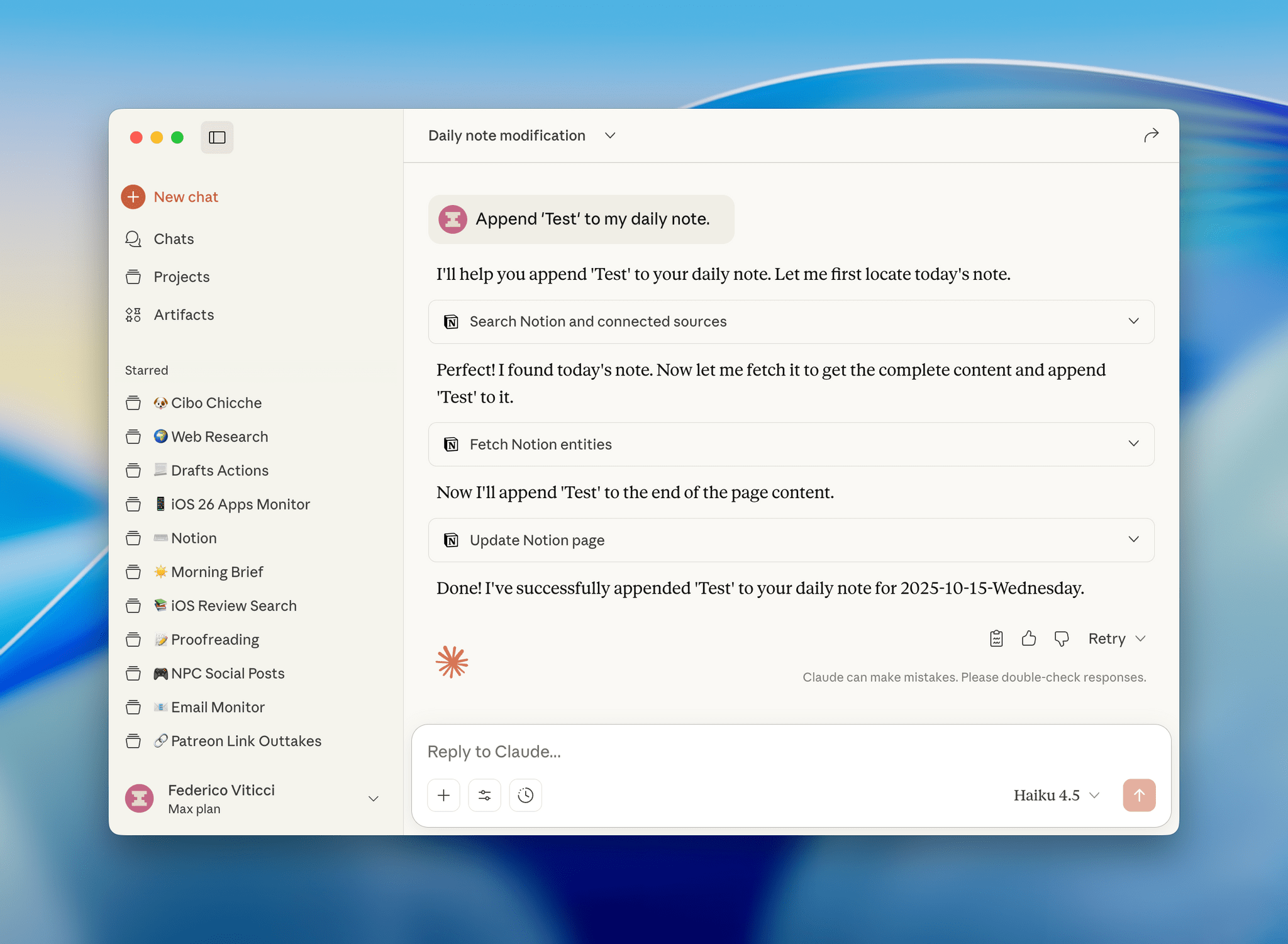
Even more impressively, after Claude was done finishing the playlist from an old chat, I asked it to take all the playlists created so far and append their links to my daily note in Notion; that also worked. From my phone, in a conversation that started as a search test for old chats and later grew into an agentic workflow that called tools for web search, Spotify, and Notion.

I find these use cases very interesting, and they’re the reason I struggle to incorporate ChatGPT into my everyday workflow beyond web searches. They’re also why I hesitate to use Apple apps right now, and I’m not sure Liquid Glass will be enough to win me back over.

Permalink

Building a Better AI App

This week, Federico and John pick and choose their favorite AI app features to imagine a better AI app future, critiquing the leading LLM apps along the way. And, as a bonus, John explains why read-later apps should support Shortcuts and other automation schemes.

On AppStories+, the critique continues with a look at how Todoist could be improved.


We deliver AppStories+ to subscribers with bonus content, ad-free, and at a high bitrate early every week.

To learn more about an AppStories+ subscription, visit our Plans page, or read the AppStories+ FAQ.


AppStories+ Deeper into the world of apps

AppStories Episode 449 - Building a Better AI App

0:00
36:27

AppStories+ Deeper into the world of apps

This episode is sponsored by:

  • Factor – Healthy, fully-prepared food delivered to your door. Use code appstories50off

Read more


The iPadOS and macOS 26 Public Betas

This week, Federico and John share their experiences with iPadOS and macOS 26, which are now available as part of Apple’s public beta program.

On AppStories+, Federico and John discuss the state of engagement bait posting about Apple and how it’s affecting the discourse about the company and its products.


We deliver AppStories+ to subscribers with bonus content, ad-free, and at a high bitrate early every week.

To learn more about an AppStories+ subscription, visit our Plans page, or read the AppStories+ FAQ.


AppStories+ Deeper into the world of apps

AppStories Episode 448 - The iPadOS and macOS 26 Public Betas

0:00
34:57

AppStories+ Deeper into the world of apps

This episode is sponsored by:

Read more


Thoughts on iPadOS 26: Hello, It’s Good to Be Back

iPadOS 26.

iPadOS 26.

Apple released the first public betas of iOS and iPadOS 26 last week, and I’m going to cut to the chase with this story: although I’m still wrapping my head around Liquid Glass and trying to understand where this new design language will land, iPadOS 26 has fundamentally revolutionized my workflow in just a little over a month. While talking to Craig Federighi at WWDC, I did get the sense that Apple was approaching the iPad platform from a different – perhaps more humble – perspective, with a newfound willingness to listen to power users and find a better balance between the simplicity of the iPad and its flexibility. Actually using iPadOS 26, however, has far exceeded my expectations – which pushed me to completely rethink my desk setup (again) and the apps I use around the iPad Pro and iPadOS 26.

Conversely, I’ve been struggling to understand iOS 26 and the role of Liquid Glass. I’ve documented my issues with Apple’s new design with a variety of examples recently, but the truth is that at this point in the beta cycle, I don’t know what to write about Liquid Glass yet. For this reason, despite my many attempts to write this story over the past few weeks, I’ve decided to take a different approach.

Today, I only feel comfortable sharing my opinion about iPadOS 26, and I’ve chosen to delay my analysis of iOS 26 until later this year. I’ve found it incredibly challenging to form an opinion on Liquid Glass and iOS 26 when everything is still so in flux and being adjusted on a beta-by-beta basis. I feel like sharing what I think about Liquid Glass right now would be a fruitless exercise, or shortsighted perhaps, one way or another. Instead, since I find iPadOS 26 to be more of a known entity at the moment, I’ve decided to focus on that and how this software update is changing the way I work. The time will come for me to write about Liquid Glass and Apple’s vision for the future of its software design. Today, though, I’m all about the iPad.

It’s been an interesting month since WWDC. This year more than ever, I have a feeling that Apple isn’t done tweaking its OSes and much will continue to change between now and September. But for now, as always, let’s dive in.

Read more


Gaming Sidekicks: Videogame Companion Apps with Brendon Bigley

This week, John is joined by Brendon Bigley to explore the wide world of videogame companion apps from media trackers to game specific companion apps.

On AppStories+, John and Brendon dig into 16 years of App Store history to compile a list of games that have defined gaming on the iPhone.

Also available on YouTube here.


We deliver AppStories+ to subscribers with bonus content, ad-free, and at a high bitrate early every week.

To learn more about an AppStories+ subscription, visit our Plans page, or read the AppStories+ FAQ.


AppStories+ Deeper into the world of apps

AppStories Episode 447 - Gaming Sidekicks: Videogame Companion Apps with Brendon Bigley

0:00
43:13

AppStories+ Deeper into the world of apps

Read more


A Secondary Device Check-In

This week, Federico and John explain how they use their secondary systems, which for John is the iPad and for Federico, the Mac.

On AppStories+, Federico asks whether technologies like web-based MCP render Apple’s native App Intents irrelevant?

Also available on YouTube here.


We deliver AppStories+ to subscribers with bonus content, ad-free, and at a high bitrate early every week.

To learn more about an AppStories+ subscription, visit our Plans page, or read the AppStories+ FAQ.


AppStories+ Deeper into the world of apps

AppStories Episode 446 - A Secondary Device Check-In

0:00
28:13

AppStories+ Deeper into the world of apps

Read more