Federico Viticci

10762 posts on MacStories since April 2009

Federico is the founder and Editor-in-Chief of MacStories, where he writes about Apple with a focus on apps, developers, iPad, and iOS productivity. He founded MacStories in April 2009 and has been writing about Apple since. Federico is also the co-host of AppStories, a weekly podcast exploring the world of apps, Unwind, a fun exploration of media and more, and NPC: Next Portable Console, a show about portable gaming and the handheld revolution.

Wolfram Alpha Launching $4.99 A Month “Pro” Service This Week

Wolfram Alpha Launching $4.99 A Month “Pro” Service This Week

Knowledge engine Wolfram Alpha is one of our favorite web tools here at MacStories. We use it on a daily basis to look up all kinds of information – from stock prices to a specific country’s population and growth of a company over time – and since Apple integrated it with Siri on the iPhone 4S we (and many others) have come to rely on Wolfram as a trusted source for fact-checked and curated information and data analysis. The Verge takes a look at Wolfram Alpha Pro, a $4.99 a month service launching this Wednesday:

On Wednesday, February 8th, Wolfram Alpha will be adding a new, “Pro” option to its already existing services. Priced at a very reasonable $4.99 a month ($2.99 for students), the new services includes the ability to use images, files, and even your own data as inputs instead of simple text entry. The “reports” what Wolfram Alpha kicks out as a result of these (or any) query are also beefed up for Pro users, some will actually become interactive charts and all of them can be more easily exported in a variety of formats. We sat down with Stephen Wolfram himself to get a tour of the new features and to discuss what they mean for his goal of “making the world’s knowledge computable.”

The additions to the service sounds fantastic, and as I’ve already mentioned to the company, I hope the official iOS apps will be getting access to these new functionalities as well – especially if users will be able to create accounts and save favorites, it will be nice to be able to access those on the go. I particularly look forward to trying the Bring Your Own Data system, and checking whether Pro will make it easier for writers to embed data sets and reports on webpages.

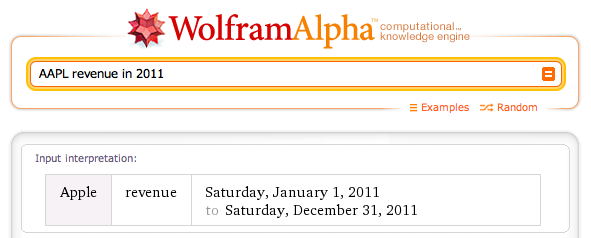
Wolfram’s new Pro product should become available on Wednesday, February 8th, with a $4.99 subscription. For those who have never tried Wolfram Alpha: here’s an example query for “Apple revenue in 2011”, and Wolfram’s results for the company itself.

Permalink

On iPads and Personal Computers: A Post-PC Retrospective

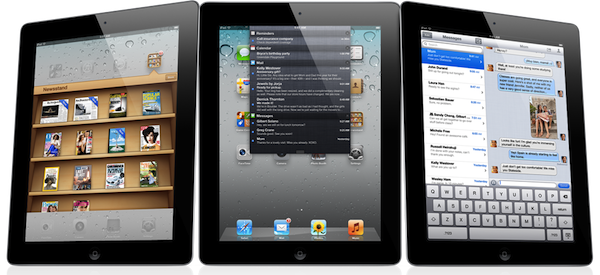
There’s been a debate lately as to whether the iPad can fit into the so-called PC category. Following the release of several estimates and market research studies showing much different results when the iPad is included in the overall PC sales of the entire industry, a number of people have voiced once again their opinions on the matter, producing a variegate mix of diverging points. Our writer Graham Spencer chimed in as well, analyzing the reasons behind certain people’s assertion that the iPad can’t be a PC because it can’t fully replace a personal computer.

I, however, would like to take a different route and look at this issue from a broader perspective that includes data, Apple’s history, the current market’s situation, and the tech community’s change of direction on the “iPad as a PC” debate over the past two years.

The starting point, I believe, lies in the words Steve Jobs used to introduce the iPad back in 2010:

Everybody uses a laptop and a smartphone. And a question has arisen lately: is there room for a third category of device in the middle? Something that’s between a laptop and a smartphone. And of course we’ve pondered this question for years as well. The bar’s pretty high. In order to really create a new category of devices, those devices are going to have to be far better at doing some key tasks. Better than a laptop. Better than a smartphone. Now, some people have thought…that’s a netbook. The problem is, netbooks aren’t better at anything. They’re slow, they have low quality displays and they run clunky old PC software. So, they’re not better than a laptop at anything. They’re just cheaper. They’re just cheap laptops. We don’t think they’re a new category of device.

In the few minutes that led to the iPad’s introduction, Jobs carefully set the tone and Apple’s position for the upcoming discussions on the true nature of the device: the iPad is meant to be a “third category” that executes “key tasks” better than a laptop, and better than a smartphone. He didn’t compare the iPad to a PC, but he did mention that Apple wouldn’t follow the trend of releasing cheap “netbooks” that “aren’t better at anything”. Of course, Steve Jobs iterated on his statements regarding the nature of the iPad a few months later at D8 Conference. This is where Jobs famously compared PCs to trucks:

When we were an agrarian nation, all cars were trucks, because that’s what you needed on the farm,” Jobs said at D8 last month. “But as vehicles started to be used in the urban centers, cars got more popular. Innovations like automatic transmission and power steering and things that you didn’t care about in a truck as much started to become paramount in cars….PCs are going to be like trucks. They’re still going to be around, they’re still going to have a lot of value, but they’re going to be used by one out of x people.

As you can see, Jobs’ public definition and positioning of the iPad slightly changed in the months between January and June 2010. I believe the more intimate setting of D8 got Jobs into a talking mood which helped him express what he truly felt about the iPad and PCs; I also believe Apple itself was (is) still trying to understand what the iPad ultimately is, thus definitions and public statements might change and evolve over time. Tim Cook stated numerous times that, whilst excited about the opportunities opened by iPad, Apple still has to fully understand just how much market there is behind it. Furthermore, keep in mind how Apple initially touted the iPad as a productivity machine (2010 keynote), then an entertainment platform (iPad 2 keynote) and subsequently as an educational machine (January 2012). Apple still has to fully grasp the potential of the iPad, and is firing on all cylinders to gain as much share as possible before the market is too crowded. That’s not to say Apple doesn’t have a strategy; in fact, they have multiple ones and they are trying to optimize the proper sequence for the company to put them in place.

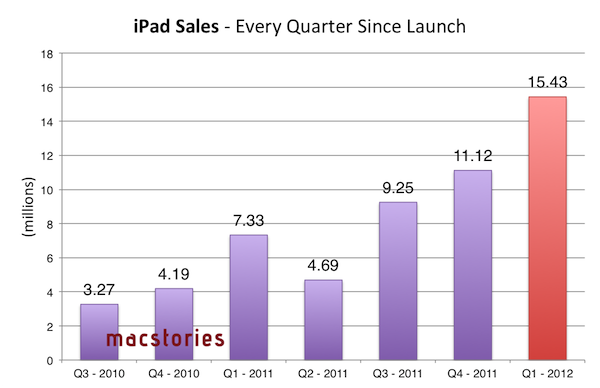
Strategies, typically, are based on patterns, and Apple wouldn’t have gotten to exceed $46 billion in revenue if these patterns hadn’t been associated with the numbers and data coming in after the launch of the original iPad. The numbers speak clearly for Apple: of all iOS devices, the iPad has the most rapid trajectory in every quarter since launch with an impressive growth from 3.27 million units (first quarter) to 15.43 million units sold (last quarter). Horace Dediu has put together a nice chart showing the penetration of the iPad in terms of shipments and growth.

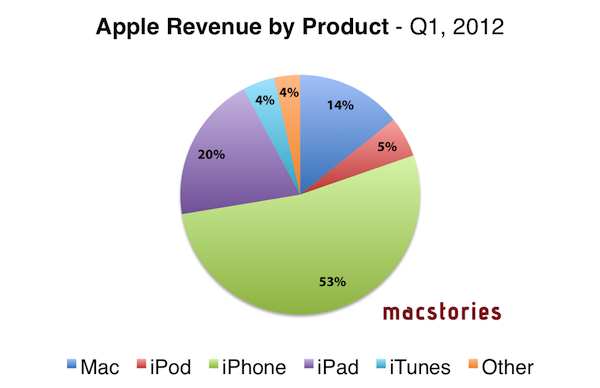
Numbers help establishing patterns that define strategies and business models. Sure enough, the early success of the iPad has allowed Apple to turn a product that represents a good 20% of revenue into a category worth focusing on for the future. As I explained in this article, if the source is to be believed, Tim Cook hinting at the iPad being a better alternative than a possible ARM-based, iPad-like MacBook Air is interesting for a number of reasons. First off, it sort of implies that tasks that can be accomplished with an iPad-inspired MacBook Air (that is, regular PC tasks with instant-on and a slimmer form factor) could be easily, if not better executed by the iPad itself. Indeed, the same report goes on to note that Tim Cook believes the iPad ”satisfies—or will soon satisfy—the needs of those who might have been interested in such a product”. More importantly, assuming an ARM-based MacBook Air has ever been in testing within Apple and that such a machine would be positioned as an ultra-portable, fast and durable low-end Mac, it means Apple sees the iPad as the portable and lightweight personal computer for the masses seeking a high-quality product in the low end. Read more


MacStories Reading List: January 29 – February 5

With quarterly earnings, education announcements and Macworld under its belt, this week the Apple community had time to think and reflect upon recent events. Much of the controversy surrounding the iBooks Author EULA is gone, thanks to a clarification from Apple with a software update and Zynga now taking the spot of most hated company on the planet. At least for this week. Independent writers and bloggers share their thoughts on what it means to attend Macworld besides getting to report on news and interview people, whilst Harry McCracken provides us with a fantastic piece against “Apple is like a cult” promoters. Meanwhile, Apple’s Q1 2012 results are still impressing a large part of the blogosphere.

It’s this week’s Reading List, so get comfortable, fire up your read-later application of choice, and enjoy. Read more


Why Apple’s A5 Is So Big, And Siri Is 4S-only

Why Apple’s A5 Is So Big, And Siri Is 4S-only

Stephen Shankland at CNET reports on a possible explanation as to why Apple decided to make Siri an iPhone 4S exclusive:

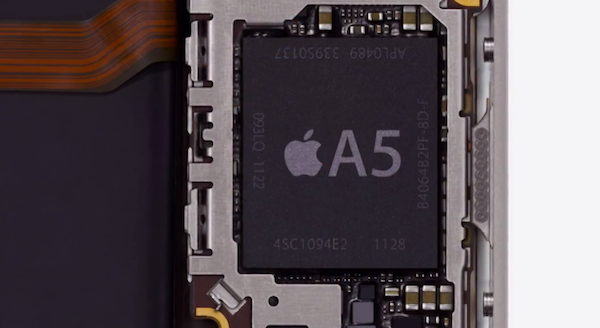
Apple’s A5 processor includes noise-reduction circuitry licensed from a start-up called Audience, and a chip analyst believes that fact resolves an iPhone 4S mystery and explains why the iPhone 4 lacks the Siri voice-control system.

Audience revealed details of its Apple partnership in January, when it filed paperwork for an initial public offering (IPO) of stock. Teardown work from iFixit and Chipworks revealed a dedicated Audience chip in the iPhone 4, but the iPhone 4S integrates Audience’s “EarSmart” technology directly into the A5 processor, the company’s S-1 filing said.

Audience confirmed in its filing that Apple signed an agreement to pay royalties for the intellectual property used in the A5 processor in the “three months ended December 31, 2011”, suggesting that only the iPhone 4S version of the A5 (the A5 CPU is also used on the iPad 2) supports Audience’s technology. Audience also said that Apple is a licensee for the next-generation IP, although they won’t be contractually forced to use it; iPhone 4-era technology from Audience also has advanced noise-reduction, but it was only with the second-generation product (the one on the A5) that Audience perfected recognition/reduction at arm’s length – thus allowing for features like voice control through Siri.

Integration of Audience’s EarSmart on the iPhone 4S’ A5 could explain why Apple decided to not offer Siri on older devices, and why it will likely only feature the voice-based assistant on newer devices going forward. A number of unofficial hacks to enable Siri on older devices surfaced in the past months, albeit with mixed results.

Permalink

Focusing On iPads

The latest report from AppleInsider claims that, after a meeting with CEO Tim Cook and CFO Peter Oppenheimer, Citi analyst Richard Gardner left with the impression that Apple is focusing on iPads, leaving little or no possibility for an ARM-based MacBook Air, which was previously rumored.

Apple doesn’t refer to iPad as a PC, but as a “post-PC device,” leaving the ARM-based tablet distinct from the company’s Intel-based Macs. Gardner further indicated the meeting dispelled the notion that Apple might introduce ARM-based Macs, countering rumors that a new MacBook Air featuring an ARM processor might appear sometime soon.

Gardner cited Cook as alluding to “rapid innovation on the iOS platform” that will “significantly broaden the use case for tablets,” and stated he “walked away from this meeting with the impression that Apple feels iPad satisfies—or will soon satisfy—the needs of those who might have been interested in such a product” as an ARM-based MacBook Air.

The rumors of Apple switching from Intel to ARM-based architectures on Macs left many wondering when they first surfaced online. And whilst it wouldn’t be a surprise to know that Apple has at least tested A5-based MacBook Airs and other sorts of ARM CPUs for portables – of course a company like Apple wants to experiment with as many hardware alternatives as possible – many debated whether it would make sense for the company to switch in the near future, when quad-core ARM processors are seemingly ready for the next-generation of iOS devices.

That Apple doesn’t believe an ARM-based MacBook Air – or, as the competitors would call it, an ARM Ultrabook – would be needed on the market isn’t a surprise, either. Assuming there is a market for users who want a low-power, battery life efficient portable machine in the range of 11” and 13” – a machine that, in theory, should be used for tasks such as word processing, lightweight image editing, browsing, and email – Apple believes that market can be satisfied – or will be “soon” satisfied as AppleInsider writes – by the iPad.

From a user’s standpoint, I think Apple’s reasoning here is that, ultimately, someone who’s seeking an 11-inch or even 13-inch machine with the technological perks of the iPad would be better off with an iPad, which is lighter, more portable, and has a richer selection of apps (from Apple’s perspective in looking at simple App Store numbers). There are edge cases, such as people who would strongly argue against iOS’ virtual keyboard, but I believe what Tim Cook is saying here – again, at least according to AppleInsider – is that the hypothetical market for an ARM MacBook Air should just settle with an iPad, as it’s a versatile, innovative machine that will get more feature soon. I don’t always want to look much into reports about interviews out of their original context, but if that “soon” is to be believed, I wouldn’t mind seeing more productivity-oriented software from Apple at the next iPad event – apps such as Aperture and, who knows, maybe even a portable programming suite would be perfect to further showcase the iPad’s capabilities as a “real” PC.

More importantly, Gardner’s “impression” that Apple feels satisfied with the iPad is also backed up by the numbers: in the past quarter alone, Apple sold over 15 million iPads, and “only” 5.2 million Macs. In the amount of time that Apple should spend transitioning a Mac product (the MacBook Air) to a new CPU architecture and getting developers to begin supporting this new “hybrid” machine, the company could easily sell another 20 million iPads. That’s not to say Apple will never switch to ARM (never is a dangerous word) on the desktop and that they haven’t considered it, but I’ve never believed it could happen in a short period of time as some of the early rumors claimed.

Looking at the first quarters of iPad sales and reception, I’d say Tim Cook is right to be focusing on iPads.


As (Some) Expected, Apple Clarifies iBooks Author EULA

As (Some) Expected, Apple Clarifies iBooks Author EULA

Megan Lavey-Heaton at TUAW reports Apple issued today an update to iBooks Author which includes a slightly revised end-user license agreement (EULA). The Next Web takes a closer look at the updates:

Apple has updated its iBooks Author app in order to clarify the language of its End User License Agreement. The changes to the EULA clarify that Apple does indeed intend the packaged product to be sold on the iBookstore only, but also makes it clear that it does not lay claim to the content that you use to create the book, nor does it try to limit what you can do with that content elsewhere.

Two weeks ago, I wrote:

…we know that Apple is a company that in the past months hasn’t been afraid of reversing a couple of unpopular decisions.

The Next Web also notes:

This change in wording should make it clear, as many right minded people have assumed…

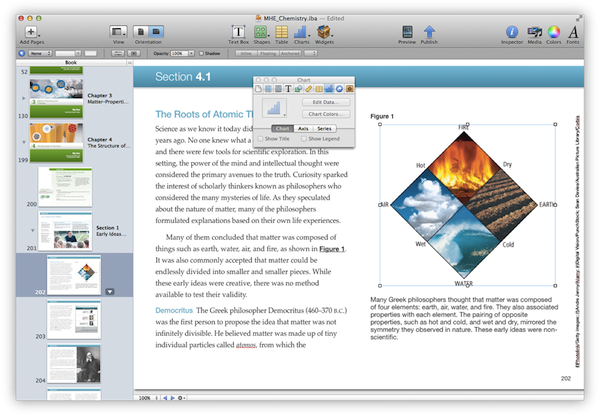
Anyone with a bit of intellect would have guessed since iBooks Author’s day one that the poorly worded EULA was set to be updated soon. Anyone who knows how Apple deals with damage control could have reminisced that the company doesn’t like rushed press released or having executives making jokes on Twitter, or, even better, could have produced a level-headed analysis of the issue. History, after all, taught us that the Apple of the most recent years has always addressed online turmoils in one way or another.

But, you know, Apple wants your content.

Permalink

Mozilla Working On Web Push Notifications for Firefox

Mozilla Working On Web Push Notifications for Firefox

Ryan Paul at Ars Technica reports about Mozilla’s “web push notification” project, which, in theory, would allow Firefox users to stay on top of websites like Twitter, Facebook, or Gmail using a push notification system similar to iOS:

Mozilla is developing a push notification system for the Firefox Web browser. It will allow users to receive notifications from websites without having to keep those sites open in their browser. The system will also be able to relay push notifications to mobile devices.

It’s important to note that this push notification system is distinct from the existing desktop notification mechanisms that are already defined in pending standards. The desktop notifications that websites like GMail and Seesmic Web display to Chrome users, for example, will only work when the website is left open in a tab. Mozilla’s push notification system moves beyond that limitation.

Jeff Balogh has written more about the project here, describing how notifications could be sent to any “Firefox device” including iPhones running Firefox Home:

Once the notification is in the system, we’ll deliver it to the recipient on all the devices they have Firefox installed, but we’ll try not to show duplicate notifications on different devices.

There’s a lot at stake here. On the one hand, desktop browsers have largely failed at delivering the kind of real-time connections and up-to-the-minute social/news updates you can expect from mobile apps on iOS and Android. Sure, there are extensions and add-ons, but they’re not nearly as integrated and “part” of the system. Push notifications almost seem “meant” for mobile devices. Furthermore, notifications are an area of mobile development both Google and Apple have been focusing on during the past years; on the desktop, apps have to rely on their own notification system or third-party apps, but browsers like Firefox sport no built-in push notification technology whatsoever. As far as “web notifications” go, Boxcar has been up to some interesting stuff including the desktop.

On the other hand, one could argue that we have enough notifications on our mobile devices, and having to see the red badge in our desktop browsers would be a terrible idea. I believe Mozilla’s project is worth of attention nevertheless, especially on the iOS side considering the existing Firefox Home app, and I look forward to seeing a first implementation, which hopefully will be available before Firefox 25 ships.

Permalink

Matthew Panzarino’s Bing Impressions

Matthew Panzarino’s Bing Impressions

The Next Web’s Matthew Panzarino tries Bing search on his iPhone for a month and reports back with his real-life impressions:

The design is largely cleaner and more attractive than Google’s more cluttered results, and more preview text helps you decide on which link to follow. But, if you’re even reading this article there’s a good chance that Bing isn’t really being made for you.

Instead, Microsoft seems to be heavily targeting the ’99%’ of mobile searchers. Those who will be looking for a restaurant close by, seeing what Lady Gaga is up to now or what the score is on the game. This is smart, because it’s exactly who Apple is targeting with the iPhone.

The whole article is worth a read and offers real-world scenarios for what a search engine should be able to do on an iOS device. I’ve always thought Bing would be a good alternative to Google on the iPhone, and I was also surprised to see Microsoft ship a good dedicated iPad app last year (what’s up with decent search apps for the iPad?).

Actually, since I started using DuckDuckGo in my daily workflow I’ve noticed just how much Google’s search and services are tied to iOS, and how big of a deal it is to be the default engine on a device that sells millions every week. In forcing myself to use a standalone app for search – or type in an address in Safari, then search – I’m noticing how frustrating it is, really, to automatically launch Safari, hit the search box, and remember that Google is in there. Or Bing, if you went through the effort of changing the default search engine in Settings.app. Think about it: not only do Google and Bing benefit from all the iOS users that manually open Safari to search – they also get all the incoming links from third-party apps that forward web pages to Safari, the default browser.

Read Matthew’s Bing impressions, including what he thinks of Maps (likely something even Apple is working on), here.

Permalink

Dropzone 2.0 Gets Path-like Radial Menu

Back in November when I took a look at the Mac App Store release of Aptonic’s Dropzone, I was impressed by how the utility transitioned to the Mac App Store whilst keeping most of its functionalities intact. Through a simple drag & drop interface, Dropzone allows you to save time on common and oft-repeated tasks such as sharing images and bits of text, uploading files to your FTP server, or moving files from one location on your Mac to another.

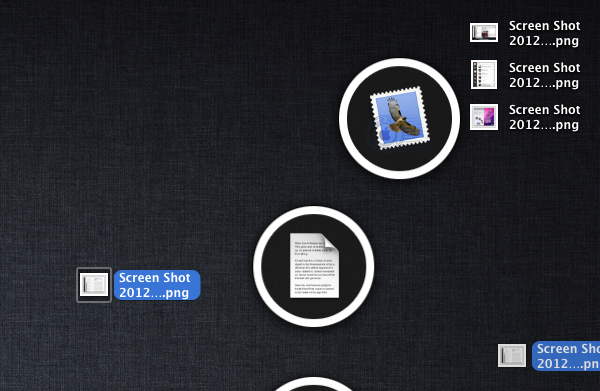
With Dropzone 2.0, released today on the Mac App Store, Aptonic has been inspired by Path’s radial menu (introduced in version 2.0 of the app) and created a new drag & drop interface based on Circles, which as the name suggests are circular icons that sport pretty much the same animation seen in Path 2.0 for iPhone. I don’t know if the new Circles system is more intuitive than the old dock/menubar-based grid of icons (as a Dropzone user myself, I’ll have to see how Circles works in daily usage and if the feature doesn’t get in the way), but it sure looks very nice. Aptonic has also put together an HTML5 demo of Circles, available here.

Dropzone 2.0 comes with other features and improvements as well:

  • New improved Amazon S3 support
  • New task completion sound
  • Added an option to choose whether to intall applications in the user or main application folder

Like I said, I’ll have to keep on using the new Dropzone to see whether the new Circles interface can grow on me. I love the custom sharing menu in Path, but I don’t know yet if the same approach can work for file management and the various shortcuts I have set up in Dropzone. To celebrate the launch of version 2.0, Dropzone will be available at $9.99 until February 5th.