Federico Viticci

10779 posts on MacStories since April 2009

Federico is the founder and Editor-in-Chief of MacStories, where he writes about Apple with a focus on apps, developers, iPad, and iOS productivity. He founded MacStories in April 2009 and has been writing about Apple since. Federico is also the co-host of AppStories, a weekly podcast exploring the world of apps, Unwind, a fun exploration of media and more, and NPC: Next Portable Console, a show about portable gaming and the handheld revolution.

iPad Diaries: Transmit Replacements and FTP Clients

iPad Diaries is a regular series about using the iPad as a primary computer. You can find more installments here and subscribe to the dedicated RSS feed.

You can download my wallpaper here.

Even though I never depended on Transmit for my daily iPad file management needs, I was sad to read that Panic couldn’t find a market for it on the App Store. Thousands of iPad owners use Panic’s app to manage their FTP servers and Amazon S3 buckets; integration with the latter is particularly important as it’s hard to find apps that combine FTP access with S3 support and aren’t hindered by questionable interface choices or a lack of updates.

Transmit for iOS was (and, until it is removed from the App Store, still is) one of a kind. Its excellent Mac foundation was adapted to iOS with taste and elegance, leveraging a split-pane UI long before iPad users were comfortable with Apple’s native Split View; thanks to Panic’s penchant for beautiful and intuitive design married to power-user functionalities, the Mac-like approach worked surprisingly well on iPad too.

It’s difficult to pin down what, exactly, made Transmit for iOS unprofitable. The iOS counterpart always lagged behind the cloud integrations from the Mac app (Backblaze B2 and Rackspace Cloud Files, for instance, never made it to iOS); Panic didn’t update Transmit to take advantage of major additions to iOS 11 such as Files and drag and drop; perhaps more importantly, Transmit for iOS is a product of the pre-iOS 11 era, back when the concepts of desktop-like file management and drag and drop were alien to the platform. Ultimately, I think Transmit for iOS lived and (slowly) died because we had it too soon.

But this isn’t a post-mortem for Transmit on iOS, which, according to Panic, may even relaunch as a new app on the Store someday. Instead, I’d like to take a quick tour of some of the alternatives for Transmit available on iPad today. In case Panic decides to pull Transmit from the App Store, or if the app stops working in a future release of iOS, these FTP clients and file managers should compensate for the features of Panic’s app. Most of them don’t offer the same sophisticated and polished UI design, but some of them may even turn out to be more flexible and better integrated with iOS than Transmit.

Read more


Connected, Episode 176: A Kernel Panic at the Disco

What does the death of Transmit mean for pro apps on the iPad? Should Apple make a laptop that runs iOS? Does Myke understand how hypothetical questions work?

I liked our discussion about pro apps on iPad and the idea of a laptop that runs iOS on this week’s episode of Connected. You can listen here.

Sponsored by:

  • Sanebox: Clean up your inbox in minutes. Sign up for a two-week free trial and a $25 credit.
  • Anchor: Radio, reinvented.
  • Ting: A smarter way to do mobile. Save $25 on selected devices or keep it as Ting credit.
Permalink

Smart Audio Report on Smart Speaker Adoption in the U.S.

Thuy Ong, reporting for The Verge on new research about smart speaker adoption in the United States:

One in six US adults (or around 39 million people) now own a voice-activated smart speaker, according to research from NPR and Edison Research. The Smart Audio Report claims that uptake of these devices over the last three years is “outpacing the adoption rates of smartphones and tablets.” Users spent time using speakers to find restaurants and businesses, playing games, setting timers and alarms, controlling smart home devices, sending messages, ordering food, and listening to music and books. Over half of respondents keep their smart speaker in the living room, followed by the kitchen (21 percent), and master bedroom (19 percent).

The survey of just under 2,000 individuals found that the time people spend using their smart speaker replaces time spent with other devices including the radio, smart phone, TV, tablet, computer, and publications like magazines. Over half of respondents also said they use smart speakers even more after the first month of owning one. Around 66 percent of users said they use their speaker to entertain friends and family, mostly to play music but also to ask general questions and check the weather.

I’m a bit skeptical about adoption of smart speakers outpacing “smartphones and tablets” (it sounds like a vague statement), but this is what the numbers seem to show.

What stands out to me is the fact that, after cars, people who participated in this research study would like to have smart speaker functionality on their phones. However, a similar study conducted by Creative Strategies in 2017 showed that the most common actions owners of smart speakers invoke on a weekly basis include setting timers, checking the weather, playing music, and controlling lights; all these tasks can also be performed by the digital assistants on our smartphones. To me, this suggests that either owners of smart speakers aren’t familiar with smartphone assistants (I doubt it) or that there is indeed something useful about stationary speakers that smartphones can’t fully replicate.

Permalink

An Interview with James Thomson, Creator of PCalc and DragThing

AppStories+ Deeper into the world of apps

AppStories Episode 38 - An Interview with James Thomson, Creator of PCalc and DragThing

0:00
33:02

AppStories+ Deeper into the world of apps

Federico and John interview James Thomson about the origins of PCalc and DragThing, life as an indie developer, selling apps on the App Store and Mac App Store, and more.

Read more


Apple’s Updated Security Guide for iOS 11.1 and iOS 11.2

Apple’s iOS Security guide is one of the most fascinating technical documents I’ve read in recent years. While the topics are intricate, they’re presented clearly in readable English. Earlier this week, the document was updated with new information on the latest additions to the iOS ecosystem – including Face ID, Apple Pay Cash, and Password AutoFill. There are some interesting details I didn’t know in each section.

On Face ID:

Facial matching is performed within the Secure Enclave using neural networks trained specifically for that purpose. We developed the facial matching neural networks using over a billion images, including IR and depth images collected in studies conducted with the participants’ informed consent. Apple worked with participants from around the world to include a representative group of people accounting for gender, age, ethnicity, and other factors. The studies were augmented as needed to provide a high degree of accuracy for a diverse range of users. Face ID is designed to work with hats, scarves, glasses, contact lenses, and many sunglasses. Furthermore, it’s designed to work indoors, outdoors, and even in total darkness. An additional neural network that’s trained to spot and resist spoofing defends against attempts to unlock your iPhone X with photos or masks.

On Apple Pay Cash, which details the new ‘Apple Payments Inc.’ subsidiary:

When you set up Apple Pay Cash, the same information as when you add a credit or debit card may be shared with our partner bank Green Dot Bank and with Apple Payments Inc., a wholly owned subsidiary created to protect your privacy by storing and processing information separately from the rest of Apple and in a way that the rest of Apple doesn’t know. This information is only used for troubleshooting, fraud prevention, and regulatory purposes.

[…]

Apple Payments Inc. will store and may use your transaction data for troubleshooting, fraud prevention, and regulatory purposes once a transaction is completed. The rest of Apple doesn’t know who you sent money to, received money from, or where you made a purchase with your Apple Pay Cash card.

To read more, get the full PDF here and check out the document revision history for January 2018.

Permalink

Apple and the Alexa Ecosystem

I recently read two interesting takes on the ever-growing Alexa ecosystem as it relates to Apple that made me think about the future of Siri and HomeKit. Here’s M.G. Siegler on Amazon’s plan to put Alexa everywhere:

The Echo Dot was the number one selling device across all of Amazon during the holiday shopping season. (The Fire TV stick with the Alexa-enabled remote was the second-most popular product.) Again, no absolute sales numbers beyond “tens of millions of Alexa-enabled devices” — more than we usually get, by the way — but no matter: tens of millions is impressive enough.

I’ve been thinking about this recently not just in the context of putting Echoes in hotels, but also relative to Apple. As we’re all well aware, Apple had to delay their foray into the space, the HomePod, into 2018. But not only did they miss the all-important holiday shopping season, I’m increasingly thinking that they may have missed the boat.

Believe me, I know how dangerous this line of thinking is with regard to Apple. Apple is almost never the first-mover in a market. Instead, they prefer to sit back and let markets mature enough to then swoop in with their effort, which more often than not is the best effort (this is both subjective in terms of my own taste, and often objective in terms of sales). But again, I increasingly don’t believe that this will be the case with their smart speaker.

Amazon has entered the speaker and home automation market with Alexa-enabled devices in two ways: first with their own Echo products, then with a growing roster of third-party manufacturers that are baking Alexa into their devices and almost treating Amazon’s assistant as a “standard” feature like WiFi or Bluetooth. There’s a fascinating parallel between Amazon Web Services – a suite of components embedded in the majority of modern websites and web apps – and Alexa Voice Service – a suite of voice APIs now embedded in hundreds of automation devices, general-purpose accessories and appliances, and web services.

Here’s Ben Bajarin on what Alexa’s presence at CES tells us about the ecosystem surrounding Apple:

While many Apple defenders want to dismiss the momentum we are observing with the Amazon ecosystem on display here at CES, while Amazon is similarly not present just like Apple, I believe it is a mistake to do so.

It is easy to say that because Apple was never present at CES that the show didn’t mean something to them or their ecosystem. It is easy, and correct to say that CES was not, or never was, a measure of the health of Apple’s products. It is, however, incorrect and dangerous to miss that CES had been, for some time, a barometer for the health of Apple’s ecosystem.

As I mentioned, our ability to measure any platforms ecosystem from what we observe at CES, is the main reason so many are paying attention to what is happening with Amazon’s Alexa platform. Google Assistant is certainly more present than it was last year, however, when you look at how third parties are talking about-and marketing-their support of these assistants they are putting significantly more effort into talking about Alexa than Google Assistant. Which is a telling signal. Again, to reiterate this point, third parties used to market, and spend energy talking about their integration with iOS or support of iPhone/iPad with the same rigor they are now talking about Amazon’s Alexa. This can not be ignored.

You could argue that most Apple-compatible gadgets and accessories announced at CES used to appear in tech blogs only to be forgotten a few months later because they were fads, vaporware, or ultimately not essential to the growth of the iOS ecosystem, and that the same will happen with Alexa-enabled devices we’ve seen this year. The difference, I think, is that this new generation of home automation products is an ecosystem in itself with higher value than, say, the iPad keyboards or stylii we used to see at CES. Alexa hasn’t “won”, but it has momentum among third-party companies making products that are or will soon be in our homes, sharing the same space of our TVs, routers, consoles, and mobile devices.

Read more


Making the App Icon Grid

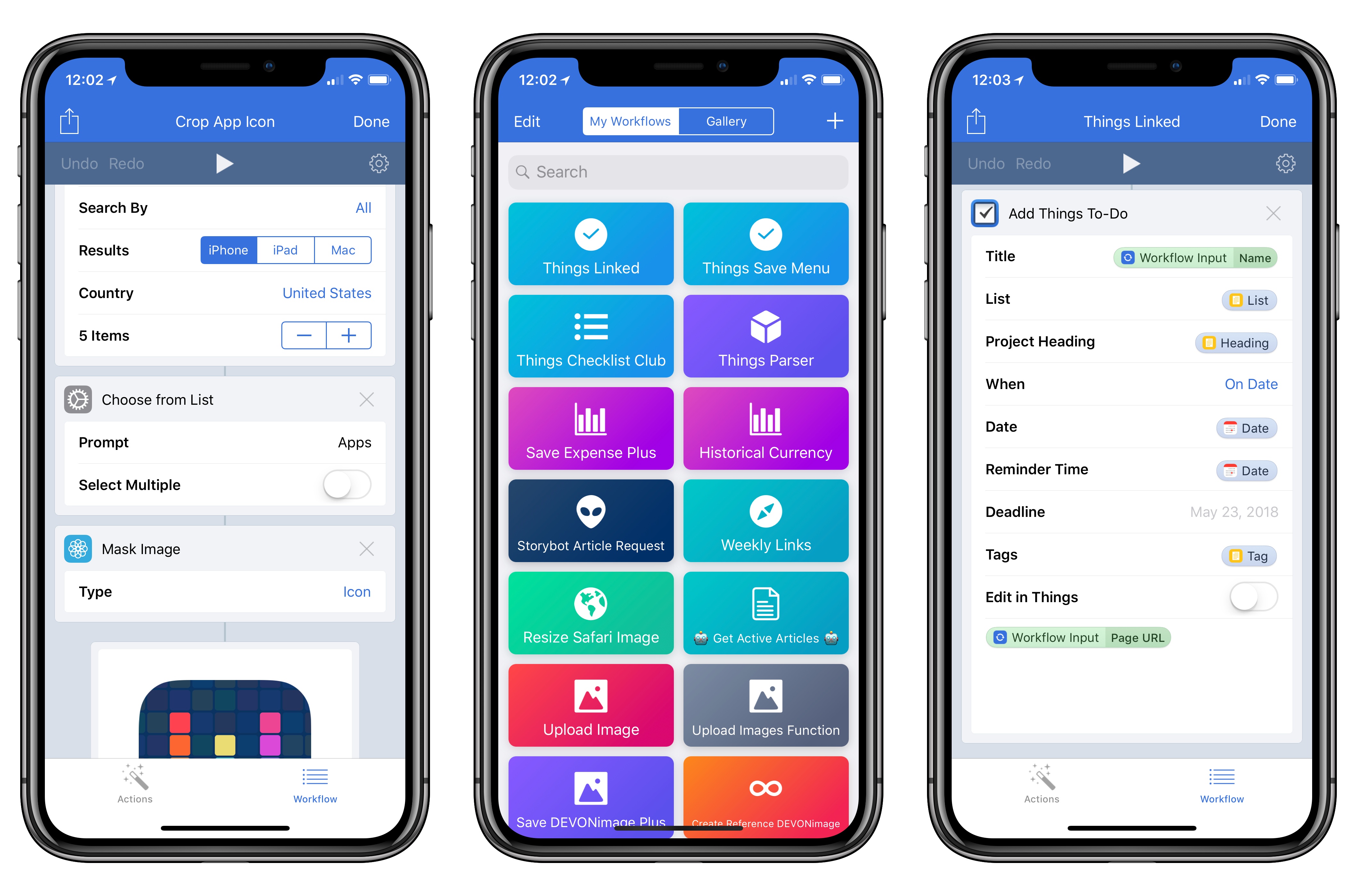
In the latest installment of my annual Must-Have iOS Apps roundup, I included an image with a grid of icons from all the apps listed in the collection. I received a few questions about how I created the image – whether it was the result of patient manual work or an automation – and...


Member Requests

Question: From an email message received in Spark (or Gmail), I’d like to send an attachment to DEVONthink, copy the link of the item added in DEVONthink, make a note in Bear, copy the link of this Bear note and finally create a project in Things with the DEVONthink and Bear links in its descriptions....


The Effects of Safari’s Intelligent Tracking Prevention

Alex Hern, reporting for The Guardian on the results of Safari’s new Intelligent Tracking Prevention (ITP), launched last year with iOS 11 and macOS High Sierra (via John Gruber):

Internet advertising firms are losing hundreds of millions of dollars following the introduction of a new privacy feature from Apple that prevents users from being tracked around the web.

Advertising technology firm Criteo, one of the largest in the industry, says that the Intelligent Tracking Prevention (ITP) feature for Safari, which holds 15% of the global browser market, is likely to cut its 2018 revenue by more than a fifth compared to projections made before ITP was announced.

Here’s how Apple officially describes ITP in Safari 11’s documentation:

Added Intelligent Tracking Prevention, which updates the default cookie and website data policy to isolate and remove cookies and website data for sites with the ability to track users across-site.

This isn’t the first time ad companies have complained about Apple’s protection of user privacy in Safari and stance against invasive cross-site tracking. In September, six trade groups claimed Apple was “sabotaging” the industry with a “unilateral and heavy-handed approach”, to which Apple responded:

“Ad tracking technology has become so pervasive that it is possible for ad tracking companies to recreate the majority of a person’s web browsing history,” according to an Apple spokesperson. “This information is collected without permission and is used for ad re-targeting, which is how ads follow people around the Internet.”

“Unilateral” is exactly right: Apple should only care for the interests of users buying their devices, not those of third-party ad companies creepily tracking them around the web.

Cross-site tracking and ad targeting has gotten so out of hand over the past couple of years, it’s become a regular comment from friends who don’t follow tech news – “Why am I seeing an ad for something I was checking out two days ago on another site?” is a question I hear frequently despite the existence of third-party ad blockers and Apple’s own ITP in Safari. Personally, I think the more Apple can advance ITP, the better it is for the privacy of all iOS users.

Permalink