Posts tagged with "artificial intelligence"

Procreate Will Not Include Generative AI in Its Apps

Today on its website, Procreate announced that it would not build generative AI tools into its apps. The company’s position is clear and unequivocal:

Generative AI is ripping the humanity out of things. Built on a foundation of theft, the technology is steering us toward a barren future. We think machine learning is a compelling technology with a lot of merit, but the path generative AI is on is wrong for us.

We’re here for the humans. We’re not chasing a technology that is a moral threat to our greatest jewel: human creativity. In this technological rush, this might make us an exception or seem at risk of being left behind. But we see this road less travelled as the more exciting and fruitful one for our community.

In a short video on X.com, Procreate CEO James Cuda said:

I don’t like what’s happening to the industry, and I don’t like what it’s doing to artists.

I couldn’t agree more or be happier to see Procreate take a stand in defense of artists. Federico and I interviewed Cuda at WWDC, and although Cuda struck a diplomatic tone having just received an Apple Design Award for Procreate Dreams, it was clear to me then that we were unlikely to see generative AI in Procreate’s apps. For everyone who wasn’t in the room with Cuda that day, though, today’s statement should set their minds at ease. I hope we see more developers whose apps support creative fields take a similar stand.

Permalink

Apple Says It Won’t Ship Major New OS Features in the EU This Fall Due to DMA Uncertainty

A new round in the fight between the EU and Apple has been brewing for a while now. About a week ago, the Financial Times reported that unnamed sources said that the EU was poised to levy significant fines against the company over a probe of Apple’s compliance with the Digital Markets Act. Then, earlier this week, in an interview with CNBC, the EU’s competition chief, Margrethe Vestager telegraphed that Apple is facing enforcement measures:

[Apple] are very important because a lot of good business happens through the App Store, happens through payment mechanisms, so of course, even though you know I can say this is not what was expected of such a company, of course we will enforce exactly with the same top priority as with any other business.

Asked when enforcement might happen, Vestager told CNBC ‘hopefully soon.’

Apple made no comment to CNBC at the time, but today, that shoe has apparently dropped, with Apple telling the Financial Times that:

Due to the regulatory uncertainties brought about by the Digital Markets Act, we do not believe that we will be able to roll out three of these [new] features – iPhone Mirroring, SharePlay Screen Sharing enhancements, and Apple Intelligence – to our EU users this year.

Is it a coincidence that Apple made its statement to the same media outlet that reported that fines were about to be assessed? I doubt it. The more likely scenario is that Apple is using OS updates as a negotiating chip with EU regulators. Your guess is as good as mine whether the move will work. Personally, I think the tactic is just as likely to backfire. However, I’m quite confident that you’ll be hearing from me again about fines by the EU against Apple sooner rather than later.

Permalink

Wired Confirms Perplexity Is Bypassing Efforts by Websites to Block Its Web Crawler

Last week, Federico and I asked Robb Knight to do what he could to block web crawlers deployed by artificial intelligence companies from scraping MacStories. Robb had already updated his own site’s robots.txt file months ago, so that’s the first thing he did for MacStories.

However, robots.txt only works if a company’s web crawler is set up to respect the file. As I wrote earlier this week, a better solution is to block them on your server, which Robb did on his personal site and wrote about late last week. The setup sends a 403 error if one of the bots listed in his server code requests information from his site.

Spoiler: Robb hit the nail on the head the first time.

Spoiler: Robb hit the nail on the head the first time.

After reading Robb’s post, Federico and I asked him to do the same for MacStories, which he did last Saturday. Once it was set up, Federico began testing the setup. OpenAI returned an error as expected, but Perplexity’s bot was still able to reach MacStories, which shouldn’t have been the case.1

Yes, I took a screenshot of Perplexity's API documentation because I bet it changes based on what we discovered.

Yes, I took a screenshot of Perplexity’s API documentation because I bet it changes based on what we discovered.

That began a deep dive to try to figure out what was going on. Robb’s code checked out, blocking the user agent specified in Perplexity’s own API documentation. What we discovered after more testing was that Perplexity was hitting MacStories’ server without using the user agent it said it used, effectively doing an end run around Robb’s server code.

Robb wrote up his findings on his website, which promptly shot to the top slot on Hacker News and caught the eye of Dhruv Mehrotra and Tim Marchman of Wired, who were in the midst of investigating how Perplexity works. As Mehrotra and Marchman describe it:

A WIRED analysis and one carried out by developer Robb Knight suggest that Perplexity is able to achieve this partly through apparently ignoring a widely accepted web standard known as the Robots Exclusion Protocol to surreptitiously scrape areas of websites that operators do not want accessed by bots, despite claiming that it won’t. WIRED observed a machine tied to Perplexity—more specifically, one on an Amazon server and almost certainly operated by Perplexity—doing this on wired.com and across other Condé Nast publications.

Until earlier this week, Perplexity published in its documentation a link to a list of the IP addresses its crawlers use—an apparent effort to be transparent. However, in some cases, as both WIRED and Knight were able to demonstrate, it appears to be accessing and scraping websites from which coders have attempted to block its crawler, called Perplexity Bot, using at least one unpublicized IP address. The company has since removed references to its public IP pool from its documentation.

That secret IP address—44.221.181.252—has hit properties at Condé Nast, the media company that owns WIRED, at least 822 times in the last three months. One senior engineer at Condé Nast, who asked not to be named because he wants to “stay out of it,” calls this a “massive undercount” because the company only retains a fraction of its network logs.

WIRED verified that the IP address in question is almost certainly linked to Perplexity by creating a new website and monitoring its server logs. Immediately after a WIRED reporter prompted the Perplexity chatbot to summarize the website’s content, the server logged that the IP address visited the site. This same IP address was first observed by Knight during a similar test.

This sort of unethical behavior is why we took the steps we did to block the use of MacStories’ websites as training data for Perplexity and other companies.2 Incidents like this and the lack of transparency about how AI companies train their models have led to a lot of mistrust in the entire industry among creators who publish on the web. I’m glad we’ve been able to play a small part in revealing Perplexity’s egregious behavior, but more needs to be done to rein in this sort of behavior, including closer scrutiny by regulators around the world.

As a footnote to this, it’s worth noting that Wired also puts to rest the argument that websites should be okay with Perplexity’s behavior because they include citations in their plagiarism. According to Wired’s story:

WIRED’s own records show that Perplexity sent 1,265 referrals to wired.com in May, an insignificant amount in the context of the site’s overall traffic. The article to which the most traffic was referred got 17 views.

That’s next to nothing for a site with Wired’s traffic, which Similarweb and other sites peg at over 20 million page views that same month. That’s a mere 0.006% of Wired’s May traffic. Let that sink in, and then ask yourself whether it seems like a fair trade.


  1. Meanwhile, I was digging through bins of old videogames and hardware at a Retro Gaming Festival doing ‘research’ for NPC
  2. Mehrotra and Marchman correctly question whether Perplexity is even an AI company because they piggyback on other company’s LLMs and use them in conjunction with scraped web data to provide summaries that effectively replace the source’s content. However, that doesn’t change the fact that Perplexity is surreptitiously scraping sites while simultaneously professing to respect sites’ robot.txt file. That’s the unethical bit. 

Apple Developer Academies in Six Countries to Add AI Courses This Fall

Today, Apple announced that this fall, the company will offer a new curriculum for its Developer Academy students focused on machine learning and artificial intelligence.

According to Apple:

Beginning this fall, every Apple Developer Academy student will benefit from custom-built curriculum that teaches them how to build, train, and deploy machine learning models across Apple devices. Courses will include the fundamentals of AI technologies and frameworks; Core ML and its ability to deliver fast performance on Apple devices; and guidance on how to build and train AI models from the ground up. Students will learn from guided curriculum and project-based assignments that include assistance from hundreds of mentors and more than 12,000 academy alumni worldwide.

The new curriculum will be offered at 18 academies in Brazil, Indonesia, Italy, Saudi Arabia, South Korea, and the United States. With the company’s emphasis on Apple Intelligence at WWDC, it’s not surprising that the skills needed to implement those new features are being added to its educational efforts.


How We’re Trying to Protect MacStories from AI Bots and Web Crawlers – And How You Can, Too

Over the past several days, we’ve made some changes at MacStories to address the ingestion of our work by web crawlers operated by artificial intelligence companies. We’ve learned a lot, so we thought we’d share what we’ve done in case anyone else would like to do something similar.

If you read MacStories regularly, or listen to our podcasts, you already know that Federico and I think that crawling the Open Web to train large language models is unethical. Industry-wide, AI companies have scraped the content of websites like ours, using it as the raw material for their chatbots and other commercial products without the consent or compensation of publishers and other creators.

Now that the horse is out of the barn, some of those companies are respecting publishers’ robots.txt files, while others seemingly aren’t. That doesn’t make up for the tens of thousands of articles and images that have already been scraped from MacStories. Nor is robots.txt a complete solution, so it’s just one of four approaches we’re taking to protect our work.

Read more


AppStories, Episode 378 – Are We Entering a Post-App World?

This week on AppStories, we explore whether we’re experiencing the beginning of the end of apps and consider what might replace them.


Sponsored by:

  • Genius Scan – A scanner in your pocket.
  • Jam – Developer friendly bug reports in 1 click.

Are We Entering a Post-App World?


On AppStories+, we explain why we’ve said goodbye to time tracking.

We deliver AppStories+ to subscribers with bonus content, ad-free, and at a high bitrate early every week.

To learn more about the benefits included with an AppStories+ subscription, visit our Plans page, or read the AppStories+ FAQ.

Read more


Club MacStories Sample: BetterTouchTool Tips, Vision Pro Shortcuts, a Task Manager Review, and the Effect of AI on the Internet

We often describe Club MacStories as more of the MacStories you know and love reading on this website. That’s an apt shorthand for the Club, but when you’re being asked to sign up and pay for something, it still helps to see what you’re buying. That’s why every now and then, we like to share samples of some of what the Club has to offer every week.

So today, we’ve made Issue 408 of MacStories Weekly from a couple of Saturdays ago available to everyone. Just use this link, and you’ll get the whole issue. You can also use the links in the excerpts below to read particular articles.

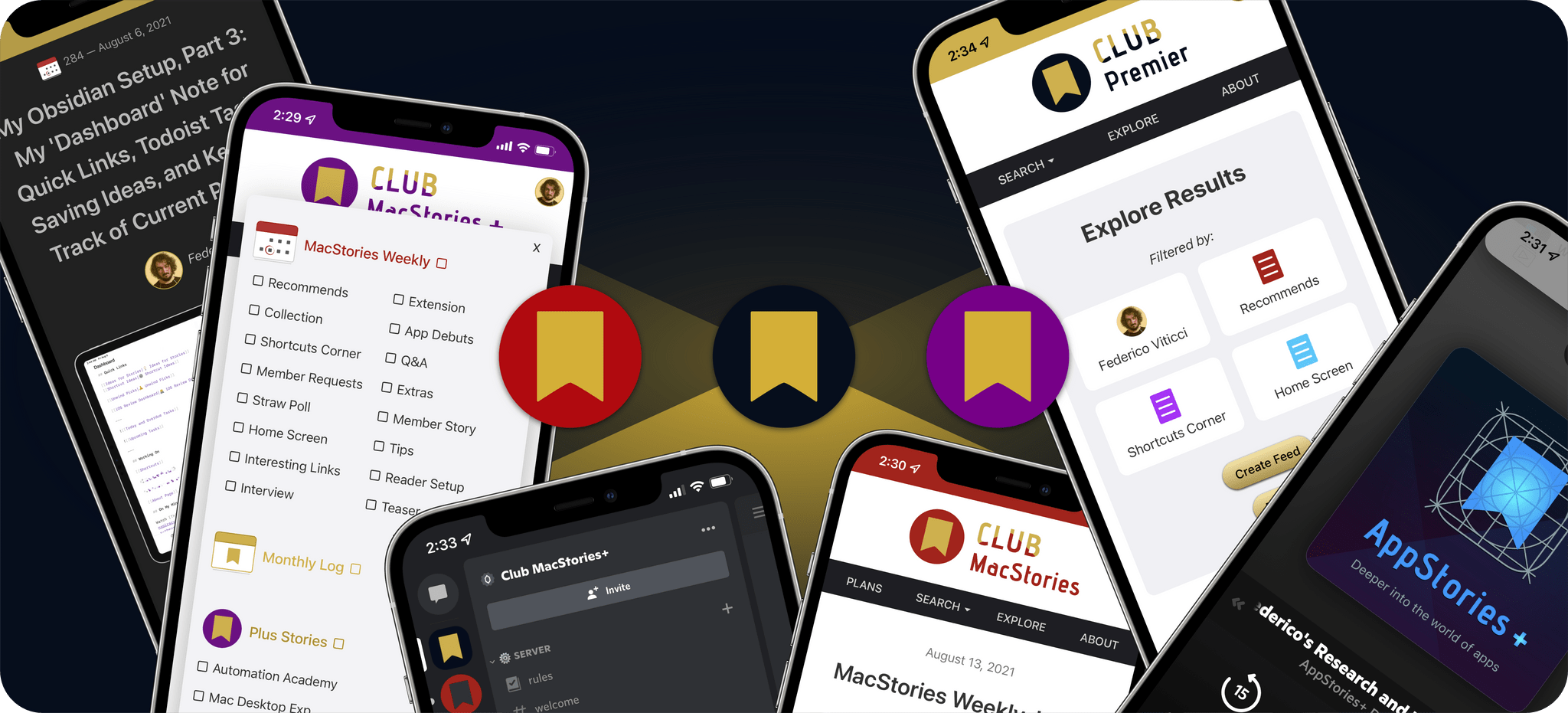
Everybody in the Club gets MacStories Weekly and our monthly newsletter called the Monthly Log, but there’s a lot more to the Club than just email newsletters. All members also get MacStories Unwind+, an ad-free version of the podcast that we publish a day early for Club members. All Club members also have access to a growing collection of downloadable perks like wallpapers and eBooks.

Club MacStories+ members get all of those perks along with exclusive columns that are published outside our newsletters, access to our Discord community, discounts on dozens of iOS, iPadOS, and Mac apps, and advanced search, filtering, and custom RSS feed creation of Club content. Club Premier builds on the first two tiers by adding AppStories+, the extended, ad-free version of our flagship podcast that’s delivered a day early, as well as full-text search of AppStories show notes, making it the all-access pass for everything we do at MacStories.

To learn more and sign up, you can use the buttons below:

Join Club MacStories:

Join Club MacStories+:

Join Club Premier:

Issue 408 of MacStories Weekly, which you can access here, starts with two excellent tips from Niléane on how to use BetterTouchTool to remap the Mac’s yellow and green ‘stoplight’ buttons. Like a lot of tips and workflows we share, Niléane’s was inspired by a similar technique Federico employed a couple of weeks before:

Two weeks ago, in Issue 406 of MacStories Weekly, Federico shared a tip for BetterTouchTool that resonated with me. Just like him, I am used to minimizing my windows instead of hiding them, which can be annoying since minimized windows no longer come up when you Command (⌘) + Tab to their app’s icon…

…after poking around in BetterTouchTool for a few minutes, I realized that the app allows you to change what the red, yellow, and green window buttons do. As a result, I was able to make it so that the yellow button will actually hide a window instead of minimizing it to the Dock.

Read more


The Browser Company Announces Act II for Arc: ‘The Browser That Browses For You’

Today, The Browser Company announced a selection of new features coming to their Arc browser for Mac as part of what they are billing ’Act II’ of their increasingly popular app. There are four features in total, centered around the theme of ‘the browser that browses for you.’

For those unfamiliar, Arc started as a Mac browser built around the Chromium code base with eye-catching features like tabs listed down the side, Split View, built-in ‘easels’ and notes, and the ability to adjust the visual look of webpages. Arc is now targeting what CEO Josh Miller has called ‘a post-Google Internet’ by implementing AI within the browsing experience, amongst other strategies.

Current ‘Arc Max’ AI features like ‘Ask On Page,’ which answers questions about the contents of webpages, and ‘5 Second Previews’, which summarises a webpage at the other end of a link, have all proved to be hits with users.

It’s no secret I’m a fan of Arc. I would even call their ‘Shared Quotes’ feature my favorite ‘little’ feature in any browser right now. The Browser Company has big ambitions for 2024, including an imminent launch on Windows, and Miller had this to say about Arc’s next step:

“Here is our vision. It’s really simple. You tell Arc what to do, and Arc will go and do it for you.”

It’s a very broad statement, but with the new features announced today, the context of what he is saying comes more into focus. Two of these new features are available today, with the other two coming soon. Let’s take a look at them in detail.

Read more


How ChatGPT Changed Tech Forever

I thoroughly enjoyed this story from a couple weeks ago by David Pierce, writing for The Verge about OpenAI’s ChatGPT turning one and how it created a revolution in the tech industry that no one saw coming:

We definitely seem to like being able to more quickly write business emails, and we like being able to ask Excel to “make this into a bar graph” instead of hunting through menus. We like being able to code just by telling ChatGPT what we want our app to do. But do we want SEO-optimized, AI-generated news stories to take over publications we used to love? Do we want AI bots that act like real-life characters and become anthropomorphized companions in our lives? Should we think of AI more as a tool or a collaborator? If an AI tool can be trained to create the exact song / movie / image / story I want right now, is that art or is that dystopia? Even as we start to answer those questions, AI tech seems to always stay one step and one cultural revolution ahead.

At the same time, there have been lawsuits accusing AI companies of stealing artists’ work, to which multiple US judges have said, essentially: our existing copyright laws just don’t know what to do with AI at all. Lawmakers have wrung their hands about AI safety, and President Joe Biden signed a fairly generic executive order that instructed agencies to create safety standards and companies to do good and not evil. There’s a case to be made that the AI revolution was built on immoral and / or illegal grounds, and yet the creators of these models and companies continue to confidently go ahead with their plans, while saying it’s both impossible and anti-progress to stop them or slow them down.

This all gets really heady really fast, I know. And the truth is, nobody knows where all this will be even 12 months from now, especially not the people making the loudest predictions. All you have to do is look at recent hype cycles — the blockchain, the metaverse, and many others — for evidence that things don’t usually turn out the way we think. But there’s so much momentum behind the AI revolution, and so many companies deeply invested in its future, that it’s hard to imagine GPTs going the way of NFTs.

I recommend reading the whole piece on The Verge. I quoted these paragraphs because they get right to the heart of the conflict that I also feel whenever I think about ChatGPT and similar tools. On the one hand, they were (largely? Partially?) built with data sets stolen from artists and creators (including this very website); on the other, the practical benefits of, say, using ChatGPT to help me proof-read my articles are undeniable.

I’ve been thinking about these issues a lot, perhaps because I make a living out of, well, creating content for the Internet. Is there a way to enjoy the power of LLMs without feeling weird and conflicted about how they were made in the first place? Will it even matter years from now? I don’t know the answer, but I’m hoping Apple will have one.

Permalink