Posts tagged with "apple"

Apple’s Fitness+ Comes to New Countries and Gets New Language Support

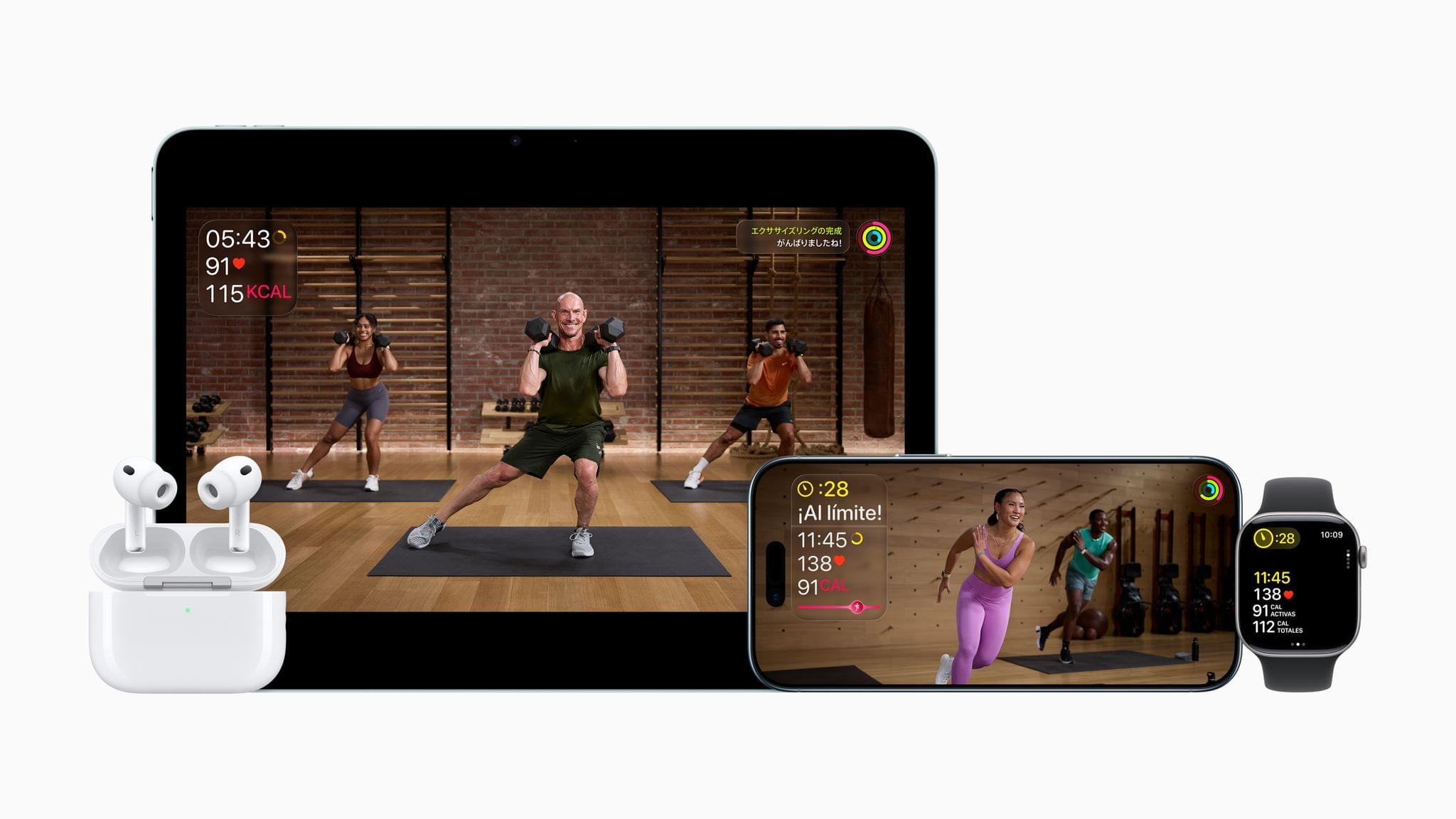
Source: Apple.

Source: Apple.

On December 15, Apple is expanding Fitness+ to 28 new markets, including Chile, Hong Kong, India, Japan, the Netherlands, Singapore, and Taiwan, which will more than double the number of places with access to the service. The company is also dubbing fitness classes into Spanish, German, and Japanese, with the first two languages coming December 15, and Japanese dubbing coming early next year. K-Pop is being added as a new music genre to the service, too.

The dubbing of fitness classes into Spanish, German, and Japanese sounds like it’s using the same tech found in the Apple Watch’s Workout Buddy feature, which uses a generated voice based on existing instructors’ voices:

To help make Fitness+ even more welcoming to users around the world, the service is introducing digitally dubbed versions of workouts and meditations in Spanish and German, with Japanese dubbing to follow early next year alongside the availability of the service in Japan. The dubbed workouts and meditations feature a generated voice based on the actual voice of each of the 28 Fitness+ trainers.

I’ve been using Workout Buddy ever since watchOS 26 launched, and at least in English, the voices work well.

Last month, Mark Gurman wrote in his newsletter that Fitness+ was under review and might be folded into a broader health service. It may have been the case that the service was under review, but with the expansion into 49 total countries and the addition of new features, it appears that Apple has concluded Fitness is worth keeping as a standalone subscription.


Apple Announces That Kate Adams, Its General Counsel, and Lisa Jackson, Head of Environment, Policy, and Social Initiatives, Are Retiring

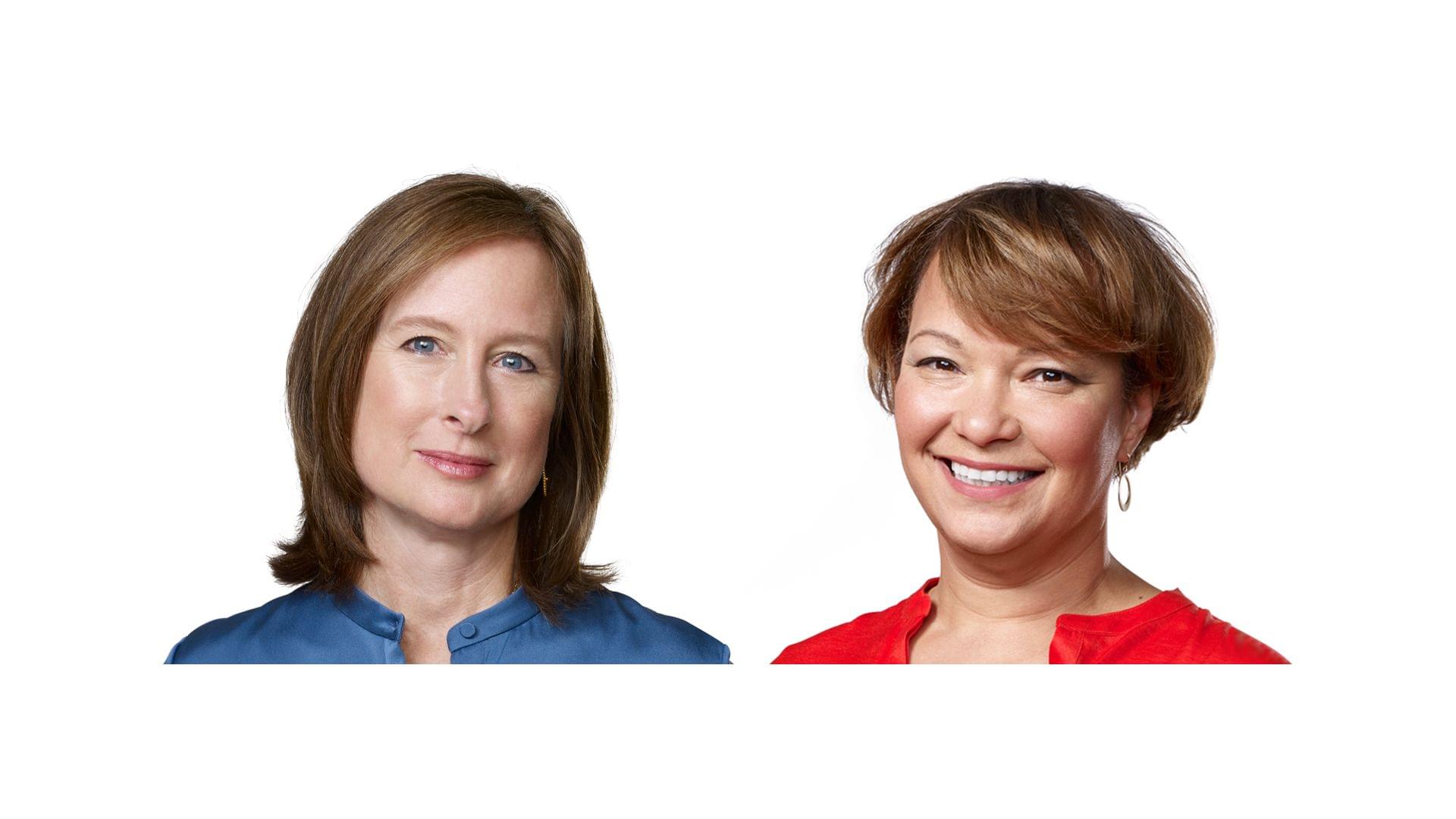
If you thought Apple’s leadership changes were finished, you’d be wrong. Today, the company announced two more changes.

The first change is to Apple’s General Counsel position, which has been led by Kate Adams since 2017. Adams will step down as general counsel on March 1, 2026 and will be replaced by Jennifer Newstead, Meta’s recent general counsel. Newstead will begin her tenure at Apple at the beginning of 2026 as a senior vice president and report to Tim Cook.

The second change is that Lisa Jackson, Apple’s vice president for Environment, Policy, and Social Initiatives is retiring in late January 2026. Under her leadership, Apple says it has reduced its global greenhouse emissions by 60% in the past ten years. Upon Jackson’s retirement, Government Affairs will be handled by Adams who will be staying at Apple until late 2026 when she plans to retire herself, at which point Government Affairs will become Newstead’s responsibility. The team handling Environmental and Social Initiatives will report to Sabih Khan, Apple’s chief operating officer.

Although Apple doesn’t say so in its press release, it’s pretty clear that a few things are playing out among its executive ranks. First, a large number of them are approaching retirement age, and Apple is transitioning and changing roles internally to account for those who are retiring. Second, the company is dealing with departures like Alan Dye’s and what appears to be the less-than-voluntary retirement of John Giannandrea. Finally, the company is reducing the number of Tim Cook’s direct reports, which is undoubtedly to simplify the transition to a new CEO in the relatively near future.


John Giannandrea’s Retirement From Apple Announced

Today Apple announced the retirement of John Giannandrea, the company’s senior vice president for Machine Learning and AI Strategy. Giannandrea will remain at Apple as an advisor until next spring.

News of Giannandrea’s retirement was paired with an announcement that Apple has hired Amar Subramanya as vice president of AI. Subramanya, who worked at Microsoft since this past summer, previously worked at Google for 16 years on projects including the company’s Gemini Assistant. Subramanya will take the lead on Apple Foundation Models, ML research, and AI Safety and Evaluation, while other areas of Giannandrea’s work will be inherited by Sabih Khan and Eddy Cue.

Apple CEO Tim Cook thanked Giannandrea for his tenure at the company:

We are thankful for the role John played in building and advancing our AI work, helping Apple continue to innovate and enrich the lives of our users. AI has long been central to Apple’s strategy, and we are pleased to welcome Amar to Craig’s leadership team and to bring his extraordinary AI expertise to Apple. In addition to growing his leadership team and AI responsibilities with Amar’s joining, Craig has been instrumental in driving our AI efforts, including overseeing our work to bring a more personalized Siri to users next year.

Given the troubled history of Apple’s AI efforts, the retirement of Giannandrea isn’t surprising. It will be interesting to see if Subramanya settles into his new role given the frequency with which top AI talent tends to turn over in the tech industry.


MacStories Setups Update: An Apple Gear Refresh, Dual-Screen Gaming, and HomeKit

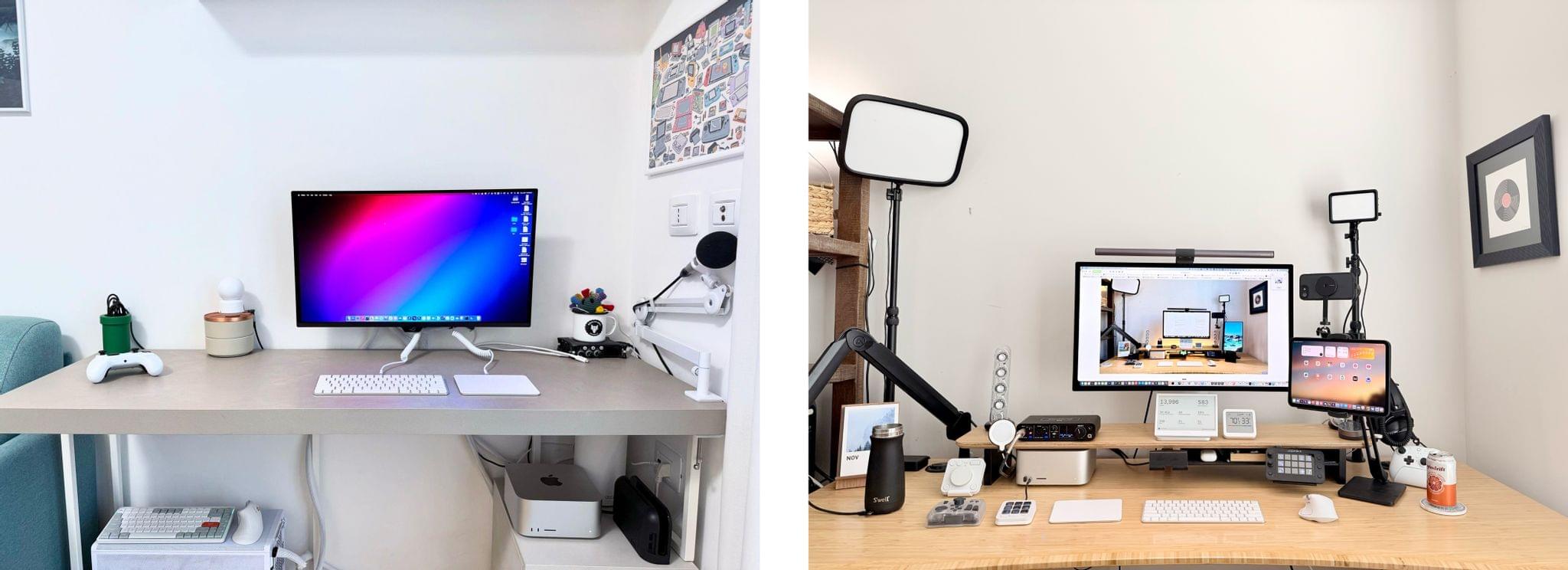
Our desk setups. Federico (left) and John (right).

Our desk setups. Federico (left) and John (right).

As we head into the final weeks of 2025, Federico and I figured it would be a good time to update the MacStories Setups page. There’s an ebb and flow to the gear and apps we test each year, and as the fall OS update season fades into the past, it’s not unusual for one or both of us to take stock of our setup and make changes. That’s been very true for both of us this year, but in different ways.

Federico has been focused on simplifying his hardware setup and testing a long list of apps and services. In contrast, I’ve made fewer gear cuts, focusing more on strategic changes to the gadgets I use and settling on a core set of work apps.

The result is that Federico’s hardware setup changes have primarily been updates to his Apple and portable gaming gear. He made the transition from the iPhone 16 Pro Max to the iPhone Air, and couldn’t be happier with the result. He also replaced the M4 iPad Pro with the latest M5 model and moved from the AirPods 4 to the AirPods Pro 3.

Both of us ditched our previous Apple Vision Pro head strap solutions for the Apple Dual Knit Band, which has been a big upgrade. It’s comfortable, and having one dial to adjust both bands is both clever and far simpler than other solutions I’ve tried.

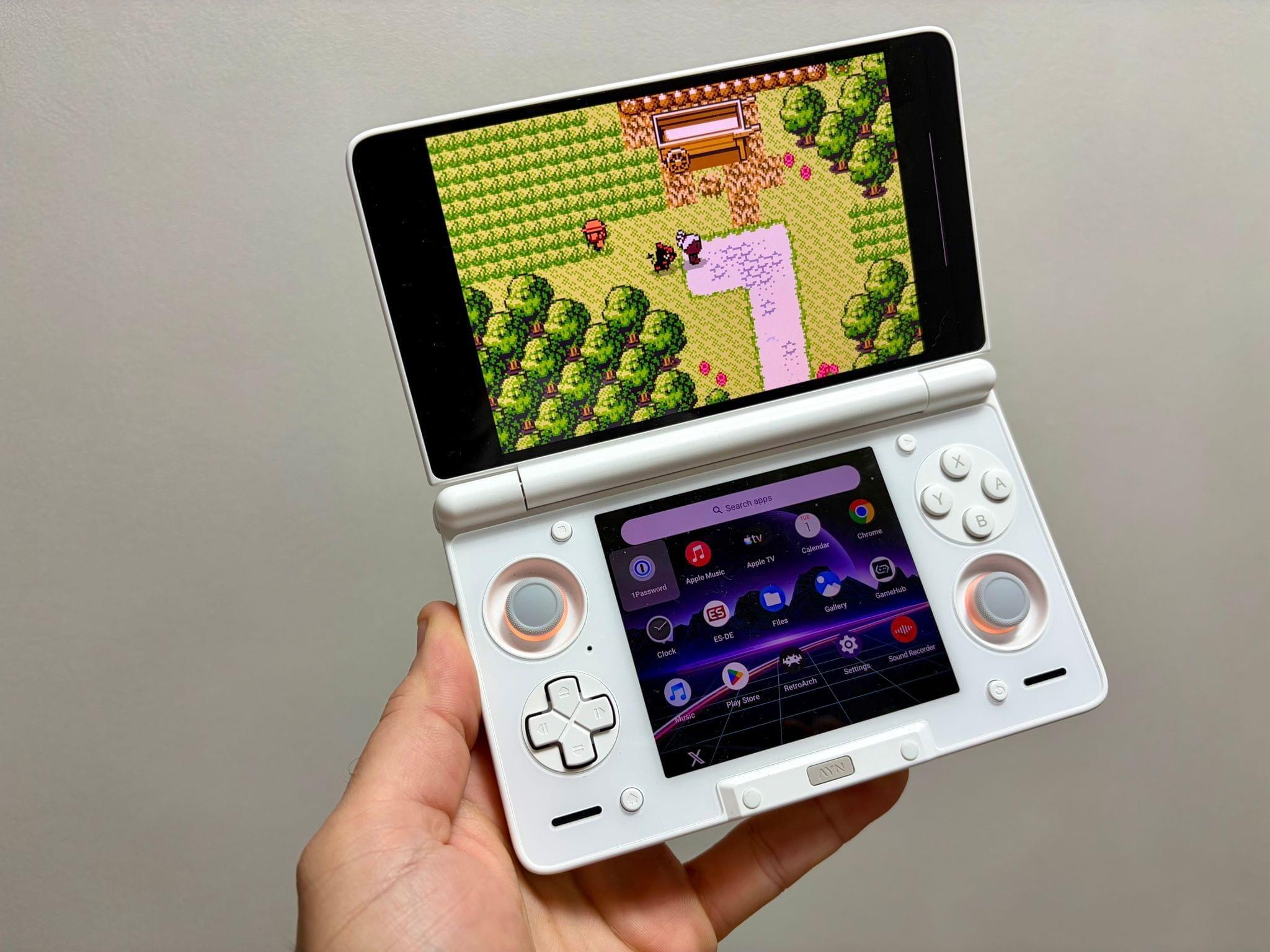
Ayn Thor.

Ayn Thor.

Federico also added the Ayn Thor to his handheld gaming lineup. The Thor, which I also bought this fall, is a dual-screen OLED gaming handheld that runs Android. It’s perfect for emulating dual-screen systems like the Nintendo DS and 3DS, but it has also been excellent for game streaming and testing the emerging world of emulating SteamOS on Android. If game tinkering is your thing and this sounds intriguing, we have two episodes of NPC: Next Portable Console that go in-depth on the Ayn Thor.

Read more


Are Pride Wallpapers and a Watch Band Enough in 2025?

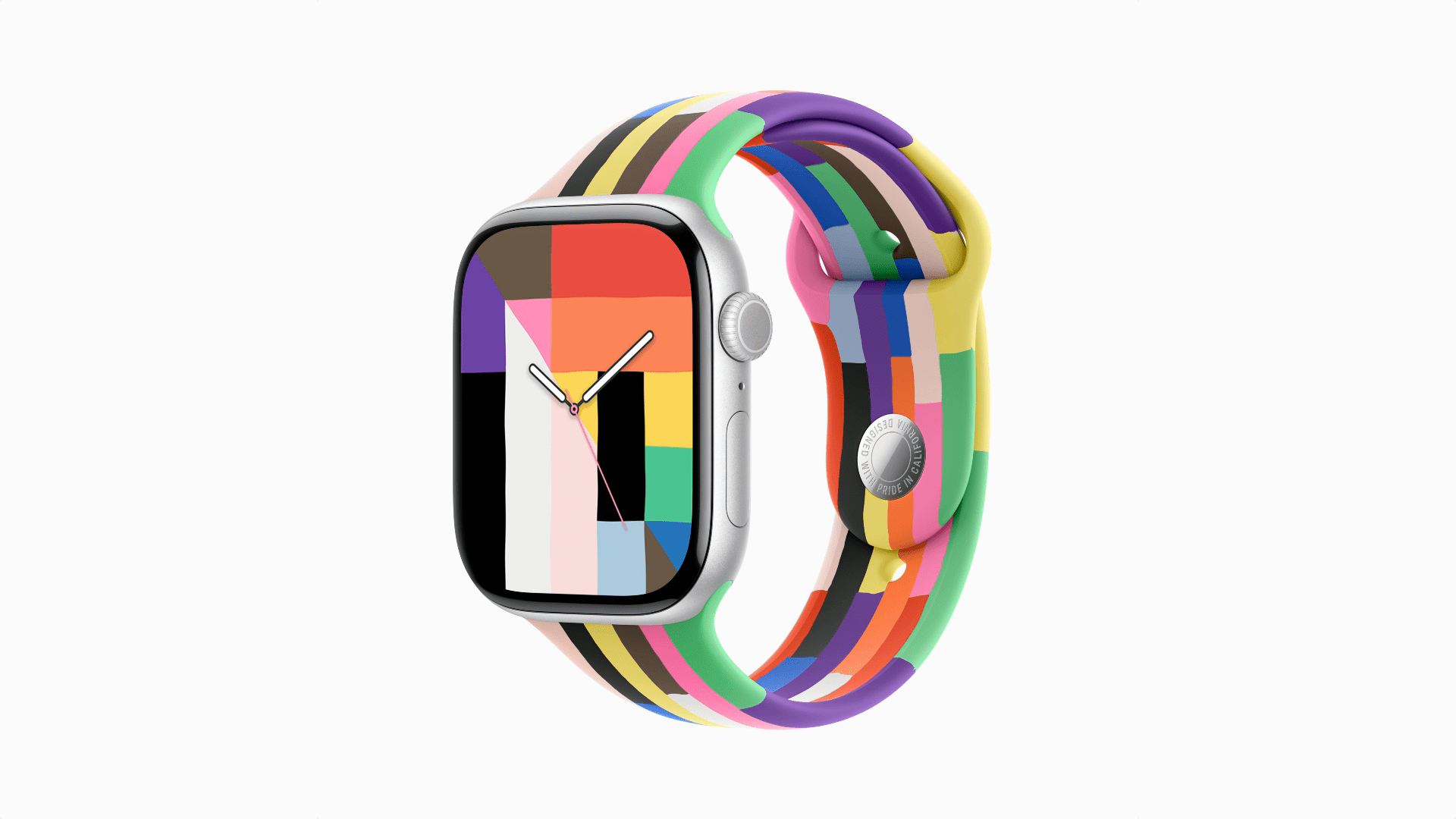
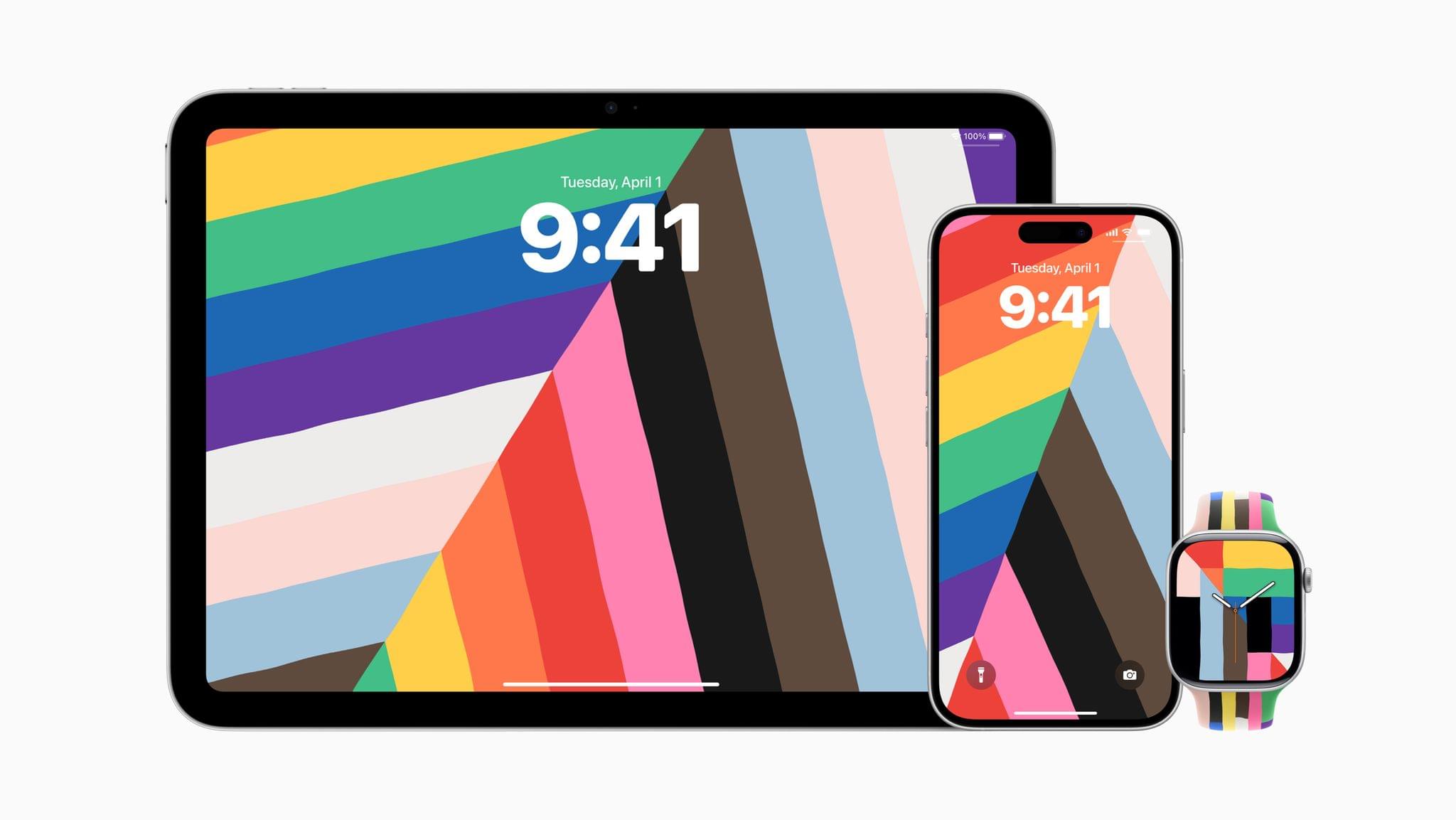
Today, Apple introduced their 2025 Pride Collection, with a set of new LGBTQ+-themed wallpapers for iOS and iPadOS that will be available as part of iOS and iPadOS 18.5. The collection also includes an Apple Watch Pride Edition Sports band, which matches a new Pride Harmony watch face in watchOS 11.5.

Despite being just another installment in what has become an annual tradition for the company, the 2025 collection rings hollow in contrast with Apple’s stance regarding the current U.S. administration.

Image: Apple

Image: Apple

On January 20th, President Trump signed executive orders that have already gravely impacted trans people across the United States. Despite the President’s clear intentions to do so before he was sworn into office, Apple CEO Tim Cook chose to donate $1M to the President’s inauguration fund and attended the inauguration alongside other American tech company leaders, including Google’s Sundar Pichai, Amazon’s Jeff Bezos, and Meta’s Mark Zuckerberg. The latter three have all scrapped Diversity, Equity and Inclusion (DEI) efforts inside their respective companies, following the President’s executive order terminating U.S. government DEI initiatives and scrubbing governmental documents of all references to trans people. In February, Apple shareholders rejected a proposal to follow the government’s lead, choosing to preserve the company’s diversity programs. However, Cook hedged saying that the company “may need to make some changes to comply”, while also reassuring that Apple’s “north star of dignity and respect for everyone and our work to that end will never waver.” Then last week, Cook remotely appeared at a celebration of the President’s first 100 days in office.

This seemingly nuanced alignment with President Trump contrasts with Tim Cook’s outspoken support for the LGBTQ+ community when he came out in 2014, and Apple’s continued participation in the San Francisco Pride Parade. The same dissonance appears in the final sentence of the company’s press release which states that “Apple is proud to financially support organizations that serve LGBTQ+ communities.

Today’s announcement of the 2025 Pride Collection’s made me think back to Joe Rosensteel’s great piece that he published in January soon after the inauguration, in which he expresses immense disappointment in Tim Cook. In regard to Apple’s yearly Apple Watch Pride bands and its participation in the San Francisco Pride parade, he rightly asked:

How should people reconcile Tim’s explicit support of Trump with his support of trans and enby people working at Apple, buying products from Apple, and attending pride parades with Apple?

At a time when some trans people are actively seeking to flee the U.S. to preserve their fundamental right to a healthy, safe, and decent life free from the threat of President Trump’s actions, Apple doesn’t seem to be stepping up to its professed values to the extent that the situation requires. As of today, there have been no reports of the company increasing its financial support of organizations that support LGBTQ+ people in the U.S. Nor has Apple attempted to publicly and explicitly speak out against the administration’s attacks targeting trans people. Instead, Apple has chosen to simply iterate on its Pride wallpapers and watch bands, which will retail at $49.

Maybe I should feel relieved that Apple chose not to discontinue the Pride Collection. But considering the urgency felt by the LGBTQ+ community, Apple releasing Pride bands and wallpapers is simply not enough to compensate for its decision not to speak out against President Trump’s attacks on trans people. There are certainly risks to Apple if it were to do more to stand up for the LGBTQ+ community, but those risks pale in comparison to the increasing threats trans and other people in the LGBTQ+ community face in the U.S. and around the world every day. It’s time for Apple to step up and do more than wallpapers and a watch band.


Bloomberg Reports that Apple Is Shaking up Siri Leadership

Less than two weeks ago, Apple announced that it was delaying the launch of a more personalized Siri. Today, Mark Gurman, reporting for Bloomberg, says the company is shuffling leadership of the project, too. According to Gurman:

Chief Executive Officer Tim Cook has lost confidence in the ability of AI head John Giannandrea to execute on product development, so he’s moving over another top executive to help: Vision Pro creator Mike Rockwell. In a new role, Rockwell will be in charge of the Siri virtual assistant, according to the people, who asked not to be identified because the moves haven’t been announced.

Giannandrea isn’t leaving Apple. Instead, Gurman says Giannandrea will continue to oversee “research, testing and technologies related to AI” including a team investigating robotics. Rockwell, who led the development of the Vision Pro, will report to Craig Federighi, Apple’s senior vice president of software.

Rockwell has had a long and successful track record at Apple, so hopefully Siri is in good hands going forward. It’s clear that there’s a lot of work to be done, but the promise of a more personalized Siri and a system for apps to communicate with each other via Apple Intelligence is something I’m glad the company isn’t giving up on. Hopefully, we’ll see some progress from Rockwell’s team soon.

Permalink

European Commission Orders Apple To Improve Third-Party Device Integration

Just as I was linking to Eric Migicovsky’s post about the disadvantages third-party smartwatch makers face when trying to integrate with the iPhone, the European Commission (EC) released a pair of related specification decisions regarding Apple’s Digital Markets Act compliance. The first covers iPhone connectivity with third-party devices:

The first set of measures concerns nine iOS connectivity features, predominantly used for connected devices such as smartwatches, headphones or TVs. The measures will grant device manufacturers and app developers improved access to iPhone features that interact with such devices (e.g. displaying notifications on smartwatches), faster data transfers (e.g. peer-to-peer Wi-Fi connections, and near-field communication) and easier device set-up (e.g. pairing).

The other decision focuses on the process of interoperability:

The second set of measures improves the transparency and effectiveness of the process that Apple devised for developers interested in obtaining interoperability with iPhone and iPad features. It includes improved access to technical documentation on features not yet available to third parties, timely communication and updates, and a more predictable timeline for the review of interoperability requests.

An unidentified spokesperson for Apple responded with a statement to 9to5Mac:

Today’s decisions wrap us in red tape, slowing down Apple’s ability to innovate for users in Europe and forcing us to give away our new features for free to companies who don’t have to play by the same rules. It’s bad for our products and for our European users. We will continue to work with the European Commission to help them understand our concerns on behalf of our users.

This decision shouldn’t come as a surprise to anyone who has been following our DMA coverage. It’s easy to understand why Apple is unhappy about this decision, but it’s also just as easy to understand how the status quo holds back competition. There are no easy answers to any of this, but as difficult as this may be for Apple to do while upholding its privacy, security, and other standards, I’m glad the EU is pushing for change and hope those changes spread to other corners of the globe.


Choosing Optimism About iOS 19

I loved this post by David Smith on his decision to remain optimistic about Apple’s rumored iOS 19 redesign despite, well, you know, everything:

Optimism isn’t enthusiasm. Enthusiasm is a feeling, optimism is a choice. I have much less of the enthusiastic feelings these days about my relationship to Apple and its technologies (discussed here on Under the Radar 312), but I can still choose to optimistically look for the positives in any situation. Something I’ve learned as I’ve aged is that pessimism feels better in the moment, but then slowly rots you over time. Whereas optimism feels foolish in the moment, but sustains you over time.

I’ve always disliked the word “enthusiast” (talk about a throwback), and I’ve been frequently criticized for choosing the more optimistic approach in covering Apple over the years. But David is right: pessimism feels better in the short term (and performs better if you’re good at writing headlines or designing YouTube thumbnails), but is not a good long-term investment. (Of course, when the optimism is also gone for good…well, that’s a different kind of problem.)

But back to David’s thoughts on the iOS 19 redesign. He lists this potential reason to be optimistic about having to redesign his apps:

It would provide a point of differentiation for my app against other apps who wouldn’t adopt the new design language right away (either large companies which have their own design system or laggards who wouldn’t prioritize it).

He’s correct: the last time Apple rolled out a major redesign of iOS, they launched a dedicated section on the App Store which, on day one, featured indie apps updated for iOS 7 such as OmniFocus, Twitterrific, Reeder 2, Pocket Casts 4, and Perfect Weather. It lasted for months. Twelve years later1, I doubt that bigger companies will be as slow as they were in 2013 to adopt Apple’s new design language, but more agile indie developers will undoubtedly have an advantage here.

He also writes:

Something I regularly remind myself as I look at new Apple announcements is that I never have the whole picture of what is to come for the platform, but Apple does. They know if things like foldable iPhones or HomeKit terminals are on the horizon and how a new design would fit in best with them. If you pay attention and try to read between the lines they often will provide the clues necessary to “skate where the puck is going” and be ready when new, exciting things get announced subsequently.

This is the key point for me going into this summer’s review season. Just like when Apple introduced size classes in iOS 8 at WWDC 2014 and launched Slide Over and Split View multitasking for the iPad (alongside the first iPad Pro) the next year, I have to imagine that changes in this year’s design language will pave the way for an iPhone that unfolds into a mini tablet, a convertible Mac laptop, App Intents on a dedicated screen, or more. So while I’m not enthusiastic about Apple’s performance in AI or developer relations, I choose to be optimistic about the idea that this year’s redesign may launch us into an exciting season of new hardware and apps for the next decade.


  1. Think about it this way: when iOS 7 was released, the App Store was only five years old. ↩︎
Permalink

Six Colors’ Apple in 2024 Report Card

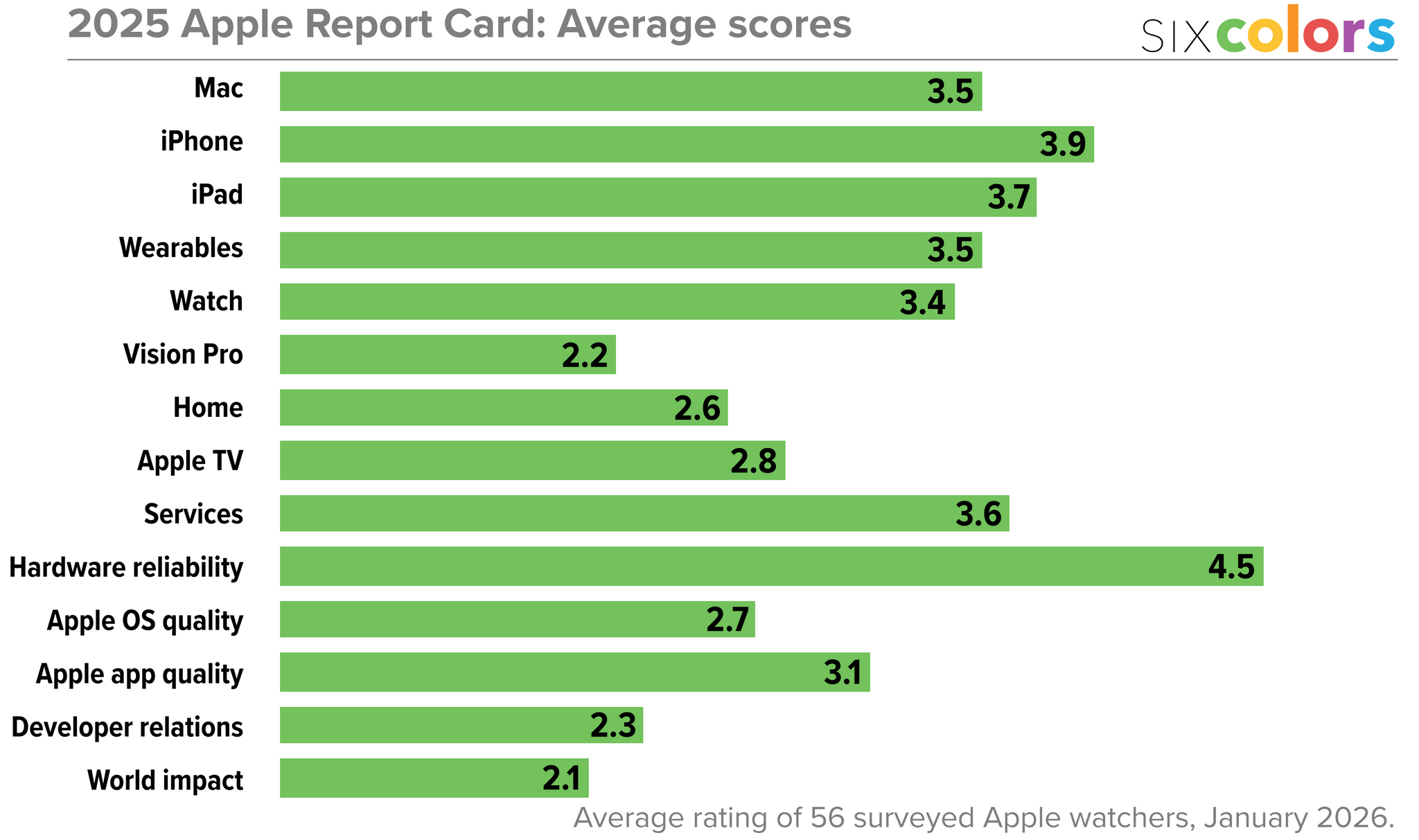
Average scores from the 2024 Six Colors report card. Source: [Six Colors](https://sixcolors.com/post/2025/02/apple-in-2024-the-six-colors-report-card/).

Average scores from the 2024 Six Colors report card. Source: Six Colors.

For the past 10 years, Six Colors’ Jason Snell has put together an “Apple report card” – a survey to assess the current state of Apple “as seen through the eyes of writers, editors, developers, podcasters, and other people who spend an awful lot of time thinking about Apple”.

The 2024 edition of the Six Colors Apple Report Card has been published, and you can find an excellent summary of all the submitted comments along with charts featuring average scores for the different categories here.

I’m grateful that Jason invited me to take part again and share my thoughts on Apple’s 2024. As you’ll see from my comments below, last year represented the end of an interesting transition period for me: after years of experiments, I settled on the iPad Pro as my main computer. Despite my personal enthusiasm, however, the overall iPad story remained frustrating with its peculiar mix of phenomenal M4 hardware and stagnant software. The iPhone lineup impressed me with its hardware (across all models), though I’m still wishing for that elusive foldable form factor. I was very surprised by the AirPods 4, and while Vision Pro initially showed incredible promise, I found myself not using it that much by the end of the year.

I’ve prepared the full text of my responses for the Six Colors report card, which you can find below.

Read more