

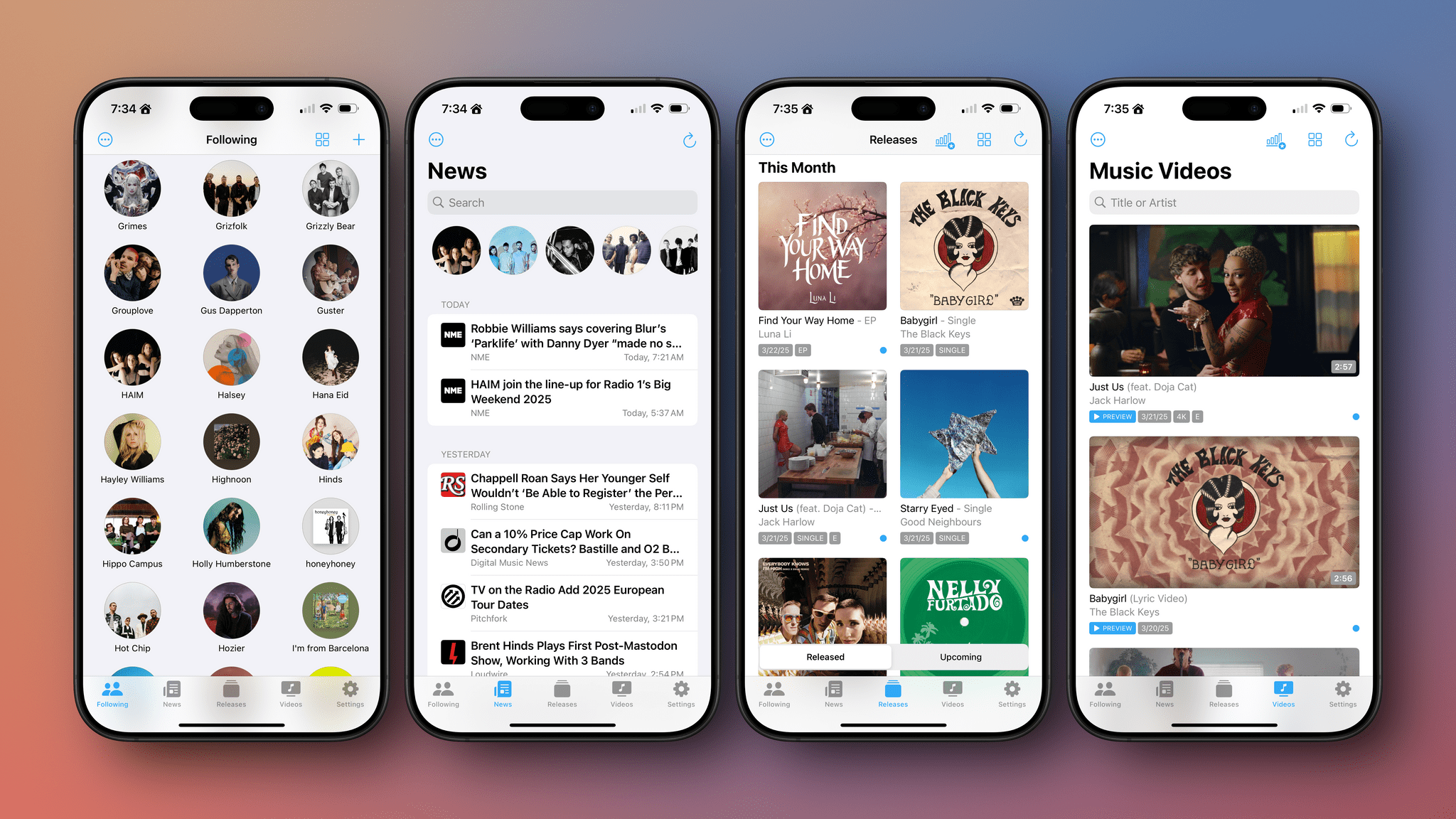
Marcos Tanaka kicked off his App Store career with a real banger when he released MusicHarbor, an app for following the work of your favorite music artists on the iPhone, iPad, and Mac. We awarded MusicHarbor App of the Year in 2020, and since then, it has been steadily updated, making it my go-to app for catching up on my favorite bands. Today, MusicHarbor’s latest update, version 5.0, takes the app even further with new news, top chart, time capsule, and list features.
MusicHarbor’s Latest Update Creates a Richer Music Experience with News and More
Podcast Rewind: Mark Gurman’s Origin Story and Wild GDC Handheld Console Announcements
Enjoy the latest episodes from MacStories’ family of podcasts:
AppStories






In this special interview episode, Federico and I welcome Bloomberg’s Mark Gurman to discuss his 16-year journey covering Apple. Mark shares how he started as a teenage app developer before joining 9to5Mac and eventually Bloomberg. The conversation explores Mark’s most memorable scoops, the evolution of Apple news coverage, his relationship with Apple, and advice for aspiring tech journalists.
This episode is sponsored by:
- Memberful – Easy-to-Use Reliable Membership Software
- Drafts – Where text starts. New and expired subscribers can use the link to get your first year of Drafts for $9.99.
- Tripsy – Your Travel Toolkit. Use the link for 25% off a lifetime purchase or 30% off a 1-Year subscription.
NPC: Next Portable Console
This week, Brendon shares his surprising early impressions of the Ayn Odin Portal. Then Federico, Brendon and I dive into Nintendo Switch 2 pricing rumors, explore the performance issues of Assassin’s Creed Shadows on M4 Macs despite being Steam Deck verified, and break down Qualcomm’s confusing new G-series chips powering upcoming handhelds. Then, the trio reacts to OneXPlayer’s chaotic ONEXSUGAR handheld and AYANEO’s new devices. Plus, Federico has exciting news about a DLSS plugin for Steam Deck that improves performance on games like Final Fantasy VII Rebirth, turning blurry gameplay into a sharp, high-settings experience.
NPC XL
This week on NPC XL, Federico, Brandon and I share their most unusual handheld gaming devices. From my nostalgic Tamagotchi Connection to Brandon’s beast of a modded PSP Go and Federico’s Ashida Wii, the conversation reveals their weird obsessions with handheld gaming.

How I Fixed Switching Between Safari Profiles with BetterTouchTool and a Hyper Key
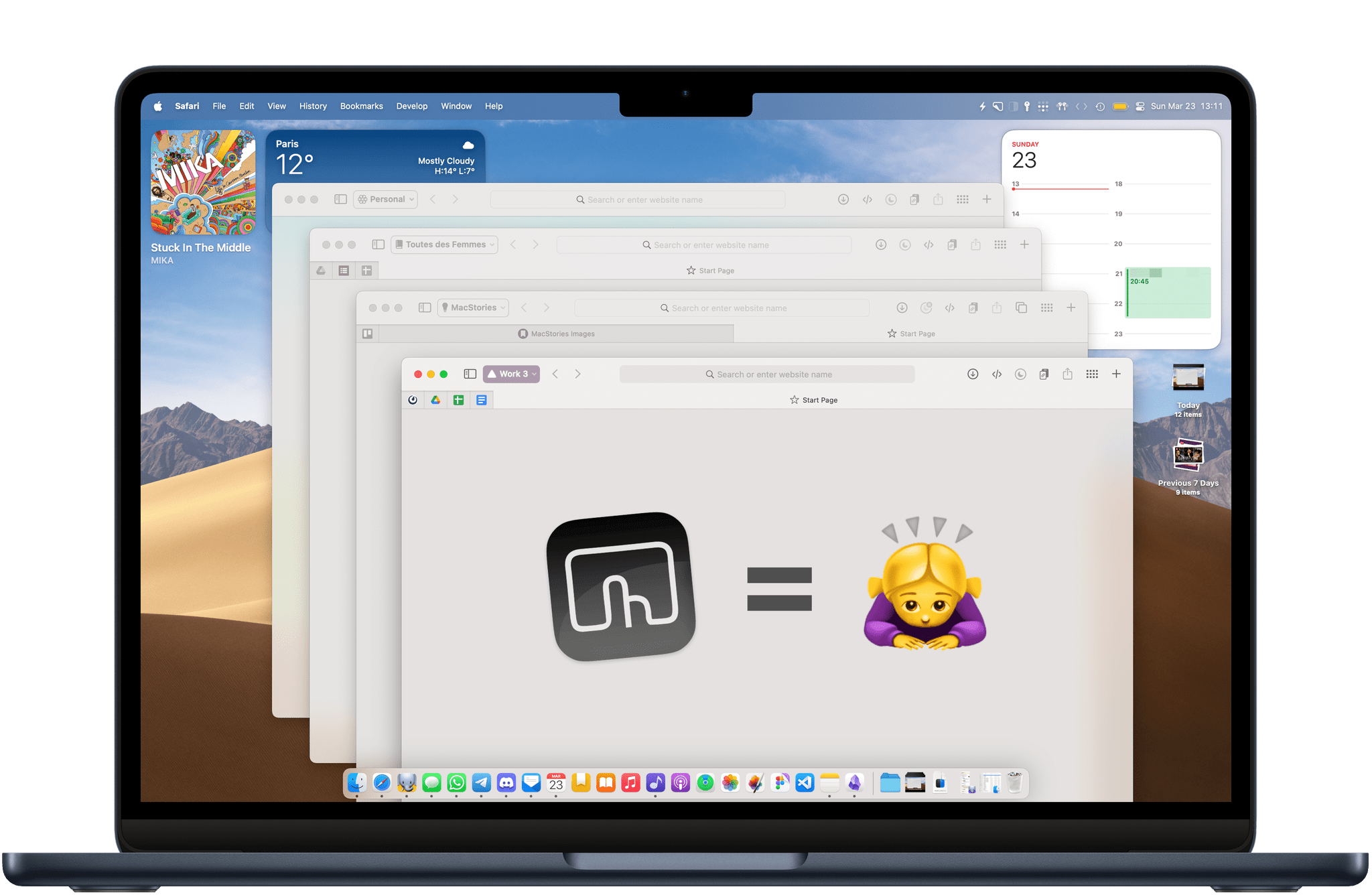
A lot has changed in my professional life over the past year. As of today, I am working fully from home on three separate long-running projects, and now more than ever, the web browser has become central for all three. Since the M2 MacBook Air is my only computer, I found myself in urgent need of a way to allow these virtual workspaces to coexist on the same device.
Fortunately, Apple added profiles to Safari in macOS 14 Sonoma, iOS 17, and iPadOS 17 (then later in visionOS 2). Profiles offer a way to keep your bookmarks, cookies, extensions, and browsing history separate between, say, a Personal profile and a Work profile. Even though Google Chrome and Firefox have had similar solutions in place for a while, Safari remains my web browser of choice, so I wanted to take full advantage of the new feature.
In my prolonged usage, Safari profiles work exactly as intended. I’ve set up four different profiles: a Personal profile and three separate work profiles. They are each logged into a different Google account, and they each have their own set of bookmarks, their own pinned tabs for quick access to relevant tools and web apps, and their own set of extensions. Safari makes it easy enough to tell profile windows apart by allowing you to assign a custom icon and color to each one.
That being said, Safari’s implementation of profiles has one major UI flaw: Apple has made it unusually cumbersome to switch between them on the fly, or even to launch Safari into a specific profile directly. So, to no one’s surprise, I have once again attempted to leverage the power of Mac automation utility BetterTouchTool to come up with a workaround. The solution I’ve arrived at is simple, but it makes a huge difference.
Let me show you.
WWDC 2025 Scheduled for June 9-13 Along with Special Event at Apple Park
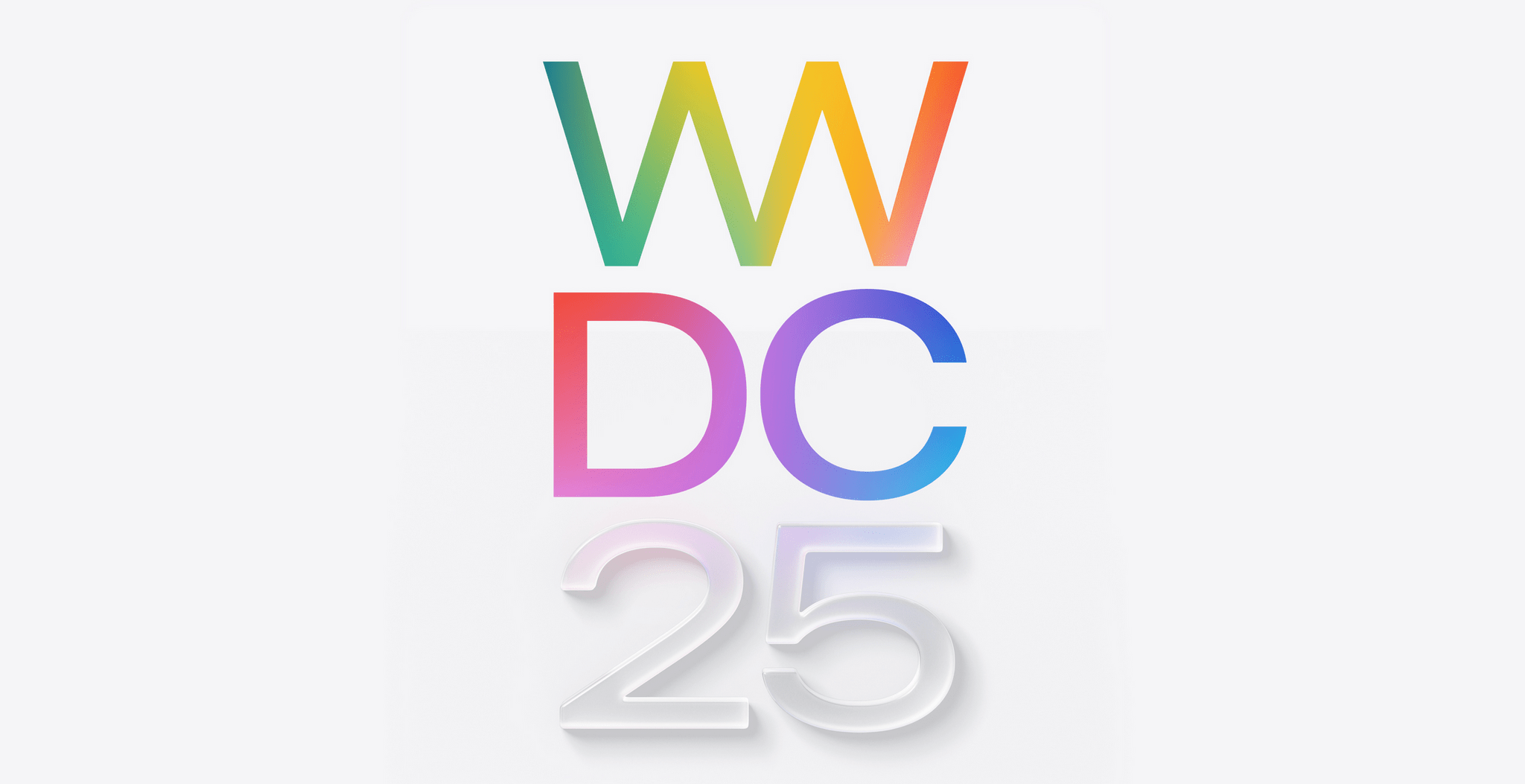
WWDC25 will be held from June 9 - 13 this year and include an in-person experience on June 9 that will provide developers the opportunity to watch the keynote at Apple Park, meet with Apple team members, and take part in special activities. Space will be limited, and details on how to apply to attend can be found on the Apple Developer site and app.
Apple has announced that WWDC 2025 will primarily take place online again this year from June 9-13 2025. However, the company said that it simultaneously will hold a corresponding limited in-person event at Apple Park for developers, students, and press like last year.
In a press release issued by today, Susan Prescott, Apple’s Vice President of Worldwide Developer Relations and Enterprise and Education Marketing, said:
We’re excited to mark another incredible year of WWDC with our global developer community. We can’t wait to share the latest tools and technologies that will empower developers and help them continue to innovate.
Apple also had this to say about events that will be held at Apple Park during the conference:
To celebrate the start of WWDC, Apple will also host an in-person experience on June 9 that will provide developers with the opportunity to watch the Keynote and Platforms State of the Union at Apple Park, meet with Apple experts one-on-one and in group labs, and take part in special activities. Space will be limited; details on how to apply to attend can be found on the WWDC25 website.
As time passes, fewer of the people I used to count on seeing at WWDC attend. I suppose that’s to be expected now that the event is primarily online. However, I’m just as excited as ever for this year’s event. It’s a chance to preview new technology and meet many of the developers whose work we cover. However, with rumors of new hardware on the horizon and a design refresh for all of Apple’s OSes, I’m sure this year’s WWDC will be as interesting as always.
Of course, MacStories readers can expect the same kind of comprehensive WWDC coverage we do every year. We’ll have extensive coverage on MacStories, AppStories, and MacStories Unwind, which will extend to Club MacStories too.
Apple Courts DJs with New DJ with Apple Music Program
Apple has announced a partnership with DJ software and hardware platforms to integrate Apple Music’s catalog into their offerings.
The new program, called DJ with Apple Music, expands on an integration that was already in place for Algoriddim’s djay Pro app adding AlphaTheta, Serato, and inMusic’s Engine DJ, Denon DJ, Numark, and RANE DJ.
In an emailed press release, Apple Music’s Stephen Campbell, Global Head of Dance, Electronic & DJ Mixes said:
Apple Music is committed to supporting DJs. With this latest integration, we’re taking that commitment even further—seamlessly connecting Apple Music with the industry’s leading DJ software and hardware. This innovation brings the full power of Apple Music into the creative workflow, making it easier than ever for DJs to access, play, and discover music in real time.
Starting today, you can visit a dedicated DJ with Apple Music in the Music app on all platforms. There, you’ll find curated playlists picked for DJs by the Apple Music editorial team and links to pages dedicated to each of the participants in the program.
To check out the available playlists and other materials you can follow this link.
Terminology 5: Rebuilt and Better than Ever
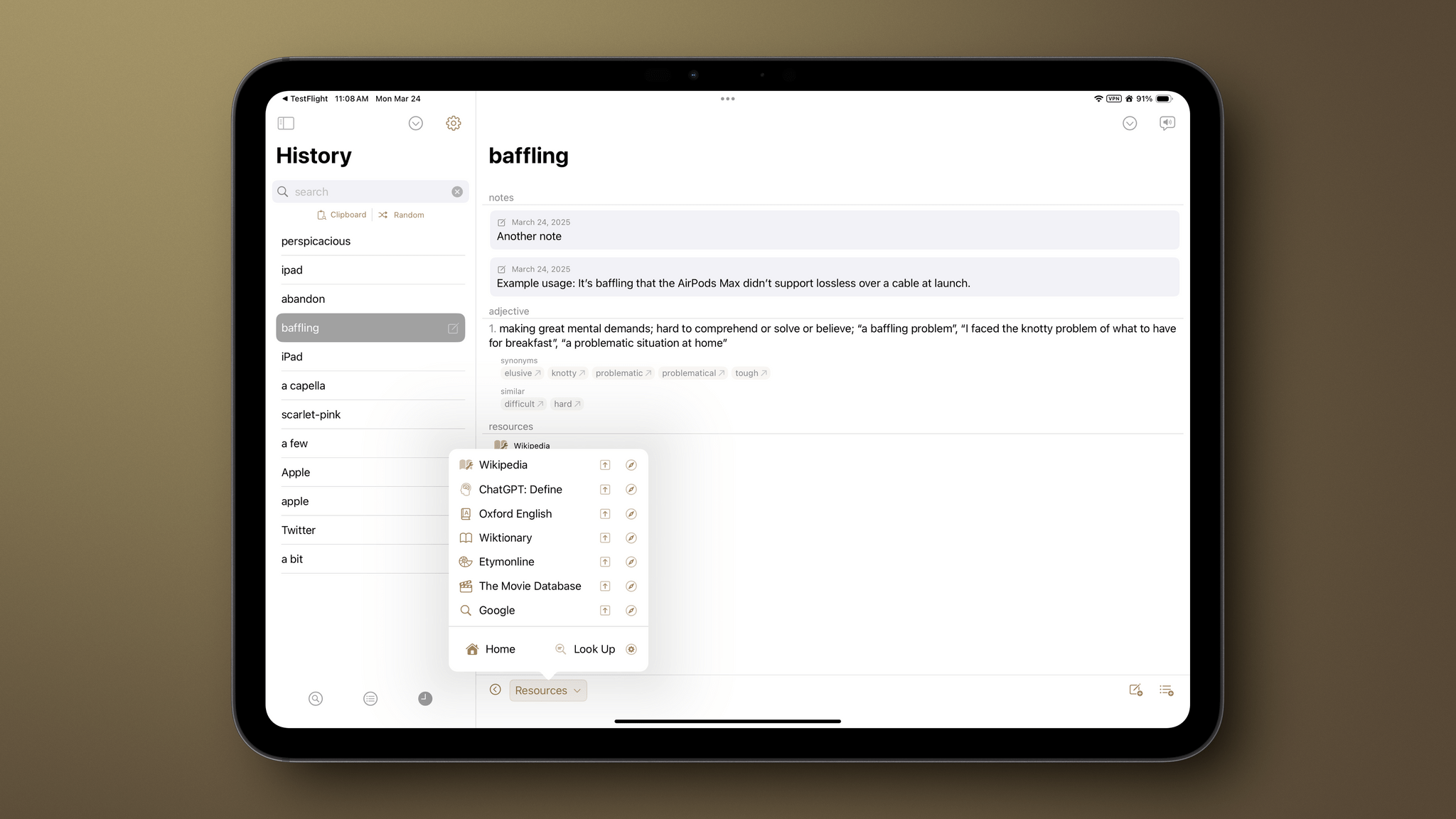
It’s been quite a while since I did a full review of Agile Tortoise’s Terminology, an extensible dictionary and reference tool for the iPhone and iPad. It’s hard to believe the app has been around for 15 years now, but with today’s release of version 5.0, Greg Pierce has introduced a thoroughly modern ground-up rewrite of the app that is richer and more extensible than ever, making it one of my favorite research tools.
Let’s take a look at what’s new.
Opening iOS Is Good News for Smartwatches→
Speaking of opening up iOS to more types of applications, I enjoyed this story by Victoria Song, writing at The Verge about the new EU-mandated interoperability requirements that include, among other things, smartwatches:
This is a big reason why it’s a good thing that the European Commission recently gave Apple marching orders to open up iOS interoperability to other gadget makers. You can read our explainer on the nitty gritty of what this means, but the gist is that it’s going to be harder for Apple to gatekeep iOS features to its own products. Specific to smartwatches, Apple will have to allow third-party smartwatch makers to display and interact with iOS notifications. I’m certain Garmin fans worldwide, who have long complained about the inability to send quick replies on iOS, erupted in cheers.
And this line, which is so true in its simplicity:
Some people just want the ability to choose how they use the products they buy.
Can you imagine if your expensive Mac desktop had, say, some latency if you decided to enter text with a non-Apple keyboard? Or if the USB-C port only worked with proprietary Apple accessories? Clearly, those restrictions would be absurd on computers that cost thousands of dollars. And yet, similar restrictions have long existed on iPhones and the iOS ecosystem, and it’s time to put an end to them.
On Apple Allowing Third-Party Assistants on iOS→
This is an interesting idea by Parker Ortolani: what if Apple allowed users to change their default assistant from Siri to something else?
I do not want to harp on the Siri situation, but I do have one suggestion that I think Apple should listen to. Because I suspect it is going to take quite some time for the company to get the new Siri out the door properly, they should do what was previously unthinkable. That is, open up iOS to third-party assistants. I do not say this lightly. I am one of those folks who does not want iOS to be torn open like Android, but I am willing to sign on when it makes good common sense. Right now it does.
And:
I do not use Gemini as my primary LLM generally, I prefer to use ChatGPT and Claude most of the time for research, coding, and writing. But Gemini has proved to be the best assistant out of them all. So while we wait for Siri to get good, give us the ability to use custom assistants at the system level. It does not have to be available to everyone, heck create a special intent that Google and these companies need to apply for if you want. But these apps with proper system level overlays would be a massive improvement over the existing version of Siri. I do not want to have to launch the app every single time.
As a fan of the progressive opening up of iOS that’s been happening in Europe thanks to our laws, I can only welcome such a proposal – especially when I consider the fact that long-pressing the side button on my expensive phone defaults to an assistant that can’t even tell which month it is. If Apple truly thinks that Siri helps users “find what they need and get things done quickly”, they should create an Assistant API and allow other companies to compete with them. Let iPhone users decide which assistant they prefer in 2025.
Some people may argue that other assistants, unlike Siri, won’t be able to access key features such as sending messages or integrating with core iOS system frameworks. My reply would be: perhaps having a more prominent placement on iOS would actually push third-party companies to integrate with the iOS APIs that do exist. For instance, there is nothing stopping OpenAI from integrating ChatGPT with the Reminders app; they have done exactly that with MapKit, and if they wanted, they could plug into HomeKit, HealthKit, and the dozens of other frameworks available to developers. And for those iOS features that don’t have an API for other companies to support…well, that’s for Apple to fix.
From my perspective, it always goes back to the same idea: I should be able to freely swap out software on my Apple pocket computer just like I can thanks to a safe, established system on my Apple desktop computer. (Arguably, that is also the perspective of, you know, the law in Europe.) Even Google – a company that would have all the reasons not to let people swap the Gemini assistant for anything else – lets folks decide which assistant they want to use on Android. And, as you can imagine, competition there is producing some really interesting results.
I’m convinced that, at this point, a lot of people despise Siri and would simply prefer pressing their assistant button to talk to ChatGPT or Claude – even if that meant losing access to reminders, timers, and whatever it is that Siri can reliably accomplish these days. (I certainly wouldn’t mind putting Claude on my iPhone and leaving Siri on the Watch for timers and HomeKit.) Whether it’s because of superior world knowledge, proper multilingual abilities (something that Siri still doesn’t support!), or longer contextual conversations, hundreds of millions of people have clearly expressed their preference for new types of digital assistance and conversations that go beyond the antiquated skillset of Siri.
If a new version of Siri isn’t going to be ready for some time, and if Apple does indeed want to make the best computers for AI, maybe it’s time to open up that part of iOS in a way that goes beyond the (buggy) ChatGPT integration with Siri.
App Store Vibes→
Bryan Irace has an interesting take on the new generation of developer tools that have lowered the barrier to entry for new developers (and sometimes not even developers) when it comes to creating apps:
Recent criticism of Apple’s AI efforts has been juicy to say the least, but this shouldn’t distract us from continuing to criticize one of Apple’s most deserving targets: App Review. Especially now that there’s a perfectly good AI lens through which to do so.
It’s one thing for Apple’s AI product offerings to be non-competitive. Perhaps even worse is that as Apple stands still, software development is moving forward faster than ever before. Like it or not, LLMs—both through general chat interfaces and purpose-built developer tools—have meaningfully increased the rate at which new software can be produced. And they’ve done so both by making skilled developers more productive while also lowering the bar for less-experienced participants.
And:
I recently built a small iOS app for myself. I can install it on my phone directly from Xcode but it expires after seven days because I’m using a free Apple Developer account. I’m not trying to avoid paying Apple, but there’s enough friction involved in switching to a paid account that I simply haven’t been bothered. And I used to wrangle provisioning profiles for a living! I can’t imagine that I’m alone here, or that others with less tribal iOS development knowledge are going to have a higher tolerance for this. A friend asked me to send the app to them but that’d involve creating a TestFlight group, submitting a build to Apple, waiting for them to approve it, etc. Compare this to simply pushing to Cloudflare or Netlify and automatically having a URL you can send to a friend or share via Twitter. Or using tools like v0 or Replit, where hosting/distribution are already baked in.
Again, this isn’t new—but being able to build this much software this fast is new. App distribution friction has stayed constant while friction in all other stages of software development has largely evaporated. It’s the difference between inconvenient and untenable.
Perhaps “vibe coding” is the extreme version of this concept, but I think there’s something here. Creating small, low-stakes apps for personal projects or that you want to share with a small group of people is, objectively, getting easier. After reading Bryan’s post – which rightfully focuses on the distribution side of apps – I’m also wondering: what happens when the first big service comes along and figures out a way to bypass the App Store altogether (perhaps via the web?) to allow “anyone” to create apps, completely cutting out Apple and its App Review from the process?
In a way, this reminds me of blogging. Those who wanted to have an online writing space 30 years ago had to know some of the basics of hosting and HTML if they wanted to publish something for other people to read. Then Blogger came along and allowed anyone – regardless of their skill level – to be read. What if the same happened to mobile software? Should Apple and Google be ready for this possibility within the next few years?
I could see Google spin up a “Build with Gemini” initiative to let anyone create Android apps without any coding knowledge. I’m also reminded of this old Vision Pro rumor that claimed Apple’s Vision team was exploring the idea of letting people create “apps” with Siri.
If only the person in charge of that team went anywhere, right?