The MacStories Selects 2022 Lifetime Achievement Award

Drafts

When we chose the second annual lifetime achievement award winner, there was no doubt in my mind that it should be Drafts. Developed and maintained by Greg Pierce of Agile Tortoise, Drafts has been the place where text starts on iOS for nearly a decade now. Times have certainly changed, but Drafts remains. Through the years, it has evolved into so much more than the simple text utility it once was.

While it has evolved, the most beautiful thing about Drafts has been the fervent dedication to its original mission statement. If you are about to type some text – any text — on your iPhone or iPad (and even, in modern times, your Mac), you should open Drafts. The app is so focused on text capture that it defaults to opening a new blank “draft” every time you open the app.

Writing text is only as useful as what you do with it, so the second pillar of the Drafts mission is its action menu; an infinitely customizable list of actions that allow you manipulate and send text from the app to essentially anywhere else you can think of. From random web services to other native apps on your devices, Drafts can almost certainly deliver your text. As your words get delivered throughout your entire digital life, you can take comfort in knowing that you can always search for and find anything you’ve written simply by looking up its record in Drafts.
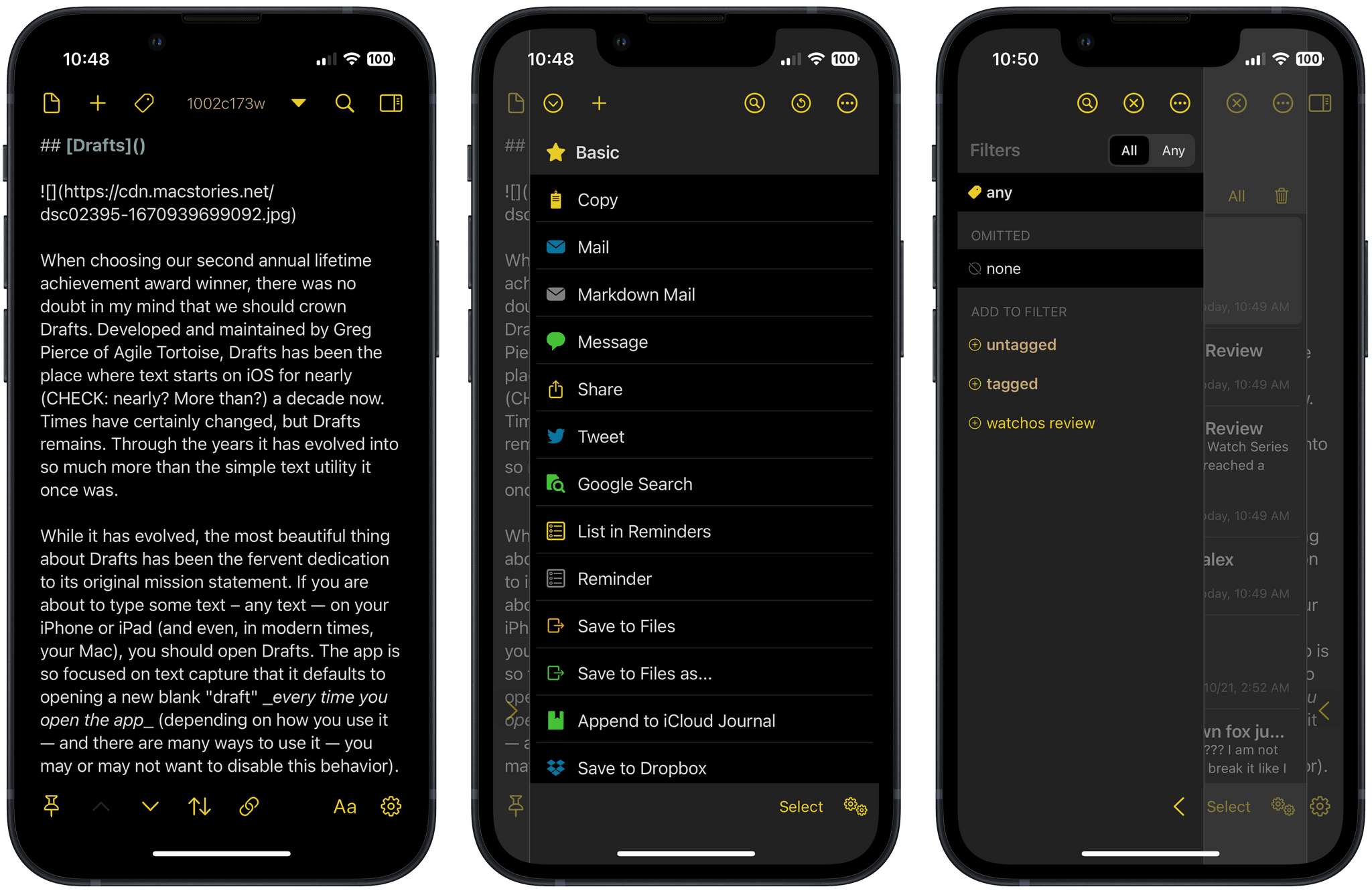
Drafts in 2022. From left: the editing view, the action menu, and the filtering view.

Drafts in 2022. From left: the editing view, the action menu, and the filtering view.

It amazes me that after hearing that pitch (and even personally writing about it) again and again for over a decade, I still find it to be an alluring idea. Drafts’ longevity is a testament to the prescience of Pierce’s original vision. It pleases me immensely to see this app carrying on for so long, and it’s an honor to award it MacStories’ Lifetime Achievement award.
Read more

Access Extra Content and Perks

Founded in 2015, Club MacStories has delivered exclusive content every week for nearly a decade.

What started with weekly and monthly email newsletters has blossomed into a family of memberships designed for every MacStories fan.

Learn more here and from our Club FAQs.

Club MacStories: Weekly and monthly newsletters via email and the web that are brimming with apps, tips, automation workflows, longform writing, early access to the MacStories Unwind podcast, periodic giveaways, and more;

Club MacStories+: Everything that Club MacStories offers, plus an active Discord community, advanced search and custom RSS features for exploring the Club’s entire back catalog, bonus columns, and dozens of app discounts;

Club Premier: All of the above and AppStories+, an extended version of our flagship podcast that’s delivered early, ad-free, and in high-bitrate audio.

Learn more here and from our Club FAQs.


Last Week, on Club MacStories: AV Club Returns to Club MacStories+, the Club Is on Mastodon, and a Fun Experiment That Almost Went Too Far

Because Club MacStories now encompasses more than just newsletters, we’ve created a guide to the past week’s happenings along with a look at what’s coming up next:

MacStories Weekly: Issue 349

Access Extra Content and Perks

Founded in 2015, Club MacStories has delivered exclusive content every week for nearly a decade.

What started with weekly and monthly email newsletters has blossomed into a family of memberships designed for every MacStories fan.

Learn more here and from our Club FAQs.

Club MacStories: Weekly and monthly newsletters via email and the web that are brimming with apps, tips, automation workflows, longform writing, early access to the MacStories Unwind podcast, periodic giveaways, and more;

Club MacStories+: Everything that Club MacStories offers, plus an active Discord community, advanced search and custom RSS features for exploring the Club’s entire back catalog, bonus columns, and dozens of app discounts;

Club Premier: All of the above and AppStories+, an extended version of our flagship podcast that’s delivered early, ad-free, and in high-bitrate audio.

Learn more here and from our Club FAQs.


Making ActivityPub Your Social Media Hub for Mastodon and Other Decentralized Services

For many people who have stepped away from Twitter, Mastodon is their first experience with a decentralized social network. There’s a lot that can be said about the pros and cons of decentralization, but I want to focus on one very specific technical feature that Mastodon shares with a growing list of other services: ActivityPub.

ActivityPub is a W3C-recommended standard that was published by its Social Web Working Group almost five years ago and defines a decentralized social networking protocol for client apps and servers that connect them. The benefit to users is interoperability among services that adopt the protocol.

In practice, that means users of one ActivityPub service can follow and interact with users of a different service, which opens up some interesting possibilities. Tumblr seems to agree. The company plans to add ActivityPub support, so its users can interact with Mastodon’s users. That news piqued my interest in ActivityPub, but I’m not patient enough to wait for Tumblr to add support. I wanted to take two ActivityPub services for a spin now, so I set up a Pixelfed account on pixelfed.social.

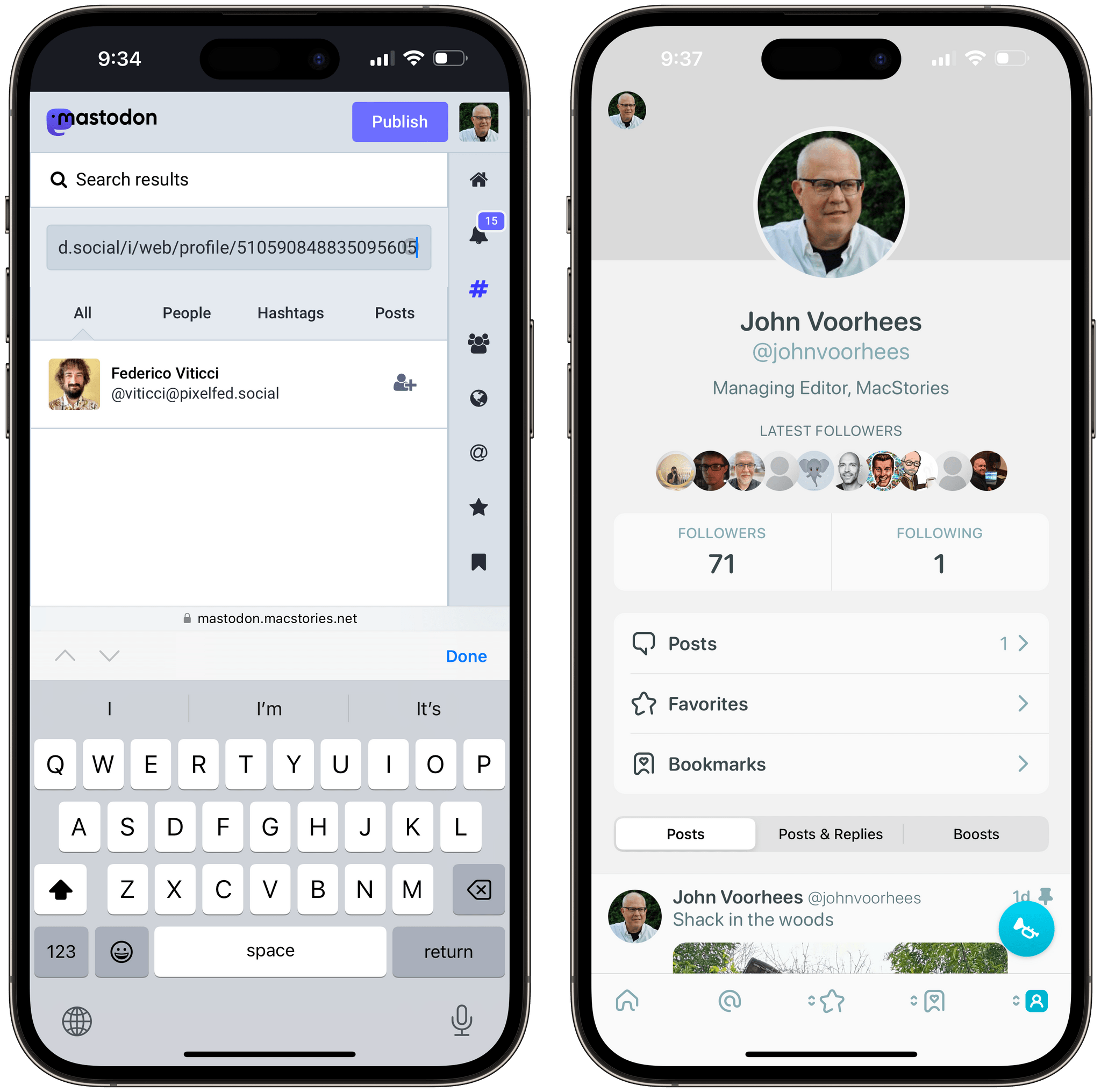
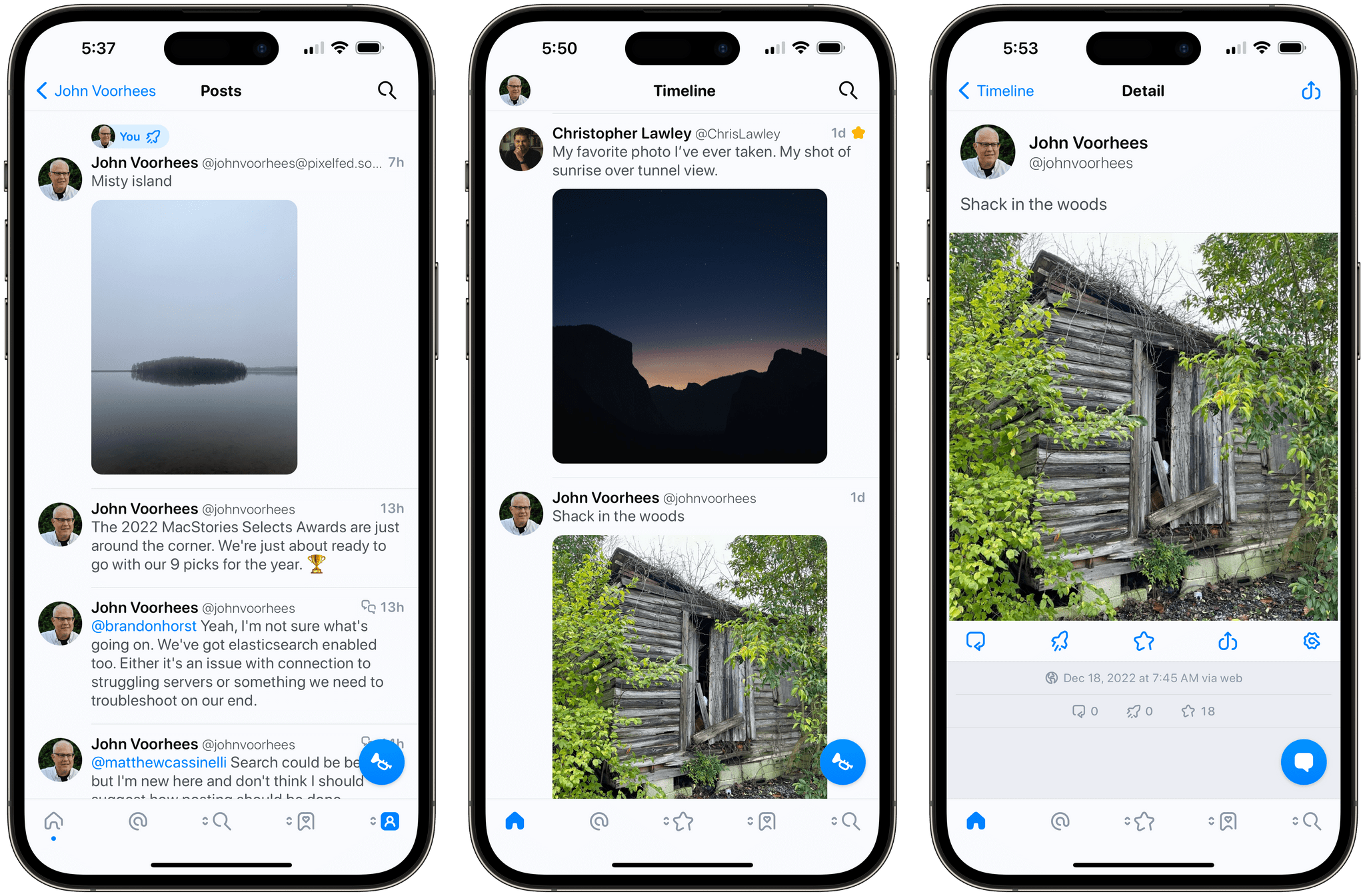
Following Federico using Mastodon's web app (left) and my Pixelfed profile viewed from Tapbots' Ivory Mastodon app (right).

Following Federico using Mastodon’s web app (left) and my Pixelfed profile viewed from Tapbots’ Ivory Mastodon app (right).

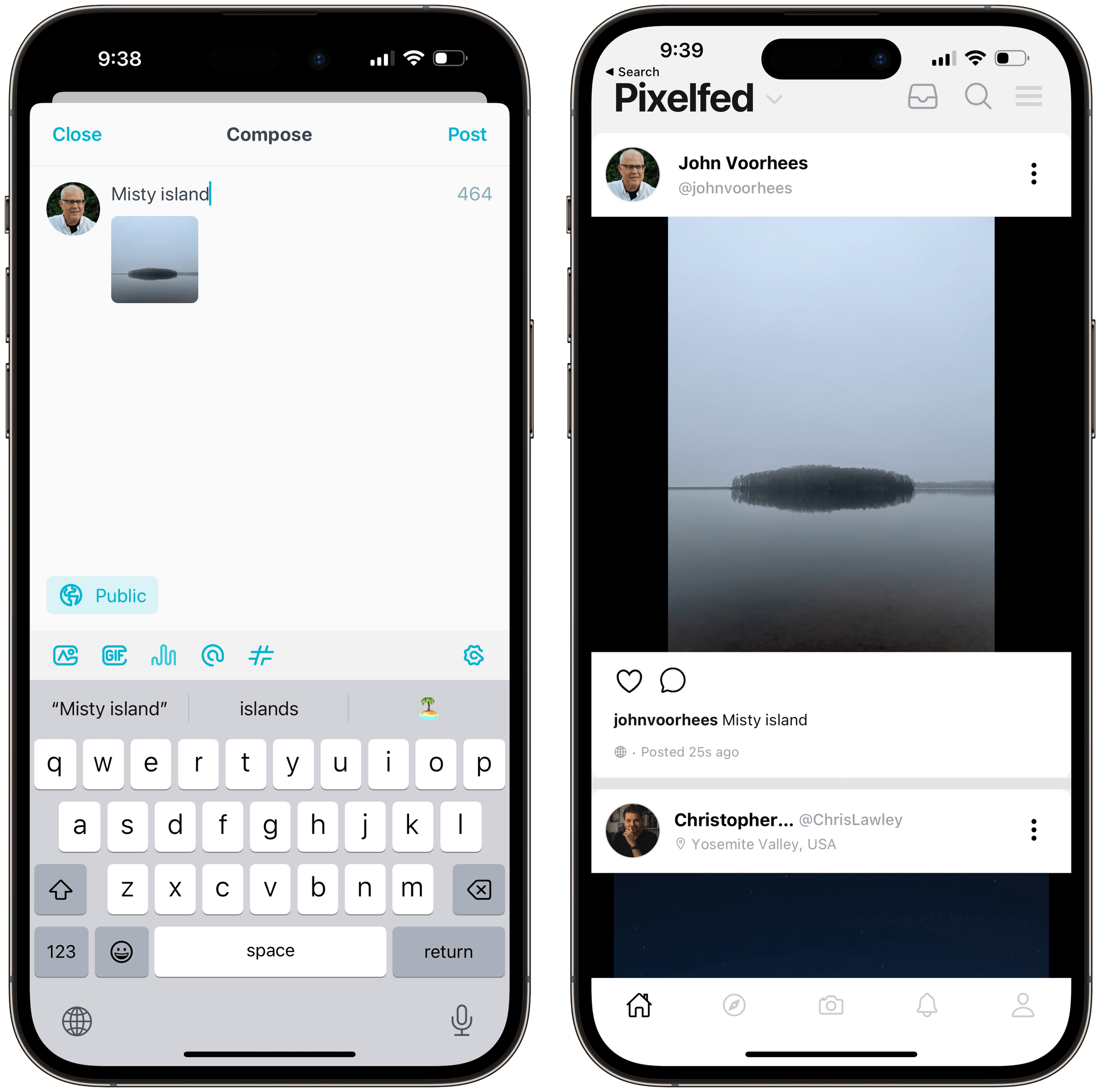
Pixelfed is sort of like a decentralized version of Instagram that has adopted the ActivityPub protocol. Users can post photos, follow other users, and send each other messages. The service recently started beta testing an iOS app that is available on TestFlight, so I downloaded it, set up an account, and posted about it on Mastodon.

Because Pixelfed and Mastodon servers both comply with ActivityPub, anyone can follow my Pixelfed account from Mastodon without having to create a Pixelfed account or download the app, which is exactly what Federico did:

In practice, following someone’s Pixelfed feed is even easier. Instead of searching for my username, Federico could have searched for the URL for my Pixelfed profile in a Mastodon app and followed me that way. It’s worth noting, though, that not all Mastodon apps support searching for non-Mastodon servers. If you have trouble adding someone to your Mastodon feed, try Mastodon’s web app, which I’ve tried and know works. Also, be patient because some Pixelfed servers like pixelfed.social are struggling with an influx of new users that have hurt its reliability.

Photos posted from Mastodon (left) appear in the Pixelfed app too (right).

Photos posted from Mastodon (left) appear in the Pixelfed app too (right).

As the owner of a Pixelfed account, ActivityPub provides me some additional benefits too. First, I added my Pixelfed account to Ivory, the Tapbots Mastodon app that’s currently in alpha testing. That lets me post photos and respond to followers in the same app I’m using for Mastodon, which is nice. I’ve also followed my Pixelfed account from my Mastodon account, which allows me to view my posts from my Mastodon feed and boost them to my Mastodon followers, creating the equivalent of cross-posting on two services without actually posting separately to both.

Although there are a growing number of services that support ActivityPub, including PeerTube, a YouTube alternative for video, micro.blog, which supports parts of the protocol, and many others, it’s still early days for the protocol. However, with Twitter reminding users of the peril of relying on a centralized service provider, the pace of ActivityPub adoption is picking up, which should make 2023 a very interesting year for the open web.

Access Extra Content and Perks

Founded in 2015, Club MacStories has delivered exclusive content every week for nearly a decade.

What started with weekly and monthly email newsletters has blossomed into a family of memberships designed for every MacStories fan.

Learn more here and from our Club FAQs.

Club MacStories: Weekly and monthly newsletters via email and the web that are brimming with apps, tips, automation workflows, longform writing, early access to the MacStories Unwind podcast, periodic giveaways, and more;

Club MacStories+: Everything that Club MacStories offers, plus an active Discord community, advanced search and custom RSS features for exploring the Club’s entire back catalog, bonus columns, and dozens of app discounts;

Club Premier: All of the above and AppStories+, an extended version of our flagship podcast that’s delivered early, ad-free, and in high-bitrate audio.

Learn more here and from our Club FAQs.


Kolide: Endpoint Security Shouldn’t Mean Compromising Employee Privacy [Sponsor]

“If you build a dystopian and cynical security program born out of fear, mistrust, and suspicion, then you will inevitably make your fellow employees your enemies.”

That’s a quote from Honest Security, Kolide’s mission statement, and North Star. It was written by its CEO, Jason Meller, who spent his career in cybersecurity before founding Kolide. 

He was troubled by the widely-accepted idea among cybersecurity professionals that end users should be treated, first and foremost, as threats. This way of thinking informs the traditional approach to device management, which relies on MDMs that take control of devices and come with surveillance capabilities that most companies don’t need or even really want.

Kolide works by notifying your employees of security issues via Slack, educating them on why they’re important, and giving them step-by-step instructions to resolve them themselves.

Kolide’s open-source agent collects data across 43 categories on Mac, Windows, and Linux devices. It can answer questions like:

  • Do any of my developers have unsecured SSH keys floating around?
  • Does everyone have disk encryption, screen lock, and password managers set up?
  • Are there any Macs in my fleet in need of a new battery?

And while Kolide can provide insights that MDMs can’t, its commitment to transparency really sets it apart. Employees can visit the User Privacy Center for an explanation of precisely what data is being collected, by whom, and for what purpose.

Want to see how it works for you? Click here for a free trial, no credit card required, and let us show you what we’re all about.

Our thanks to Kolide for sponsoring MacStories this week.

Access Extra Content and Perks

Founded in 2015, Club MacStories has delivered exclusive content every week for nearly a decade.

What started with weekly and monthly email newsletters has blossomed into a family of memberships designed for every MacStories fan.

Learn more here and from our Club FAQs.

Club MacStories: Weekly and monthly newsletters via email and the web that are brimming with apps, tips, automation workflows, longform writing, early access to the MacStories Unwind podcast, periodic giveaways, and more;

Club MacStories+: Everything that Club MacStories offers, plus an active Discord community, advanced search and custom RSS features for exploring the Club’s entire back catalog, bonus columns, and dozens of app discounts;

Club Premier: All of the above and AppStories+, an extended version of our flagship podcast that’s delivered early, ad-free, and in high-bitrate audio.

Learn more here and from our Club FAQs.


MacStories Unwind: The Best Videogames of 2022

AppStories+ Deeper into the world of apps
0:00
27:50

AppStories+ Deeper into the world of apps


This week on MacStories Unwind, Federico and John share their favorite videogames of 2022.

The Best Videogames of 2022

Joint Picks:

Federico’s Picks:

John’s Pick:

Games We Want to Return to Later:

Follow us on Mastodon

Follow us on Instagram

Access Extra Content and Perks

Founded in 2015, Club MacStories has delivered exclusive content every week for nearly a decade.

What started with weekly and monthly email newsletters has blossomed into a family of memberships designed for every MacStories fan.

Learn more here and from our Club FAQs.

Club MacStories: Weekly and monthly newsletters via email and the web that are brimming with apps, tips, automation workflows, longform writing, early access to the MacStories Unwind podcast, periodic giveaways, and more;

Club MacStories+: Everything that Club MacStories offers, plus an active Discord community, advanced search and custom RSS features for exploring the Club’s entire back catalog, bonus columns, and dozens of app discounts;

Club Premier: All of the above and AppStories+, an extended version of our flagship podcast that’s delivered early, ad-free, and in high-bitrate audio.

Learn more here and from our Club FAQs.


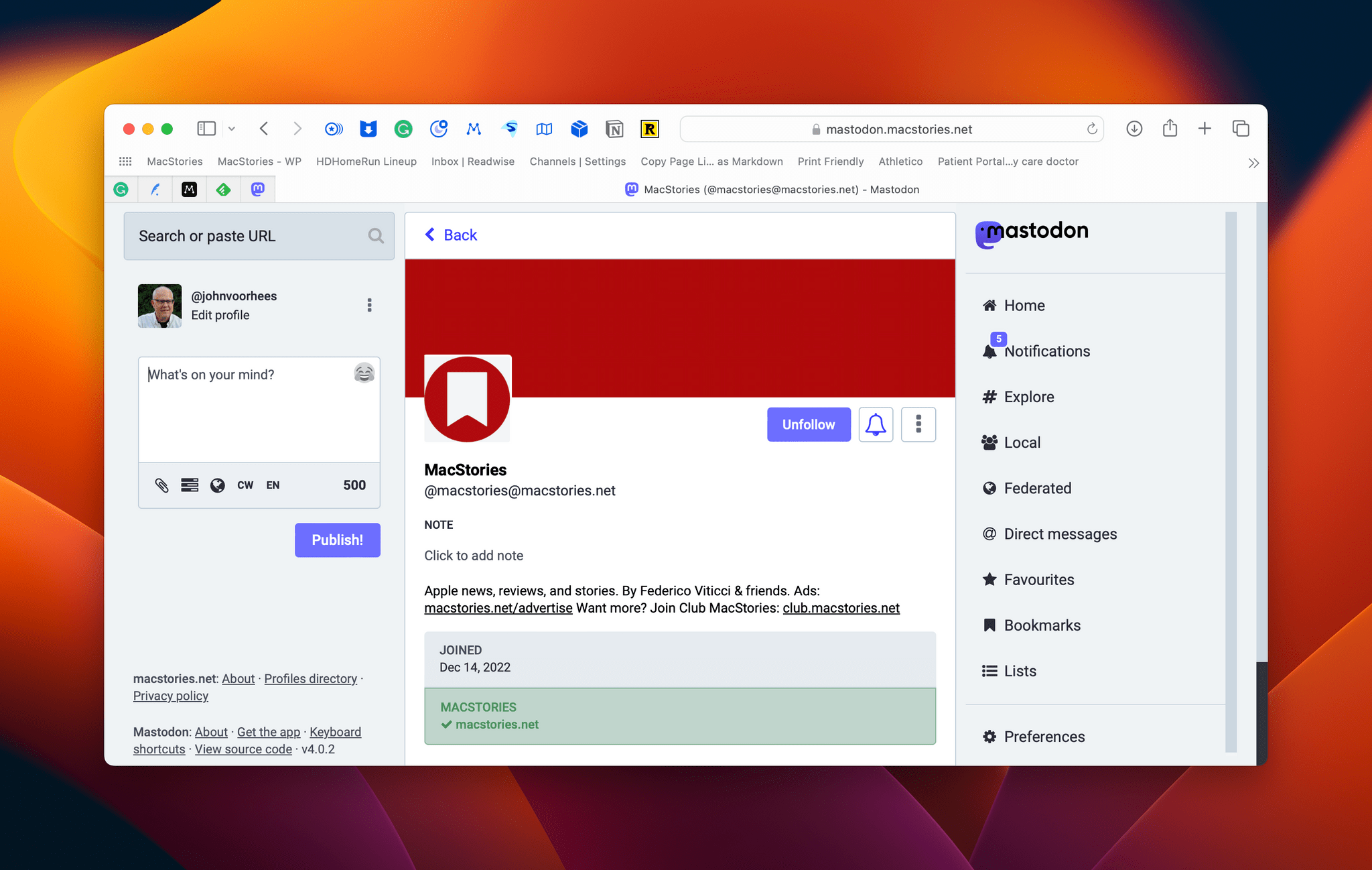
MacStories Is on Mastodon with Its Own Server

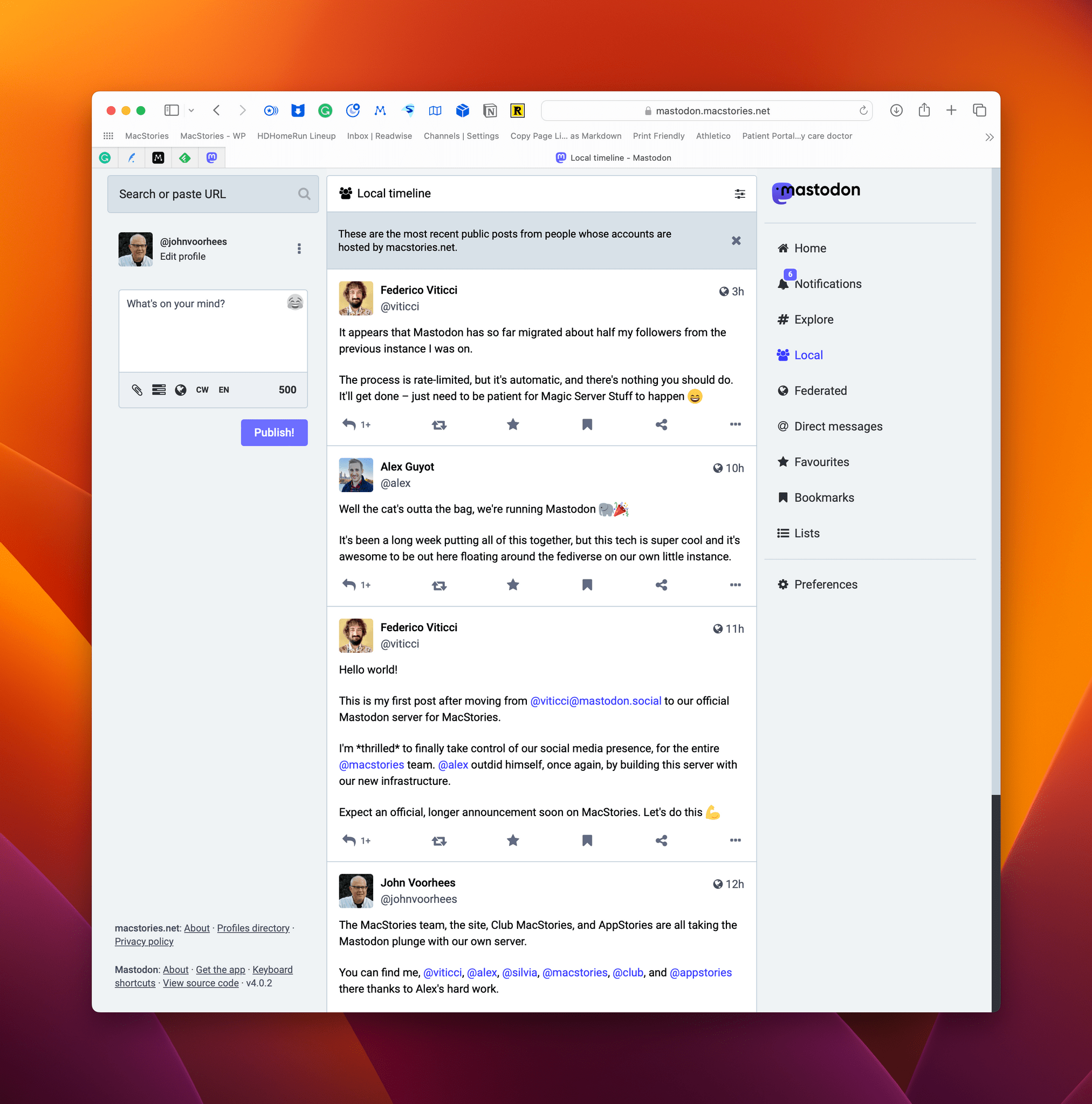
As of today, MacStories is officially on Mastodon with its own server for each of its properties and team members. You can find us here:

The new MacStories Mastodon account.

The new MacStories Mastodon account.

We’re not closing down our Twitter accounts (yet), but as you may have noticed, they haven’t been active lately and won’t be going forward. That’s because we’ve grown increasingly uncomfortable with the direction the company is heading. If you’ve been keeping up with the news, you know what I mean. If you haven’t, I highly recommend Casey Newton’s recent piece on Platformer. Casey’s perspective and reasons for winding down his personal and business presence on Twitter are very close to our own.

Although I’ll miss what Twitter was at its best and always remember what it’s meant to me professionally, I’m excited to be moving on too. I don’t know if Mastodon will be the next big thing, but it doesn’t have to be. It gives us a place to experiment and expand the places we connect with the MacStories audience, which we’re eager to do.

Read more

Access Extra Content and Perks

Founded in 2015, Club MacStories has delivered exclusive content every week for nearly a decade.

What started with weekly and monthly email newsletters has blossomed into a family of memberships designed for every MacStories fan.

Learn more here and from our Club FAQs.

Club MacStories: Weekly and monthly newsletters via email and the web that are brimming with apps, tips, automation workflows, longform writing, early access to the MacStories Unwind podcast, periodic giveaways, and more;

Club MacStories+: Everything that Club MacStories offers, plus an active Discord community, advanced search and custom RSS features for exploring the Club’s entire back catalog, bonus columns, and dozens of app discounts;

Club Premier: All of the above and AppStories+, an extended version of our flagship podcast that’s delivered early, ad-free, and in high-bitrate audio.

Learn more here and from our Club FAQs.


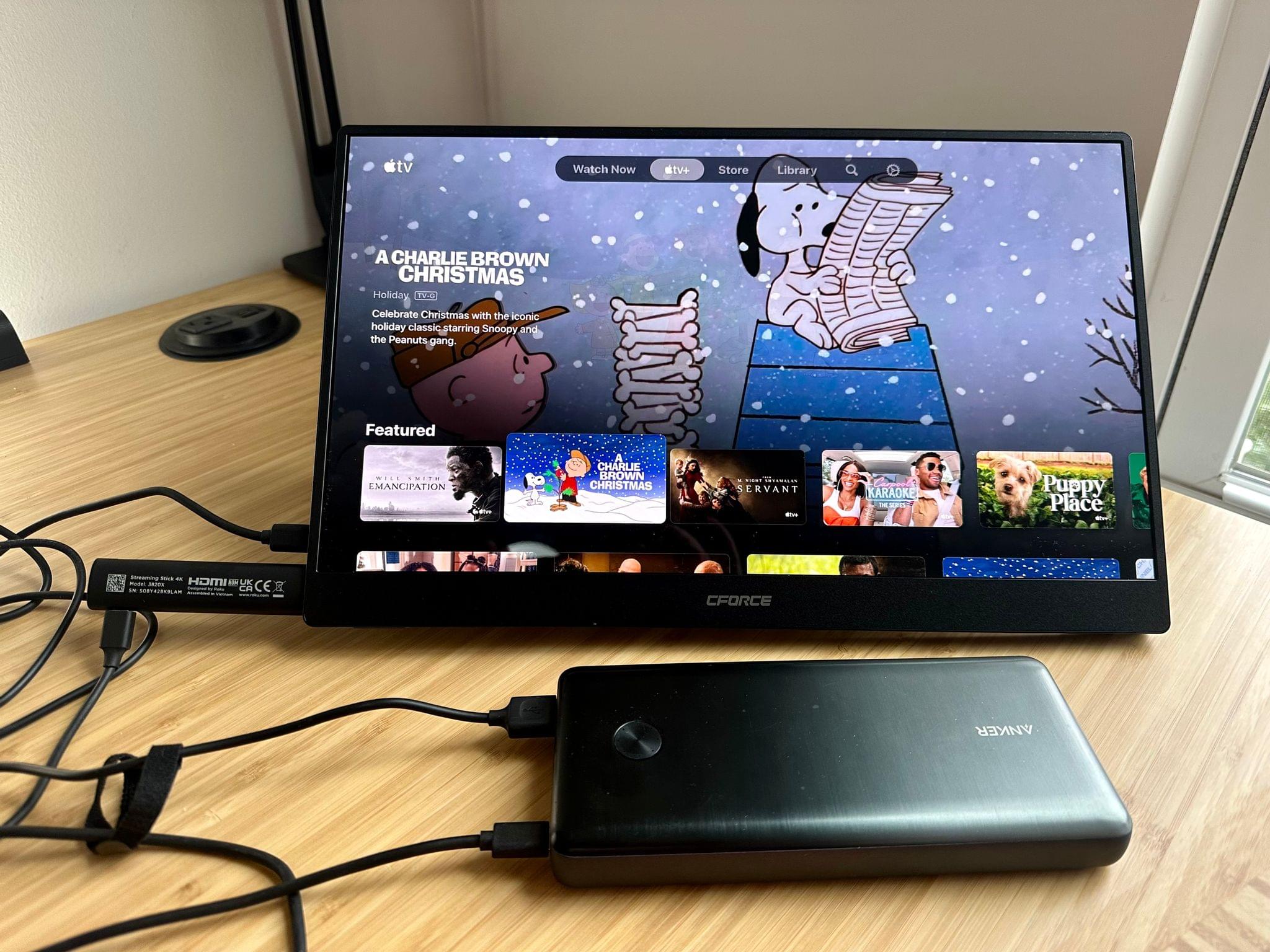
AppStories, Episode 309 – Gone but Not Forgotten: The Third-Party Apps (Part 1)

This week on AppStories, we extend last week’s ‘Gone but Not Forgotten’ theme to third-party apps, including Dropbox text editors, Twitter apps, email clients, and more.

Sponsored by:

  • Pillow – Sleeping better, made simple.
  • Memberful – Monetize your passion with membership.

On AppStories+, I have a gripe about TV app sports notifications, and Federico experiments with Siri and wonders if he should set up a second home in his garage.

We deliver AppStories+ to subscribers with bonus content, ad-free, and at a high bitrate early every week.

To learn more about the benefits included with an AppStories+ subscription, visit our Plans page, or read the AppStories+ FAQ.

Permalink

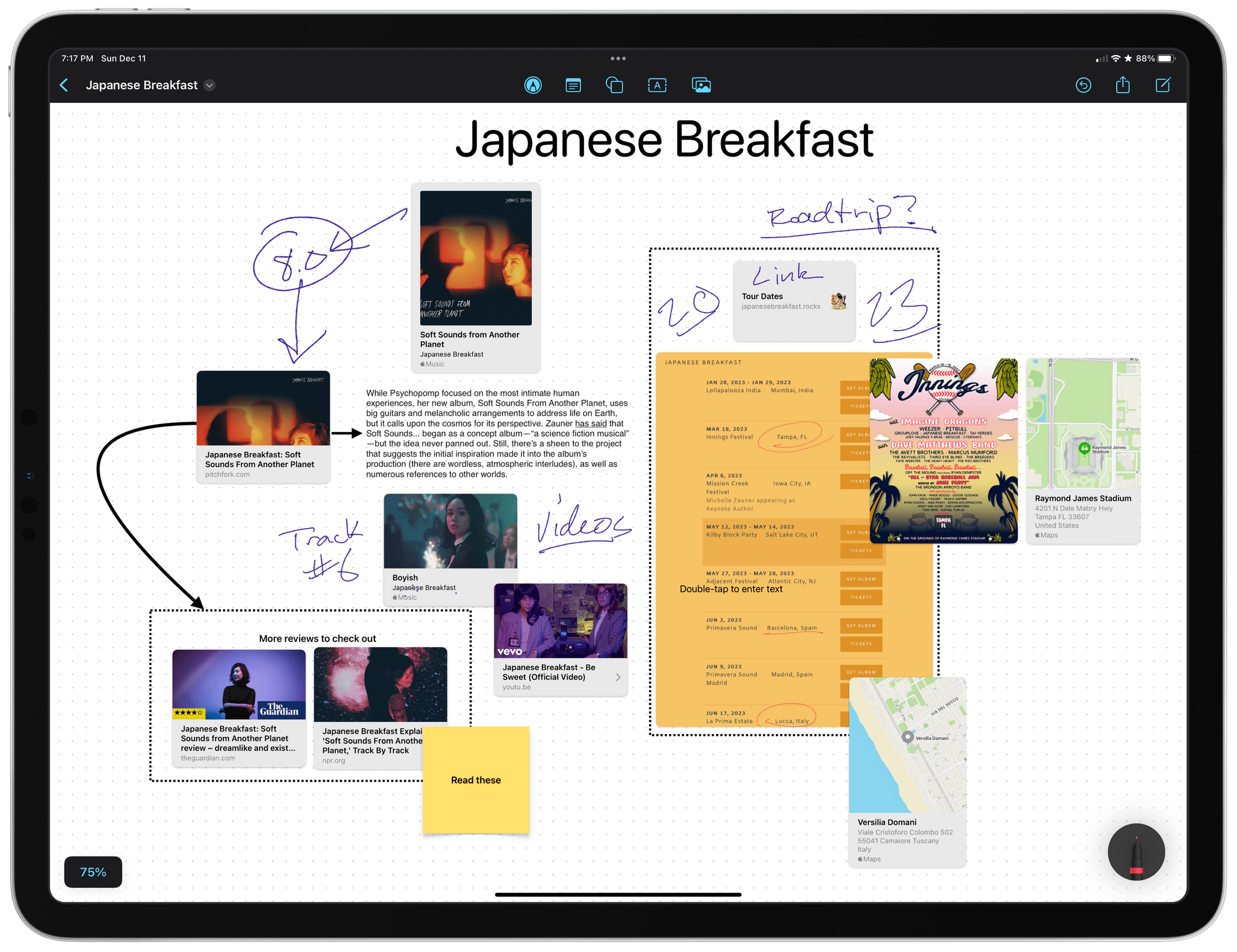
Freeform Leverages the Freedom and Flexibility of a Blank Canvas

Freeform is a brand new iPhone, iPad, and Mac app from Apple that lets users create multimedia boards on an infinite canvas that include text, images, drawings, links, files, and more. It’s an ambitious entry into a crowded category of apps that take overlapping approaches, emphasizing everything from note-taking to collaborative design to whiteboarding.

As is so often the case with Apple’s system apps, Freeform falls squarely in the middle of the landscape of existing apps. Freeform isn’t going to replace apps that are deeply focused on a narrow segment of apps in the blank canvas category. Instead, Freeform is targeted at a broader audience, many of whom have probably never even considered using this sort of app. For them, and for anyone who has felt constrained by more linear, text-based ways of exploring ideas, Freeform is a perfect solution.

At first blush, Freeform’s spare interface may give the impression that it’s a bare-bones 1.0 release, but that’s not the case. The app is easy to use and impressively feature-rich for a new release. So, let’s dig into the details to see what it can do.

Read more

Access Extra Content and Perks

Founded in 2015, Club MacStories has delivered exclusive content every week for nearly a decade.

What started with weekly and monthly email newsletters has blossomed into a family of memberships designed for every MacStories fan.

Learn more here and from our Club FAQs.

Club MacStories: Weekly and monthly newsletters via email and the web that are brimming with apps, tips, automation workflows, longform writing, early access to the MacStories Unwind podcast, periodic giveaways, and more;

Club MacStories+: Everything that Club MacStories offers, plus an active Discord community, advanced search and custom RSS features for exploring the Club’s entire back catalog, bonus columns, and dozens of app discounts;

Club Premier: All of the above and AppStories+, an extended version of our flagship podcast that’s delivered early, ad-free, and in high-bitrate audio.

Learn more here and from our Club FAQs.