This Week's Sponsor:

HomeSnap

A Private, Read-Only Window Into Your HomeKit Home


T-Mobile UK iPad 2 Subsidies: No 32 GB and 64 GB Models Tomorrow, 2-Year Contract

According to Geeky Gadgets, carrier T-Mobile UK will begin selling the iPad 2 tomorrow with online and phone orders, and there will be upgrade options (with different prices) for owners of the original iPad.  The website reports the following prices with a 2-year contract:

  • iPad 2 16 GB WiFi + 3G:  £199 upfront + £25 per month for existing customers
  • iPad 2 16 GB WiFi + 3G:: £229 upfront + £27 per month for new customers

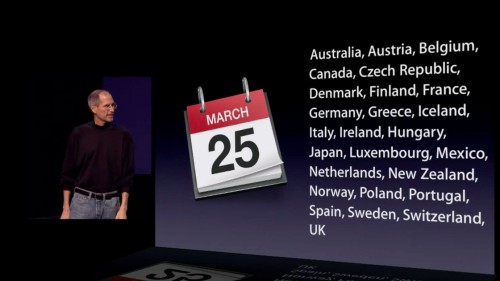
The two-year contract with T-Mobile UK gives 1 GB of data per month and an additional “quiet time” 1 GB for usage between 12 AM and 10 AM. Online and phone orders with T-Mobile UK will start tomorrow at 5 PM – same applies if you want to buy an iPad 2 at the Apple Store tomorrow in the 25 countries that will get the device.


iPad 2 Price Comparison Across The World

Thanks to Italian blog Setteb.it you can easily check how much the iPad 2 price varies across most of the 25 countries launching the iPad 2 tomorrow. As is always the case for internationally sold products, and for a variety of reasons, the price varies quite substantially from country to country - even when currency and tax discrepancies are removed. The iPad 2 is no exception and some countries are paying a little more than their US counterparts, whilst some are paying far more.

The site tried to take the key variables of currency and tax out of the comparison by converting the local prices into the Euro and adding a rough sales tax average of 9.2% to the US prices. What was revealed was that the US had the cheapest prices for the iPad 2 but Australia was not far behind, only 14 Euros more expensive on the base 16GB WiFi only model and had the next cheapest prices for every other model except the 64GB WiFi + 3G which New Zealand had for the second cheapest price at only 18 Euros more than the US.

Comparatively the iPad 2 had the highest markup in Sweden and Norway at 100 Euros more for the 16GB WiFi model in Sweden and more than a 200 Euro markup in Norway for the 64GB WiFi + 3G. Click here for the full table of prices.

[Via TUAW]


Happy Birthday, OS X!

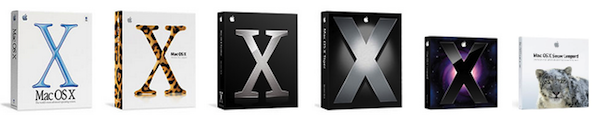
Ten years ago today, on March 24th 2001, Apple released Mac OS X 10.0 Cheetah. Now ten years on, OS X has evolved into what we know and love as being Snow Leopard, that latest major update to OS X.

Between the original, and rather buggy version of OS X, Cheetah and Snow Leopard now, we had 10.1 Puma (September 2001), 10.2 Jaguar (August 2002), 10.3 Panther (October 2003), 10.4 Tiger (April 2005) and 10.5 Leopard (October 2007). With just a few short months before the summer, we don’t have much longer to wait until OS X 10.7 Lion arrives and brings a convergence of traditional desktop OS design and iOS design together into one great operating system.

So Happy Birthday OS X! If you’re feeling nostalgic you might want to have a read of the Wikipedia page on OS X which gives a nice synopsis of the major feature additions each release brought and jump the break to watch Steve Jobs introduce OS X at the 2000 MacWorld.

Read more


The Big Data Center Theory

Data Center Theory Banner

Data Center Theory Banner

Amidst news about the departure of Bertrand Serlet, this morning has seen some outstanding opinions about what Apple will do with their data-center in Maiden, North Carolina. Combined with the unrelated rumors that Apple could license AirPlay to consumer-electronics makers, and we have various pieces of the puzzle that when brought together give pundits food-for-thought.

It’s stupid at this point to speculate whether Apple’s data-center is being built for delivering iTunes content and MobileMe: that answer was satisfied by COO Tim Cook at their shareholder meeting last month. Yet that’s a non-answer, because if Apple’s model for consuming iTunes content doesn’t change then why bother with a bigger facility? Scale is one thing, but you don’t invest a billion dollars in something without a game-plan. The question isn’t what the data-center will be used for, but how. Certainly MobileMe needs some help in the reliability department, but iTunes’ current model for consuming content (with a focus on downloading vs. streaming) has been well handled. Has anything recently consistently stuttered or ground to a halt on iTunes? Downloads have always been generally seamless. To instigate such an expenditure, the iTunes model would obviously move from primarily downloading content to streaming it. They’re not building a data-center because Apple can’t handle the iTunes load – they’re building it to prepare for what’s next. When you match this to today’s AirPlay rumors, I think Apple will make a huge play for the television market this year.

Read more


iPad 2 Makes Its Way To The Top Of A Volcano

Here’s a story about the iPad 2 we thought was interesting and worth mentioning. Tech writer Robert Evans over at I4U News and  TechEYE recently made a trip to Guatemala, and decided to bring the just-bought iPad 2 along with him, inside his backpack. As he landed in Guatemala and took a bus to the city of Antigua, the iPad became an irreplaceable companion: kids Evans met at local bars and shops were fascinated by the device, especially by the Photo Booth and GarageBand apps. He says some kids (who never saw a touchscreen before, or an Apple device for that matter) spent an entire hour making music with GarageBand, which turned out to be intuitive and enjoyable.

Every morning, I’d flit into a nearby cafe to eat my breakfast and take care of my morning work. The place was always filled with ex-pats and missionaries working in the outlying villages. Within a few short mornings, my iPad 2 was the “go to” email machine for all of my new friends.

But it wasn’t until I travelled to the sleepy town of San Lorenzo that my new iPad was really put through its paces. Five minutes of tooling around on GarageBand was enough to convince me that the iPad 2 was the perfect device to keep a gaggle of little kids entertained. A local youth mission was only too eager to help me test that theory out.

Then the iPad 2 was put inside a backpack as Evans found his way onto the Pacaya volcano. Evans says he only had to charge the device twice during his trip, and the iPad even resisted being sat on (inside the backpack) and exposed to the moisture of Pacaya. Evans even used Photo Booth next to a geo-thermal cave to shoot some pictures, while they were roasting marshmallows using the “boiling geothermal heat” radiating out of the volcano.

Perhaps the iPad 2 wasn’t meant for rural bars and volcanoes in Guatemala, but it sounds like it might work just fine over there. Read more of Evans’ story (and check out the photos) here.


“No Acrimony” Over Serlet’s Departure - A Planned Transition

“No Acrimony” Over Serlet’s Departure - A Planned Transition

Following this morning’s news that senior vice president of Mac Software Engineering Bertrand Serlet is leaving Apple after 22 years of collaboration with Steve Jobs, John Paczkowski at All Things Digital puts the pieces together and says this is a planned transition that’s been in the works for months:

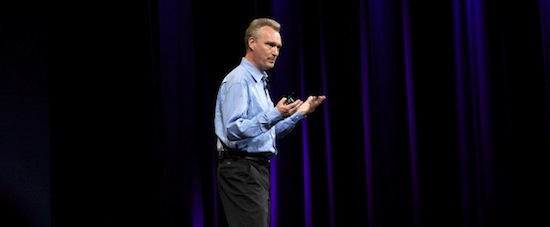
There’s a reason Craig Federighi, who is to take over Serlet’s role, handled demo duties for Apple’s Lion preview demo last year (see video below). And there’s a reason Serlet has been selling off Apple shares recently. They’ve been preparing for this day, which sources tell me is not at all the result of a spat over differences in strategic direction or the diminishment of OS X’s importance to Apple.

“There’s no acrimony there,” one source close to the company told me. “Bertrand’s just decided it’s his time to move on. Avie (Tevanian, former senior vice president of software engineering) handed off to him and now he’s handing off to Craig. It’s just a changing of the guard.

Serlet says he wants to focus on science now. People speculated this morning that Serlet might have left because of the iOS-like approach Apple is taking with Lion, but that sounds like a really stupid theory. I bet Serlet himself saw the evolution of OS X into something like Lion years ago.

Permalink

WSJ Starts Selling Single-Issues Using In-App Purchases

As reported last night, the Wall Street Journal has updated its official iPad application to include the possibility for readers to buy single issues for a specific day. These single-issues downloads are available as $1.99 in-app purchases, whilst “regular” WSJ monthly and weekly subscriptions are still being sold through a website – which is embedded into the WSJ app for login and purchasing option. At this point, it seems that the WSJ is slowly complying to Apple’s in-app purchase and subscription policies but it’s not quite there yet. Recently, Apple started enforcing a rule that requires developers to implement in-app purchases as an option by default in iOS apps that come with extra, purchasable content.

Single issues (up to a week) can be viewed in the “start screen”. Here, you can choose to buy one or subscribe to the WSJ. iPad subscribers also get free unlimited access to WSJ.com, iPhone and Blackberry apps. Single issues don’t carry any kind of additional benefit as they’re simply tied to an iTunes account.

The WSJ app for iPad is free, and it’s available here. Read more


Apple Wants To Pay More To Have Continuous Touch Panel Supply

With several Japanese manufacturers struggling to bring their facilities back into operation after the earthquake and tsunami, Digitimes reports Apple is willing to pay more to have a constant, steady flow of touch panel supply for the coming months. After the release of the iPad 2 and with several reports about Apple facing issues with low tablet shipments from Asian manufacturers, the rumor is interesting as it suggests Apple is re-considering the amount of money that goes into pre-production deals with companies in China and Taiwan.

In order to secure sufficient supply of touch panels used in the iPad and iPhone, Apple has talked with Taiwan-based makers, considering some room for them to hike quotes, according to these makers.

With Apple’s capacity, It is a reasonable strategy from Apple to allow suppliers to hike quotes, and it will be a great help to the overall supply chain, even just for the short term, but will increase pressure to other vendors for tablet PCs and smartphone, touch panel makers believed.

In the past week many publications reported the Japanese earthquake might have not affected the stream of supplies necessary for the iPad 2 production. Apple is clearly looking ahead though, with an iPhone 5 set to debut this summer and likely ready to go into mass-production in a few weeks. Digitimes claims Apple is taking 60% of the current touch panel market, and a deal to pay manufacturers more to ensure availability may spell bad news for competitors like Samsung or Motorola, both heavily betting on Android-based tablets for 2011. [via MacRumors]


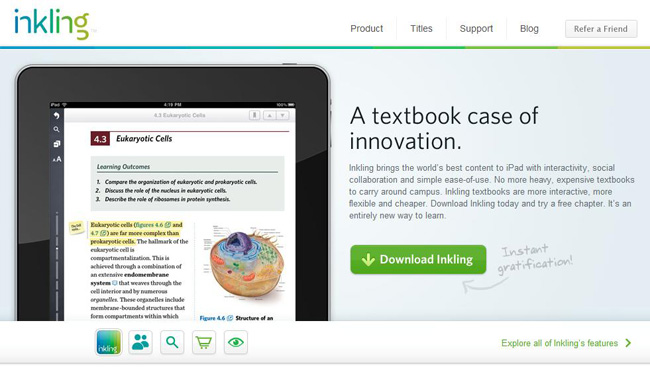
Major Publishers in Support of Inklings iPad Textbooks

Inkling, an iPad textbook startup, has just announced that it has won financial backing from McGraw-Hill and Pearson, the two biggest names in the textbook business. The exact amount was not disclosed, except that it was a “multimillion dollar” financing.

Matt MacInnis, the Founder and chief executive of Inkling, said their goal involves using the content of an existing textbook then adding multimedia and interactive content for the iPad. Inkling started up right after the announcement of the iPad in January of last year. Based in San Francisco, the startup has now released 14 textbooks and more than 100 titles by this fall.

There is other competition building iPad textbooks, MacInnis acknowledged. Competitors like ScrollMotion, and Kno but he argued that everyone else is adding ‘limited’ features to a PDF of the textbook and that competitors e-books are developed by the publishers’ business divisions without very much input from the original textbook creators. Alternately, Inkling wants to publish apps that feel like they were built for the iPad, which means working with the books’ authors to create new content.

Video after the break. Read more