


If you didn’t already know, we’ve set up a new twitter account for Deals, it’s @MacStoriesDeals - please follow for Deals-only posts. We’ll tweet the daily deals there as well as exclusive weekend deals too. Help spread the word! Here are today’s deals on iOS, Mac, and Mac App Store apps that are on sale for a limited time, so get ‘em while they’re hot!
#MacStoriesDeals - Wednesday
The iPhone 4 That Survived A 1,000 Foot Fall
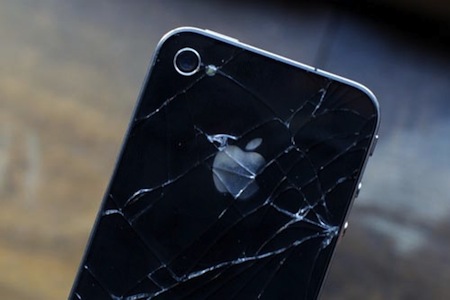
Some stories about the build quality of iOS devices are just too good to not be mentioned. Take the iPhone 4 for example: in the past year, we’ve heard stories of shattered glasses and damages to the metal band that runs across the device, but in most of those stories the device always ended up being functional – although broken. The glass that Apple uses in its iPhones certainly is resistant enough to protect the multitouch display beneath it, but it may break even after a stupid fall from the coffee table. It happens.
The story shared by iLounge today, however, is quite possibly the most dramatic and, at the same time, incredible we’ve heard so far: an iPhone 4 falls off a plane flying at 130 knots, ends up in the woods, the glass breaks but the phone is still active and working. It was a 1,000 foot fall. The owner installs Find My iPhone on a second device, retrieves the iPhone 4’s position through GPS, gets his iPhone back and uses it to send an email to iLounge about what happened. Again, that was a 1,000 foot fall from a plane.
Plotting the phone’s position on maps, Mr. Walker and a friend headed out on ATVs to see if they could track the phone down, if only so Mr. Walker could attempt to back up his data for transfer to a replacement unit. Within an hour, the two had pinpointed the phone’s location near a tree, ultimately finding the phone in complete working order, apparently with nary a scratch or patch of dirt on it. Mr. Walker says that the phone only had a Griffin Motif TPU case and an aftermarket metal backing on it for protection; he believes that the phone’s fall may have been slowed by tree leaves and needles as it made its way towards land.
So the iPhone was inside a case and had a metal backing, but the fact that it’s still working after such a fall is still impressive. Perhaps the trees and leaves made the impact less strong? Maybe he just got lucky? One thing is for sure: Find My iPhone is a must-have. [via iSpazio]
What’s The Next Step For Social Magazines?→
What’s The Next Step For Social Magazines?

Former Design Director of The New York Times Khoi Vinh shares his thoughts on apps like Flipboard and TweetMag for iPad, digital magazines that plug into your Twitter, Facebook and Google Reader accounts to fetch articles to display in a beautiful magazine-like view. As Vinh points out – and as we argued in the past as well – the next step for these apps isn’t optimizing performances or improving the design. It’s all about making the apps “smarter” and capable of playing an important role in your social graph:
The apps could then become more than just a reader for links found in my Twitter stream. They could let me see which stories my friends are reading, sharing, or tweeting the most, and it could prioritize what I see based on that information. They could help me form and access communities around topics, or contribute content of my own, or add associations with other, similar content. There’s a deep reservoir of opportunity here; some of it would be easy to pull off but a lot of it would be difficult to make happen, because it would entail turning these apps from magazines into truly social products that just happen to look like beautifully designed magazines.
I was thinking about this the other day. What if Flipboard was capable of looking at my Twitter stream and automatically find out the topics that I really care about? And after that, what about filtering articles belonging to those topics and visualize the most relevant ones in a top position? With the acquisition of the Ellerdale Project last year, it seems like the Flipboard developers want to bring further integration with the social graph into the app.
The process, however, includes a difficult goal: making sure the algorithm is intelligent enough to understand whether a user wants to read about content he’s interested in, or discover new articles and material thanks to the app and his friends using the same application. It’s a complex system, but someone will get there eventually. The iPad is only one year old.
iReply: Never Forget To Respond To A Text Message Again
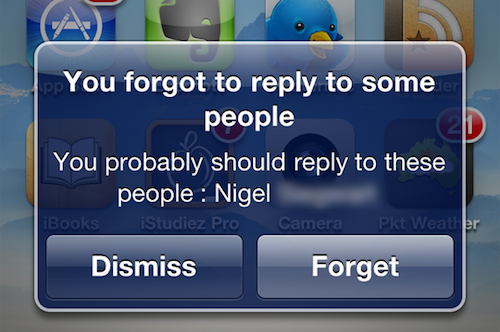
It’s happened to everyone, you’ve received a text message and quickly read it but for any number of reasons decided you would respond to it later but then realize two days later that the message is still sitting unanswered in the Messages app on your iPhone.
Apple does a good enough job of alerting you to any unread text messages, but once read, you won’t get any more alerts about that text message. A new tweak to hit the Cydia store, iReply, aims to enhance that iOS SMS alert function by also reminding you of any text messages that you haven’t replied to and avoiding that awkward moment when your friend or boss asks why you ignored their text message. Jump the break for a short review of the app.
US Senators Want Apple To Pull Apps That Aid DUI Checkpoint Evasion

A group of four US senators have called on Apple to remove apps from its App Store that warn and alert users of where DUI (driving under the influence) checkpoints are. In a letter addressed to Scott Forstall, Apple’s senior vice president of iPhone software, the four US senators which includes Harry Reid, Charles Schumer, Frank Lautenberg and Tom Udall convey their “grave concern” over the apps which are “harmful to public safety.”
The letter doesn’t name any specific apps but takes at aim at those which “allow customers to identify where local police officers have set up DUI checkpoints” and citing a police officer asks “what other purpose are they going to use them for except to drink and drive?” The App Store does indeed include numerous apps that have DUI checkpoint databases, some of which are free and some of which are paid and many feature crowd-sourced information gathering on the location of the DUI checkpoints.
The senators end their letter stating “We appreciate the technology that has allowed millions of Americans to have information at their fingertips, but giving drunk drivers a free tool to evade checkpoints, putting innocent families and children at risk, is a matter of public concern.” Currently the App Store Guidelines only state that apps cannot “encourage excessive consumption of alcohol or illegal substances, or encourage minors to consume alcohol or smoke cigarettes” - there is no mention of such police or DUI checkpoint evasion apps.
CNet contacted Apple for comment but received no comment at the time of publication. For the full letter from the senators, jump the break.
Bertrand Serlet Is Leaving Apple After 22 Years

With a press release posted a few minutes ago, Apple has announced that senior vice president of Mac Software Engineering Bertrand Serlet is leaving the company after 22 years. Craig Federighi will assume Serlet’s responsibilities and report directly to Steve Jobs.
I’ve worked with Steve for 22 years and have had an incredible time developing products at both NeXT and Apple, but at this point, I want to focus less on products and more on science,” said Bertrand Serlet, Apple’s senior vice president of Software Engineering. “Craig has done a great job managing the Mac OS team for the past two years, Lion is a great release and the transition should be seamless.
Serlet has been working with Jobs for the last 22 years: the two worked together at NeXT and Serlet followed Jobs in his return at Apple to work on the modern versions of OS X as we know it. He played a key role in the development of Mac OS X and this is certainly a huge loss for Apple and the whole OS X engineering team. Serlet says he wants to focus “more on science”, and we wish him the best of luck. Craig Federighi – the guy that demoed OS X Lion back in October – worked at NeXT, too, and came back to Apple in 2009.
Press release and a video of Serlet at the WWDC below. [image via]
Quick Tip: iMovie App May Not Recognize Videos From Your Camcorder

With the release of the iPad 2, Apple updated the official iMovie app for iOS to include native support for the device and a brand new user interface that takes advantage of the features and real screen estate offered by the tablet. With new precision controls, intuitive UI and several sharing functionalities, we have seen iMovie for iPad has become for many the perfect way to quickly import a video, edit it with cool transitions and subtitles, and send it off to the cloud. These videos can be imported from an iPhone or iPod Touch, or just shot with an iPad 2 in HD.
Weeks ago we discussed Apple needed a better way to let iOS devices communicate with each other to share information and data without the need of using the cable. Something like AirDrop for iOS. As it stands now, you’re either forced to attach cables, sync with iTunes, or upload to MobileMe or Dropbox and download media again on a second device.
But the problem with the iMovie app for iOS also lies in the fact that it doesn’t recognize “certain non-Apple video clips” recorded with non-iOS devices. A support document updated yesterday explains:
iMovie for iOS is designed to work with video recorded with iPad 2, iPhone 4, and iPod touch (4th generation). To ensure optimal performance, the app filters out certain non-Apple video clips from the Video browser. These incompatible clips cannot be added to your iMovie project.
It’s simple: videos from your camcorder might not be compatible with iMovie out of the box, so forget about the camera connection kit or other techniques. Apple doesn’t provide technical specifications, but we’re pretty sure a free app like Handbrake can help you along with the conversion of a video to an iOS-compatible format. [via AppAdvice]
Long-time Subscriber? The NYT Gives You 1 Year of Free Web, iPhone and iPad Access→
Long-time Subscriber? The NYT Gives Out 1 Year of Free Web, iPhone and iPad Access

Jim Dalrymple at The Loop reports the New York Times is refining its paywall introduction by gifting one year of full free digital access (web, iPhone and iPad) to “long-time subscribers”. Apparently the NYT started sending out emails to some subscribers earlier today inviting them to join the promotion, and the one who got in touch with by The Loop has been a subscriber for 12 years.
The customer I spoke with has been a subscriber for 12 years and received the email this afternoon. He said he took The Times up on the offer and accepted the one-year free.
In the email The Times says “as a frequent reader of NYTimes.com, you’ve demonstrated an uncommon interest in a wide variety of today’s most important topics.” The email and subscription is being sponsored by Lincoln.
The New York Times’ paywall is set to go live for everyone on March 28th.
“Single-Issue” $1.99 Downloads Coming to WSJ iPad App

In an effort to drive more customers to its monthly subscription plans and experiment with the App Store distribution platform, the Wall Street Journal is launching “single-issue” downloads in its official iPad app, Paid Content reports. The option, not available yet in the free iPad app, will allow users to download a day’s WSJ content for $1.99 on their iPad, and according to Dow Jones’ digital head Alisa Bowen the new system will better invite users to subscribe to the full-access digital subscription plan. Single-issue downloads will offer a relatively cheap way to sample content and decide whether or not a full subscription is worth it.
There will be limitations in the single-issue downloads, but the WSJ hasn’t provided additional details. These new downloads won’t affect in any way the current $18 subscription that gives readers complete access to the WSJ website.
Right now, any current WSJ subscriber with a log-in can get full access—to the site and all the apps—and that won’t change. In addition, the WSJ recently began offering a digital bundle offer. Basically, for $3.99 per week, you can get full access to WSJ.com and its suite of digital products (iPad, Android Tablet Edition, iPhone and BlackBerry apps), all of which works out to roughly $17 with tax for a full month.
Bowen told me that she believes readers are more likely to subscribe once they had a taste of the content. But it’s not the first time they’ve tried that approach. For example, WSJ content is available for free to users who log on to Starbucks’ digital network as part of the coffee chain’s free wifi access.
Last week, controversy arose around the New York Times’ subscription plans that will force readers to choose between three different packages for website access, smartphone and tablet apps. Many think the NYT’s plans are too expensive and complex in differentiating between smartphones and tablets; it is unclear at this point whether the WSJ will consider a unified option for iPhone, iPad and Android users or take a similar approach to the NYT by launching different subscriptions across devices. The single-issues downloads are expected to be implemented with a new version of the iPad app, which was last updated in February.