Behind The Scenes of Verizon iPhone: Special PIN Security Protocol, “ACME” Code Name

In a lengthy report published earlier today, TechnoBuffalo shares some of the interesting details behind the launch of the Verizon iPhone 4, which went on sale in the United States in February. In the months leading to the launch of the CDMA device, speculation was running wild on the Internet as to whether Apple was really ending AT&T exclusivity to release an updated version of the iPhone to support Verizon Wireless’ CDMA infrastructure; citing a source “close to the action”, TechnoBuffalo says only top executives at Verizon knew about the device, which internally used to be mentioned as “ACME device” to avoid other employees would hear the “iPhone” name and leak information outside of the company. Public testing of the CDMA iPhone 4 began at Apple Stores (and obviously, Apple’s own campus, where Steve Jobs said they had installed Verizon and AT&T towers) six months ahead of the official launch, meaning in summer 2010 shortly after the release of the AT&T iPhone.

Though key employees and executives were in the loop, everyone else at the carrier knew little more than the rest of the public. And it would seem the higher ups wanted to keep it that way. No one talked about the Apple smartphone externally, and even internally, it was still a hush-hush operation. In fact, says the source, the word “iPhone” was never uttered; only its codename was referenced: It was called the “ACME” device.

Between NDAs to sign, corporate secrets and internal discussions about field-testing and cooperation with Apple, the most interesting tidbit details how, rather than installing geo-location software (like Find my iPhone) on the prototypes to make sure they wouldn’t end up in the wrong hands (as the AT&T iPhone 4 did), Verizon testers were required to text a PIN code every 12 hours as a confirmation the device was being used internally for testing purposes only.

Our source describes a unique protocol requiring staffers to text a secret PIN code to a dedicated phone number every 12 hours. This served as ongoing confirmation that the handset was still in the proper hands. So no PIN code, no functionality.

Unlike the original iPhone 4, Apple managed to keep the Verizon iPhone closely under wraps until the official announcement, not even allowing Verizon to tease anything at CES 2011 in Las Vegas a few weeks before. The security measures taken by Apple to ensure devices were only used internally are particularly interesting, and a sign Apple must have reconsidered its testing process after the AT&T iPhone got leaked to Gizmodo.com in Spring 2010, months before the WWDC announcement.

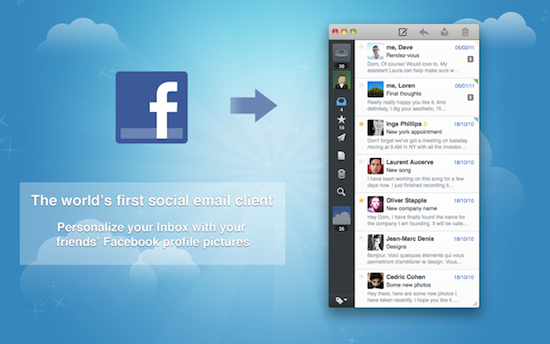


Sparrow Unveils Unified Inbox and Facebook Integration in Version 1.2

Sparrow, the minimal email client for the Mac that was born as a mix between Mail.app and Tweetie for Gmail and eventually evolved into a full-featured IMAP email application, has just announced version 1.2 at TechCrunch Disrupt, which will add a number of new features including the long-awaited unified inbox and a new social layer for your contacts. Since the app was first revealed as beta in October, Sparrow saw a terrific rise in popularity throughout the release of the various betas, and especially after the launch of a Mac App Store version and lite edition, Sparrow has quickly become many people’s favorite way to access Gmail and any other email provider with a convenient, simple interface that follows the latest trends set by apps like Twitter and Reeder for Mac. With the 1.1 update, the developers added IMAP support and integration with Google’s Priority Inbox, thus turning Sparrow from a lightweight client into a serious alternative to more complex apps like Mail and Postbox. The 1.2 update will bring the possibility to see all email messages in a single inbox without switching between accounts, as well as Facebook Connect integration to automatically add profile pictures to contacts. It’s not clear now if this new Facebook feature will also add photos to people that have emailed you using standard IMAP and Gmail accounts, but CEO Dom Leca says they’re “not adding social layers mail for the sake of it”, and Facebook Connect will let you add people as Facebook friends within the app.

Victor Ageda, Jr. from TUAW further reports Sparrow 1.2 will also add some kind of Tumblr integration. The Sparrow team has raised $250,000 in funding over the last months (funders include Twitter’s Loren Brichter), and the developers are looking forward to bring Twitter and LinkedIn support to Sparrow in future versions, turning an email client into a complete social messaging experience like no other on the Mac. The idea of grouping all kinds of social communication into a single app has always attracted users and developers, but no one really quite nailed it. Hopefully Sparrow will manage to blend it all together, yet retaining its nature of simple and powerful email client.

Sparrow 1.2 should be available later today or tomorrow on the Mac App Store at the regular price of $9.99. We’re looking forward to the update and the full list of changes in version 1.2.


The Daily for iPad Nearing 1 Million Downloads

The Daily, the iPad-only magazine built by News Corp. with help from Apple when the two companies unveiled iTunes app subscriptions in February, is about to hit 1 million App Store downloads, TechCrunch reports. At the TechCrunch Disrupt panel entitled “Disrupting Publishing from Tablets to Links”, The Daily publisher Greg Clayman said the app is nearing the important milestone of 1 million downloads, though he didn’t provide any details on the number of people that decided to subscribe to the app since late March, when The Daily started charging for content after an initial free run sponsored by Verizon Wireless. The Daily currently comes with in-app subscriptions priced at $1 per week or $40 per year; a report from April suggested The Daily, both because of paywall and editorial choices, was seeing a decline in popularity in spite of Apple’s heavy promotion on Apple.com and the App Store homepage. Others suggested the same when News Corp. confirmed 800k downloads in 3 months and a $10 million loss over the last quarter to run The Daily operations.

However, 1 million downloads is a notable milestone that, in the words of Clayman, puts The Daily “in the large pantheon of large news apps.” Our first impressions of the app still hold true today – The Daily isn’t the fastest news app available on the App Store and not even the iPad 2’s beefier processor managed to make The Daily run smoothly without crashes of sorts. The Daily is expected to become available on more devices later this year, including the Android tablets that have been rolling out in the market in the past months.


Twelve South’s BookBook Case Now Available for MacBook Air

We love Twelve South’s Mac and iOS accessories, they make some of the most beautiful third-party accessories for Apple devices. We’ve previously talked about the Compass mobile stand, the BookArc for iPad and MacBook Air. Today we’re showing you the BookBook for MacBook Air.

Twelve South’s new BookBook case was designed for the MacBook Air (11 & 13-inch 2nd Gen). The genuine leather case is only 13.5 ounces and has two hardback covers with reinforced corners and a tough spine for impact protection. The inside of the case is lined with a velvet-like soft padded interior as well. Read more


QuickCal Mobile: Fast Calendar Entry On Your iPhone

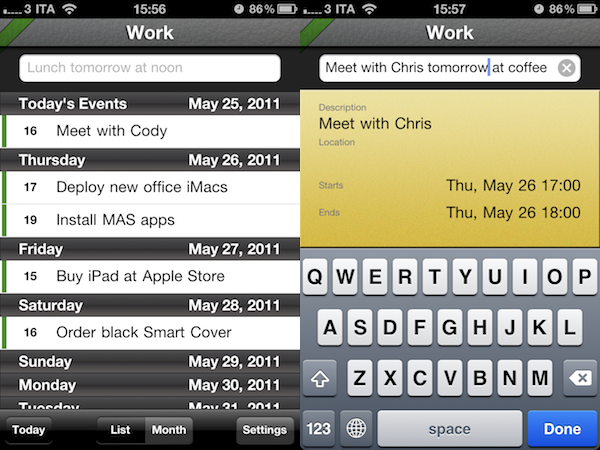
Last night I reviewed QuickCal for Mac, a menubar utility that works in conjunction with the desktop iCal to provide a simple way to add new events to your calendars using plain English as natural language input. Unlike Fantastical, QuickCal can’t sync back to any calendar in the cloud if iCal isn’t running because of its lack of native CalDAV support (though it’s got built-in Google Calendar integration), but still it offers a cheap and easy to use way to create new events without having to deal with iCal’s menus, popups, and checkboxes. As I mentioned in my review, QuickCal also comes with an iPhone counterpart called QuickCal Mobile that, just like the Mac version, allows you to quickly jot down events using nothing but plain English.

QuickCal Mobile for iPhone may look like a stripped down version of the Mac app, but I was surprised to see it’s actually the same app, only integrated with iOS standard calendar features. This means events displayed in a list or monthly view can be edited and deleted with the same interface of Calendar.app for iPhone, and everything from alerts to location and availability status can be modified in-app without launching Apple’s Calendar. QuickCal Mobile recognizes all calendars already configured out of the box, allows you to specify a default one and comes with the same Smart Reminders functionality of QuickCal for Mac – you can set a default reminder, one for events that are weeks away, and another one for things you’ll have to take care of in the next months. The app’s icon badge can visualize the current day of the month, or you can disable it and enjoy the icon on your homescreen with no red badge.

QuickCal Mobile’s biggest feature is obviously support for natural language input, and I was pleased to see it works just like on the Mac. You fire up the app, start typing in a single text entry field, and QuickCal will recognize your words as values for a new calendar event. It’s really fast and results update as you type – again, like on the Mac. At this point, I wish QuickCal would also run natively on my iPad – most of the times I check on my calendar from the tablet, and being able to quickly enter events there would be nice.

QuickCal Mobile is available at $0.99 on the App Store, and if you’re fan of the Mac application you should definitely give it a try. The app won’t replace your Week Calendar or Calvetica, but it’s a very convenient way to add events in seconds.


AT&T Begins LTE Rollout Across 5 Cities

AT&T today released its initial LTE rollout plan, with five markets to get LTE sometime “this summer”. Those lucky cities will be Dallas, Houston, Chicago, Atlanta and San Antonio.

Ten more markets, which are yet to be named, will also be getting AT&T’s LTE network built in the second half of this year. AT&T says in its press release that across those first 15 markets, 70 million Americans will have coverage on their LTE network. Currently AT&T does not offer any LTE compatible devices, but again claims that there will be, by the end of the year, some devices that are LTE capable.

Earlier this year, Apple posted a job listing for someone with cellular protocol experience, who would have the specific duty of implementing, integrating and maintaining various network protocols, including LTE. Whilst in January, China Mobile’s Chairman said “Apple has made it clear they will support TD-LTE.” This year’s iPhone, which is widely expected to be revealed in September, is unlikely to have LTE support. However, with LTE adoption spreading across the world, and multiple Android and soon Windows Phone 7 devices supporting LTE, it seems very plausible that the following iPhone will support LTE.

[Via Engadget]


ConvertIt Makes Image Conversion Simple From The Menubar

If your work consists of dealing with lots of image files on a daily basis, you know how much time is usually spent converting images from one format to another. While OS X provides a great built-in application called Preview that takes care of converting and swapping formats with a few clicks (alongside many other features), you’ll still need to open multiple files in it, manually select a new format, choose a destination, hit save, make sure the conversion went correctly, and trash the original files. Could the process be more straightforward, especially when trying to batch-convert multiple files at once? ConvertIt, a $0.99 utility from the Mac App Store, offers a simple solution to the problem.

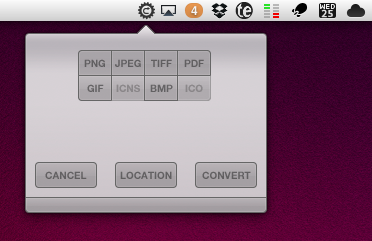
Now, I’m sure there are hundreds of free and paid utilities for Mac out there that can handle image conversion just fine, and even offer batch-processing for when you need to get things done faster. However, I was impressed by ConvertIt’s super-simple interface that lives in the menubar, doesn’t get in the way when you don’t need it, and is capable of converting images to different formats with drag & drop. With ConvertIt, you can drag as many images as you want from the Finder onto the app’s menubar icon, and choose from a popover a new format for the files. The default location for the new files is the Desktop, but you can change this in the Preferences. To convert, you just have to select a new image format, wait a few seconds, and you’ll end up with the new files in your desired location; it works with a single file, as well as multiple ones dragged at the same time. Unfortunately, ConvertIt doesn’t have an option to delete the original files once conversion is over – I’d also like an option to convert existing files, rather than creating new ones. However, it was very nice to see ConvertIt could easily transform a PNG in a PDF document in a matter of seconds.

ConvertIt does one thing well, and it’s available at $0.99 on the Mac App Store. Go get it here.


iPhone 4 Finally Coming to India This Friday

As reported by BGR.in, 337 days after the original release in the United States and other European countries, the iPhone 4 will finally launch in India this Friday, May 27. Back in early April carriers Bharti Airtel and Aircel confirmed they would release the iPhone in India “in the coming months”, though no details were provided about launch costs, subsidies, or effective availability; in spite of Airtel starting iPhone registrations on its website a few weeks ago, it looks like Aircel will be the first mobile operator to launch the popular the device in India.

The iPhone 4 will be available at Rs. 34,500 ($760) for the 16 GB model and Rs. 40,900 ($900) for the 32 GB one. Unlike most carriers worldwide, Aircel will apply a “reverse subsidized” payment model, through which users pay the full cost of the iPhone upfront, and get a full refund with credits over the next two years.

Following an upfront payment of Rs. 34,500 for the 16GB model and Rs. 40,900 for the 32GB model, customers will have the opportunity to recover 100 percent of their upfront iPhone cost in monthly credits on their service plan over a period of 24 months.

A breakdown of the full plans is available after the break. [via The Next Web India] Read more