Moving From iPhoto To Dropbox

I like iPhoto on the Mac. The app’s interface sports Apple’s proverbial attention to polish and details, the Faces feature is nice, and I like the possibility to visualize photos on a map, just as I find Photo Stream very convenient for my blogging workflow. However, I realized that I don’t want to depend on iPhoto to store the photos that, twenty years from now, I’ll look back to as memories. I need my photos — moments captured as .jpeg files — to be photos, not a database. And at the same time, I need to be able to access them now from any device I have without having to worry about sync, apps, formats, and corrupted entries. I have decided to move all my photos from iPhoto to Dropbox.

This is something I have been thinking about for the past year. Do I want my photos to be stored inside someone else’s app? And if not, why not do the same for any other media I store on my computer? Should I also ditch Rdio and go back to neatly organized .mp3 files in the Finder?

I have come to the conclusion that photos are irreplaceable. Decades from now, I’ll probably be able to find a 2Pac record somewhere online or in a record store (will those still exist?). But not so with photos. If something — anything — happens to my photos, they’ll be gone forever. There won’t be anyone able to give me my memories back. Just as I do for text files — the words I write — I have chosen to store my photos — the things I experience — as .jpeg files, a format that should still be around for the foreseeable future. Read more


Paper 1.1 Now Available With Faster Ink, “Move”, “Duplicate” and “Easy Add” Features

2012 Apple Design Award winner Paper by FiftyThree has reached version 1.1 today, adding a number of much requested features and improvements to bring better organization of pages and smoother ink. Paper, a digital sketching app for the iPad, made headlines earlier this year as it somehow managed to make the process of drawing on screen fun and intuitive. With sharing built-in, a clever in-app purchase mechanism (you can buy single tools at $1.99 each, or the entire package at $6.99), and a simple multi-touch based interface, Paper has become for many the best way to take quick visual notes and draw sketches on iOS.

Today’s major update brings up to 3x faster virtual ink for every tool included in Paper, and users can now also draw with their fingers (or a stylus) to the edge of the screen, which wasn’t previously possible. In an interview with The Verge’s Ellis Hamburger, the Paper team shared some of the secrets behind their technology:

When you draw, you want strokes to appear at an even speed and even rate, which gives the system a reliable feel. If you hit the CPU or GPU at an even rate, the results end up being very smooth,” he says. Every brush inside FiftyThree’s “Expressive Ink Engine” has been fine tuned to be up to three times faster, and you can now draw all the way to the edge of the screen — a top request from users. The 1.1 update also saves battery, since requests are made to the iPad’s processor more consistently. The Rewind feature, which lets you undo brush strokes, also received some attention in Paper 1.1, and responds accordingly based on how quickly you move your two fingers in a circle.

The big new feature of this new version, however, is the improved organization. Relying once again on multi-touch to navigate the core elements of the app, users can now tap & hold with one finger to select a page from a notebook, then use the other hand to navigate other notebooks as they normally would; once in another notebook, the tap & hold can be released to drop the page in its new location. The “move” feature is a welcome addition that, alongside the new Duplicate function, should make for a much better experience for those who rely on Paper for wireframes, project templates, and more.

Paper 1.1 is a good update, especially thanks to the focus on better organization of pages, which was a huge downside of previous versions of the app. Check out Paper 1.1 on the App Store, and the official promo video below. (Also: pardon my poor drawing skills. But, yes, real coffee is Italian)
Read more


iPhone 5 Now Available for Pre-order

The iPhone 5 is now available for pre-order at Apple.com. Fortunately, it does not require missiles or the Morph Ball to obtain.

Ordering the iPhone 5 tonight? Your best bet is Apple’s Online Store. Even better is the Apple Store app, which might fetch you a new iPhone faster than the guy who’s waiting for the web server to respond to his order request. Last year lots of people had good luck with the carrier’s online stores for the 4S, Sprint (after a short delay) and Verizon especially. We’ve listed the United State’s carrier’s stores below so you can hopefully order without hassle.

The iPhone 5 is an awesome power-up for anyone on the iPhone 3GS or the iPhone 4. The iPhone 5 is super thin and lightweight, has a larger 4-inch display, and has twice as much horsepower as the iPhone 4S thanks to its A6 processor. Available in white and black in 16 GB, 32 GB, and 64 GB models ($199, $299, $399 respectively) on AT&T, Sprint, and Verizon, the iPhone 5 is equipped to utilize the incredible speed of LTE wireless networks without sacrificing battery life. With an improved 8 MP camera that takes pictures 40% faster than the iPhone 4S, includes wideband audio for clearer calls (carrier support coming soon), an even more vibrant Retina display, and packaged with Apple’s completely redesigned EarPods, the iPhone 5 isn’t just a incremental upgrade. It’s redesigned from the ground up.

* * *

Don’t know if you want to upgrade? The iPhone 5 is bound to be a fantastic phone, but having the latest and greatest isn’t necessary, especially if you have the iPhone 4S (and you guys bought that knowing you would be locked in for the two-year long haul… riiiight?). The iPhone 5 has no differentiating features in iOS 6 over the 4S — you’ll have Panorama and all of Siri’s latest features. Having LTE would be nice, as would be having apps launch faster and games look prettier, but I’m betting you’ll see the upgrades you care about — more battery-life and a significantly improved camera — with the iPhone 5S or whatever the heck Apple names it. (After all, they did break the space-name-time-continuum by naming their 6th phone the iPhone 5.) Plus, you’ll feel good when you leap-frog the iPhone 5 owners next year. Boom. Circle of life.

If you have an iPhone 3GS or iPhone 4 (most of you) that’s due for an upgrade, of course you should upgrade — the iPhone 4S was a significant update a year ago, so you guys are really gonna feel how much faster iOS is with an even newer iPhone. No questions asked, do it. I can’t help you with picking a color though.

If you happen to be someone who got a free 3GS or a $100 iPhone 4 recently (and will be locked-in to a contract for a while), you can at least have some solace: you’ll still be getting iOS 6, but not necessarily all of the features (no Siri). Depending when your contract ends or full upgrade eligibility begins, I recommend waiting for Apple’s next flagship iPhone and ordering it then. That way, you’ll get on Apple’s cycle, won’t have to worry as much about being out of date, and won’t be behind the curve on software if Apple pulls another feature-X-won’t-work-on-older-phones bit as Apple did with Siri between the iPhone 4 and 4S.


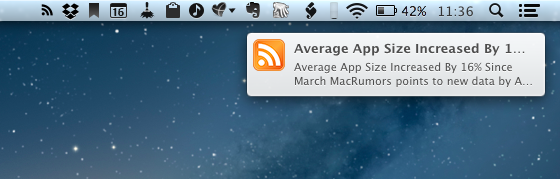
Omnikey Simplifies Website-Specific Search In Safari

When I search the web for something, it’s mostly about music and artist discographies. Therefore I am used to the following typing workflow: “cmd+L” for toggling the URL bar, “en” to bring up the Wikipedia bookmark, open the site, and search there. I’ve often wished for a simpler key combination for quick access to such searches. Earlier this year I reviewed Bang On for iOS – a small app for easy website search on the iPhone and iPad. Using “!” as a toggling prefix you could create search commands for any website you can imagine, from Wikipedia to Amazon. It worked pretty well. I really wished for a similar functionality on the Mac.

Now, Safari users can have exactly this feature through a new extension called Omnikey, developed by Mario Estrada. Install it, and afterwards you’ll just need to type “wiki [search query]” into the Safari address bar to automatically open up the search results to your query on Wikipedia.org.

The “wiki” is the “omnikey” for toggling this kind of search. The same system also works for YouTube, Amazon, and some other websites out of the box. Put a “!” in front of your URL bar search query and Safari will use the default Google search. You can also easily add new websites you want quick Omnikey search for: just open up the extension’s editing panel in the toolbar, click “Add Site”, select a key for toggling the site search and paste a dedicated search query URL into the panel. Now you just have to replace the search query in the URL with a “{search}“ wildcard (like a software placeholder) and you’re done. I tried it with the MacStories search powered by DuckDuckGo, and it immediately worked.

Omnikey is a very handy Safari extension. It is lightweight, fast, and easy to use. Setting up new search keys is easy and works flawlessly. For people like me, who often need to search specific websites for links and information, Omnikey is a great companion. Download it for free at the project’s GitHub page.


Uberlayer Is A Handy Tool For Pixel-Perfect Design

Twelve Twenty, the Dutch maker of the print-size checking OS X app Will It Fit and the iOS calendaring tool Get Together, recently published their third app, Uberlayer. Uberlayer is a small tool for UI and web designers on Mac OS X to quickly overlay images of a new design work onto your desktop.

Let’s say you just designed a mockup of an update to an existing website or application. Drop it onto Uberlayer to bring it on the screen. Using shortcuts you can move it around in pixel steps, make it more or less transparent, and activate click-through options. If you make the design half-transparent and you have the current version of an app or website just behind it, you can easily check how the current design changes will affect the overall look of the whole product. Using the click-through option, it’s easy to select certain parts you want to change to copy or delete them in the “real” version of your product.

I tried Uberlayer on my personal website by trying out a different style for an ad I currently have on it. This is what a half transparent “uberlayed” image looks like:

It’s actually pretty hard to describe how the app works using only words and pictures. If you’re curious, I recommend you head over the Twelve Twenty website and check out their Uberlayer demo video. I think Uberlayer can be a useful tool in a web or application designer’s workflow. Uberlayer is $1.99 on the Mac App Store.


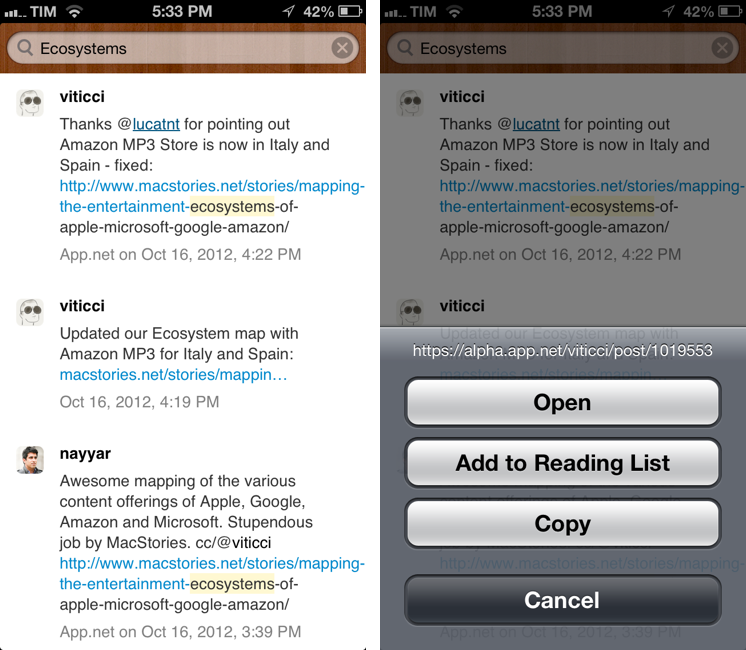
Twitter Archiving Tool Watermark Gets Dropbox Export Feature

Recently relaunched under a new name, Manton Reece’s Watermark is one of my favorite web services. Seamlessly integrated with Twitter, Watermark is an archiving tool that, through filters and custom collections, lets you archive and search your entire timeline. From our previous coverage:

Tweet Marker Plus was one of my favorite services to provide the kind of Twitter functionalities that Twitter the company always ignored: powerful search and filtering tools, collections, and additional browsing options. Like Cue, Tweet Marker Plus has proven to be a worthy addition to my workflow to retrieve tweets and leverage the information shared on the platform every day.

I use Watermark on a daily basis to retrieve tweets that have been shared in my timeline – status updates that would be hard to retrieve using Twitter’s web interface, let alone the official apps. Twitter never invested in powerful archiving and filtering tools, and Watermark provides a fantastic backup solution to know that, in the background and automatically, your timeline will be archived and made searchable for the future. This is important for online data preservation, a subject I’ve been exploring for the past year.

Today’s update to Watermark introduces yet another option to make sure your data will always be with you: automatic Dropbox export. Available in Watermark’s settings, once authorized with Dropbox the service will create archives of filters, collections, and your own tweets as .csv files. For your tweets, the 10,000 most recent ones will be saved, whereas filters and collections are limited to 1,000 for now. As Manton writes on his personal blog:

Dropbox sync fixes that. Watermark can now automatically copy tweets (and App.net posts) from your saved filters and custom collections to CSV files on Dropbox. For example, search Watermark for “iPhone 5”, click “Save as filter”, and the most recent 1000 tweets matching that query will appear in a file called “iPhone_5.csv” on Dropbox. It keeps running in the background, so the files are updated every hour as new tweets matching the search are downloaded by Watermark, even if you aren’t signed in.

Like I said, I use Watermark every day, and being a Dropbox fan as well, it’s great to see the two services coming together. I feel like Dropbox is becoming, for many, the de-facto “filesystem for the web”, and it only makes sense for a service like Watermark, which aims at freeing data from the pressure of Twitter, to gain an export option based on it. Right now, tweets are saved in .csv files with their ID, author’s username, date, service (Twitter or App.net), message, and original URL. In a future version, I hope Manton will consider some kind of plain text export option as well, though that might be tricky; right now, I’m comfortable with the structure of .csv archives.

Watermark is a service I highly recommend, and it’s only $5 per month.


Apple Details iOS 6 Feature Availability By Country

As noted by Horace Dediu, Apple has published an official list of iOS 6 feature availability on its website. While iOS 6 is officially coming out next week, on September 19th, not every feature will be available in every country.

The list focuses mainly on Siri, Maps, and Dictation. Availability of iTunes Store and App Store content is mentioned as well, but that’s not really new if you’ve been following the expansion of Apple’s digital storefronts in the past months. What’s interesting ahead of iOS 6’s launch is the list of features that, due to content limitations or the “beta” nature of Siri, won’t be available in some parts of the world.

For instance, Maps’ “standard” operation will be available from Afghanistan to Zimbabwe for a total of 181 supported countries. This should include the “standard” view of Maps – the new tiles that Apple is using after removing Google’s ones from iOS 6 entirely. Similarly, the Satellite view of Maps will be available in the same 181 countries worldwide. However, things start getting different with Maps’ Directions and and Turn-by-Turn navigation: the former will be available in 96 countries, the latter in 56. 3D buildings, another feature of Maps, will only be available in the United States at launch, whereas Traffic information will be available in 23 countries. Last, Maps Local Search will be available in 49 countries, and Business Reviews and Photos in 15.

Siri is even more limited. In spite of the voice assistant gaining support for more languages in iOS 6, several functionalities and integrations will be limited by the user’s location. So, for instance, while everyone will be able to set Siri to a supported language and issue commands, Sports data will be limited to 15 countries; Twitter and Facebook integration to 14; Local Search and Restaurant Information to 10, but Restaurant Reviews will only be available through Siri in 9 countries and Reservations in 3 (USA, Canada, Mexico). Another Siri integration, Movies, will be limited to 13 countries for Movie Information, 4 for Reviews, and only 3 for showtimes.

As Apple embraces more third-party services in its operating systems, it’s no surprise that some features will be restricted to only the countries where those services are fully operational. The same happened with the first version of Siri last year – some commands were only supported in the United States initially.

Check out the full list of iOS 6 feature availability here.


iPhone 5 Camera Tests and iPhone 4S Comparison

iPhone 5 Camera Tests and iPhone 4S Comparison

As usual with new iPhone releases, Apple has created a webpage showing “actual photos taken with the iPhone 5”. It is available here, and it features a gallery of six photos with an option to view them in full-size (the iPhone 5’s camera shoots photos at at 3264×2248 pixels).

Curiously enough, Dpreview’s Scott Everett recently took a photo of Big Sur in California (the location pictured above) with an angle very similar to Apple’s one for the iPhone 5 (also embedded above). Because of this, Dpreview was able to closely compare the picture quality of the devices with the same subject. While the camera may appear to be the same, there are some notable differences.

Looking at the EXIF data of the images confirms Apple’s assertion that this is a new sensor, despite the pixel count remaining the same. Close examination shows the iPhone 5 is using a 4.1mm lens to give a 33mm equivalent field of view, rather than the 4S’s 4.3mm lens, which gave a 35mm equivalent view. This means the new sensor is a tiny fraction larger. The iPhone 5 has also selected ISO 50, 1/3EV below the 4S’s minimum sensitivity of ISO 64.

Last year, a Sony camera was found in the iPhone 4S’ teardown. Check out the 4S/5 comparison shots at Dpreview, and more iPhone 5 photos over at Apple’s website.

Permalink