Chatology Review: Flexibits Reinvents Messages.app Search

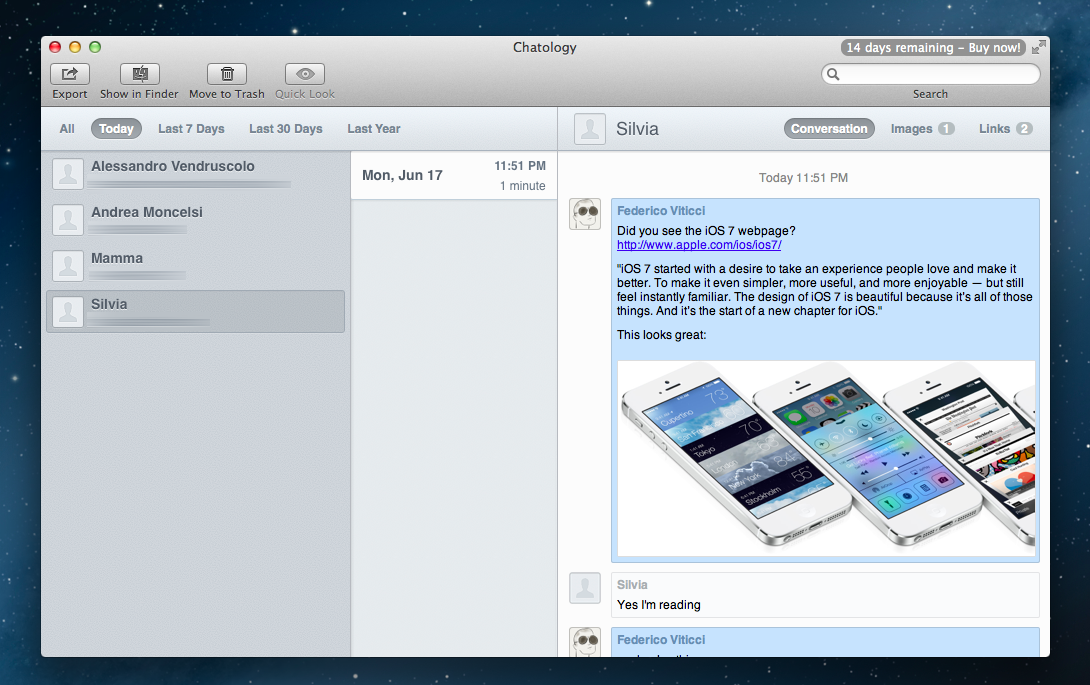
Chatology for MacChatology’s main window. I only couldn’t buy it because the Store wasn’t available during the beta.
Chatology for Mac

Flexibits, run by Michael Simmons and Kent Sutherland, makes two of my favorite apps. With Fantastical for Mac, released almost two years ago, they removed friction from event creation on OS X through a simple yet powerful menubar app that leveraged natural language processing. Fantastical is the only calendar interface that I interact with on my Mac, as it can send events to configured accounts directly – in the background – without needing Apple’s Calendar. Last November, they brought everything they had learned on the Mac to the iPhone with the release of Fantastical for iOS, a fantastic Calendar replacement with native iOS integration, a gorgeous Day Ticker interface, and advanced features such as a URL scheme and multiple alarms.

With the Fantastical brand, Flexibits has established itself as capable of building apps that use existing Apple technologies to create new, enjoyable experiences that are equally efficient, reliable, and rich in detail. Today, with the release of Chatology, Flexibits aims at supercharging a tough and infamous subject: Messages for Mac. Read more


Sponsor: Drafts

Our thanks to Agile Tortoise for sponsoring MacStories this week with Drafts.

Drafts is the definitive scratchpad for your iPhone or iPad. It’s the fastest way to get any idea out of your head and onto something physical. You don’t have to come up with a title, choose a folder you’re going to save your text in, or even worry about formatting. Drafts intuitively keeps a blank page open for you, and even knows when previous drafts were written so you can recall your ideas later. It can integrate with services like Dropbox and Evernote so you can take your drafts anywhere.

Drafts supports Markdown, a markup language for generating text optimized for the web. And there’s little big things like action templates that makes everything actionable. Ultimately, Drafts can be your idea napkin, or a pro-tool that integrates seamlessly with most apps.

Drafts is available on the App Store. You can grab the iPhone version for $2.99, and the iPad version for $3.99. Learn more about Drafts and other Agile Tortoise apps here.


The iOS 7 Summer

When I launched MacStories in April 2009 I wanted to focus on – as the name implies – Mac apps and the stories of the people who made them and used them. In the summer of 2009, I bought my first iPhone[1], the 3GS. As I started buying iPhone apps[2] and increasingly using the iPhone as a work device, my focus quickly shifted from “a Mac-only site” to “a Mac and iPhone site” for news, reviews, and opinion.

This summer represents the biggest change for my work since July 2009: in just a few months, I’ll be writing articles about iPhone and iPad apps that are based on an operating system that’s radically different from the one that I got to know four years ago, when I bought a 3GS at my local 3 Store and demoed Copy & Paste to my friends. Read more


“Why You Got a New Phone?”

A great piece by Matt Drance.

This is a thought I wish I had in my article on iOS 7:

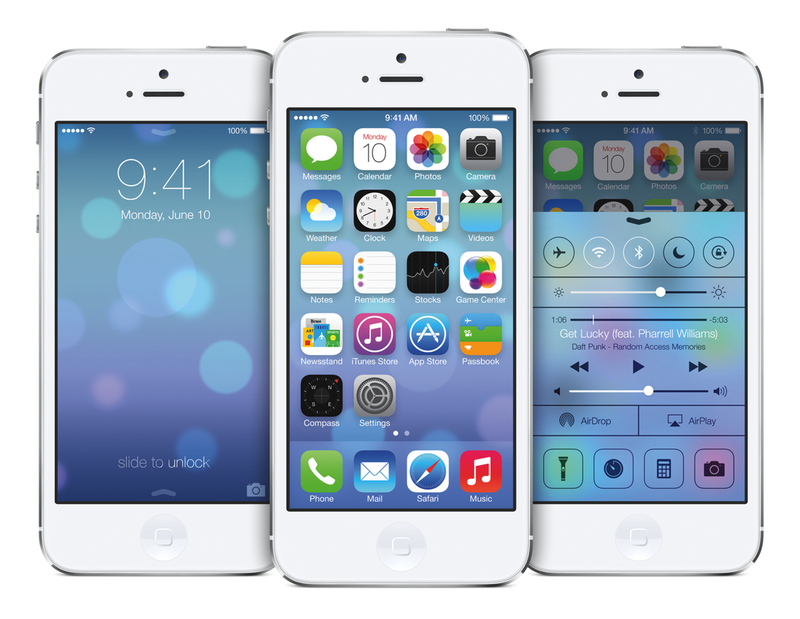
The emphasis on text is also striking. More than just content, text has replaced iconography in many cases. Look at Camera: the modes — VIDEO, PHOTO, SQUARE, PANO — are represented by text for the first time ever on iOS. This to me is proof that “clarity” has taken top priority. iOS is available in a number of countries and languages, which means every piece of text has to be localized (translated) many times over. This isn’t only time consuming, it’s disruptive to UI design: a short word in English is not necessarily short in German, and suddenly things don’t fit on screen anymore. I attended many meetings at Apple where people cringed at changing a word shortly before release, because it meant a whole new round of localize-then-build-then-test.

Apple still hasn’t seeded a developer beta of iOS 7 for iPad. Looking at one of the official screenshots posted online (the Music app, mirrored here), I wonder if more Apple apps for iPad will also prefer text over icons in tab bars.

Permalink

Skype Launches Video Messaging

Today, Skype has officially introduced a new feature called Video Messaging, which allows users to send video files to other contacts. Video Messaging, rolling out today to every platform (including iOS and OS X),  is aimed at letting users “record and share a personal video message, even when your friends and loved ones are not available”. Video Messaging is free for all Skype users.

Skype Video Messaging adds another great way to keep in touch with friends and family during life’s most meaningful moments. Send a video message to your friends and family today—it’s easy. You can capture a fleeting memory, create a heartfelt reminder or simply tell a friend or family member “wish you were here” even when they aren’t online.

Skype videos can be up to three minutes long, and they can be recorded directly from Skype’s apps. In a promotional video, Skype shows how users can record and re-record videos on the iPhone, previewing them before sending them to someone. Videos will be played inline on Skype for desktop computers, and users can also reply to a video message.

Updates to Skype for iOS and OS X will be released today to support video messaging. In the meantime, Skype has posted an official announcement and FAQ here.

Permalink

Apple Posts Letter On “Commitment to Customer Privacy”

Apple has today posted a lengthy public statement on how they handle customer data following allegations of involvement in the NSA-operated PRISM surveillance program. In the letter, Apple reiterates that they don’t provide any government agency with direct access to their servers, and that only the “narrowest possible set of information” is provided to the authorities after a court order and an evaluation of Apple’s Legal team.

Apple writes:

From December 1, 2012 to May 31, 2013, Apple received between 4,000 and 5,000 requests from U.S. law enforcement for customer data. Between 9,000 and 10,000 accounts or devices were specified in those requests, which came from federal, state and local authorities and included both criminal investigations and national security matters. The most common form of request comes from police investigating robberies and other crimes, searching for missing children, trying to locate a patient with Alzheimer’s disease, or hoping to prevent a suicide.

Apple also explains that they don’t mantain a “mountain of personal details about our customers in the first place”.

For example, conversations which take place over iMessage and FaceTime are protected by end-to-end encryption so no one but the sender and receiver can see or read them. Apple cannot decrypt that data. Similarly, we do not store data related to customers’ location, Map searches or Siri requests in any identifiable form.

Apple’s letter is available here, and it’s linked directly on Apple.com’s front page as well.

Permalink

Automattic Acquires Poster for iOS

In a post (via 512 Pixels), developer Tom Witkin has announced that his WordPress client for iPhone and iPad, Poster, has been acquired by Automattic – the company that is also behind WordPress.com (among other products). He writes:

I’m elated to share that I, along with Poster, will be joining Automattic. I’ll be working with the mobile team where I’ll be both designing and coding.

Following the acquisition, Poster has been removed from the App Store and is no longer available for sale. According to Witkin, the best features of the app will be incorporated into the official WordPress app over time. Poster isn’t listed in Automattic’s gallery of products.

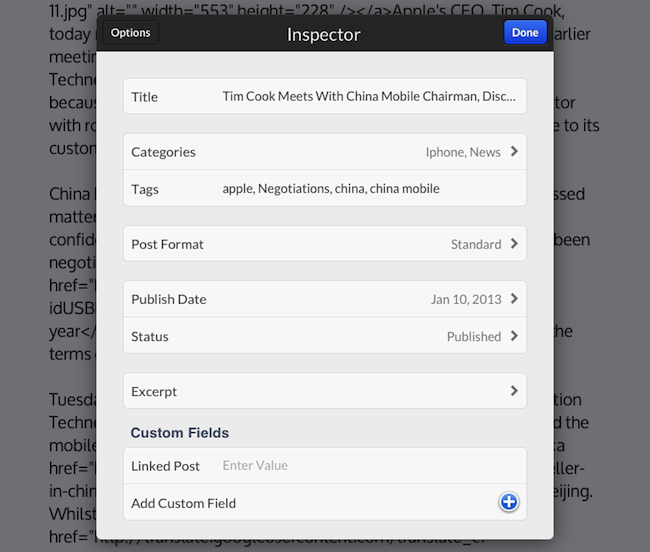
Poster is one of my most used apps on the iPhone and iPad. I have developed several workflows for it, which leverage the app’s advanced features such as support for URL schemes, custom fields, and integration with browser bookmarklets.

It will be interesting to see which Poster features Automattic will decide to bring over to WordPress, and how. Automattic also acquired popular note-taking tool Simplenote earlier this year, and the service has continued to work albeit with no major additions or changes yet.

For now, I will keep Poster installed on my devices, as I believe it provides a superior posting experience than the official WordPress app. I am sad that we’ll never see a proper iOS 7 version of Poster, though.


The New TweetDeck for OS X

TweetDeck used to be this sort-of all powerful Twitter console before Twitter bought it, dumbed it down in some aspects while improving it in others, and changed the icon from yellow to blue. It’s only a 2-star app on the App Store, but I don’t think it’s given enough credit. The changes rolled out around the same time that Twitter’s own iOS app went through the same kinds of changes, and I was receptive to it since I thought the TweetDeck refresh was generally more accessible to the public. I haven’t used TweetDeck much in the meantime, so I’m looking at today’s refresh as a returning user with some familiarity of the previous version.

TweetDeck 3.0 is still a web app, acts like a web app, and will misbehave like a web app. Expanding and collapsing the new sidebar currently breaks the interface — right clicking and reloading the app fixes the missing sidebar.

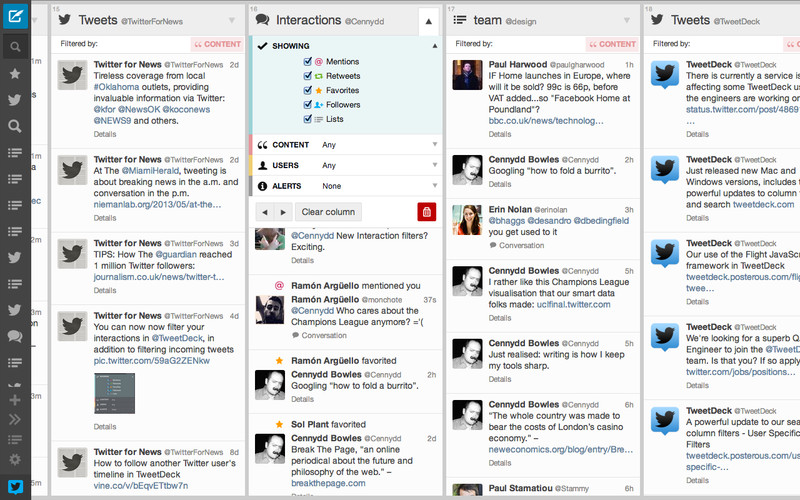
Otherwise, it’s fairly solid. TweetDeck is known for its multiple columns, and filters have been reintroduced through drop down menus that are quite nice. Per column, you can adjust what users you see, only view tweets that contain a certain keyword, or exclude a hashtag of your choosing. You can even receive alerts for tweets that match your query. My impression of TweetDeck is that it’s not an app I’d want to use all the time as it’s optimized for following events like a big media campaign or something like the WWDC Keynote.

TweetDeck has live streaming for all of its columns, although direct messages don’t refresh in real time if you’re replying to someone and they reply back. Through the app’s settings you can adjust font sizes and column width, although you’ll likely have to pan across the trackpad with five or more columns on a MacBook. Columns can be used for just about anything from lists, to searches, to mentions. For example, TweetDeck gives me flexibility in watching replies to our MacStories Twitter account (or another blog’s if I’m interested in a response to a post), and that stuff will update in real time. There’s a column where you can customize Interactions as well, for keeping an eye on new follows, retweets, or favorites.

It’s not a native app, there’s a bug or two, but I can’t help but think there is some clear improvement over the last update. It continues to omit Facebook or LinkedIn integration (sorry folks — that’s probably gone for good), but a lot of new features have been added since. Custom filters per column don’t prevent the app from continuing to be relatively easy to use. My current complaint is that you still need a separate TweetDeck account (which is used for syncing columns and filter preferences), and you’ll need to authorize with Twitter on top of that.

You can download TweetDeck for free from the Mac App Store.