Posts in reviews

Grazing 2.1 & Grazing for OS X: Push Links Back to the Mac

When Grazing 2.0 was released in July, I wrote it was my favorite iOS browser. Three months into this summer’s major update, it still is: Grazing, available on the iPhone and iPad, managed to find the right combination between offering “alternative features” that would make a paid app worth its price (Apple’s Safari, a more than fine browser, comes pre-installed on all iOS devices and is gaining some sweet improvements in iOS 5), while at the same time being simple enough for the average user to be able to approach it without feeling overwhelmed by a custom interface and overly designed functionalities. Grazing doesn’t look like Safari and it’s got a few more buttons and actions than Apple’s browser, but it does feel and work like a regular desktop browser, only ported to the iPhone and iPad. Things I loved about Grazing included tabs, gestures, combined search/address bar, possibility to push links between devices, and several customization options for the sharing menu and settings.

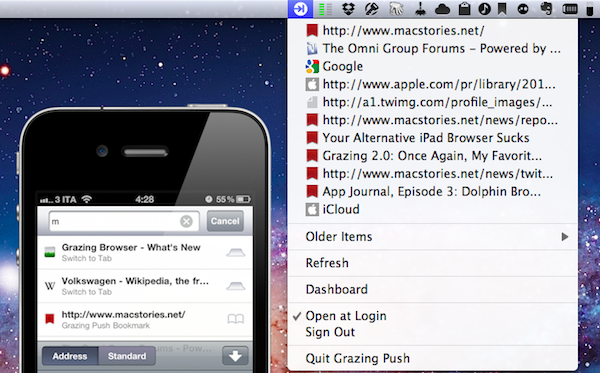
With the 2.1 update released last week and a new free Mac companion app for push notifications, my favorite features of Grazing have been taken to the next level, offering a simple solution for something I’ve been looking for since February. Read more


Diminish Debt with DebtMinder

DebtMinder is the latest creation from the talented developers over at Return7 and aims to help users eliminate their debt. You might already be familiar with their successful BillMinder app that helps users keep track of when bills are due to ensure that late fees are a thing of the past. BillMinder is known for being polished, reliable, and incredibly easy to keep multiple devices in sync. Thankfully the developers were able to bring those features and more to DebtMinder all wrapped up in a familiar interface.

DebtMinder allows you to input multiple accounts of debt into the app and it will help calculate the best payment plan to reduce your debt as quickly as possible. You can also customize this plan by telling DebtMinder that you either want to focus on debt that has the highest interest rate or debt with the lowest balance. This is known as the debt-snowball method. You basically pay off the smallest debt first while paying the minimum payment on the larger debt. It is the quickest way to decrease your total number of bills. Once a payment plan is created your monthly minimum payment is calculated and you can begin paying off you bills.

If you are a user of BillMinder then you will be able to pick up DebtMinder and feel as if you already know how to use the app. I was able to log in with my BillMinder credentials (new users will have to set up an account). As I added accounts to DebtMinder I had the option to link them with accounts that I had already set up in BillMinder. It was hard to appreciate this at first because it was so easy to set up, only two clicks. Once the account was linked and I added a payment to DebtMinder, I was able to launch BillMinder and see that the bill had already been paid. And not just on my phone, but on my iPad and on my wife’s phone as well because all devices are kept in sync under one account.

DebtMinder is my favorite kind of app for iOS because it is inexpensive, useful, and easy on the eyes. It will more than pay for itself when your credit card gets paid off ahead of schedule and unnecessary interest fees are avoided.

BillMinder is available in the iTunes App Store today for only $1.99


Gradient for Mac Public Beta: Creating Simple CSS Gradients

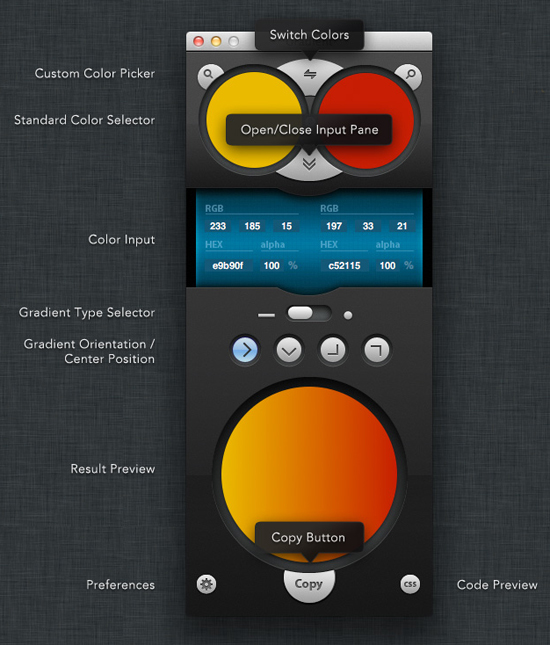
Gradient, made by JUMPZERO, is a simple yet powerful Mac OS X app that lets you easily create CSS gradients by getting rid of the clumsiness of vendor prefixes. The user interface is beautiful and works wonderfully. Gradient is in open beta for any designer that wants to help test the app out or see what Gradient will be able to do.  In Gradient, you can pick/select/input the colors and then define which type of gradient you’re looking for; click the Copy button near the bottom of the application window and paste the generated code into your favorite editor.

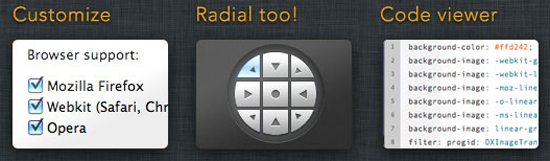
Gradient is customizeable as to which browser needs support by opening the preference pane and activating the radio buttons for the browsers you are going to support. No need for Internet Explorer? Simply uncheck the button. Gradient not only supports linear gradients but radial as well, just move the slider over to the type you need. The gradients’ directions can be altered by the directional arrows for linear and by using the radial-center-matrix-button for radial gradients. Before you decide to copy the CSS, you can preview the code in-app by clicking the CSS button. A hovering code box pops up and displays your code all within Gradient.

Gradient lives in your dock, menubar, or whatever mix you want. You can click the menu bar icon to activate the app and get to work. You can also click either of the two large top colors to bring up the OS X built-in color selector or click the magnifying glass icon to bring up the zoom tool to use on every pixel of your Mac’s screen.

Gradient feels very polished for only being in beta 2, and it looks like this will be a great tool for web designers looking for a simple yet intuitive way to create CSS gradients. Gradient’s development roadmap consists of adding HSL input & output, SASS syntax and multiple step gradients. No details on the app’s release date have been provided, but it should be soon according to the website.


ClickToPlugin Brings AirPlay Support to Safari for Mac

ClickToFlash, the popular plugin to block Adobe Flash content in Safari and make videos play in higher quality through HTML5, had to go through a series of changes after Apple released Safari 5.1, which dropped support for WebKit Plugins. Those of you who use ClickToFlash on a daily basis may have noticed that ClickToFlash for Safari 5.1 recently got a new home, and it’s been developed by Marc Hoyois as a Safari extension called ClickToPlugin.

Marc Hoyois actually offers both ClickToPlugin and ClickToFlash rewritten as a Safari extension – the former is simply a broader version of ClickToFlash that doesn’t stop at Flash content, but prevents Safari from launching a variety of plugins, including Facebook Video Calling and Java. The same functionality of ClickToFlash is still there, only it’s been split in two versions depending on what you need (if you only want to block Flash, get the new ClickToFlash extension) with a new settings page. As usual, the extension replaces content with a placeholder that doesn’t load automatically and, when possible, allows for a direct plugin-to-HTML5 conversion that, in the case of YouTube, will allow you to load a video’s source in higher quality. ClickToFlash/ClickToPlugin comes with several preferences to tweak and support for many video websites – you should check out the complete list of features and screenshots of the settings at the developer’s website.

An update released earlier this week for the ClickToPlugin/ClickToFlash extensions adds a feature Mac users have been requesting since the introduction of iOS 4.2 last year – AirPlay support in Safari for Mac. While AirPlay had been enabled first in Apple’s iOS apps, then the Mobile Safari browser and third-party apps, Mac users were only given AirPlay support for audio in iTunes, but nothing related to video streaming on OS X. A number of hacks and utilities surfaced to send Mac video to an Apple TV or AirPlay receiver and even turn a Mac into an AirPlay-compatible device, but there’s never been a way to easily select a video in the browser, and instantly beam it to an Apple TV with the click of a button.

The latest ClickToPlugin adds exactly this feature in combination with its built-in HTML5 video recognition and a second utility available on Marc Hoyois’ website called Media Center. Version 2.5.2 of Hoyois’ extension adds a new “AirPlay” option in the HTML5 media player (the one you get if you, say, decide to replace Flash content on YouTube with HTML5 video), enabling you to send video to an Apple TV on your network. The Apple TV’s hostname or IP address needs to be specified in ClickToPlugin’s settings, but it’s set by default to apple-tv.local, which is what Apple gives you with an Apple TV out of the box. The default hostname worked for me and found my Apple TV (connected with WiFi first, then via Ethernet to my AirPort Extreme).

Once ClickToPlugin is set to fetch HTML5 video instead of Flash (you can optionally choose a default resolution – I picked 720p) and the Apple TV is configured to accept incoming AirPlay streams (the extension has support for AirPlay passwords, too), you’ll be able to try AirPlay in Safari by opening a YouTube video, like this one, and choose AirPlay from the source selector on the top left. If your settings are correct, the video should start playing on your Apple TV.

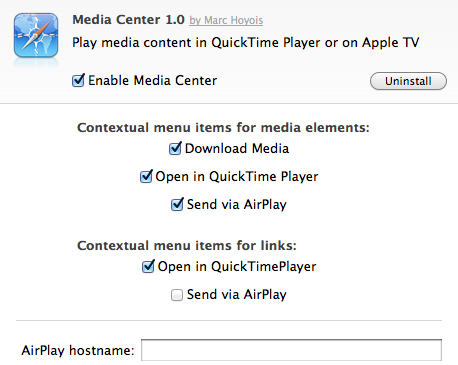
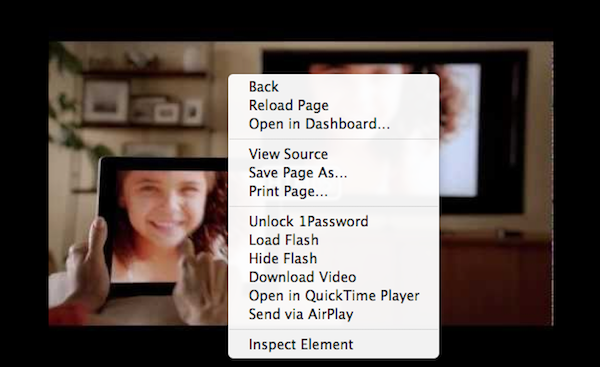
Media Center works in conjunction with the latest ClickToPlugin in that it adds a contextual menu item to links and HTML5 media to download a video file, open it in QuickTime, or send it to an Apple TV via AirPlay. Some of these functionalities are already provided by ClickToPlugin, but I like Media Center’s AirPlay action on right-click and, more importantly, the toolbar button that allows you to stop a a video from being streamed to the Apple TV.

In my tests, ClickToPlugin and Media Center have been fairly reliable, streaming 720p content from YouTube to my Apple TV, although I’ve experienced some connection drops (the video would stop playing after a few minutes on the Apple TV) and errors with the Vimeo website. I need to mention, though, that I’m running OS X, Safari and Apple TV beta software, so that might be the culprit. Even with these betas (OS X 10.7.2, Safari 5.1.1, Apple TV Software beta 6), ClickToPlugin’s AirPlay support worked fine most of the time, and I’m sure optimizations for the new OS and Safari will be available once Apple publicly releases the updates. I’ve also noticed you don’t have to keep a tab open after the video starts playing with AirPlay, but Safari can’t be quit or you’ll lose the AirPlay stream.

I wouldn’t be surprised to see native AirPlay support by Apple in a future version of Safari for Mac (or, even better, systemwide AirPlay support on OS X), but right now, ClickToPlugin and Media Center provide an interesting solution for those who want to comfortably enjoy video from their web browser on a widescreen TV. The extensions surely need some work and refinements, and it would be great to see them land on Chrome someday (if it’s even possible, I don’t know).

Go download ClickToPlugin and Media Center on Marc Hoyois’ website.


Control Multiple Macs with Teleport

I don’t always use two Macs simultaneously, but when I do, either there’s an Apple keynote or I’m trying new apps.

That’s how I stumbled upon Teleport, a free OS X utility, last year when I needed to switch back and forth between MacBooks during an Apple keynote, and why I decided to take the app for a spin again now that’s been updated for Lion. Teleport isn’t new to Mac users – in fact, it’s been around since Tiger and it’s probably the most popular app to control two Macs on the same local network. Now that version 1.1 is out with support for Lion and multi-touch gestures, I thought a fresh mention would be appropriate.

Teleport is extremely simple in what it does, although it uses some advanced technology to accomplish it: once installed in System Preferences, Teleport allows you to move your cursor (and keyboard) between multiple Macs. Teleport recognizes Macs “shared” on the same network, and through a system similar to Apple’s “hot corners” and based on Bonjour, it lets you “teleport” the mouse across screens.

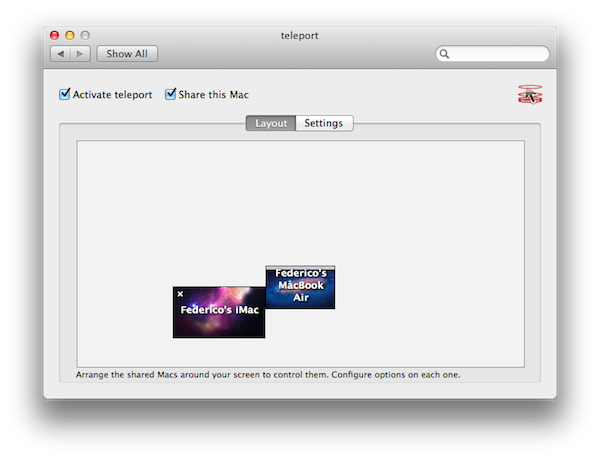
Shared Macs that have Teleport activated in the settings will show up with their respective desktops in the app’s panel; you can arrange Macs placing them next to a main computer’s screen so you’ll remember how to switch displays, and configure options in a dedicated sub-menu. These options include handy things like “switch only if key is pressed” or “share pasteboard”. In this latest version of Teleport you can assign a keyboard shortcut to switch to another Mac, and Lion’s gestures are fully supported so you’ll be able to perform three-finger swipes and other Mission Control trickery on a Mac running Lion.

When controlling my iMac through my MacBook Air’s trackpad and keyboard, I was able to drag & drop files using Teleport, and have the contents of the pasteboard from my MacBook Air automatically synced on my iMac. There are several utilities to control how the pasteboard is shared and synced across local Macs, but Teleport manages to make the whole process “invisible” in a package that also happens to do much more.

For instance, Teleport supports encryption for file transfers, and you can read more about it on Abyssoft’s website and the ReadMe file included in the download. Long story short: you can generate your own certificate to activate encryption and it’s even easier if you already have a .Mac account. Also in Teleport’s settings, you can enable a menubar item, bezel, and sound notifications. The sound effect is particularly neat when you switch between Macs, as it really gives you the sense of something “travelling” between two spaces (Teleport also displays a quick animation at the side of your screen). Control requests are also handled well between shared Macs, with options to “ask me if host can be trusted”, “reject if host not already trusted” and “automatically accept”. If you leave Teleport always running, when a shared Mac comes back online a red indicator will flash on the previously configured side of the screen.

Version 1.1 includes a few more features like:

  • Host specific options: you can define the switching and sharing options per host, to have different settings.
  • Propagated options: the options you set for a host also apply when coming back from it.
  • Full multi-screens support: all screens of shared Macs are now visible, so pairing a secondary screen is much easier than before.

Teleport isn’t new, but it’s nice to see the app working well on Lion with gestures and multiple displays. If you happen to control multiple Macs every once in a while, give Teleport a try. It’s a free download (and make sure to donate if you really like it).


Realmac’s Analog: Apply Filters & Share Your Photos

Released today on the Mac App Store after months of teaser videos and private betas, Analog is the latest creation by Realmac Software, makers of great apps for the Mac like Courier and LittleSnapper. As the early preview videos suggested, Analog is an application to quickly edit and “beautify” your photos in a way that has been made popular recently by iOS apps like Instagram and Camera+ or, on the Mac, Flare by The Iconfactory. Whilst Analog undoubtedly shares some similarities in the main concept with these applications (pick a photo, apply a filter, share it), the execution and attention to detail of the Realmac team makes sure Analog can stand out from the crowd of post-processing utilities.

I’ve been playing with Analog, and I like it because it is extremely simple, focused, and elegant. Everything from choosing a filter to cropping an image has been made intuitive and fast, with some graphical elements (like the sharing menu) inspired by recent iOS interface guidelines brought over to OS X by Apple. Most of all, Analog is fast: I tried the app on my 13-inch MacBook Air (entry model), and filters were applied in less than a second – Analog is very snappy and responsive.

When you fire up Analog for the first time, you’re presented with a large “drop” area on the left, and a sidebar for filters and borders on the right. To start editing an image, you have to drop it into Analog’s main window; once an image is in there, you can start choosing filters and borders to “give your photo some soul”, and share it with your friends. The typical navigation and usage pattern of Analog is fairly simple: import photo, process, share.

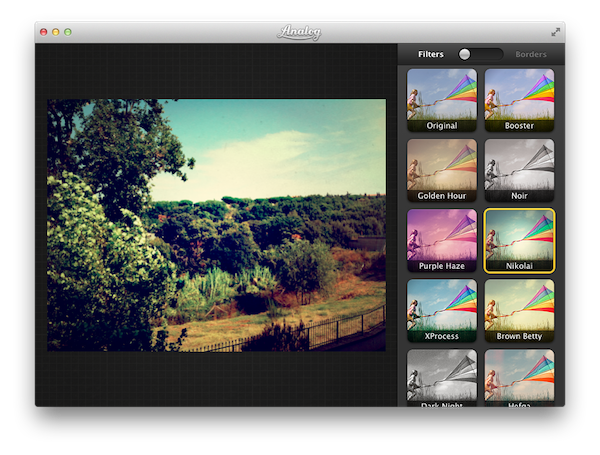
Analog offers 20 filters, which have been carefully researched by Realmac over the past months to make sure each one of them has its own personality (something we know that matters in this kind of apps) and will make your photos look great. Now I’m no photography expert, but I can recognize a nice filter when I see it. Analog’s filters range from washed out (Hefga, Golden Hour) to black & white (Noir, Dark Knight, Bromide – three B&W variations with different grey scales and contrast) to contrasty (Memory, XProcess) and other interesting options that I can’t quite classify (Kyoto, Hawkeye). Analog’s filters look good, and I definitely like the choice of 20 different filters offered by Realmac. You might argue some of them look similar to each other, but the developers have also implemented a system that ensures scratches, noise and other effects are always randomized on each processing session.

A photo processed and exported using Analog

To switch between effects you simply have to click on them; a switch button at the top of the sidebar enables you to choose borders, which will look instantly familiar if you’ve used other apps like Instagram and Flare. Read more


JotAgent 2: Quickly Save Notes In Dropbox or Evernote

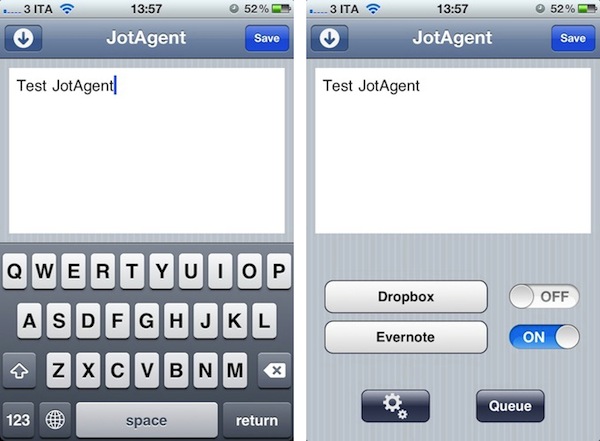
Last year, I reviewed JotAgent, a quick and easy way to save notes in your Dropbox account with a few taps. JotAgent 2, released earlier this week, improves on every aspect of the original app, adding support for Evernote and a refreshed user interface both on the iPhone and iPad. Just like the first JotAgent, you can configure the app to save text notes in your Dropbox account (you can pick your own folder for notes); in this version, you can also log in with your Evernote credentials, and select a notebook where new notes will be saved. If you configure both Dropbox and Evernote, you can easily de-activate one of the two services in JotAgent’s main screen, which has got service, settings, and queue icons in the lower section.

As soon as the app launches, you can begin writing. When you’re done with a text note, you can hit Save to send it to Dropbox or Evernote – the saving process will require a few seconds depending on your Internet connection. If you’re offline, JotAgent allows you to queue notes for later, and upload them when you’re back online. Two interesting features of JotAgent are TextExpander support for snippets and title formatting: the latter lets you change the default template for your notes’ titles, and you can choose between a nice selection of modifiers available on JotAgent’s website. Thanks to these modifiers, I’ve been able to customize the way notes are saved in my Evernote account to show only the month and day of creation.

JotAgent 2.0 doesn’t want to be a full-featured text editor as its focus is completely different. It’s a lightweight app to quickly send a note or idea to the cloud – as I wrote last year, it’s like Captio for text notes. You can get JotAgent 2.0 now at $0.99 on the App Store, or jump after the break to enter our giveaway. Read more


Magical Weather: A Beautiful Weather Station For Your iPad

When Sophiestication invited me to try a beta of her upcoming weather app, I was curious to see how the typical style of Sophia’s apps (Coversutra, Articles) would fit with this kind of software – I’m no Ben Brooks, but I’ve tried several weather apps for iOS in the past year, and I know that putting too much focus on the presentation, rather than data, can be counterproductive for the developer and an app’s success. That’s one of the reasons why apps like Weather HD quickly sold thousands of copies on the App Store, but never really got the weather geeks’ attention and long-term usage.

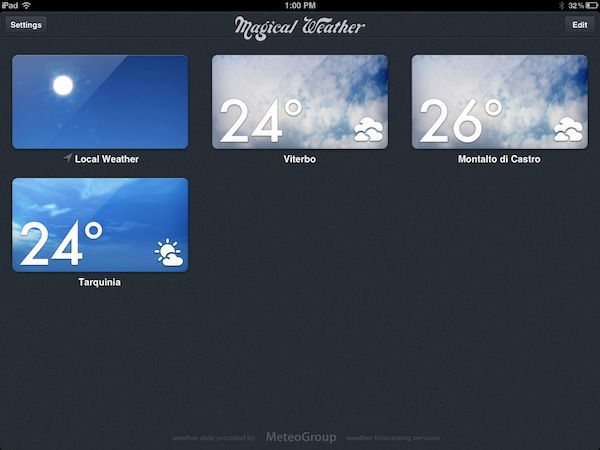
Magical Weather by Sophiestication might just hit the right spot between available weather data and attention to beautiful pixels. When you start the app for the first time (Magical Weather is iPad-only for now), you’re presented with a grid of thumbnails for different cities, labelled with their names and current temperature. You may notice the thumbnails are actually generated in real-time based on weather conditions, but more on this in a bit. The first item in the grid is “local weather”, which is obtained by default. You can add new locations to the app’s main screen by searching (city, ZIP and Airport codes are supported) and, with the Edit button, you can remove locations at any time. From the Settings popover in the upper left corner, you can set the temperature to Celsius and Fahrenheit, and tweak Wind Speed to the unit you’re more comfortable with.

When you tap on a location, the app brings you to a full-screen view of the current weather conditions. This new screen is gorgeous: Sophiestication built in several different animations that look great, and provide an instant summary of what’s going on. If it’s raining, you’ll see dark clouds and rain; if there’s a thunderstorm, you’ll see thunders animated on screen. But the real treat isn’t the weather animation itself – it’s the combination of beautiful artwork and data in the right sidebar.

As you open a location, in fact, Magical Weather will launch a weather animation and a sidebar containing a forecast, current temperature, and the following data:

  • Current temperature with today’s high and low
  • Relative humidity
  • Probability of rain
  • Atmospheric pressure
  • Wind speed (in Beaufort, knots, mph, kph, or mps)
  • Change in temperature since yesterday
  • Current UV index

If you don’t understand the icons displayed on screen, you can hit the “?” button to make a handy guide appear explaining all the data points offered by Magical Weather. This sidebar, however, offers two additional views: you can “hide it” by dragging it at the bottom of the screen – thus displaying only the current temperature in a corner – or expand it by revealing an additional section with a hourly forecast. Weather icons and typography are extremely clear and legible, and look elegant no matter the background they’re visualized against.

At $0.99 on the App Store (limited time offer), Magical Weather is a great piece of work with beautiful graphics and data that doesn’t confuse the user. The app isn’t complex and doesn’t require a learning curve, it’s fun and intuitive to use. Magical Weather may not be enough for the uber-geek, but it’s a fine weather app for everyone else. Get it here.


RestoreMeNot Disables Lion’s Resume For Individual Apps

One of Lion’s biggest changes for geeks and average OS X users alike has been its Resume functionality, which combined with Auto-Save ensures your documents are always saved in the background, and their application windows restored after you reboot your Mac, or quit an app. Whilst Lion’s window restoration may come in handy if you don’t want to lose your Safari browsing session or writing point in TextEdit, the opposite can also be true: automatic window restoration can be annoying for scratch documents that you don’t want to see again, in apps that perhaps you think should always start up fresh and uncluttered.

In our OS X Lion review, we detailed how it’s possible to decide to “quit and discard windows” every time by pressing the Option key alongside the usual CMD+Q combination – but wouldn’t it be nice to automatically disable window restoration forever in a specific app? In the days following Lion’s release, a number of Terminal hacks surfaced indicating that it was indeed possible to disable window restoration on an app-by-app basis. RestoreMeNot, a free System Preferences panel covered by Lifehacker earlier today, gives these Terminal hacks a graphical user interface that lets you choose apps you don’t want to restore windows with.

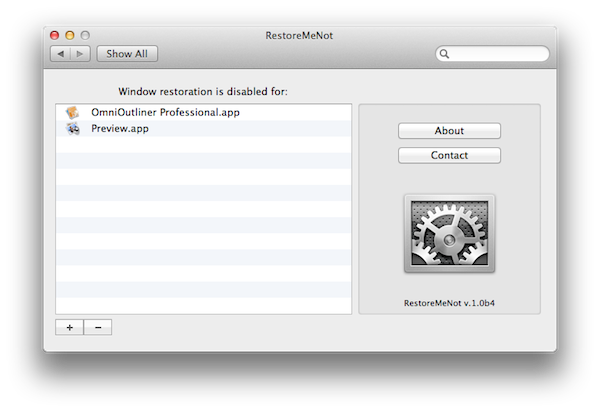
The app is extremely simple. Once installed, it’ll ask you for apps from your Finder. In my workflow, I always find myself hitting Command+Option+Q to quit and discard windows in Preview and OmniOutliner, so I might as well add them and go back to my usual Command+Q shortcut. RestoreMeNot does exactly this – it basically overrides the standard “Quit” command with “Quit and Discard Windows” and it’ll make sure your selected apps will launch window-free when possible (TextEdit, for instance, will create an “Untitled” document every time). Don’t worry though – this won’t disable auto-save: I tried with TextEdit, and whilst its windows wouldn’t be restored, the contents of a modified document were still correctly saved by Lion.

If you’re looking for a more advanced way to tweak your OS X Lion’s behavior, TinkerTool recently added an option to individually control Resume for apps as well. You can download RestoreMeNot for free here.