Federico Viticci

10975 posts on MacStories since April 2009

Federico is the founder and Editor-in-Chief of MacStories, where he writes about Apple with a focus on apps, developers, iPad, and iOS productivity. He founded MacStories in April 2009 and has been writing about Apple since. Federico is also the co-host of AppStories, a weekly podcast exploring the world of apps, Unwind, a fun exploration of media and more, and NPC: Next Portable Console, a show about portable gaming and the handheld revolution.

Six Colors’ ‘Apple in 2022’ Report Card

For the past eight years, Six Colors’ Jason Snell has put together an ‘Apple report card’ – a survey that aims to assess the current state of Apple “as seen through the eyes of writers, editors, developers, podcasters, and other people who spend an awful lot of time thinking about Apple”.

The 2022 version of the Six Colors Apple Report Card was published yesterday, and you can find an excellent summary of all the submitted comments along with charts featuring average scores for different categories here.

Once again, I’m happy Jason invited me to share some thoughts and comments on what Apple did in 2022. MacStories readers know that last year didn’t exactly go as planned. While iOS 16 delivered a meaningful update to the Lock Screen for people who care about customization and the iPhone 14 Pro came with substantial improvements to the display and camera tech, the iPad story was disappointing and confusing. This is reflected in my answers to Jason’s survey, and it’ll be a recurring topic on MacStories in 2023. At the same time, I was also impressed by Apple’s performance on services, concerned by the evolution of the Shortcuts app, and cautious about the company’s newfound approach to HomeKit.

I’ve prepared the full text of my answers to the Six Colors report card, which you can find below. I recommend reading the whole thing on Six Colors to get the broader context of all the participants in the survey.

Read more


macOS Isn’t as Small as You Think→

Interesting comparison of macOS and iPadOS interface elements by Matt Birchler:

I will say that there are certainly some macOS UI elements that could be tricky to use with touch, but I think they’re the exception, not the rule. Still, Apple will certainly make some UI changes to accommodate touch as an officially-supported input method on the platform.

And:

There’s a narrative out there that touch is just so incompatible with macOS and that in order to make it work, the macOS UI would have to get blown up to comical proportions, but I don’t think that’s the case. Changes will be made, but I think macOS is more touch-friendly today than many people give it credit for.

I don’t disagree, and count me among those who think Apple should consider bringing touch support to the Mac.

I’ve seen this argument regarding the concern of “blowing up” the macOS UI in recent years too, and I think it’s shortsighted. Look no further than the iPad Pro: in a single device, Apple was able to let touch, pointer, and now even hover interactions coexist. Even without display scaling, I don’t think iPadOS has a comically large interface, as some believe.

There is a lot of work to be done to achieve a similar kind of input balance on macOS (think of all the elements that haven’t been redesigned in recent years, like drag controls for windows; the list is long), but it is possible, and I hope Apple gets there in the near future.

Permalink

Mastodon Web, Mac, and Utility Apps

AppStories+ Deeper into the world of apps

AppStories Episode 315 - Mastodon Web, Mac, and Utility Apps

0:00
0:00

AppStories+ Deeper into the world of apps

This week, Federico and John conclude their look at Mastodon apps with web and Mac clients, plus Mastodon utilities.

Read more


The Cross-Platform Apps and Services I Use

As part of my tour of other platforms and devices lately, I’ve been thinking about the cross-platform apps and services I was already using, and how they made it easy to move between iOS, iPadOS, Android, and Windows. During this process I also started using some new services to simplify my life, and I thought...


The Practicality of Art in Software

I’ve been following with great interest this series of articles by John Gruber (and Matt Birchler’s related story) about the chasm between iOS and Android apps. I have some thoughts since expanding my app knowledge beyond iOS and iPadOS is one of my goals for 2023.

About a month ago, during my holiday break, I purchased a Google Pixel 7 as a way to re-familiarize myself with Android.1 To say that I found the ecosystem worse than I remembered would be an understatement. It’s not just about the fact that – as Gruber and Birchler noted – most Android apps suck compared to their iOS counterparts; it’s that the entire OS lacks cohesiveness.

Read more


Two Apps I’ve Been Trying Lately

For this first Monthly Log column of 2023, I thought I’d take readers on a quick behind-the-scenes tour of two apps I’ve been testing on my iPhone lately and how they’ve been working out so far for me. Pocket Casts This is, by far, the biggest app-related change I’ve brought to my everyday iPhone workflow...


Mastodon Clients for iOS and iPadOS

AppStories+ Deeper into the world of apps

AppStories Episode 314 - Mastodon Clients for iOS and iPadOS

0:00
0:00

AppStories+ Deeper into the world of apps

This week, Federico and John cover the iPhone and iPad Mastodon apps they’ve been testing and share what they like and don’t about each.

Read more


Unread 3.3→

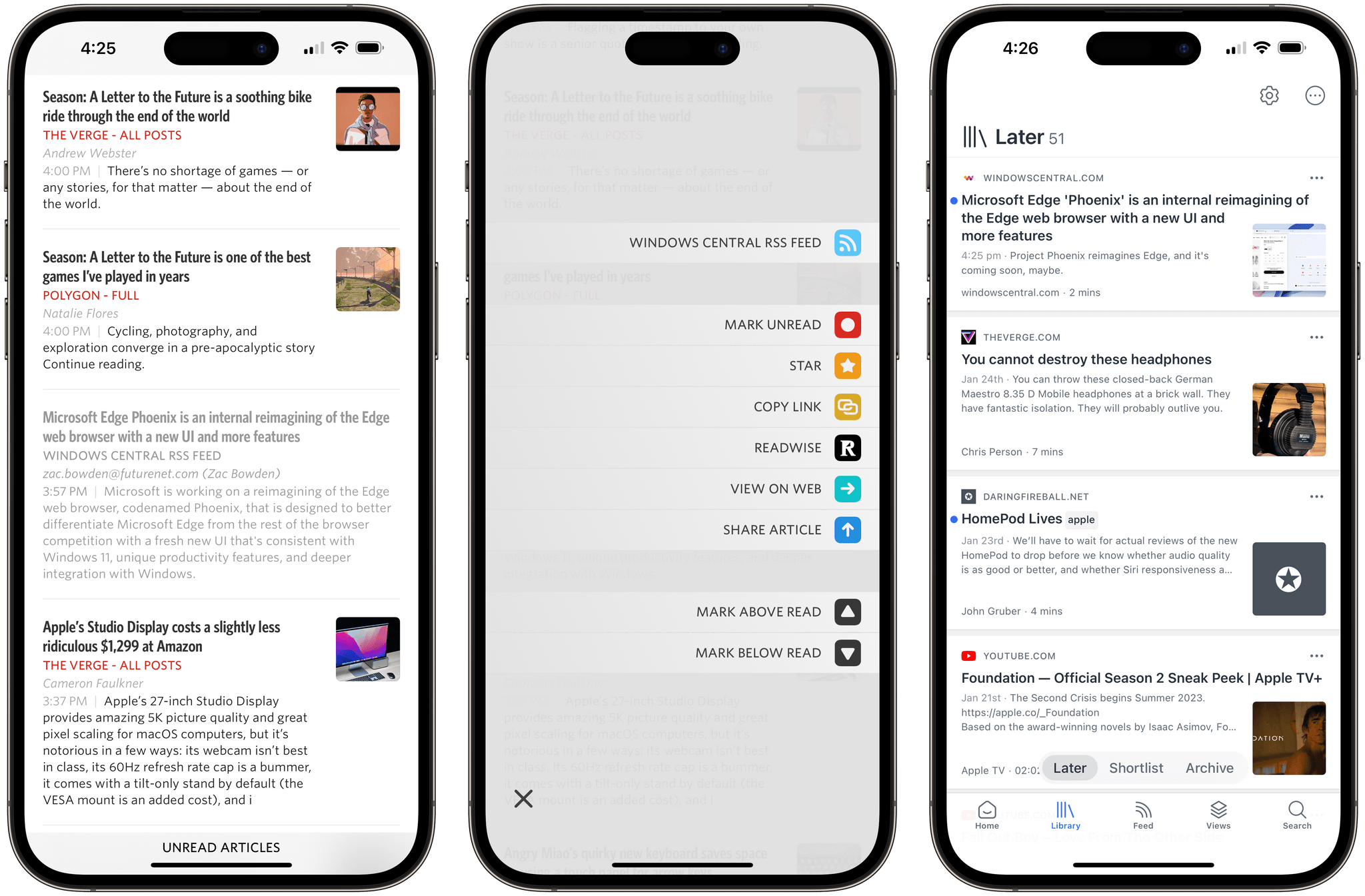
Saving an article from Unread to Readwise Reader.

Saving an article from Unread to Readwise Reader.

Unread, the elegant RSS reader by Golden Hill Software that we’ve covered before on MacStories, received its 3.3 update today, and it’s an interesting one I’ve been playing around with for the past week. There are two features I want to mention.

The first one is the ability to set up an article action to instantly send a headline from the article list in the app to Readwise Reader. As I explained on AppStories, I decided to go all-in with Reader as my read-later app (at least for now), and this Unread integration makes it incredibly easy to save articles for later. Sure, the Readwise Reader extension in the share sheet is one of the best ones I’ve seen for a read-later app (you can triage and tag articles directly from the share sheet), but if you’re in a hurry and checking out headlines on your phone, the one-tap custom action in Unread is phenomenal. To start using it, you need to be an Unread subscriber and paste in your Readwise API token.

The second feature is the ability to save any webpage from Safari as an article in Unread, even if you’re not subscribed to that website’s RSS feed. Essentially, this is a way to turn Unread into a quasi-read-later tool: the app’s parser will extract text and images from the webpage, which will be then be saved as a ‘Saved Article’ in Unread Cloud, Local feeds, or NewsBlur, or as a ‘Page’ in Feedbin.

If you’re a new Readwise Reader user, I recommend checking out Unread 3.3, which is available on the App Store for iPhone and iPad.

Permalink

Ivory for Mastodon Review: Tapbots Reborn

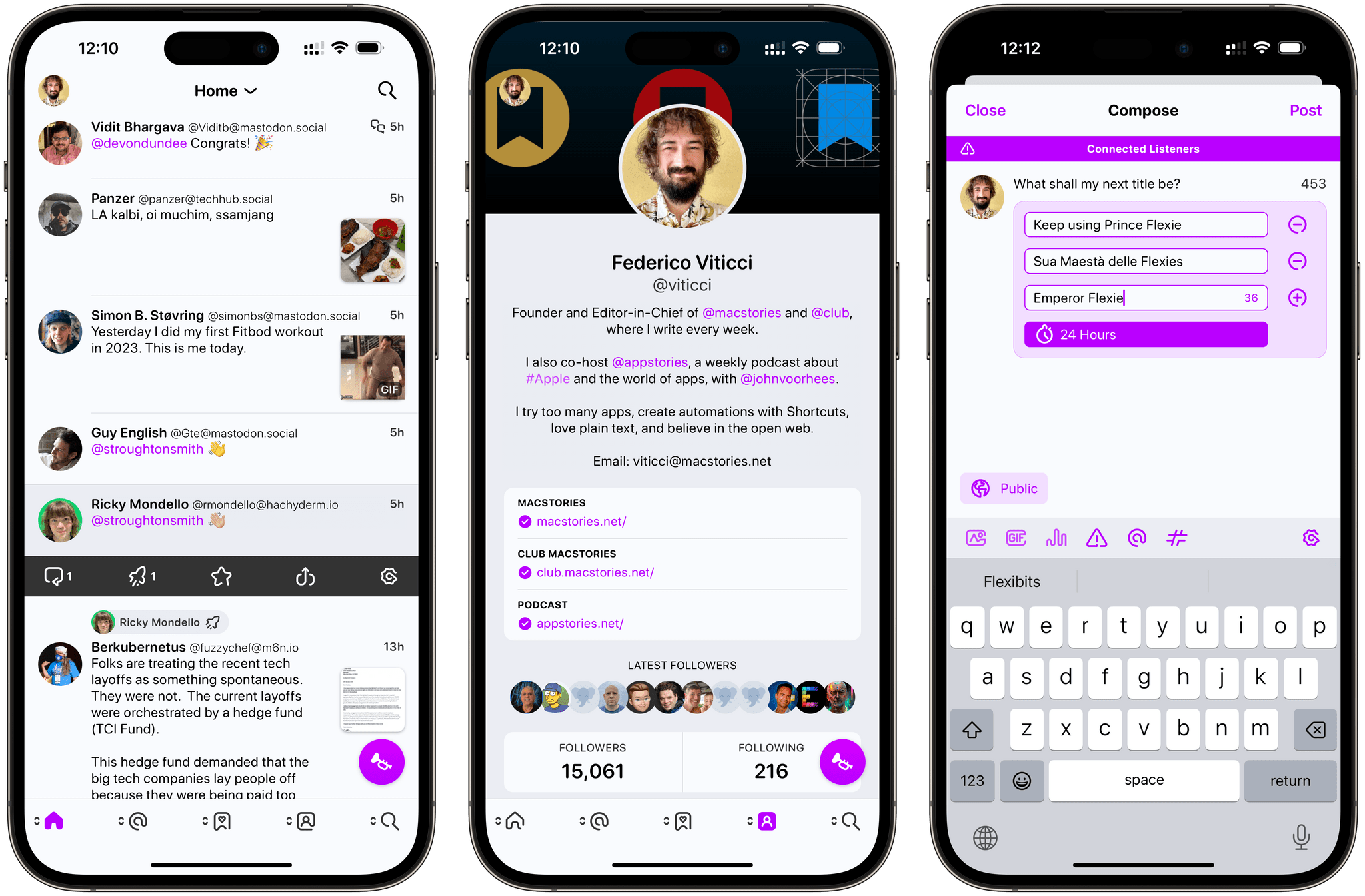
Ivory for Mastodon.

Ivory for Mastodon.

There’s an intangible, permeating quality about Tapbots apps that transcends features and specs: craftsmanship. With Ivory, launching today on the App Store for iPhone and iPad, you can instantly appreciate that level of care and refinement that the Texas-based duo is well known for after more than a decade on the App Store. But there’s something else, too: for the first time in a few years, it feels like Mark and Paul are having fun again.

Ivory is a Mastodon client, and it’s tricky to evaluate it right now because its version 1.0 is launching under extraordinary circumstances.

As we’ve documented on MacStories, Twitter’s idiotic new “leadership” recently decided to unceremoniously and crassly put an end to third-party clients such as Tweetbot with no warning, which forced Tapbots to scramble and figure out a solution on how to discontinue Tweetbot while dealing with subscription renewals while also accelerating the timeline for the launch of Ivory, which they’d been working on for months. I’ve been following the development of Ivory very closely (I’ve been using the app as my main Mastodon client since its first alpha in late November), and I know that the Ivory 1.0 launching today isn’t the debut version Mark and Paul were envisioning. By Tapbots’ own admission, there’s still a lot of work to do on Ivory, but given how the Twitter situation evolved, they had to ship something. There is already a roadmap on Tapbots’ website for Ivory, if you’re curious to know what the developers are planning for the foreseeable future.

As I was saying above, however, there’s something else about Ivory that, in many ways, makes today’s release an important milestone in our community worth documenting and celebrating. Ever since we at MacStories decided to abandon Twitter, we’ve gone all-in on Mastodon and, broadly speaking, we want to embrace the idea of decentralized and federated social media. Over the past few weeks, I’ve seen hundreds of other people I used to follow on Twitter do the same. I believe we’re witnessing the beginning of a new social networking era, and even though Mastodon has been around for a few years, many of us (myself included) are only realizing now that we should have paid attention to this kind of technology years ago.

For the second time since I started MacStories in 2009, I can observe developers imagining what interfaces for reading and posting status updates on the web should look like. New conventions are being created as we speak, and we are, once again, witnessing the rise of a vibrant ecosystem of third-party apps designed for different needs, platforms, and people. Only, this time, there is no single company that controls the fate of all this.

So that’s the something that makes the release of Ivory a special one in the Apple community. More than a reactionary “what if Tweetbot, but for Mastodon” move, Ivory marks a new beginning for Tapbots in a way that Netbot never was. (If you know, you know.) We’re living in new and exciting times for indie apps, and I think that you can feel it when the creator of an app feels the same way. Ivory exudes enthusiasm. Even though it’s not the most feature-rich client I’m testing right now, it’s the one I’m constantly drawn towards. Ivory is going to establish a baseline for quality and polish on iOS and iPadOS; it’s the app future Mastodon clients for iPhone and iPad (and, hopefully soon, Mac) will have to measure up against.

Ivory is the start of a new chapter for one of the most beloved indie studios in our community. So let’s take a look.

Read more