Federico Viticci

10759 posts on MacStories since April 2009

Federico is the founder and Editor-in-Chief of MacStories, where he writes about Apple with a focus on apps, developers, iPad, and iOS productivity. He founded MacStories in April 2009 and has been writing about Apple since. Federico is also the co-host of AppStories, a weekly podcast exploring the world of apps, Unwind, a fun exploration of media and more, and NPC: Next Portable Console, a show about portable gaming and the handheld revolution.

Apple Changing App Store Prices for Several Countries

Section on VAT clarified, more updates at the bottom of the article.

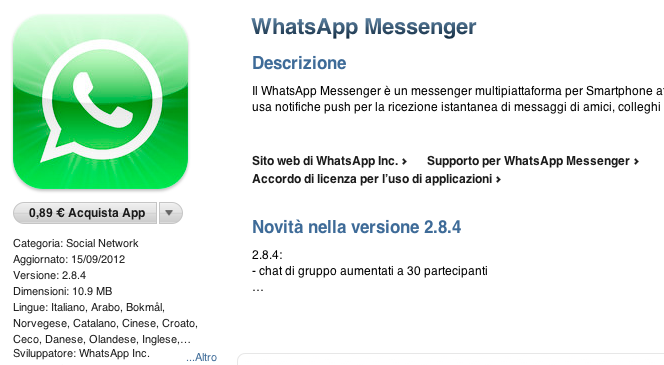
As pointed out by several readers on Twitter, Apple appears to be changing pricing tiers of App Store applications in several European countries. Specifically, the lowest price used to be €0.79, which has today been bumped to €0.89. We’ve been able to confirm this is indeed the case, as shown in the screenshot above, taken from the Italian App Store.

So far, we’ve received notices of App Store pricing changes in:

  • Italy
  • Spain
  • Netherlands
  • Portugal
  • Greece
  • Poland
  • Germany
  • France
  • Belgium
  • Austria
  • Czech Republic
  • Denmark
  • Luxembourg
  • Hungary
  • Russia
  • Ireland
  • Finland

Read more


Apple Q4 2012 Results: $36 Billion Revenue, 26.9 Million iPhones, 14 Million iPads, 4.9 Million Macs Sold

Apple has just posted their Q4 2012 financial results for the quarter that ended on September 29, 2012. The company posted revenue of $36 billion ($8.67 per diluted share), with 14 million iPads, 26.9 million iPhones and million 4.9 Macs sold. Apple sold 5.3 million iPods. The company reported quarterly net profit of $8.2 billion. Gross margin was 40.0 percent compared to 40.3 percent in the year-ago quarter. International sales accounted for 60 percent of the quarter’s revenue.

In this quarter, Apple’s Board of Directors has declared a cash dividend of $2.65 per share of the Company’s common stock.

The dividend is payable on November 15, 2012, to shareholders of record as of the close of business on November 12, 2012.

From the press release:

We’re very proud to end a fantastic fiscal year with record September quarter results,” said Tim Cook, Apple’s CEO. “We’re entering this holiday season with the best iPhone, iPad, Mac and iPod products ever, and we remain very confident in our new product pipeline.

We’re pleased to have generated over $41 billion in net income and over $50 billion in operating cash flow in fiscal 2012,” said Peter Oppenheimer, Apple’s CFO. “Looking ahead to the first fiscal quarter of 2013, we expect revenue of about $52 billion and diluted earnings per share of about $11.75.

Estimates and Previous Quarters

For Q4 2012, Apple had set its guidance at revenue of about $34 billion and diluted earnings per share of about $7.65.

The Street consensus’ average estimate was earnings of $8.75 per share and revenue of $35.80 billion.

On October 24, 2012, both independent and “pro” analysts polled by Fortune (68 in total) forecasted earnings and revenue higher than Apple’s guidance, as it often happens.

After getting clobbered quarter after quarter for nearly four years by a bunch of bloggers, day traders and other amateur analysts, the professionals seem to be giving their clients more realistic numbers. And having badly misjudged two of the last four quarters, the more bullish independents have, for the most part, started to come back to earth.

In Fortune’s poll, the “pros” averaged earnings per share of $8.82 on sales of $36.02 billion; the independent analysts forecasted earnings of $10.14 on sales of $38.8 billion.

Horace Dediu of Asymco also published his forecast for Apple’s fourth fiscal quarter on September 20, 10 days before the quarter (and fiscal year) ended. As he notes, it’ll be difficult to predict iPhone sales for the quarter as consumers have been probably holding off their purchase due to rumors of a product refresh. Furthermore, the iPhone 5 has only been on sale during the quarter for 8 days: the device went on sale in 9 countries on September 21, and 22 more on September 28. Apple only stated that iPhone 5 sales topped over 5 million units during the opening weekend.

The iPhone is going to be extremely difficult to project. On one hand we have the launch of the i5 which will account for about 10 million units in the quarter, on the other, chances are that sales were very weak prior to the launch as purchases were being deferred even more than during the last quarter.

Horace Dediu’s forecast was the following:

  • iPhone units: 27.8 million (62%)
  • Macs: 5.6 million (15%)
  • iPads: 18.8 million (69%)
  • iPods: 5.6 million (–15%)
  • Music (incl. app) rev. growth: 40%
  • Peripherals rev. growth: 10%
  • Software rev. growth: 15%
  • Total revenues: $39.5 billion (40%)
  • GM: 42%
  • EPS: $9.75 (38%)

A better picture of iPhone 5 sales, as well as those from the iPad mini, iPad 4, and recently-updated Macs, will be offered by Apple’s current holiday quarter – Q1 2013.

In the previous quarter, Q3 2012, Apple posted revenue of $35 billion, with 17 million iPads, 26 million iPhones and 4 million Macs sold. iPhone represented a 28 percent unit growth over the year-ago quarter, while iPad reported a 84 percent unit increase over the year-ago quarter. Apple sold 6.8 million iPods, a 10 percent unit decline from the year-ago quarter. The company posted quarterly net profit of $8.8 billion, or $9.32 per diluted share. International sales accounted for 62 percent of the quarter’s revenue.

In the year-ago-quarter, Q4 2011, Apple posted record-breaking revenue of $28.27 billion, with 11.12 million iPads, 17.07 million iPhones and 4.89 million Macs sold.

Apple will provide a live audio feed of its Q4 2012 conference call at 2:00 PM PT, and we’ll update this story with the conference highlights. You can find the full press release and a graphical visualization of Apple’s Q4 2012 after the break. Read more


Words: Instapaper Client for Mac

Words: Instapaper Client for Mac

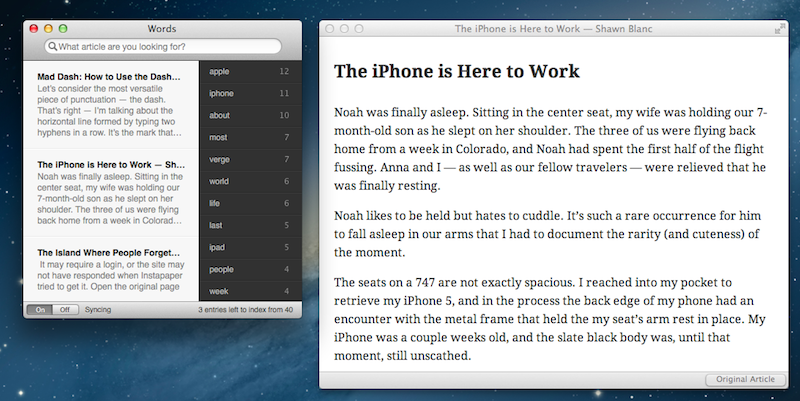
Last week, I stumbled across a Mac app called Words, which is a desktop client to access your Instapaper, Pocket, and Readability “read later” lists. Especially following Pocket’s acquisition of Read Later, I thought it was appropriate to post my impressions of the app after using it with my Instapaper account for the past week.

Unfortunately, while promising, Words isn’t there yet. Words looks decent when it’s focused on text (generated by the Instapaper parser) in full-screen mode, but everything else is pretty buggy, unstable, and unfinished. Sync fails often, reporting incosistent errors for actually-correct account information; there are no font options to control the text’s apperance, or keyboard shortcuts to navigate the app; the window’s width can’t be resized (it only supports height), and the sidebar with tags (I assume they are tags, though I never created those) often “gets stuck” on a black background. There are no sharing options, no additional menus, no support for Instapaper’s Archive or Liked items. Just the Unread list, and it doesn’t even work well.

Even Instapaper is spelled as “InstaPaper” in the app.

The Words developers say they’re working on fixes and improvements, and I’m looking forward to trying Words again in the future. But at $5.99, I can’t recommend it right now.

Permalink

Bartender 1.0

Bartender 1.0

Bartender is one of my favorite OS X utilities. It is a menubar app to contain other menubar apps in its own menubar. I can confirm it’s not some kind of Inception. As I wrote in my original look at the beta version:

Bartender lets you organize your menubar apps while retaining the functionalities they come with. The app automatically finds third-party apps running in the menubar; it allows you to completely hide them, or show them in the Bartender bar. If you choose the latter option, your menubar apps will stil remain fully working with popover windows and keyboard shortcuts.

If you tried the app while it was in beta and abandoned it because it didn’t support system icons, now’s the time to check it out again. Bartender 1.0, released earlier this week, comes with full support for system icons that you can customize individually. It also supports the Notification Center icon if you’re on Mountain Lion. Items can be manually rearranged if you, say, want to keep Spotlight in the main menubar, but Notification Center on the rightmost side of Bartender’s bar.

There’s a good selection of keyboard shortcuts, too. You can create hotkeys to show the full menubar or the Bartender bar; you can also customize the appearance of Bartender’s icon, its position, or its autohide settings. Menubar apps with interface elements, such as Fantastical, Currencies or Take Five, usually work out of the box even inside Bartender, but you can apply a fix if they’re not working. Alternatively, you can choose to show those apps in the main menubar for a few seconds when they receive activity – for instance, when Sparrow’s icon is highlighted for an incoming message.

Bartender is a great utility to hide menubar items you don’t use often but still want to keep running. Get the app here for $15 – there’s also a four-week free trial available.

Permalink

Languages Review

Can an offline translator for iPhone be beautiful?

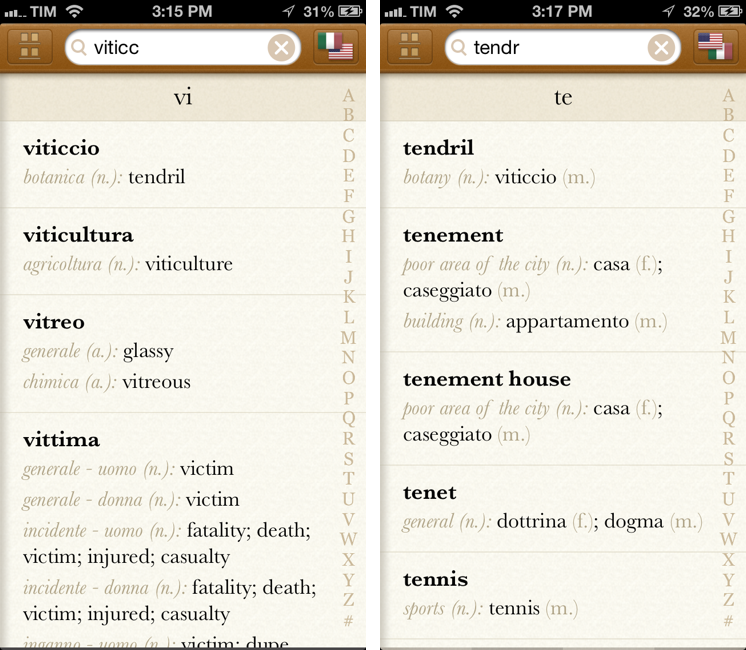
Translations are boring. Even Google, which has put some effort into caring more about its appearance in the past year, has seemingly forgotten that Google Translate is used by millions every day. Not only is Google Translate outdated from a design perspective, it also doesn’t take advantage of the trends and interactions that have recently defined great mobile experiences.

In a collaboration with Sonico, award-winning development studio Tapity wants to reinvent mobile translators for iPhone starting with two core concepts: multi-touch and offline access. Read more


Pocket Releases Mac App

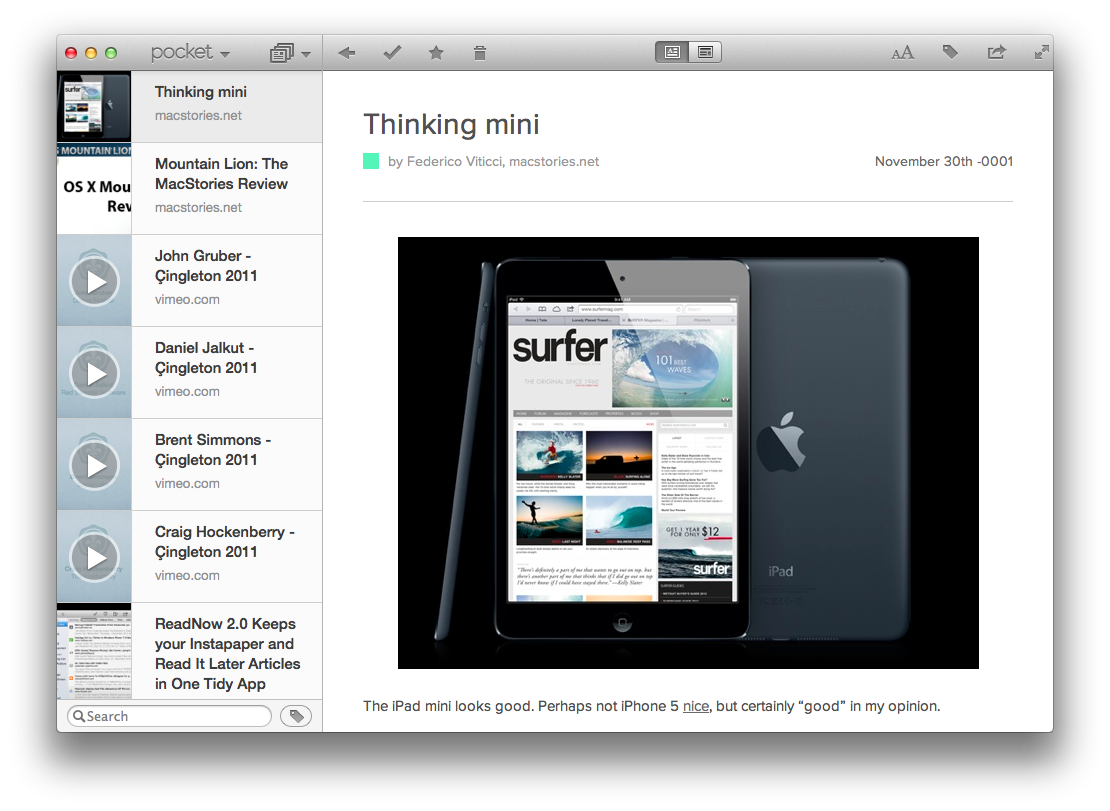
Pocket, the “save for later” service that relaunched as a major revamp of Read It Later back in April, is launching today its first official desktop application for OS X. Pocket for OS X is available today for free on the Mac App Store.

I’ve been able to test Pocket for Mac during the past week. Michael Schneider, creator of Read Later (nèe Read Now), joined the Pocket team to create the new Mac app; you may remember Read Later as a client for Instapaper/Pocket/Readability articles that we’ve been following here at MacStories since the first version. According to Pocket, the former Read Later app will continue to work for existing users, but it will no longer be supported.

Pocket for Mac is a new app, but it borrows heavily in terms of underlying concept and flow from Read Later. On the left, there’s a sidebar listing articles and videos with thumbnails for visual previews; the actual article (or video) is displayed on the right in a clean, Pocket-formatted view that uses the same parser of the mobile app. I personally find Instapaper’s parser to be slightly more precise than Pocket’s when it comes to long articles, but I also find Pocket way better at parsing content than Readability, especially for embedded videos and images. Read more


A Conversation With Loren Brichter

Following my review of Letterpress, I sat down with Loren Brichter to chat about his latest effort, developing for iOS, other mobile platforms, and spitting into microphones. In reality, I was still in Italy and our interview was conducted on Skype, but Loren says the part about spitting was real.

Federico: Hey Loren, thanks for chatting with me today. Firstly, so we can get this out of the way: why a game?

Loren Brichter: When I left Twitter I started working on a whole slew of projects that I hadn’t had time to work on since Tweetie took off.

One of them was a game (not Letterpress), which was a testbed for some graphics ideas I was kicking around. It was pretty close to finished, just needed some more polish and content. But around that time I went out to dinner with my wife, and while we were waiting for a table, we were both playing this other (totally awesome) word game called SpellTower. But it was single player only, and I figured I could try my hand at a multiplayer word game. So I dropped the first game, and made this instead. Read more


Loren Brichter’s Comeback: Letterpress

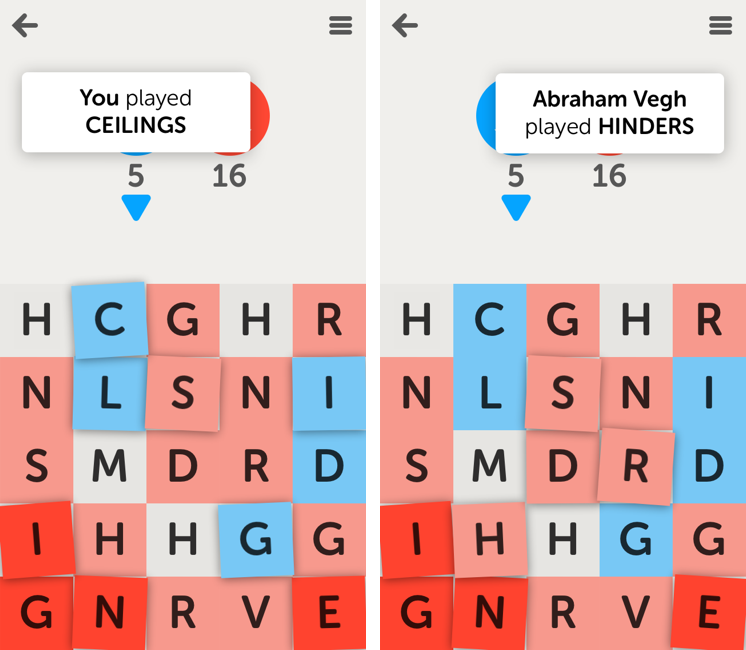
Loren Brichter’s comeback app isn’t a Twitter client, something that works with Tent.io, or a revolutionary implementation of multitouch on the iPad.

It’s a word game. It’s called Letterpress, and it’s available for free on the App Store. I’ve been able to beta test it for a while, and it’s quickly become one of my favorite games on iOS. One I instantly reach out to whenever I have 5 minutes to kill.

Letterpress is similar to SpellTower, but it’s focused on multiplayer and has deeply different rules when it comes to assembling words. Read more