

Question: Hi Federico, like you I’m considering going iOS only but one thing I haven’t figured out is the offline backup. On my Mac I use CrashPlan for off-site backup next to my Time Machine local backup. I understand you use the Synology to create a local backup but how do you manage off-site backups?...
Day One Adds IFTTT Integration
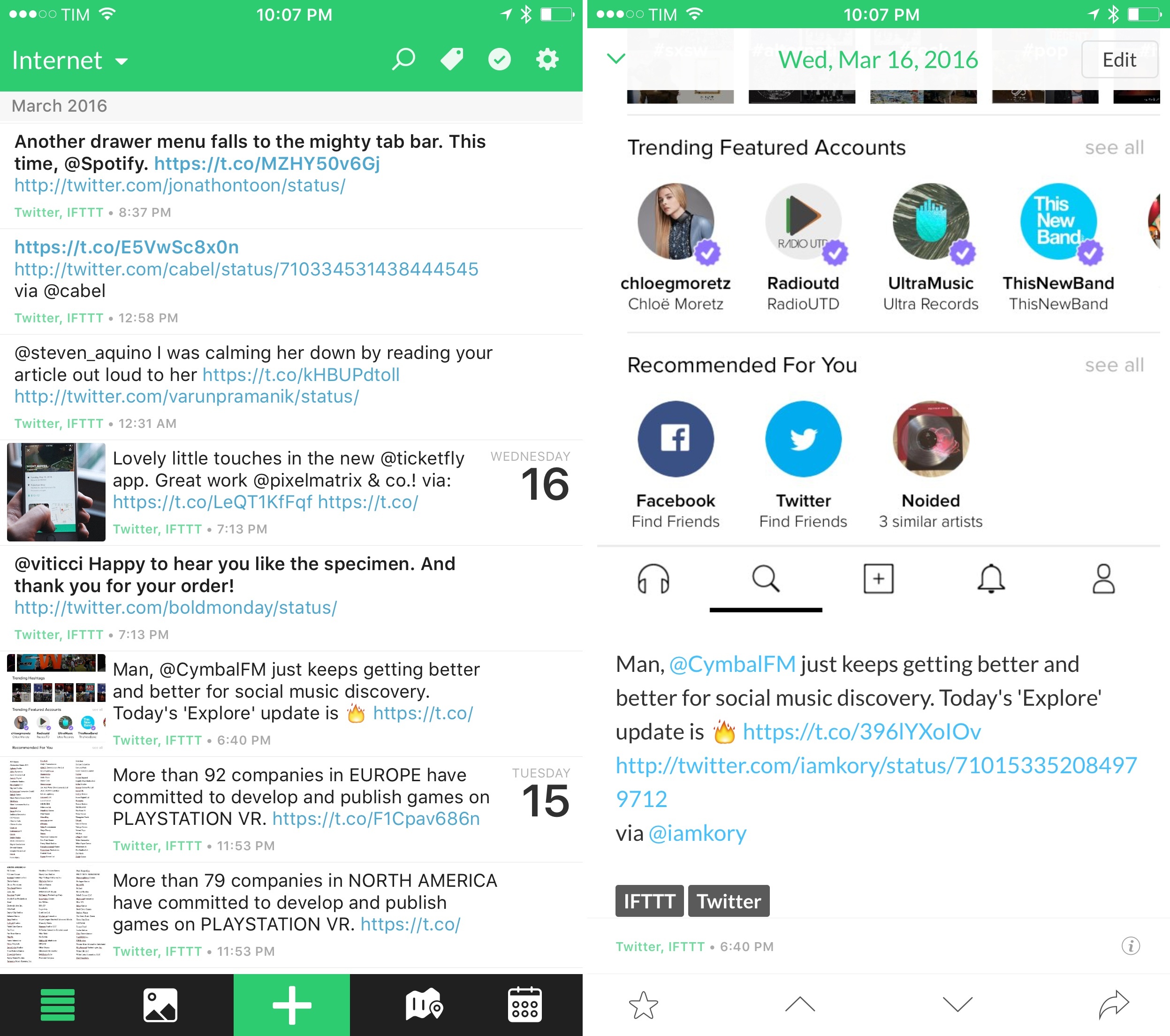
Great change for those who want to populate their journal entries with content from the web: Day One has launched their IFTTT channel today, which will let you create all sorts of automated recipes such as saving Instagram pictures to a journal, emailing a new entry to yourself, or logging check-ins from a third-party service.
Much as Day One 2 was criticized for ditching iCloud and Dropbox in lieu of its own sync, integrations like this are always better when the developers can fully control the sync platform they’re using. Thanks to Day One Sync and support for multiple journals, you can connect to IFTTT and set your recipes to save data into a dedicated journal separate from your main thoughts (something that bugged me a few years ago with a similar solution).
I’ve been playing around with the beta of Day One + IFTTT, and it works well. I have recipes to save liked tweets and YouTube videos to an ‘Internet’ journal, and I’m planning to build more soon. If you use Day One and IFTTT, this is a fantastic addition.
Miitomo Is a Strong Start for Nintendo’s Mobile Strategy→
Nadia Oxford, writing for US Gamer, shares some first impressions of Miitomo, Nintendo’s first iOS app that went live in Japan yesterday:
One of Tomodachi Life’s most appealing features made it into Miitomo, too: Outfit collection. Like its inspiration, Miitomo has tons of outfits and accessories for sale, and stock changes daily. You can also play a Pachinko-style game to win super-exclusive outfits. Which, by the way, is how I wound up blowing all my coins. I was trying to score a black cat ensemble. If Nintendo ever does get around to releasing Nintendo-themed costumes for the app’s Miis, I’m definitely going to live my life in perpetual Miitomo poverty.
Speaking of coins, there’s understandably been a lot of worry about how Nintendo will monetize Miitomo. From my angle, Miitomo is fair about in-app purchases. I was happy to see there’s no secondary “hard currency,” a staple of free-to-play games. Hard currency usually needs to be bought with real-world cash (though some games occasionally throw you a bone – or a diamond or gem, as the case may be), and often needs to be on-hand in order to acquire the game’s coolest accessories.
It sounds like Nintendo has thought this through – there are push notifications to keep you engaged a few minutes every day, there’s My Nintendo integration to unlock rewards, and you can even redeem DS games on the 3DS eShop by playing Miitomo on iOS. I still don’t know if this will catch on outside of Japan, but I’m curious to check it out.
Miitomo is a pretty fresh app, it has 3D Touch shortcuts even! pic.twitter.com/6hgCM6MVjh
— Daniel Vuckovic (@VOOK64) March 17, 2016
See also: Jeff Benjamin’s video overview.
Game Center Is Still Broken After Six Months→
Craig Grannell, reporting on a Game Center issue that has been around for the past few months:
When iOS 9 hit beta last summer, I heard concerns from developers about Game Center. Never Apple’s most-loved app, it had seemingly fallen into a state of disrepair. In many cases, people were reporting it outright failed to work.
And:
Additionally, some games freeze on start-up, because developers had quite reasonably expected Game Center would at least be functional. This makes for angry users, who can’t directly contact developers through the App Store and therefore leave bad reviews. Developers are now updating their apps to effectively check whether Game Center is broken, flinging up a dialog box accordingly, and at least allowing players access.
I’ve also come across this problem and heard about it from MacStories readers and game developers. There’s a thread on the TouchArcade forums that is over 50 pages long with hundreds of responses. This is bad for everyone – users and developers – and Apple should fix it soon.
Tim Cook on Encryption, Public Safety, and Right to Privacy→
TIME’s Nancy Gibbs and Lev Grossman have published the full transcript of a Tim Cook interview that will be the subject of the magazine’s March 28 cover story.
It’s a lengthy interview, with Cook discussing a variety of issues related to the FBI’s requests in the San Bernardino case. Cook comments on his views on encryption in the modern technological landscape, how the US Congress should approach this debate, and why Apple views the FBI’s demands as a threat to civil liberties. It’s a great read with some fantastic passages.
The thing that is different to me about Messages versus your banking institution is, the part of you doing business with the bank, they need to record what you deposited, what your withdrawals are, what your checks that have cleared. So they need all of this information. That content they need to possess, because they report it back to you.
That’s the business they’re in. Take the message. My business is not reading your messages. I don’t have a business doing that. And it’s against my values to do that. I don’t want to read your private stuff. So I’m just the guy toting your mail over. That’s what I’m doing. So if I’m expected to keep your messages, and everybody else’s, then there should be a law that says, you need to keep all of these.
Now I think that would be really bad. I think it would be really bad because in order for me to keep them, I have to have a way to see them. If I have to have a way to see them and a place to copy them, you can imagine—if you knew where the treasure was buried at, and everybody else did, then it puts a bull’s eye on that target. And in the world of cyber security, the last thing you want is to have a target painted on you.
Apple Airs New iPhone 6s Ad Featuring Cookie Monster

Apple aired a new iPhone 6s commercial earlier today, featuring Sesame Street’s popular Cookie Monster character.
The ad is focused on the hands-free Siri capabilities of the iPhone 6s. In the video, Cookie Monster unsurprisingly wants to eat cookies and sets a timer for the oven to finish baking them. Cookie Monster asks Siri to set a timer without interacting with the iPhone’s display and then asks Siri to check how much is left in the timer, also without having to press the Home button.
The ad follows various commercials Apple has aired to highlight 3D Touch and Live Photos, two other features available on the iPhone 6s. You can watch the video below.
Researchers Look to Smartwatches to Prevent Strokes→
Speaking of Apple Watch and heart problems, here’s the opposite end of the spectrum: the developers of Cardiogram are working with researchers of the UCSF Health eHeart Study to understand if heart rate data captured by smartwatches can generate insights to prevent strokes.
Heart researchers from the University of California, San Francisco as well as developers behind the heart rate-tracking app Cardiogram are teaming up to investigate if the tech built into smartwatches could be used to identify those at risk for a stroke or heart failure.
The research team will be honing in on one of the most commonly undiagnosed irregular heart conditions: atrial fibrillation, an irregular and often rapid heart rate also known as a type of arrhythmia.
Working within an observational study dubbed mRhythm, which kicked off on Wednesday, researchers will track data from participants using both the Apple Watch and Android Wear-based devices while looking for signs of irregular heart rates. These kinds of watches don’t have advanced electrocardiogram (EKG) machines inside. But they do include cheaper technology, such as LED lights, which can be used to measure blood flow in the wrist.
Like Apple’s ResearchKit, if these crowdsourced studies can lead to early diagnoses and better prevention, the impact of wearable devices on our lifestyle will be meaningful.
Those interested in the study can check out the details here.
Kardia Band for Apple Watch→
Interesting idea for an Apple Watch band by AliveCor: the Kardia band will allow users to capture EKG directly from their wrist by placing a finger on the band for 30 seconds.
Users can record a single-lead EKG by simply touching Kardia Band’s integrated sensor that communicates with the Watch app, Kardia by AliveCor. The Atrial Fibrillation (AF) Detector then uses Kardia’s automated analysis process (algorithm) to instantly detect the presence of AF in an EKG, the most common cardiac arrhythmia and a leading cause of stroke. Also included is the Normal Detector, which indicates whether your heart rate and rhythm are normal, and the Unreadable Detector, which tells you when to retake an EKG so physicians receive only the highest quality recordings.
Users can also record voice memos on their Apple Watch to accompany each EKG that give doctors and caregivers a clearer picture of what was happening at the time of the recording — describing symptoms such as palpitations or external factors like caffeine intake. Kardia also integrates seamlessly with Apple’s Health app to include EKG data with steps and calorie intake to provide richer, personal analysis over time.
The Kardia band isn’t meant for fitness aficionados – rather, it’s designed for people with heart-related problems who would benefit from medical-grade EKG and the ability to store detailed reports and notes (including voice memos dictated on the Apple Watch). I’m curious to see if more companies (including Apple) will come up with Apple Watch bands with embedded sensors that can transfer data directly to the Watch (there were some rumors about this last year).
Also worth noting: AliveCor is run by Vic Gundotra (former Google VP and head of Google+) and they have a whole line of Kardia products (which also include smartphone cases for similar measurements).
Slack 2.8 Brings 3D Touch Support, Better Search Assist
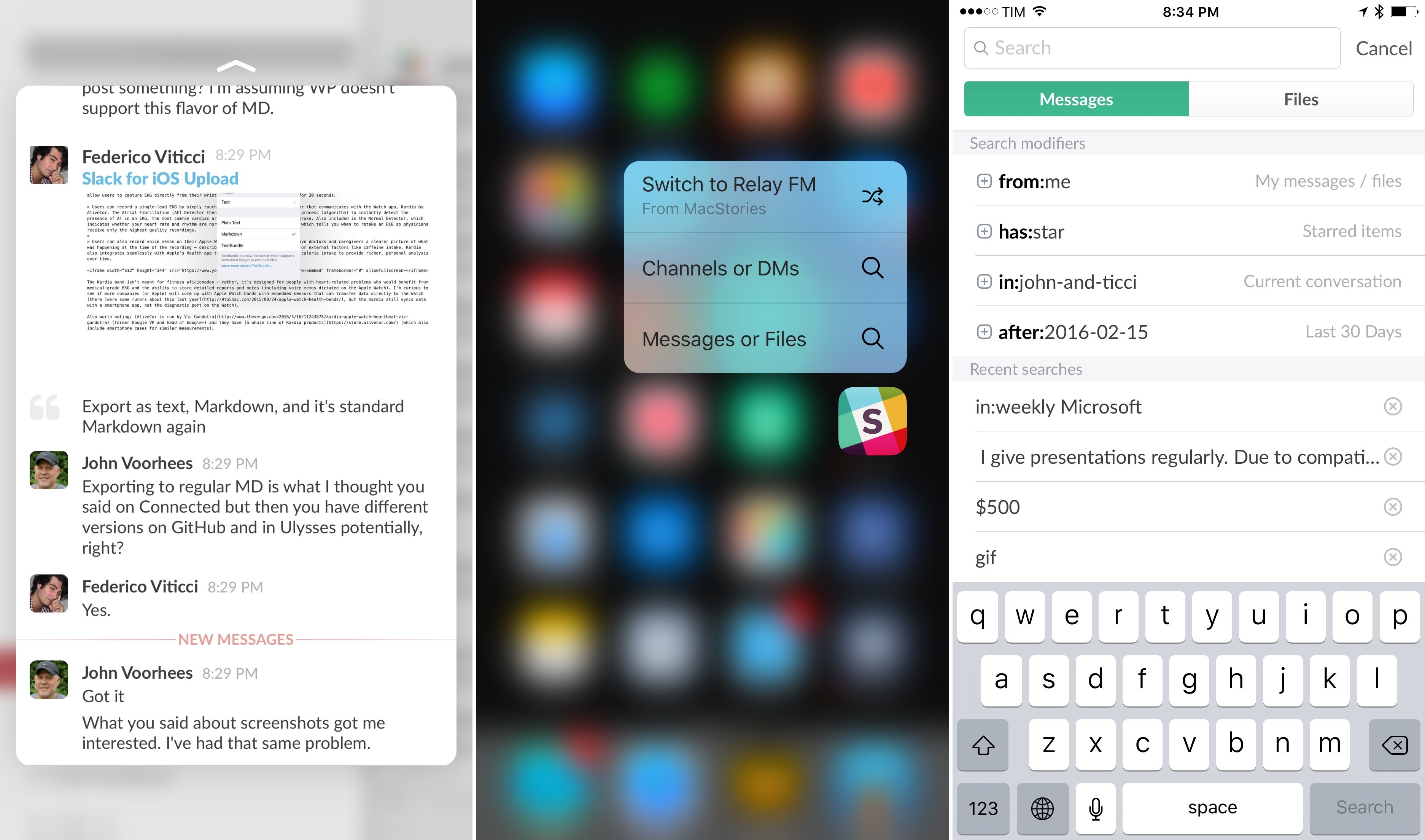
Slack has released version 2.8 of their iOS app today with some great changes to save time on the iPhone and iPad.
On the iPhone 6s, you can now use 3D Touch on the app icon to switch teams, open channels and DMs, and search for messages and files. While I would have liked to see the ability to pin specific channels and DMs to the quick action menu, the feature is welcome regardless as it cuts down the time I spend swiping to open the sidebar just to switch between teams (I think anyone who’s on multiple Slack teams can relate to this).