

Immersive Dog Show Series ‘Top Dogs’ Premieres on Apple Vision Pro Apple Reports Q1 2026 Revenue of $143.8 Billion Creator Studio Review: Redefining Pro for the Modern Era The New Club MacStories: Re-Subscribing to Your RSS Feeds and What’s Coming Next Welcome to the New, Unified MacStories and Club MacStories Tim Cook Attended an Exclusive Weekend...
 Pardon Our Dust
Yesterday was a big step forward for MacStories and the Club. If you haven’t read Federico’s story about what we’re doing and why, it’s worth checking out because it’s not just that the Club is now on macstories.net. We’re taking an entirely new approach to MacStories that, in time, will touch everything we do on...
Apple Reports Q1 2026 Revenue of $143.8 Billion

Today, Apple reported its 2026 Q1 earnings, posting quarterly revenue of $143.8 billion a 16% increase from a year ago.
Apple CEO Tim Cook had this to say of the results:
Today, Apple is proud to report a remarkable, record-breaking quarter, with revenue of $143.8 billion, up 16 percent from a year ago and well above our expectations. iPhone had its best-ever quarter driven by unprecedented demand, with all-time records across every geographic segment, and Services also achieved an all-time revenue record, up 14 percent from a year ago. We are also excited to announce that our installed base now has more than 2.5 billion active devices, which is a testament to incredible customer satisfaction for the very best products and services in the world.
As CFO Kevan Parekh noted in Apple’s press release, today’s results set an all-time earnings-per-share record, with an 19% increase and $54 billion of operating cash flow.
So yes, Apple continues to make a lot of money. Global trade politics, currency exchange rates, component prices like RAM, and other factors are all risks that could put a damper on the company’s earnings in the future, but so far, the company is doing fine. For all the details and an earnings call that is just getting started, visit Apple’s investor page.
Access Extra Content and Perks
Founded in 2015, Club MacStories has delivered exclusive content every week for nearly a decade.
What started with weekly and monthly email newsletters has blossomed into a family of memberships designed for every MacStories fan.
Club MacStories: Weekly and monthly newsletters via email and the web that are brimming with apps, tips, automation workflows, longform writing, early access to the MacStories Unwind podcast, periodic giveaways, and more;
Club MacStories+: Everything that Club MacStories offers, plus an active Discord community, advanced search and custom RSS features for exploring the Club’s entire back catalog, bonus columns, and dozens of app discounts;
Club Premier: All of the above and AppStories+, an extended version of our flagship podcast that’s delivered early, ad-free, and in high-bitrate audio.
Creator Studio Review: Redefining Pro for the Modern Era
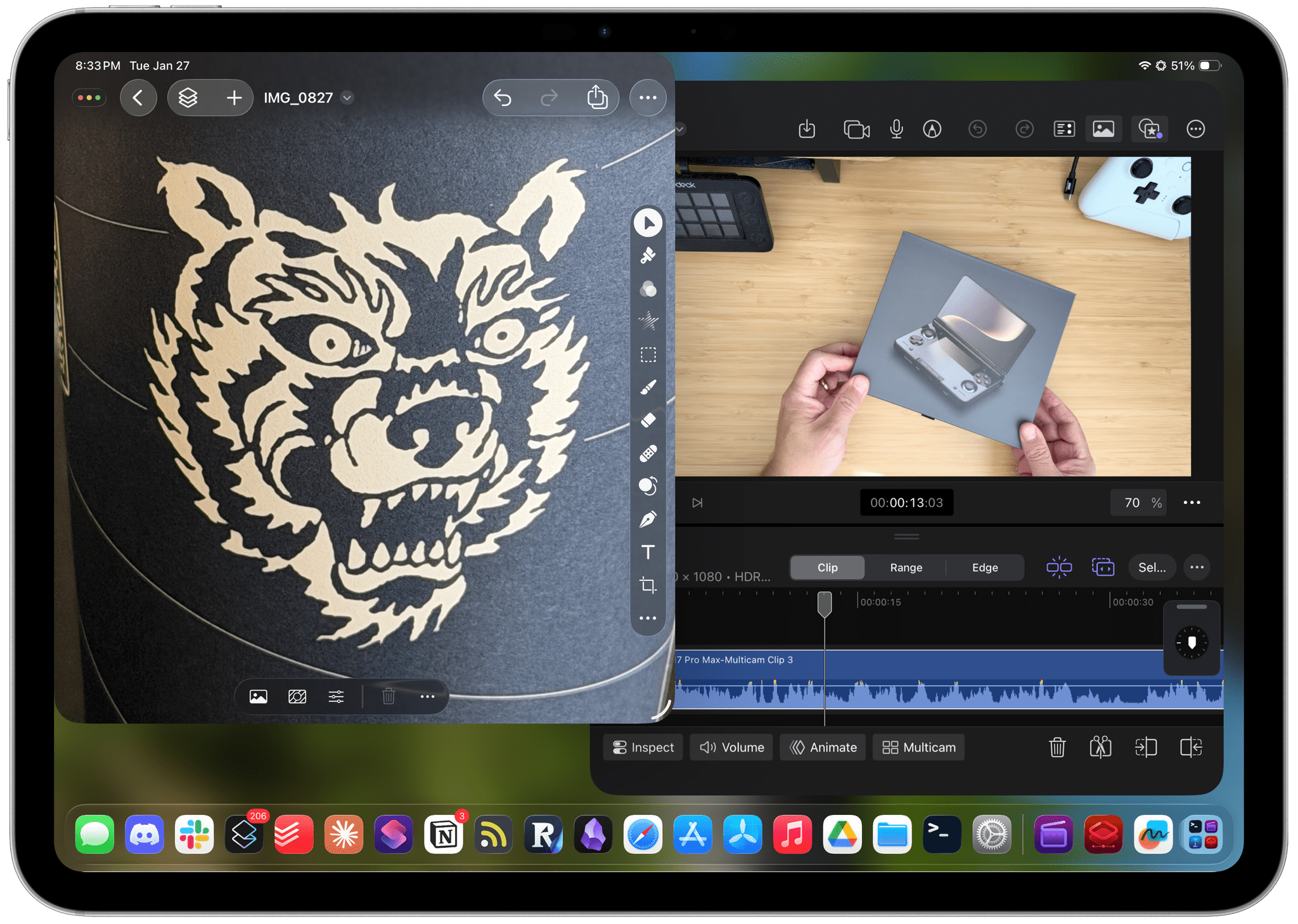
Starting today, Apple is offering a subscription bundle of its creative apps called Creator Studio. Some of what’s included is exclusive to the subscription package, while other parts of it remain available à la carte. It’s a lot to absorb, and I’ll get to all the details in due course.
However, what’s most exciting to me is the fact that Apple is clearly repositioning these apps to appeal to a broader cross-section of creatives. Apps like Final Cut Pro and Logic Pro are no longer just for Hollywood and music studios. By filling out the iPad lineup and adding Pixelmator Pro along with enhanced versions of their productivity apps, Apple has taken the first steps toward realigning its apps with what it means to be a creative professional in 2026.
This transition isn’t the sort of thing that happens overnight, which is why it’s easy to spot the gaps in Creator Studio’s offerings. I ran into a couple of bugs along the way, too. However, by and large, I think the bundle of apps hits the right notes and is heading in the right direction. Let’s take a closer look.
Access Extra Content and Perks
Founded in 2015, Club MacStories has delivered exclusive content every week for nearly a decade.
What started with weekly and monthly email newsletters has blossomed into a family of memberships designed for every MacStories fan.
Club MacStories: Weekly and monthly newsletters via email and the web that are brimming with apps, tips, automation workflows, longform writing, early access to the MacStories Unwind podcast, periodic giveaways, and more;
Club MacStories+: Everything that Club MacStories offers, plus an active Discord community, advanced search and custom RSS features for exploring the Club’s entire back catalog, bonus columns, and dozens of app discounts;
Club Premier: All of the above and AppStories+, an extended version of our flagship podcast that’s delivered early, ad-free, and in high-bitrate audio.
The New Club MacStories: Re-Subscribing to Your RSS Feeds and What’s Coming Next
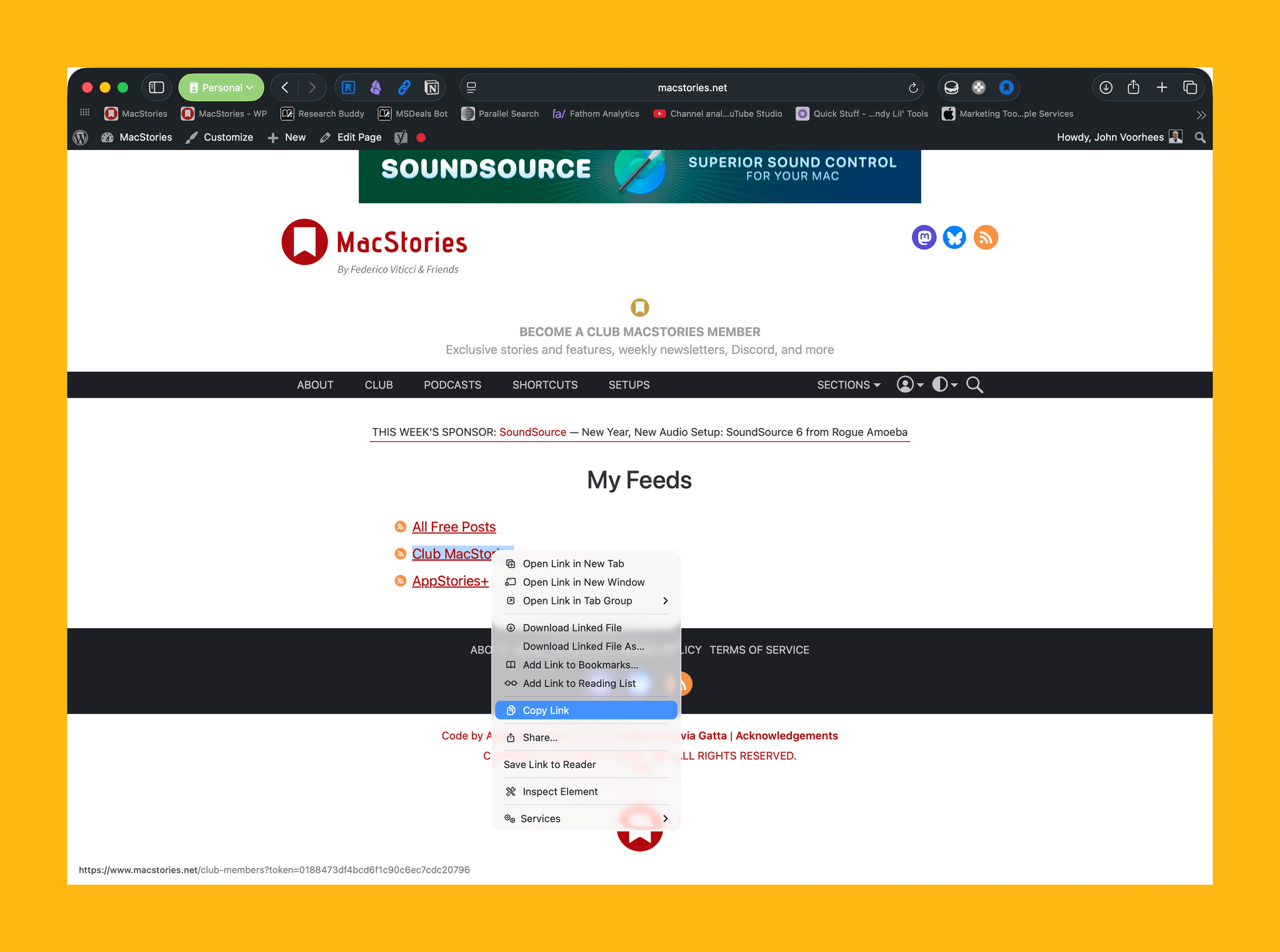
The new unified MacStories website is here, bringing Club MacStories content under the same roof as the rest of the site for the first time. While this transition delivers a more cohesive experience for members, a few things are different and others are still being implemented.
How to Re-Subscribe to Your RSS Feeds
Club MacStories+ and Premier members have access to custom feeds as part of their subscriptions. With today’s update, you’ll need to resubscribe to those feeds. The old ones will no longer work. Here’s what to do.
- Visit My Feeds from the Account dropdown on macstories.net.
- Copy the feed URL.
- Paste it into your RSS reader to subscribe.
- Note: Club Premier members will also need to do this for AppStories+.
These new feeds are personal to you and will continue to work going forward as long as you maintain your Club membership. Since these feeds are uniquely tied to your paid Club account, please don’t share them publicly.
A Note on Discord Access
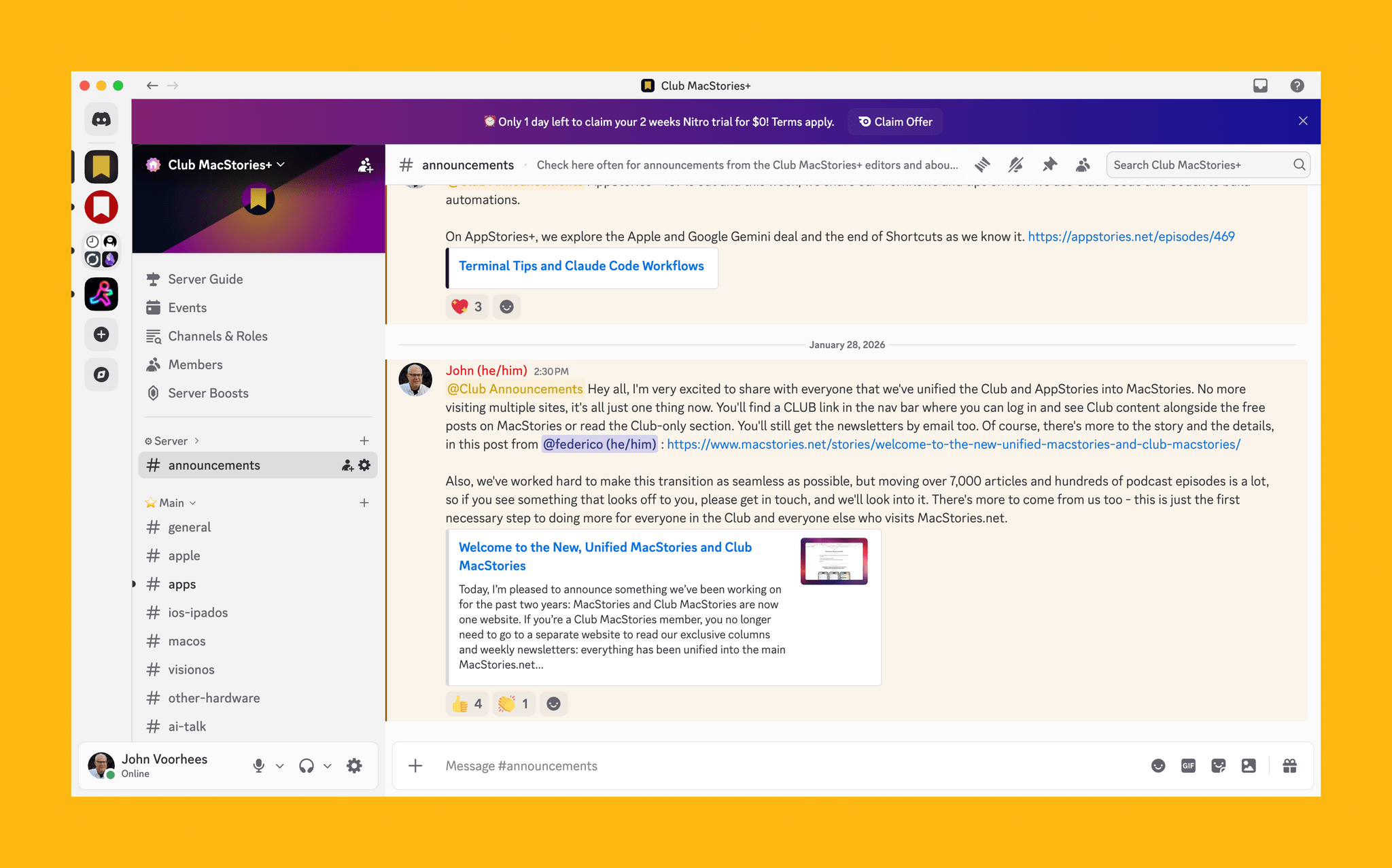
If you’re a Club MacStories+ or Premier member who joined before today’s transition, your Discord access remains intact. There’s nothing you need to do.
New or returning members who want to join the Discord community will need to wait just a bit longer. We are working with Memberful engineers to migrate users from our previous system. Once that process is complete, we’ll provide you with instructions to connect your Discord account from MacStories.
Coming Soon: Features in Development
.](https://cdn.macstories.net/cleanshot-2026-01-28-at-16-02-37-2x-1769634177375.png)
Find a bug on the new site? You can submit it here.
The launch of the new site required some tough decisions about which features to prioritize. Three capabilities from the previous Club website aren’t available yet but are actively being worked on for future updates.
- The Explore interface, which allowed members to search Club MacStories content using visual filters, hasn’t made the transition yet.
- The ability to generate unique RSS feeds for specific sections of the Club isn’t currently supported, though you can still subscribe to RSS feeds for entire newsletter issues as detailed above.
- The real-time search autocomplete suggestions that appeared as you typed in the search box are temporarily unavailable.
These features are coming back. However, the priority was on delivering a functional, unified experience now rather than continuing to maintain a fragmented system, while we waited for every legacy feature to be rebuilt.
We hope you enjoy the new Club experience on MacStories. The transition to a unified website is a significant step forward for the Club and greater MacStories community that will allow us to do more for everyone in the future. Thanks for bearing with us during this transition, and please feel free to get in touch with any questions or bug reports.
Access Extra Content and Perks
Founded in 2015, Club MacStories has delivered exclusive content every week for nearly a decade.
What started with weekly and monthly email newsletters has blossomed into a family of memberships designed for every MacStories fan.
Club MacStories: Weekly and monthly newsletters via email and the web that are brimming with apps, tips, automation workflows, longform writing, early access to the MacStories Unwind podcast, periodic giveaways, and more;
Club MacStories+: Everything that Club MacStories offers, plus an active Discord community, advanced search and custom RSS features for exploring the Club’s entire back catalog, bonus columns, and dozens of app discounts;
Club Premier: All of the above and AppStories+, an extended version of our flagship podcast that’s delivered early, ad-free, and in high-bitrate audio.
Tim Cook Attended an Exclusive Weekend Screening of the Upcoming ‘Melania’ Documentary→
The Hollywood Reporter broke the story over the weekend that an early screening of an Amazon-backed documentary about Melania Trump was held at the White House. According to reporter McKinley Franklin’s sources, the event was attended by Apple CEO Tim Cook as well as other CEOs and VIPs:
The event, which has not been promoted or advertised, is taking place in the White House on Saturday. Guests include director Brett Ratner; Queen Rania of Jordan; Zoom CEO Eric Yuan; Apple CEO Tim Cook; New York Stock Exchange CEO Lynn Martin; AMD CEO Lisa Su; Mike Tyson; socialite and Fiat heiress Azzi Agnelli; self-help guru Tony Robbins; and photographer Ellen von Unwerth, who shot the movie poster for the film.
Earlier that day, a Minneapolis man was shot and killed by federal agents. I’d like to think that in the face of such a tragedy the screening would have been called off or that attendees, including Cook, would have been no-shows, but according to Rolling Stone editor Marlow Stern, Cook and others did attend.
Apple Introduces New and Improved AirTag
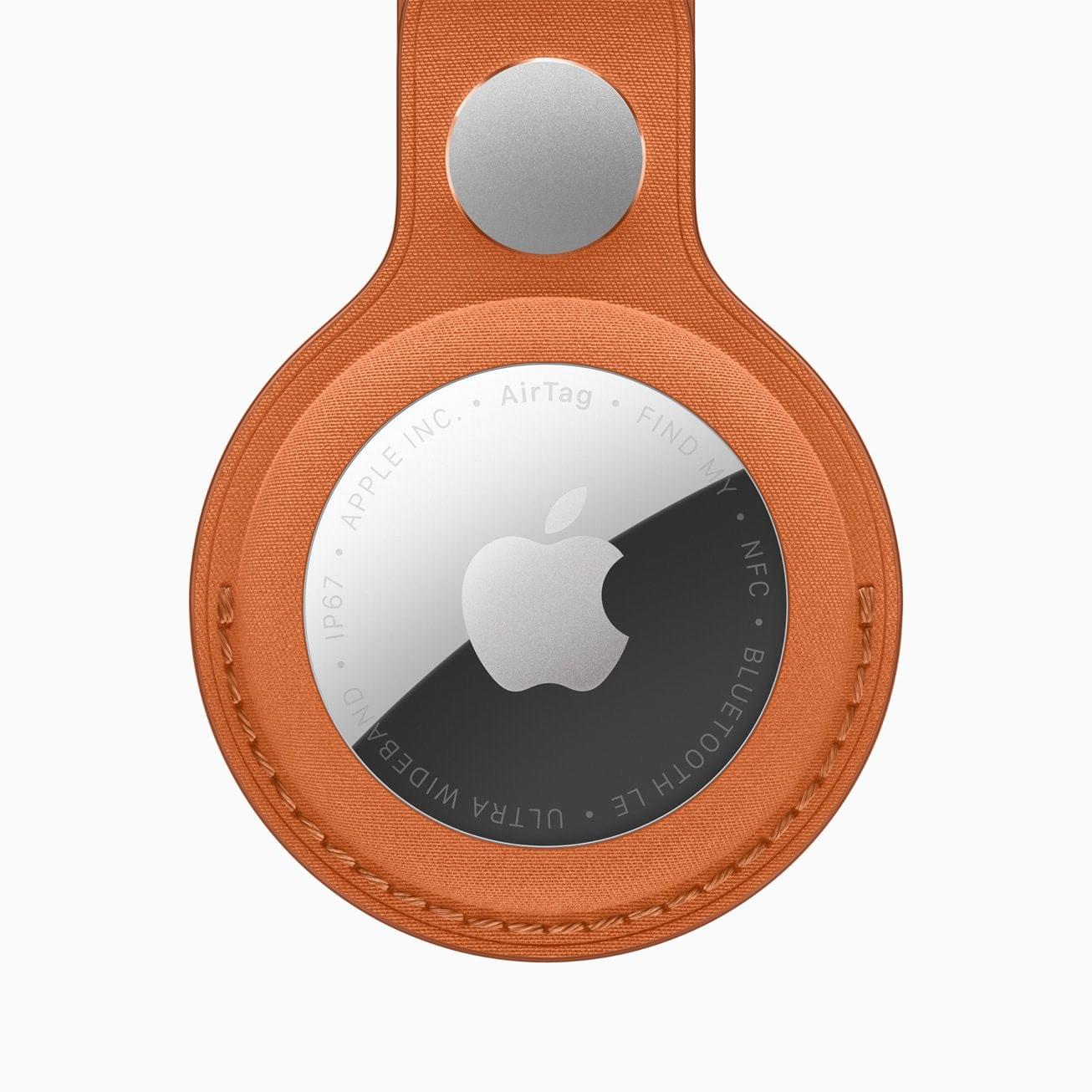
In a press release today, Apple launched a second-generation AirTag that features an upgraded components, making it easier to locate than the original 2021 AirTag.
The new AirTag features a bunch of new hardware packed into the same design as the original version, including:
- the same second-generation Ultra Wideband chip found in the iPhone 17, iPhone Air, and Apple Watch Ultra 3,
- a better Bluetooth chip that can be detected over longer distances, and
- a 50% louder speaker.
According to Apple, that allows the tiny device to be detected from 50% farther away and heard from twice as far away. Apple has changed the AirTag’s chime that it says will make it easier to find, too. Precision finding is also available for the first time from an Apple Watch Series 9 and later and Apple Watch Ultra 2 and later. To track the device from an iPhone or iPad, you’ll need to be running iOS or iPadOS 26. Apple Watch precision tracking requires watchOS 26.2.1.
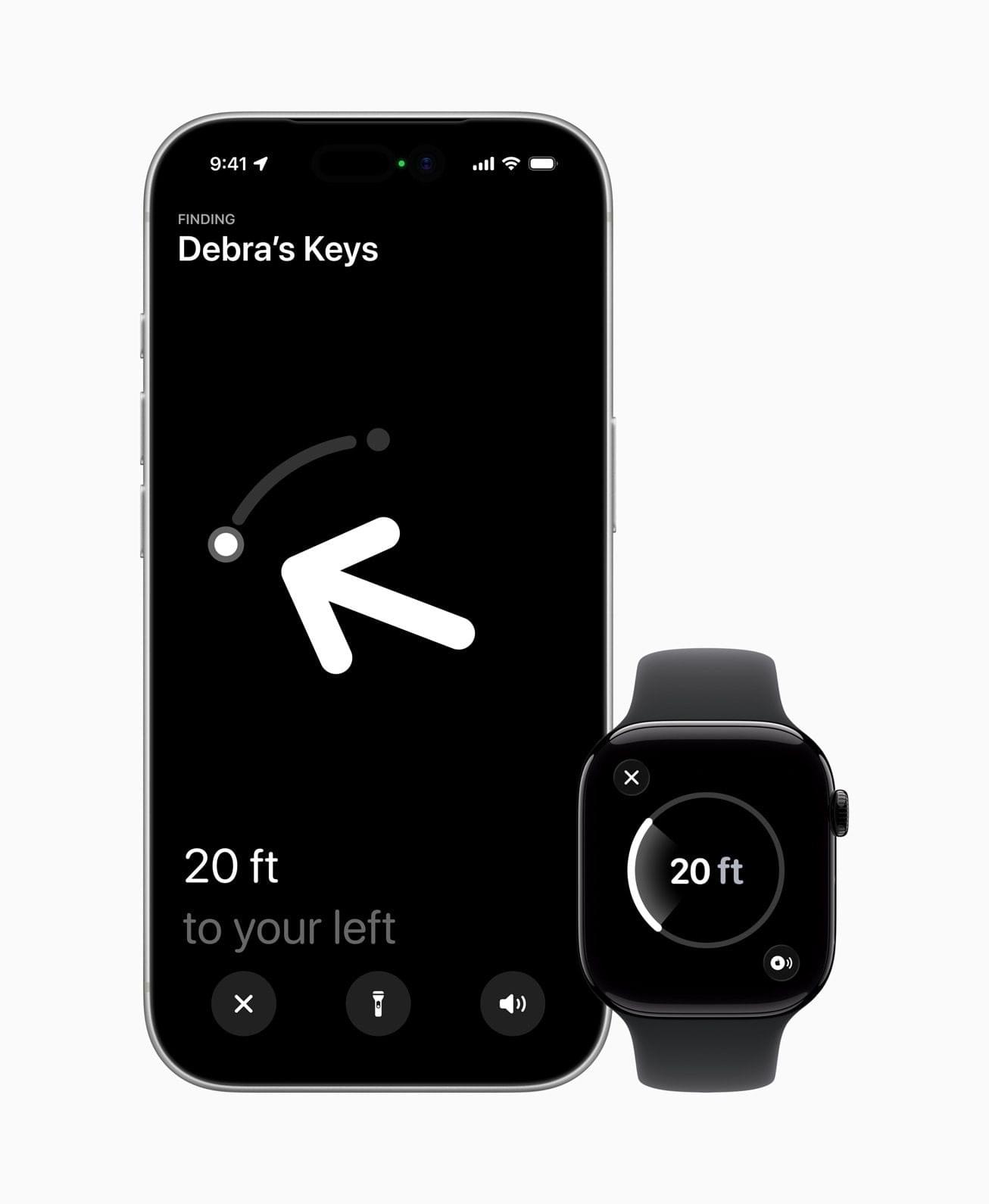
The press release also reveals more than 50 airlines now accept location links to help find missing luggage. According to a report from an airline industry IT provider, AirTags have helped reduce baggage delays by 26% and reduce lost luggage by 90%.
Like the exterior design, the price of the AirTag hasn’t changed. It still costs $29 for one or $99 for a four-pack of AirTags. Apple is also offering a FineWoven keychain for $35 that comes in five colors. The new AirTag can be ordered now and will be available in retail stores later this week.
Access Extra Content and Perks
Founded in 2015, Club MacStories has delivered exclusive content every week for nearly a decade.
What started with weekly and monthly email newsletters has blossomed into a family of memberships designed for every MacStories fan.
Club MacStories: Weekly and monthly newsletters via email and the web that are brimming with apps, tips, automation workflows, longform writing, early access to the MacStories Unwind podcast, periodic giveaways, and more;
Club MacStories+: Everything that Club MacStories offers, plus an active Discord community, advanced search and custom RSS features for exploring the Club’s entire back catalog, bonus columns, and dozens of app discounts;
Club Premier: All of the above and AppStories+, an extended version of our flagship podcast that’s delivered early, ad-free, and in high-bitrate audio.
 Terminal Tips and Claude Code Workflows
 Federico
This week, Federico and John share their workflows and tips on how they use Claud Code and Codex to build automations.
On AppStories+, John and Federico explore the Apple and Google Gemini deal and the end of Shortcuts as we know it.
](https://cdn.macstories.net/banneras-1629219199428.png)
We deliver AppStories+ to subscribers with bonus content, ad-free, and at a high bitrate early every week.
To learn more about an AppStories+ subscription, visit our Plans page, or read the AppStories+ FAQ.
AppStories Episode 469 - Terminal Tips and Claude Code Workflows
0:00
43:26
43:26
This episode is sponsored by:
- HTTPBot: A powerful API client and debugger for Apple platforms. Get a 7-day trial and 25% off your subscription.
Unexpected Lessons from Claude Code Experiments
For the past six weeks, I’ve been continuously building tools with Claude Code. I started small with things like PopClip extensions, which I covered last week, and moved on to tools like a loudness leveling script that adheres to podcasting industry standards and allowed me to dump my underutilized Creative Cloud subscription when Adobe raised...