Graham Spencer

917 posts on MacStories since January 2011

Former MacStories contributor.


Adobe Releases CS5.5 and Updates Photoshop To Support Mobile Apps

Today was a big morning for Adobe, releasing Creative Suite 5.5 and updating Photoshop to version 12.0.4. Whilst normally the Photoshop update wouldn’t be of much interest, this update brings support for Photoshop Touch Mobile Apps.

Adobe will sometime today also release its iPad demo apps, Adobe Color Lava, Adobe Eazel and Adobe Nav, onto the iTunes App Store. The apps, which we previously wrote about, are provided as demonstrations of the power of the Photoshop Touch SDK and vary in price from $1.99 to $4.99.

As for the release of CS5.5, being called a mid-cycle update, a big component is the greater ability for users to author and deliver content and applications for any screen, particularly mobile devices using iOS, Android and BlackBerry through enhanced HTML5 compatibility. New in CS5.5 is Adobe Digital Publishing Suite, which provides a hosting service and viewing technology so that publishers can easily deploy content across the iPad, Android Tablets and the BlackBerry PlayBook.

The last major component of CS5.5 is the beginning of Adobe’s subscription plans for the Creative Suite. Beginning at $19 per month for Dreamweaver, ranging up to $129 per month, users can “pay as you use” rather than paying the large lump cost of the products.


[Via MacNN, 9to5 Mac]


MG Siegler Affirms “Castle” Speculation, Internal Name For Cloud Services

Apple’s cloud ambitions have been resurfacing over the last week with several rumours surrounding Apple’s reported purchase of icloud.com and now references to a service called “Castle” in Lion. Trusted Apple blogger, MG Siegler, tonight weighed into all the speculation, endorsing previous speculation by TUAW that “Castle” refers to Apple’s internal nickname of their new cloud services.

The discovery in Lion by Consomac.fr last week found references files that cited an “upgrade from MobileMe to Castle”. Siegler provides some more information in that the internal codename had originally been “Newcastle” but was recently shortened to “Castle”. Furthermore, as far as he is aware, the official shipping name may not yet be decided and “Castle” is still being used internally. The recent speculation over the icloud.com domain may just be one of the potential names for Apple’s cloud service.

On the rumours that AppleInsider reported on Friday, Siegler is reasonably confident that Apple is testing their cloud service internally with new versions of iOS and OS X but with the “Castle” codename rather than iCloud that AppleInsider reported. The cloud service being developed is highly likely to be revealed at this years WWDC, just five weeks away now, whether it be called iCloud (Siegler believes it to be a frontrunner for the name) or something else.

[Via TechCrunch]


LucasArts Licenses Unreal Engine 3 In Multi-Year Deal

Late last week Epic Games announced that it had struck a multi-year, studio-wide licensing agreement with LucasArts for its Unreal Engine 3. The agreement covers multiple projects to be developed by LucasArts using the engine for multiple platforms.

Unreal Engine 3 is the game engine that Epic Games developed and was designed to run on Windows, OS X, Xbox 360, PlayStation 3 and most recently iOS. It certainly opens up the possibility of LucasArts expanding their development of iOS games, which currently only consists of The Secret of Monkey Island given the simplification of porting games is made with Unreal Engine 3 across platforms.

In their announcement, Epic Vice President Mark Rein said, “LucasArts is now primed to capitalize on Unreal Engine 3’s ability to scale across platforms, from mobile, through PC and console all the way up to the next generation of games.” Earlier this year Gameloft revealed that they had licensed the Unreal Engine for four iOS games following the success of Epic Citadel and Infinity Blade - demonstration games made by Epic Games that showed the power of the game engine on iOS.

[Via TouchArcade]


Safari “Reading List” Discovered In Lion, Apple Taking On Instapaper and Readability?

A new feature uncovered in OS X Lion by MacRumors reveals that Apple plans to take on “read it later” services such as ReadItLater, Instapaper and Readability. It has implemented a new bookmarking feature in that latest Lion builds of Safari that Apple is calling the “Reading List” and can be used by users to save pages for later reading. Apple describes it feature saying:

Reading List lets you collect webpages and links for you to read later. To add the current page to your Reading List, click Add Page. You can also Shift-click a link to quickly add it to the list. To hide and show Reading List, click the Reading List icon (eyeglasses) in the bookmarks bar.

The feature is currently hidden away in the latest OS X Lion build and no mention of the feature has yet been made by Apple in any of its announcements or documentation of Lion. One question certainly is about how robust the feature will be and whether it will become a service that synchronises the bookmarks across devices, including mobile devices. Marco Arment, the creator and developer of Instapaper, appears not to be to worrying about it so far and believes that “Instapaper would still have a market even if Apple implemented Reading List synced to iOS devices.”

[Via MacRumors]


E-Books Fail To Save Publishers From Revenue Decline

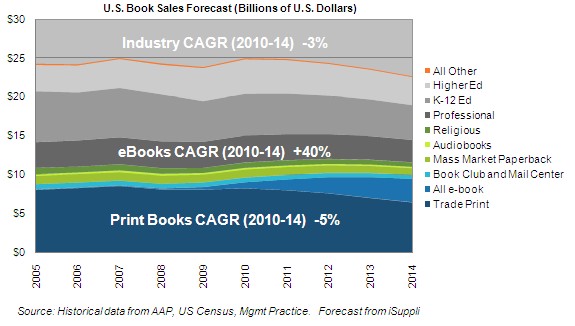
Research published yesterday by IHS iSuppli reveals that the US book publishing industry has reached a “major inflection point” in which there will be a long-term decline in revenue, as e-book sales fail to reach the levels required to compensate the fall in physical book sales.

Over the period of 2010-2014, the book publishing industry will face a compound annual growth rate (CAGR) decline of 3% for both e-books and paper books. This reflects a fall in revenue from $25 billion between 2005 and 2010 to $22.7 billion between 2010 and 2014. Driving the decline is a 5% fall in the CAGR of physical book revenue, which far outweighs the 40% CAGR in e-books. This is mostly due to the fact that the selling prices of e-books are on average 40% lower than those of paper copies.

Dedicated e-readers, however, are forecast to triple in sales from 2010’s 9.7 million sales to over 30 million units in 2014. Previous figures did forecast over 40 million sales, but IHS iSuppli believes devices such as the iPad and other tablets will limit the market for such dedicated e-reading devices. IHS iSuppli also reveals in its analysis that since the introduction of the iPad, e-reader manufacturers have been forced to shrink margins from 35% to far lower levels.

[Via IHS iSuppli]


Square Set To Add Encryption To Next Generation Of Card Readers

Yesterday Square revealed that it had received from financial services superpower, Visa, strategic investment of an unspecified size. However in a lower key announcement it also revealed that this summer they will be releasing a new card reader that uses encryption on the read head.

You may recall the little squabble a few months back where VeriFone and Square traded blows over whether the Square card reader was secure enough. VeriFone claimed it wasn’t and that Square should recall all their readers because thieves could easily skim credit card information using the device. Jack Dorsey, CEO of Square, hit back at VeriFone saying it was “not a fair or accurate claim and [that] it overlooks all of the protections already built into your credit card.”

Yet despite all that, Square will soon be addressing those “concerns” that VeriFone had, and release a card reader that employs encryption. The Square COO, Keith Rabois, notes that they are adopting Visa’s newly released (yesterday) mobile application best practices. He says that the “adoption of best practices will help increase trust in innovative payment solutions” although equally stresses that Square currently complies with all industry standards. TechCrunch rightly highlights that it is clearly no coincidence that Square’s endorsement of Visa’s best practices came on the same day as their funding announcement.

TechCrunch inquired as to whether users would have to replace their current readers but Rabois declined to comment specifically but he did continue to affirm Square’s previous rejection of VeriFone’s demand to recall the Square readers. Rabois also noted that encryption will not be the only new feature of the third iteration of readers coming this summer.

[Via TechCrunch]


Apple Plans Largest Australian Store In Brisbane CBD

Apple is reportedly planning to open its eleventh Australian retail store in the CBD of Brisbane that would become the country’s largest Apple Store. The reports come after plans were last night lodged at the Brisbane City Council over a $10.5 million renovation of the historic MacArthur Chambers (pictured above).

The plans for the renovation, which were lodged on behalf of the MacArthur Central Shopping Centre, do not mention Apple. However the interior plans include all the hallmark features of an Apple retail store with; twin glass doors, illuminated interior signs, stone floor, “feature stairs” and a “new colour scheme of shades of white.” The plans (below the break) seem to also feature a Genius bar and there is even space set aside in the plans for the “location of internally illuminated store signage”, or in other words Apple logo on the front of the building above the main doors.

The MacArthur building, built in 1934, is an English Renaissance-style building that is entrenched in Australian World War II history. It was commandeered in 1942 by US General Douglas MacArthur and was used as the Allied Forces’ South-West Area Headquarters and remained as such until November 1944. It was, until recently occupied by book chain Dymocks but is currently occupied by a discount book seller.

If the plans go ahead, the new Brisbane Apple store would become the largest in Australia at 1900sqm, which would be even larger than the flagship Apple store in Sydney and one of the most architecturally interesting of all the Australian, if not all, Apple stores. Apple has some past experience renovating cultural, and architecturally, significant buildings including the Regent Street store in London and last years Parisian Apple Store.

Also discovered in the planning application was a $3.84 million plan to remove “current modern additions” such as escalators, lifts and its tiled ceiling and returning the building to its “original form” including restoring the buildings original bronze style doors and missing stone wall panels. The glass staircase featured in the plans are speculated to be something similar to those already featured in the Sydney George Street store and the Fifth Avenue store in New York – a hallmark feature of both those stores.

Read more


White iPhone 4 Sells Out In Hong Kong And Beijing

It was delayed and delayed for 10 months but yesterday the white iPhone 4 went on sale…and promptly sold out in Hong Kong and Beijing where there were long lines around Apple stores and resellers. Some shoppers in Hong Kong began queuing up at midnight the day before, and they are probably glad they did, in some stores in China the device was gone within an hour.

It was a different and much more subdued affair in the US where few, if any lines were reported at Apple Stores, and as far as we are aware most stores should still have stock. Although on the online Apple Store there is a 3-5 day wait before shipping for the white model, with the black model shipping in the standard 24 hours.

No one is really sure why the white iPhone 4 sold out in China and not in the US but one could guess at a few factors from the white being more preferred, less stock given to Chinese stores or perhaps an increasing appeal of Apple in China. In any case its an early sign of the expected rapid retail sales growth of Apple products in China which Forbes predicts will propel Apple shares upwards.

[Via Cult of Mac]


Zynga Acquires UK Developer Wonderland Software

Zynga is becoming a growing powerhouse for casual and mobile gaming and their latest acquisition of Wonderland Software further demonstrates their tenacity to expand. Wonderland software is perhaps best known for making GodFinger – which was published by Ngmoco as freemium iOS title.

As a result of the acquisition, Wonderland Software has been rebranded as Zynga Mobile UK and it is pretty clear that Zynga’s intention is to use the company and resources to build out Zynga’s brand and developer network in the UK for mobile and social games. The buyout of Wonderland Software follows the earlier acquisition of Area/Code (developers of Drop7), which now head up Zynga New York and also NewToy (developers of Words with Friends), which was rebranded as Zynga with Friends.

[Via TUAW]