Graham Spencer

917 posts on MacStories since January 2011

Former MacStories contributor.


Intel: Apple Transferring Thunderbolt Trademark To Us

In recent days there has been confusion over who exactly owns the trademark to the Thunderbolt brand – it had been revealed that Apple had sent trademark requests for the Thunderbolt name despite Intel developing most of the I/O technology. Intel had developed what was formally known as Light Peak, a technology that would allow high-speed connectivity of up to 100Gbps using an optical cable. Apple had then suggested to Intel in 2009 to add the capability of 10 Watts of power and construct the cable out of copper instead.

The fact that Intel did not have ownership of the Thunderbolt brand trademark caused confusion amongst many, as a result, Bright Side of the News contacted Intel and asked them about the situation. The Senior Communications Manager at Intel, Dave Salvator responded and said

As part of our collaboration with Apple, they did some of the initial trademark filings.  Intel has full rights to the Thunderbolt trademark now and into the future. The Thunderbolt name will be used going forward on all platforms, irrespective of operating system.

Effectively what this means is that Apple did the original trademark work but will be transferring it back to Intel. But Apple won’t be leaving empty handed, they get in return unrestricted use of the technology. Others, such as Sony, which are planning to implement the Thunderbolt technology into their own upcoming laptops (using a USB-style port) will still have to resolve trademark disputes with Intel. Salvator also provided some clarification on the future of Thunderbolt moving towards the originally planned optical technology. He said that Intel is working now on the design of the optical version and that

The (Thunderbolt optical) cable could carry power in the same cable (running next to optical part of cable), but exact product plans are still to be announced.

[Via Bright Side of the News]
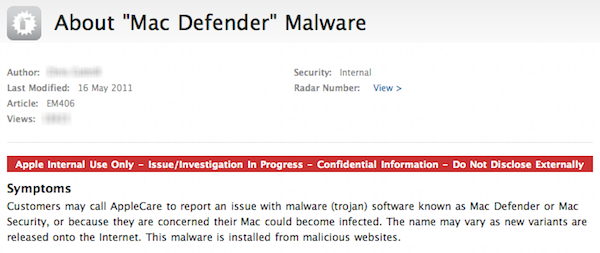

Internal AppleCare Document Directs Employees Not To Help With Malware Removal

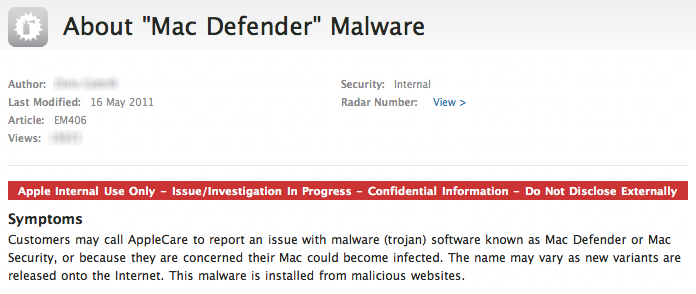
An internal AppleCare document posted earlier this week reveals that Apple is investigating ‘Mac Defender’ – a recently unleashed malicious application that pretends to be an anti-virus application when users download it. The document, which Apple clearly notes is for internal use only, tells its employees not to confirm or deny whether the application has been installed on a users computer, not to attempt to remove it or escalate the issue.

The bizarre document, which is posted in full after the break, seems to be instructing Apple employees to take no part in resolving malware issues on a users computer.

AppleCare does not provide support for removal of the malware. You should not confirm or deny whether the customer’s Mac is infected or not.

However, the document does tell employees to instruct customers that if the Mac Defender installer pops up on their screen, to cancel the installer and delete the installer immediately. Whilst if the application is already installed they are told to tell the customer to make sure all security updates have been installed with Software Update and then direct them to the “What is Malware?” document. But the document is clear in saying that Apple doesn’t deal with malware – even recommending anti-virus software in the Mac App Store.

Explain that Apple does not make recommendations for specific software to assist in removing malware. The customer can be directed to the Apple Online Store and the Mac App Store for antivirus software options.

[Via ZDNet]

Read more


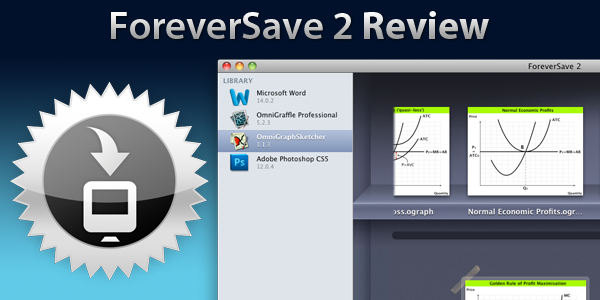
ForeverSave 2 Review: Universal Auto-Save And Versioning On Your Mac

Everybody dreads it, the moment you realize that the document you had been working on for an hour is lost, all because you hadn’t saved it and there had been a power outage or the program crashed! It seems absurd that, in 2011, so few apps have implemented an auto-save feature that saves your document periodically as you work on it. A few apps do have an auto-save feature, including the Microsoft Office suite (saving me more than a few times) – but the vast majority don’t.

For those applications that don’t feature auto-saving there may be a reasonable solution that requires very little hassle from you. Tool Force bills their recently released version 2 of ForeverSave as enabling “universal auto-save and backup versioning for all documents”. I gave the application a go for the past week so jump the break for a full review and see whether it pans out as a feasible solution.

Read more


Today Marks Ten Years Of Apple Retail Stores

On May 19 2001, Apple opened the first of its many retail Apple Stores; the Tysons Corner and Glendale stores. Ten years on, Apple’s retail ambitions have proven incredibly successful with over 300 stores in more than 10 countries.Along the way there have been some stunning stores, including the Regent street store in London (also the largest), the glass cube Fifth Avenue store in New York, the Paris Carrousel du Louvre Store and Pundong store in Shanghai.

As always, Wikipedia has some in-depth history and facts about the Apple Stores, as does ifoAppleStore which has an awesome list of unique factoids - did you know that the Bondi store has trees inside the store or that the Regent Street store has the longest Genius Bar at 46 feet? There have also been rumors in the past few days that Apple is planning to launch Apple Stores 2.0 - a relaunch of the stores with a shift in focus to ‘Personal Setups’, revamp of the actual stores with larger displays and deployment of iPad 2s for signatures being the key rumored changes.

Jump the break for pictures of these and other stunning stores, as well as a video of Jobs introducing that first Tysons Corner store - and see how much they’ve changed since!

Update: Added some pictures of the Tysons Corner store as it was on launch day (click on them for larger size), the original style of Apple Stores.

Read more


China Mobile Claims It Reached A Consensus With Apple Over A 4G iPhone

In a report on MarketWatch, China Mobile states that it has reached a consensus with Apple regarding the use of 4G technology on future iPhones. The iPhone 4 currently uses 3G technology, 4G is the ‘next-generation’ technology for mobile data which promises even faster speeds.

Wang Jianzhou, China Mobile’s Chairman, didn’t specify many details about the agreement but says that they will be beginning 4G trials in China beginning next year and that discussions with Apple are continuing. Bloomberg today also got some additional details from Jianzhou, but in that report, the consensus with Apple was not mentioned.

The company may also be able to offer Apple Inc. (AAPL)s iPhone with the shift to TD-LTE, Wang said. While Apple has decided not to make a version of the phone for the third-generation TD-SCDMA system that is used only by China Mobile, the Cupertino, California-based company may produce one for the TD-LTE system, he said.

It follows yesterday’s report from DigiTimes that this year’s iPhone was originally meant to have LTE capability (a 4G technology) but was scrapped after it was discovered Qualcomm was having problems producing chips in large enough quantities. In that report it was said that China Mobile was expected to reach a deal with Apple soon to offer the next iPhone on it’s network this year – contradicting the Bloomberg report.

[Via MacRumors]


Survey Reveals 63 Million iOS Gamers Download 5 Million Games Per Day

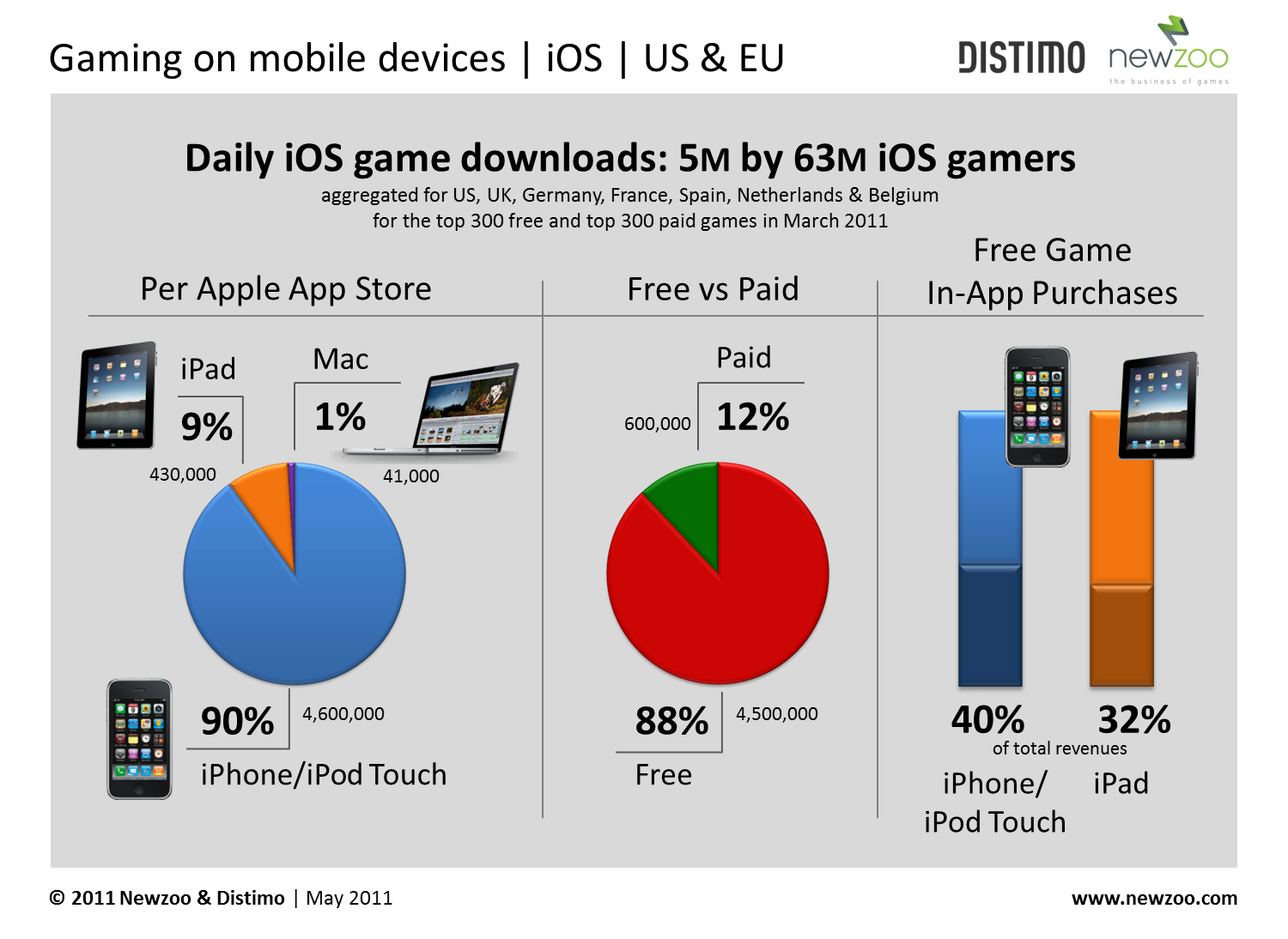
The National Gamers Survey, compiled by research firms Distimo and Newzoo from March data has revealed that there are roughly 63 million gamers on the iOS ecosystem who (individually) download, on average, 2.5 games per month. Games represent half of all apps downloaded across the iOS and Mac App Stores with more than 5 million games downloaded per day – based on the survey that included the US, UK and five other European countries. A clear majority of 4.6 million are downloaded for the iPhone or iPod Touch whilst just over 400,000 are for the iPad and just a sliver for the Mac with 41,000 per day.

The survey also revealed that in-app purchases within games is becoming an increasingly common feature found in games with revenue from in-app purchases also representing a large proportion of total revenues. 88% of the top 300 games on iOS are free, but across and free and paid games, two fifths of the revenue is now coming from in-app purchases. On the iPhone and iPod touch it represented 40% of gross revenue and 32% for the iPad. These high figures may give reason to why Lodsys has recently started to target developers that implement in-app purchases; it would certainly raise a lot of revenue if they received license fees from even just a portion of developers.

Some more statistical data about the spread of iOS devices was also revealed, noting that across some of the countries surveyed, including the US, UK, France and Germany, between 6% and 7% of the online population have an iPhone. Whilst of those iPhone users, between 50% and 75% play games. As for the iPad, the report claims 15 million Americans actively play games on it, whilst 7 million Europeans do so – exceeding the number of people using Sony’s PSP.

[Via RazorianFly]


Parallels Transporter Makes PC to Mac Migration Dead Simple

Parallels, probably best known for its popular virtualization software, has today released a new product that lets you make migration from Windows to OS X dead simple. The product, Parallels Transporter is being offered at a special introductory price of $0.99 on the Mac App Store (it’s regular price will be a rather expensive $39.99) and allows users to automatically transfer music, pictures, documents and more from a Windows computer to a Mac.

Using an external hard drive, wireless network or a Parallels USB transfer cable, Transporter will automatically transfer the data to the appropriate locations the Mac. Whether it is documents in the home directory or bookmarks for browsers, Transporter will do all the work in correctly transferring the users files.

We created Parallels Transporter to be the simplest, most efficient way to transfer everything you need from your old PC to your Mac in just a few easy steps. Now you can move to a Mac without the time-consuming chore of manually moving files and without the expense of hiring somebody to do it for you.

Transporter will even transfer over Windows applications and other files into a virtual machine on the Mac so that if you end up using Parallels Desktop, everything will be set up and ready to go for you – although note that this does require the purchase of Parallels Desktop which isn’t included in Transporter.


OmniVision Introduces 5 MP Sensor With 1080p Video Recording

Earlier this morning we reported on some rumors from DigiTimes regarding the production timeline of the upcoming iPhone 4S and rumoured components that it would include. In their report, DigiTimes claimed that it would contain an 8 MP camera from OmniVision Technologies, and to some degree it makes sense. Sony’s CEO in April made a fleeting comment suggesting that it would be supplying Apple with an 8MP camera for the next iPhone. However, those same comments were later suggested to have been largely “invented” by bloggers attending the event.

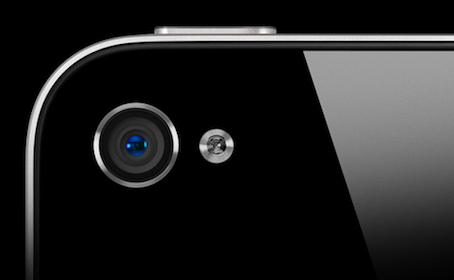
OmniVision today introduced a new 5MP image sensor, the OV5690, that was developed to produce the “best-in-class image quality” whilst being an effective solution for slimmer mobile devices such as smartphones and tablet computers by reducing the size of the camera module. With contradicting reports on whether the next iPhone will contain a 5 MP camera or an 8 MP camera, this new product certainly lends weight to the suggestion that it could have a 5 MP camera. In recent times Apple has been ferocious in crafting its devices to be as thin and light as possible, and this latest component by OmniVision could enable Apple to deliver on that goal with improved image quality (and 1080p video recording at 30 fps) whilst fitting into a smaller package.

With industry sources placing 5-megapixel CMOS image sensors at more than 15 percent of the overall sensor market today, we view 5-megapixel sensors as occupying as a sweet spot in the market. (Emphasis Added)

The iPhone 4 currently sports an older OmniVision camera component that is also 5 MP but only records video in 720p. Apple may well choose to stick with OmniVision and deliver a slightly improved camera in its next iPhone – which may be in line with reports of just small, evolutionary, improvements for the next iPhone. Although interestingly, OmniVision also revealed in early January that it had introduced a 10MP camera sensor that would similarly enable 1080p video recording at 30fps.


Former LG Executive Takes Over As Apple’s Korean Boss

The Yonhap News Agency is today reporting that Apple has recently hired Dominque Oh as its new head of South Korean operations. Oh will move to Apple after working at LG in a number of positions, including most recently as their Vice President of the Smartphone business for the past 13 months. Prior to that he worked as VP of Product Planning and Europe Mobile Business at LG.

Oh has extensive experience from his jobs within LG, where he was required to establish relationships with various operators and partners from across the world and overlook LG’s Android and Windows Phone 7 products, which will no doubt be beneficial in his new job with Apple. Oh will replace the current head of Apple’s South Korean operations, Andrew Sedgwick who held the post for over a decade.

The news comes from a number of “industry insiders” who requested anonymity, but Oh has yet to update his LinkedIn profile, still listing his VP of Smartphone Business at LG as his current job.

[Via TheNextWeb]