
 MacStories Weekly: Issue 347
MacStories Unwind: The Best Music of 2022






This week on MacStories Unwind, we kick off the first of our annual ‘best of’ Unwind recaps with the best music releases of 2022.
The Best Music of 2022
Federico’s Pick:
- English Album of the Year:
- Asphalt Meadows by Death Cab for Cutie
- Italian Album of the Year
- c@ra++ere s?ec!@le by thasup
- Other Favorites:
- Midnights by Taylor Swift
- Fix Yourself, Not the World and Is This What It Feels Like to Feel Like This? (EP) by The Wombats
- Unwanted (The Antidote Edition) by Pale Waves
- Being Funny in a Foreign Language by The 1975
- The Hum Goes on Forever by The Wonder Years
- Honorable Mentions
- New Preoccupations by Caracara
- Vaxis II: A Window of the Waking Mind by Coheed and Cambria
- Kings of the New Age by State Champs
- Will of the People by Muse
- Alpha Games by Bloc Party
John’s Pick:
- Album of the Year
- House by Shout Out Louds
- Other Favorites
- Midnights (3am Edition) by Taylor Swift
- Wet Leg by Wet Leg
* C’mon You Know by Liam Gallagher- Down By The River Thames by Liam Gallagher
- Expert in a Dying Field by The Beths
- You’re Good (EP) by Kayleigh Goldsworthy
- Asphalt Meadows by Death Cab for Cutie
- Singles of the Year
- Sidelines by Phoebe Bridgers
- All To Well (Sad Girl Autumn Version) [Recorded at Long Pond Studios] by Taylor Swift
- October Passed Me By by girl in red
- New Gold (feat. Tame Impala and Bootie Brown) [Dom Dolla Remix] by Gorillaz
- Honorable Mentions
- Dropout Boogie by The Black Keys
- Surrender by Maggie Rogers
- More Recommendations
- Two Ribbons by Let’s Eat Grandma
- Dream Machine by Lucy Daydream
- Past Life by Daywave
- You Have Got to Be Kidding Me by fanclubwallet
Stable Diffusion Optimizations Are Coming to iOS and iPadOS 16.2 and macOS 13.1 Via Core ML→
Today, Apple announced on its Machine Learning Research website that iOS and iPadOS 16.2 and macOS 13.1 will gain optimizations to its Core ML framework for Stable Diffusion, the model that powers a wide variety of tools that allow users to do things like generate an image from text prompts and more. The post explains the advantages of running Stable Diffusion locally on Apple silicon devices:
One of the key questions for Stable Diffusion in any app is where the model is running. There are a number of reasons why on-device deployment of Stable Diffusion in an app is preferable to a server-based approach. First, the privacy of the end user is protected because any data the user provided as input to the model stays on the user’s device. Second, after initial download, users don’t require an internet connection to use the model. Finally, locally deploying this model enables developers to reduce or eliminate their server-related costs.
The optimizations to the Core ML framework are designed to simplify the process of incorporating Stable Diffusion into developers’ apps:
Optimizing Core ML for Stable Diffusion and simplifying model conversion makes it easier for developers to incorporate this technology in their apps in a privacy-preserving and economically feasible way, while getting the best performance on Apple Silicon.
The development of Stable Diffusion’s has been rapid since it became publicly available in August. I expect the optimizations to Core ML will only accelerate that trend in the Apple community and have the added benefit to Apple of enticing more developers to try Core ML.
If you want to take a look at the Core ML optimizations, they’re available on GitHub here and include “a Python package for converting Stable Diffusion models from PyTorch to Core ML using diffusers and coremltools, as well as a Swift package to deploy the models.”
What Wreckfest Tells Us About the Future of iPhone and iPad Gaming→
In November, HandyGames released Wreckfest for iPhones and iPads. The demolition racing game was originally released by Bugbear Entertainment on PC in 2018 and the following year on PS4 and Xbox One. Since then, the game has been brought to current-generation consoles, streaming, and now, mobile platforms.
Although Wreckfest is several years old, it’s one of the more demanding console games brought to mobile recently, which makes it a good test for Apple’s latest SoCs. That’s what MrMacRight did on his YouTube channel, testing the game on everything from an original iPhone SE with an A9 chip to a 12.9” iPad Pro with an M2 chip.
There’s a lot of the sort of technical detail in MrMacRight’s video that I love, along with settings recommendations if you want to get the most out of whatever device you’re using to play the game. To me, though, the most interesting part of the video is the point in the Apple silicon lineup where the game’s performance drops off and how the choices the publisher made to bring Wreckfest to mobile affect the game.
The M1 and M2 SoCs handle Wreckfest well, maintaining an almost steady 60fps throughout. The first dip comes when trying to run the game at 60fps on an iPhone 14 Plus with an A15 SoC that ran into thermal throttling issues. Still, with tweaks to the game’s settings, it remains playable on a wide variety of iPhones and iPads thanks to quality reductions of some graphics assets, which also serve to reduce the size of the game and its memory footprint. Those graphical compromises made by HandyGames are understandable but also a bit disappointing for anyone with an M1, M2, or A16 device, which could handle better graphics and textures.
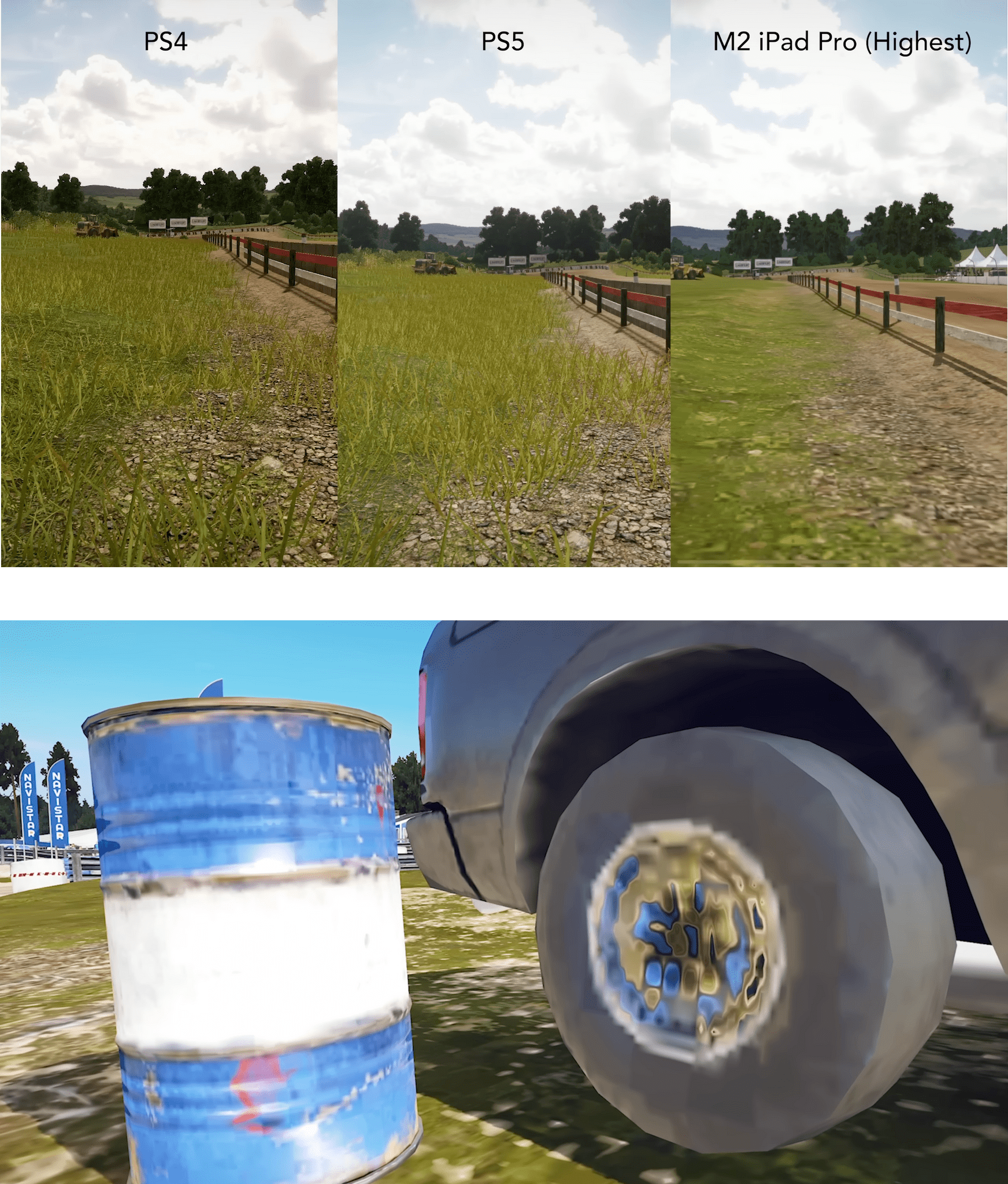
Big picture, MrMacRight’s analysis of Wreckfest suggests that we’re still in the early days when it comes to games that approach console quality coming to the iPhone and iPad. Plus, the sheer size of the gaming market that is still on older A-series SoCs means the sweet spot for game development will likely take a few more years before the performance that is possible on M-series and A16-based devices becomes the norm for most mobile gamers. Whether Apple silicon gets to that point before another solution, like game streaming, takes widespread hold, it will likely be one of the most interesting stories to follow in mobile gaming.
Monthly Log: November 2022
AppStories, Episode 307 – Nerding Out for the Holidays (Part 2)→
This week on AppStories, we concluded our two-part series on their nerdy holiday projects with home automation, RSS, WiFi, and other plans.
Sponsored by:
- Pillow – Sleeping better, made simple.
](https://cdn.macstories.net/banneras-1629219199428.png)
On AppStories+, Federico is getting to know new delivery people, and I explain how I’m working to preserve his Nintendo 3DS games.
We deliver AppStories+ to subscribers with bonus content, ad-free, and at a high bitrate early every week.
To learn more about the benefits included with an AppStories+ subscription, visit our Plans page, or read the AppStories+ FAQ.
Last.fm Turns 20 – and People Are Still Scrobbling→
I enjoyed this story about Last.fm’s 20th (!) anniversary by Jacob Kastrenakes, writing for The Verge:
I was a little surprised to see that Last.fm was still around when I first started writing this story, let alone that it had new communities flourishing around its data. (The company didn’t respond to a request for an interview.) But I suppose in a world where most services close off and hide your data, there’ll always be people looking for a way to track it and analyze it themselves. And in exchange, they get the joy of arguing about music stats every day — and not just once a year when Wrapped comes out.
My co-hosts on Connected like to make fun of me for being One of Those People Who Still Scrobbles, but I can honestly say it’s one of the best things I’ve done for my music consumption in the past few years. (That, plus having an offline library with albums I own that I can enjoy with my favorite headphones and amp – which I also scrobble via Roon.) Ever since I started scrobbling again last year thanks to Marvis Pro on iPhone and iPad (and NepTunes on the Mac), I’ve been able to enjoy some fascinating monthly and annual breakdowns of my music listening habits that go much more in depth than Apple Music or Spotify would ever want to.
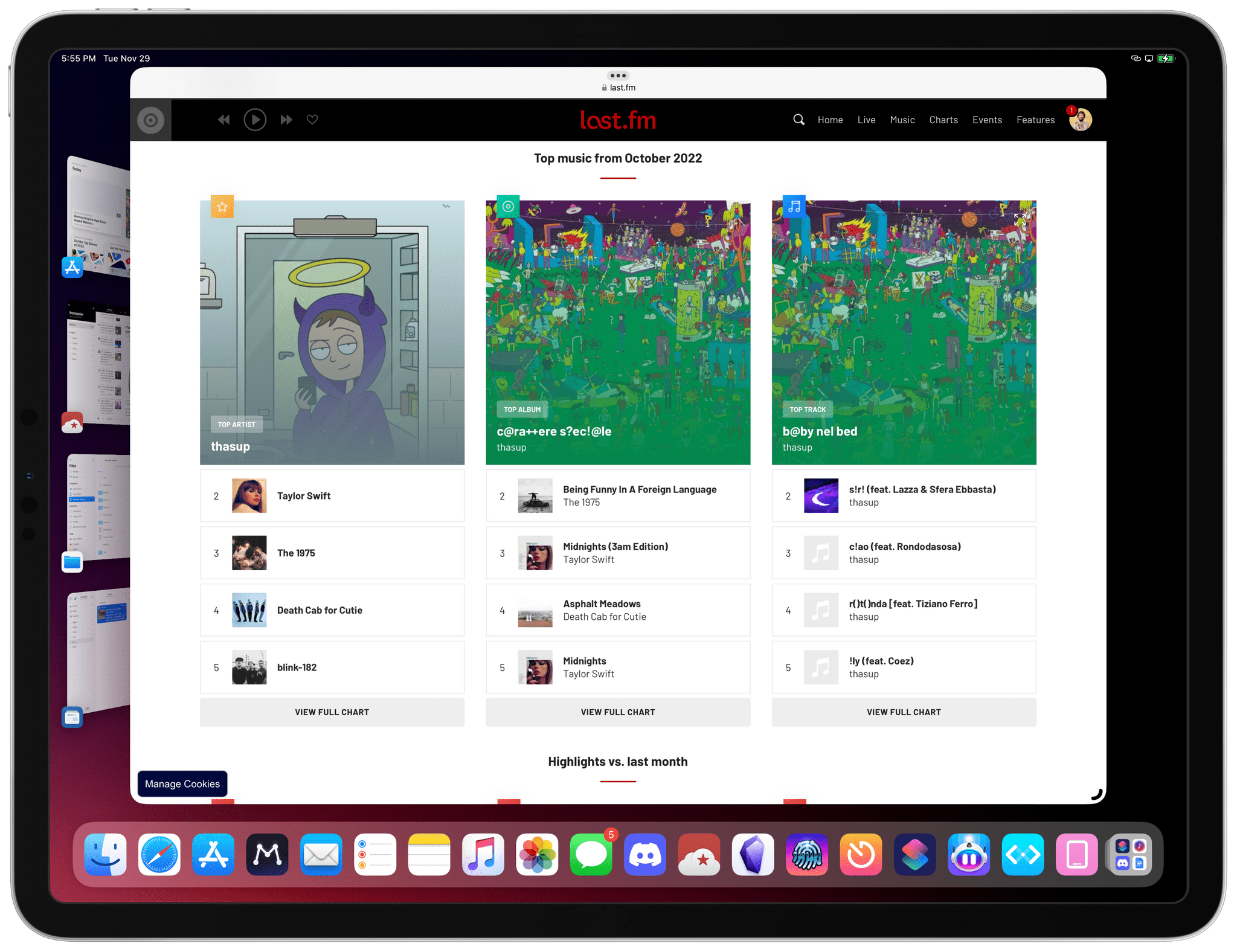
In Internet years, it’s pretty wild for anything to turn 20 – let alone a service that faces competition from the likes of Apple and Spotify. And yet Last.fm has been able to carve a niche for itself by appealing to people like me, who want to know more about the music they listen to. Maybe it’s a weird thing to say in 2022, but if you listen to a lot of music every day, I can’t recommend dusting off your old Last.fm account enough.
Masto-Redirect, a Mastodon Shortcut to Redirect Profiles and Posts to Your Own Instance
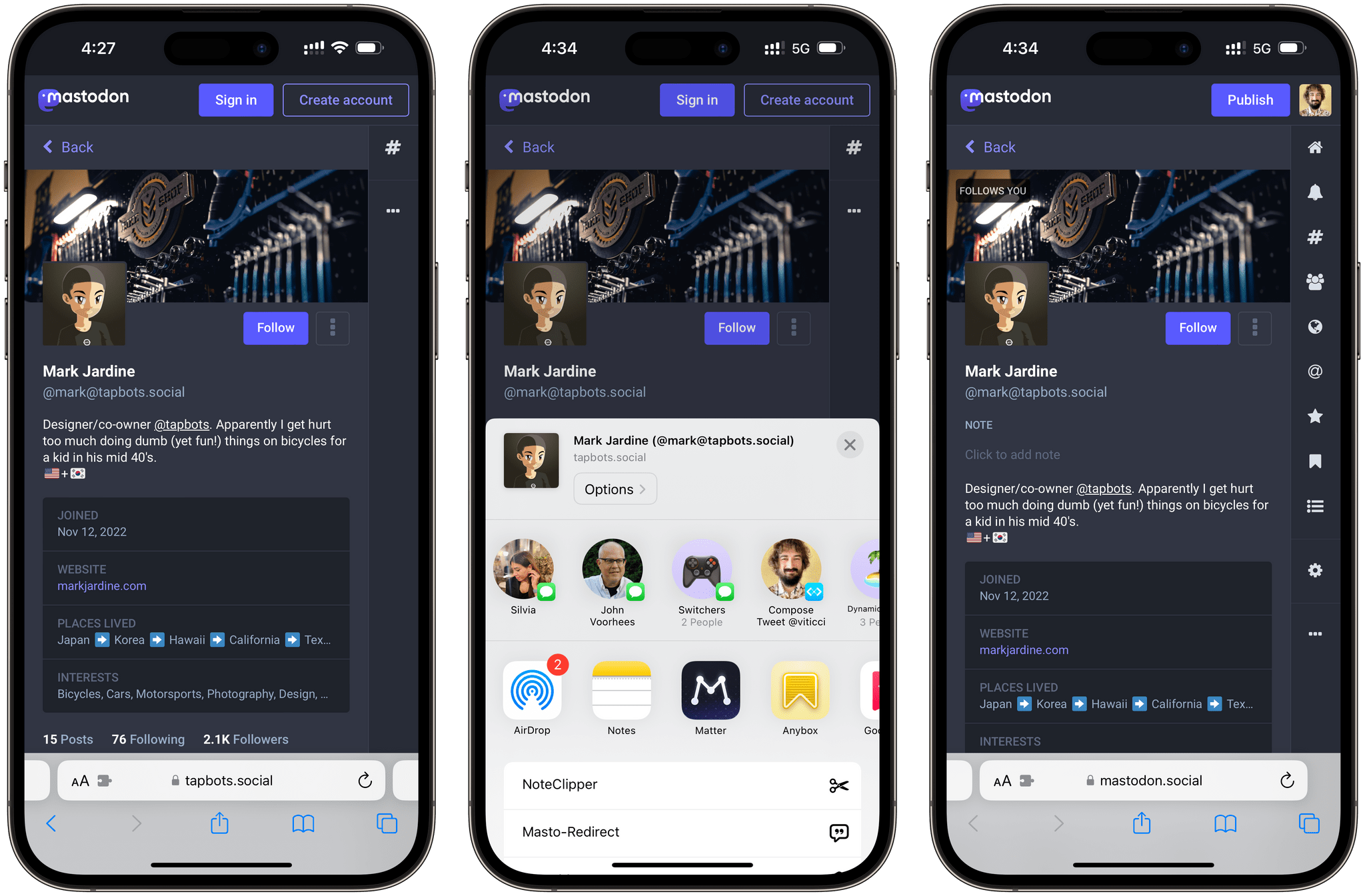
Like many others over the past month, I’ve been thinking deeply about my experience with Twitter and whether I want to align my social media usage with the kind of platform Twitter is rapidly becoming. It’s a complex discussion (if my readers are still on Twitter, am I doing them a disservice by not using Twitter?), but in the meantime, I’ve decided to learn more about Mastodon. And in doing so, I came across an aspect of the service that I wanted to improve with a shortcut.
I created an account on Mastodon.social all the way back in 2018, and you can find me as @viticci there as well. I don’t want to turn this post into a guide to Mastodon (you can find an excellent one here), but, long story short, Mastodon is a decentralized service that is based on a federated network of instances. Essentially, there isn’t a single “Mastodon website” like, say, twitter.com; instead, there can be multiple Mastodon instances across different domains (hence why it’s “decentralized”) but, thanks to an underlying API, you can follow and be followed by people regardless of the instance they’re on. I can be on Mastodon.social, and you can be on Journa.host or Mastodon.online (different instances of Mastodon), but we can still communicate with one another via the protocol Mastodon uses. It’s like living in different countries but speaking the same language. You can read more about this here.
Apple to Offer a New Coding Lab for Kids Beginning Next Week

Next week, Apple is introducing a new Today at Apple session for kids who are interested in learning to code: Coding Lab for Kids: Code Your First App. Starting December 5th, the session will walk children 10 and up through building an app with Swift Playgrounds.
According to Apple’s press release:
During the lab, Apple Creative Pros will lead aspiring coders and their guardians in an interactive activity using iPad and Swift Playgrounds…. Working in the About Me playground, participants will use SwiftUI and a new, real-time app preview to customize and bring their app to life with fun fonts, background colors, Memoji, and more.
After its debut, Coding Lab for Kids: Code Your First App will become a regular part of the Today at Apple programming.
As a parent, I’m always glad to see sessions like this added to Today at Apple. The company offers a lot of interesting programs, but having helped my kids find resources to learn to code when they were younger was difficult. Introductory sessions like the one announced today and Apple’s other resources for parents and educators have come a long way in recent years and now enable a wide spectrum of kids who are interested in coding to find the materials to help them get started.
If you want to sign a kid up, you can look for a nearby Apple Store offering the session here.