Posts tagged with "ChatGPT"

OpenAI Targets Coding and Knowledge Work with Its New GPT-5.5 Model

OpenAI announced GPT-5.5 and GPT-5.5 Pro today, which it says are faster and able to work more autonomously than the company’s previous models. It’s a message that is sure to interest business users whether their goal is accelerating software development or increasing productivity more generally. Some of the areas that OpenAI says GPT-5.5 and GPT-5.5 Pro excel at include:

  • writing and debugging code;
  • analyzing data;
  • conducting web research;
  • creating business documents such as spreadsheets and presentations;
  • using apps; and
  • juggling multiple tools.

In its press release, OpenAI claims that:

The gains are especially strong in agentic coding, computer use, knowledge work, and early scientific research—areas where progress depends on reasoning across context and taking action over time. GPT‑5.5 delivers this step up in intelligence without compromising on speed: larger, more capable models are often slower to serve, but GPT‑5.5 matches GPT‑5.4 per-token latency in real-world serving, while performing at a much higher level of intelligence. It also uses significantly fewer tokens to complete the same Codex tasks, making it more efficient as well as more capable.

I haven’t tried either model yet, but early reactions seem to support OpenAI’s claims that GPT-5.5 understands user intent better, requiring less precise instructions. The company says it is better at using the tools at its disposal, and checking its own work, too. OpenAI says the Pro model takes that up a notch, working faster on more complex tasks, such as programming, research, and document-intensive workflows. Whether the early hype translates into real-world gains that are noticeable in everday work, remains to be seen, but we shouldn’t have long to wait though, since GPT-5.5 is rolling out to users now.

GPT-5.5 is available in ChatGPT and Codex to Plus, Pro, Business, and Enterprise subscribers, and GPT-5.5 Pro is limited to Pro, Business, and Enterprise subscribers in ChatGPT. Neither model is available through OpenAI’s API, but the company says they will be soon.


Roadtripping with ChatGPT Voice Mode

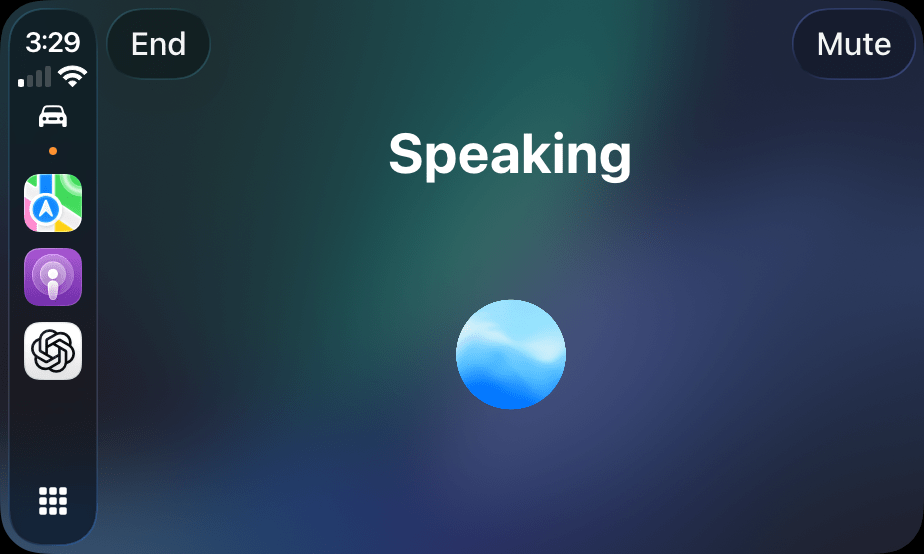
On Saturday, my wife Jennifer and I drove to Blowing Rock, a quaint little town in the Blue Ridge Mountains. We’d been there once before, but didn’t know the town well, so as we headed west I poked at the ChatGPT icon on my dashboard to give the app’s new CarPlay integration a try. I asked:

What activities would you recommend for a day trip to Blowing Rock, North Carolina?

What I got back was a short but good list of highlights including a hike, a visit to the Blowing Rock cliffside overlook, a few restaurants, a coffee shop, and some local shops. It was similar to a list of activities I’d looked up before we left using Claude. So far, so good.

I switched back to Apple Maps and was thinking I probably wouldn’t use ChatGPT in my car very often, but that it could come in handy for similar requests, when things got a little creepy. I explained to Jennifer that ChatGPT’s CarPlay feature was new, and I had been meaning to check it out all week. Then, just as I’d said I thought it had done a pretty good job, a voice interrupted. It was ChatGPT’s voice mode saying it was glad I liked it.

You see, just like a phone call doesn’t drop when you switch apps in CarPlay, neither does ChatGPT. I supposed I should have anticipated that the mic would remain live, but I didn’t. Nor did I notice the End button in the corner of the screen; I was driving, not studying the app’s UI.

I take it as a positive sign that I didn’t expect ChatGPT to follow me back to Apple Maps. I treat chatbots like I do any app. Give it some input, and you get an output. Close the app, and you’re done. It’s not my little robot buddy. It’s a tool like any other app.

Of course, that’s not how the voice modes of these chatbots are designed to work. Chats are meant to be an engaging back and forth. But having ChatGPT jump in on our one-on-one conversation while driving down the highway was too much. Suddenly, it felt like something else was in the car eavesdropping on us.

The experience was a good lesson in the balancing of utility and social norms around AI tools. Useful as they can be in some situations, their developers need to be more mindful of user expectations and provide better cues about how they work to avoid uncomfortable surprises. The recommendations we got from ChatGPT were good, but I also don’t expect it will get a second chance on our family road trips anytime soon.


Adobe Announces Image and PDF Integration with ChatGPT

Source: Adobe.

Source: Adobe.

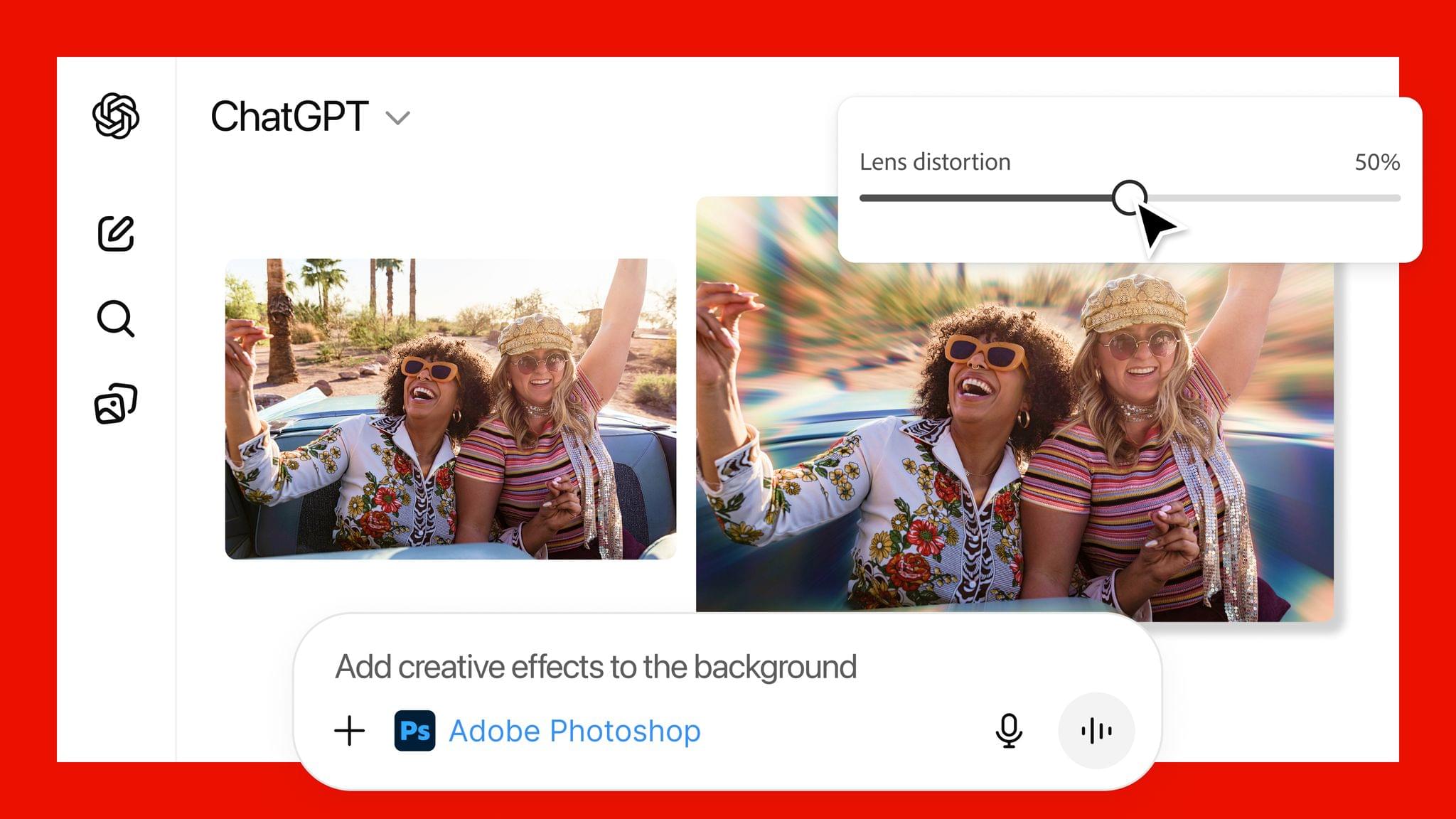
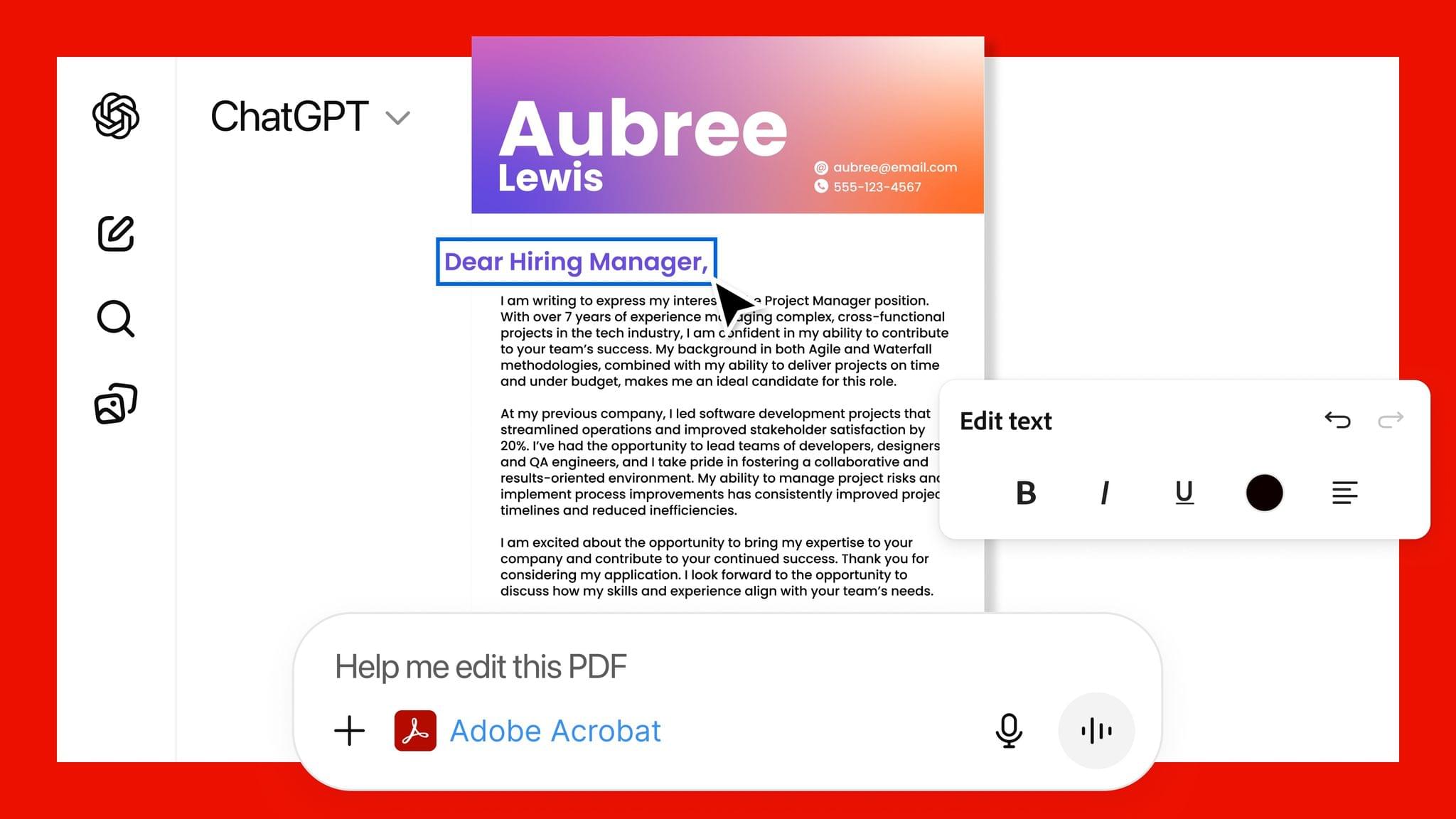
Adobe announced today that it has teamed up with OpenAI to give ChatGPT users access to Photoshop, Express, and Acrobat from inside the chatbot. The new integration is available starting today at no additional cost to ChatGPT users.

Source: Adobe.

Source: Adobe.

In a press release to Business Wire, Adobe explains that its three apps can be used by ChatGPT users to:

  • Easily edit and uplevel images with Adobe Photoshop: Adjust a specific part of an image, fine tune image settings like brightness, contrast and exposure, and apply creative effects like Glitch and Glow – all while preserving the quality of the image.
  • Create and personalize designs with Adobe Express: Browse Adobe Express’ extensive library of professional designs to find the best one for any moment, fill in the text, replace images, animate designs and iterate on edits – all directly inside the chat and without needing to switch to another app – to create standout content for any occasion.
  • Transform and organize documents with Adobe Acrobat: Edit PDFs directly in the chat, extract text or tables, organize and merge multiple files, compress files and convert them to PDF while keeping formatting and quality intact. Acrobat for ChatGPT also enables people to easily redact sensitive details.
Source: Adobe.

Source: Adobe.

This strikes me as a savvy move by Adobe. Allowing users to request image and PDF edits and design documents with natural language prompts makes its tools more approachable. That could attract new users who later move to an Adobe subscription to get more control over their creations and Adobe’s other offerings.

From OpenAI’s standpoint, this is clearly a response to the consumer-facing Gemini features that Google has begun releasing, which include new image and video generation tools and reportedly caused Sam Altman to declare a “code red” inside the company. I understand the OpenAI freakout. Google has a huge user base and has been doing consumer products far longer than OpenAI, but I can’t say I’ve been very impressed with Gemini 3. Perhaps that’s simply because I don’t care for generative images and video, but these latest moves by Google and OpenAI make it clear that they see them as foundational to consumer-facing AI tools.


Why is ChatGPT for Mac So Good?

Great post by Allen Pike on the importance of a great app experience for modern LLMs, which I recently wrote about. He opens with this line, which is a new axiom I’m going to reuse extensively:

A model is only as useful as its applications.

And on ChatGPT for Mac specifically:

The app does a good job of following the platform conventions on Mac. That means buttons, text fields, and menus behave as they do in other Mac apps. While ChatGPT is imperfect on both Mac and web, both platforms have the finish you would expect from a daily-use tool.

[…]

It’s easier to get a polished app with native APIs, but at a certain scale separate apps make it hard to rapidly iterate a complex enterprise product while keeping it in sync on each platform, while also meeting your service and customer obligations. So for a consumer-facing app like ChatGPT or the no-modifier Copilot, it’s easier to go native. For companies that are, at their core, selling to enterprises, you get Electron apps.

I don’t hate Electron as much as others in our community, but I can’t deny that ChatGPT is one of the nicest AI apps for Mac I’ve used. The other is the recently updated BoltAI. And they’re both native Mac apps.

Permalink

Apps in ChatGPT

OpenAI announced a lot of developer-related features at yesterday’s DevDay event, and as you can imagine, the most interesting one for me is the introduction of apps in ChatGPT. From the OpenAI blog:

Today we’re introducing a new generation of apps you can chat with, right inside ChatGPT. Developers can start building them today with the new Apps SDK, available in preview.

Apps in ChatGPT fit naturally into conversation. You can discover them when ChatGPT suggests one at the right time, or by calling them by name. Apps respond to natural language and include interactive interfaces you can use right in the chat.

And:

Developers can start building and testing apps today with the new Apps SDK preview, which we’re releasing as an open standard built on the Model Context Protocol⁠ (MCP). To start building, visit our documentation for guidelines and example apps, and then test your apps using Developer Mode in ChatGPT.

Also:

Later this year, we’ll launch apps to ChatGPT Business, Enterprise and Edu. We’ll also open submissions so developers can publish their apps in ChatGPT, and launch a dedicated directory where users can browse and search for them. Apps that meet the standards provided in our developer guidelines will be eligible to be listed, and those that meet higher design and functionality standards may be featured more prominently—both in the directory and in conversations.

Looks like we got the timing right with this week’s episode of AppStories about demystifying MCP and what it means to connect apps to LLMs. In the episode, I expressed my optimism for the potential of MCP and the idea of augmenting your favorite apps with the capabilities of LLMs. However, I also lamented how fragmented the MCP ecosystem is and how confusing it can be for users to wrap their heads around MCP “servers” and other obscure, developer-adjacent terminology.

In classic OpenAI fashion, their announcement of apps in ChatGPT aims to (almost) completely abstract the complexity of MCP from users. In one announcement, OpenAI addressed my two top complaints about MCP that I shared on AppStories: they revealed their own upcoming ecosystem of apps, and they’re going to make it simple to use.

Does that ring a bell? It’s impossible to tell right now if OpenAI’s bet to become a platform will be successful, but early signs are encouraging, and the company has the leverage of 800 million active users to convince third-party developers to jump on board. Just this morning, I asked ChatGPT to put together a custom Spotify playlist with bands that had a similar vibe to Moving Mountains in their Pneuma era, and after thinking for a few minutes, it worked. I did it from the ChatGPT web app and didn’t have to involve the App Store at all.

If I were Apple, I’d start growing increasingly concerned at the prospect of another company controlling the interactions between users and their favorite apps. As I argued on AppStories, my hope is that the rumored MCP framework allegedly being worked on by Apple is exactly that – a bridge (powered by App Intents) between App Store apps and LLMs that can serve as a stopgap until Apple gets their LLM act together. But that’s a story for another time.

Permalink


Sundar Pichai Testifies That He Hopes Gemini Will Be Integrated into iPhones This Fall

Ever since Apple announced its deal to integrate ChatGPT into Siri, there have been hints that the company wanted to make deals with other AI providers, too. Alphabet CEO Sundar Pichai has added fuel to the rumors with testimony given today in the remedy phase of the search antitrust case brought against it by the U.S. Department of Justice.

In response to questions by a DOJ prosecutor, Pichai testified that he hoped Google Gemini would be added to iPhones this year. According to a Bloomberg story co-authored by Mark Gurman, Davey Alba, and Leah Nylen:

Pichai said he held a series of conversations with Apple Chief Executive Officer Tim Cook across 2024 and he hopes to have a deal done by the middle of this year.

This news isn’t surprising, but it is welcome. Despite Google’s early stumbles with Bard, its successor, Gemini, has improved by leaps and bounds in recent months and has the advantage of being integrated with many of Google’s other products that have a huge user base. What will be interesting to see is whether Gemini is integrated as an alternative fallback for Siri requests or whether Apple and Google ink a broader deal that integrates Gemini into other aspects of iOS.

Permalink

Sycophancy in GPT-4o

OpenAI found itself in the middle of another controversy earlier this week, only this time it wasn’t about publishers or regulation, but about its core product – ChatGPT. Specifically, after rolling out an update to the default 4o model with improved personality, users started noticing that ChatGPT was adopting highly sycophantic behavior: it weirdly agreed with users on all kinds of prompts, even about topics that would typically warrant some justified pushback from a digital assistant. (Simon Willison and Ethan Mollick have a good roundup of the examples as well as the change in the system prompt that may have caused this.) OpenAI had to roll back the update and explain what happened on the company’s blog:

We have rolled back last week’s GPT‑4o update in ChatGPT so people are now using an earlier version with more balanced behavior. The update we removed was overly flattering or agreeable—often described as sycophantic.

We are actively testing new fixes to address the issue. We’re revising how we collect and incorporate feedback to heavily weight long-term user satisfaction and we’re introducing more personalization features, giving users greater control over how ChatGPT behaves.

And:

We also believe users should have more control over how ChatGPT behaves and, to the extent that it is safe and feasible, make adjustments if they don’t agree with the default behavior.

Today, users can give the model specific instructions to shape its behavior with features like custom instructions. We’re also building new, easier ways for users to do this. For example, users will be able to give real-time feedback to directly influence their interactions and choose from multiple default personalities.

“Easier ways” for users to adjust ChatGPT’s behavior sound to me like a user-friendly toggle or slider to adjust ChatGPT’s personality (Grok has something similar, albeit unhinged), which I think would be a reasonable addition to the product. I’ve long argued that Siri should come with an adjustable personality similar to CARROT Weather, which lets you tweak whether you want the app to be “evil” or “professional” with a slider. I increasingly feel like that sort of option would make a lot of sense for modern LLMs, too.

Permalink

One AI to Rule Them All?

I enjoyed this look by M.G. Siegler at the current AI landscape, evaluating the positions of all the big players and trying to predict who will come out on top based on what we can see today. I’ve been thinking about this a lot lately. The space is changing so rapidly, with weekly announcements and rumors, that it’s challenging to keep up with all the latest models, app integrations, and reasoning modes. But one thing seems certain: with 400 million weekly users, ChatGPT is winning in the public eye.

However, I was captivated by this analogy, and I wish I’d thought of it myself:

Professionals and power users will undoubtedly pay for, and get value out of, multiple models and products. But just as with the streaming wars, consumers are not going to buy all of these services. And unlike that war, where all of the players had differentiating content, again, the AI services are reaching some level of parity (for consumer use cases). So whereas you might have three or four streaming services that you pay for, you will likely just have one main AI service. Again, it’s more like search in that way.

I see the parallels between different streaming services and different AI models, and I wonder if it’s the sort of diversification that happens before inevitable consolidation. Right now, I find ChatGPT’s Deep Research superior to Google Gemini, but Google has a more fascinating and useful ecosystem story; Claude is better at coding, editing prose, and following complex instructions than any other model I’ve tested, but it feels limited by a lack of extensions and web search (for now). As a result, I find myself jumping between different LLMs for different tasks. And that’s not to mention the more specific products I use on a regular basis, such as NotebookLM, Readwise Chat, and Whisper. Could it be that, just like I’ve always appreciated distinct native apps for specific tasks, maybe I also prefer dedicated AIs for different purposes now?

I continue to think that, long term, it’ll once again come down to iOS versus Android, as it’s always been. But I also believe that M.G. Siegler is correct: until the dust settles (if it ever does), power users will likely use multiple AIs in lieu of one AI to rule them all. And for regular users, at least for the time being, that one AI is ChatGPT.

Permalink