This Week's Sponsor:

BetterTouchTool

Now with a Powerful Launcher for Your Mac


Posts tagged with "app store"

EU Sets DMA Compliance Deadline in App Store Anti-Steering Dispute

Last month, the European Commission (EC) fined Apple €500 million for violating the Digital Markets Act. Today, the EC issued its full 67-page ruling on the matter, giving Apple until July 23 to pay the fine or face accruing interest on the penalty.

The ruling focuses on Apple’s anti-steering rules, which were the focus of the contempt order recently entered by a U.S. District Court Judge in California. According to the EC:

Apple has not substantiated any security concerns. Apple simply states that some limitations, such as linking out only to a website that the app developer owns or has responsibility for, are allegedly grounded in security reasons. However, Apple does not explain why the app developer’s website is more secure than a third party website which the app developer has taken the conscious decision to link out to. It also does not explain why this limitation is objectively necessary and proportionate to protect the end user’s security and therefore has not provided any adequate justifications in this regard.

(EC ruling at p. 22). In other words, “the App Store isn’t more secure than the web just because you say it is.”

Apple has until June 22 to bring the App Store into compliance with the EC’s ruling or face additional periodic penalties (EC ruling at p. 67). As we reported in April, Apple has said that it intends to appeal the EC’s ruling.


Microsoft Eyes Xbox Web Store after Epic Court Decision

In the wake of U.S. District Judge Yvonne Gonzalez Rogers’ decision in Epic Games’ litigation against Apple, I commented on NPC: Next Portable Console that I expected Microsoft to enter the fray with its own web store soon. As reported by Tom Warren at The Verge, it looks like that’s exactly what Microsoft intends to do. Commenting on Judge Gonzalez Rogers’ contempt order in the context of Epic’s recent motion to return Fortnite to the App Store, Warren notes:

It’s a key ruling that has already allowed Fortnite to return to the App Store in the US, complete with the ability for Epic Games to link out to its own payment system inside the game. Microsoft has wanted to offer a similar experience for its Xbox mobile store prior to the ruling, but it says its solution “has been stymied by Apple.”

Ultimately, Microsoft wants its customers to be able to purchase and play its games from inside the Xbox app:

Microsoft started rolling out the ability to purchase games and DLC inside the Xbox mobile app last month, but it had to remove the remote play option to adhere to Apple’s App Store policies. You can’t currently buy an Xbox game in the Xbox mobile app on iOS and then stream it inside that same app. You have to manually navigate to the Xbox Cloud Gaming mobile website on a browser to get access to cloud gaming.

Developers continue to add options to link out to the web to purchase content, but as Microsoft’s court filing shows, the biggest players on the App Store are weighing the cost of setting up their own storefronts against the risk that Judge Gonzalez Rogers’ decision will be reversed on appeal.

Permalink

Google Brings Its NotebookLM Research Tool to iPhone and iPad

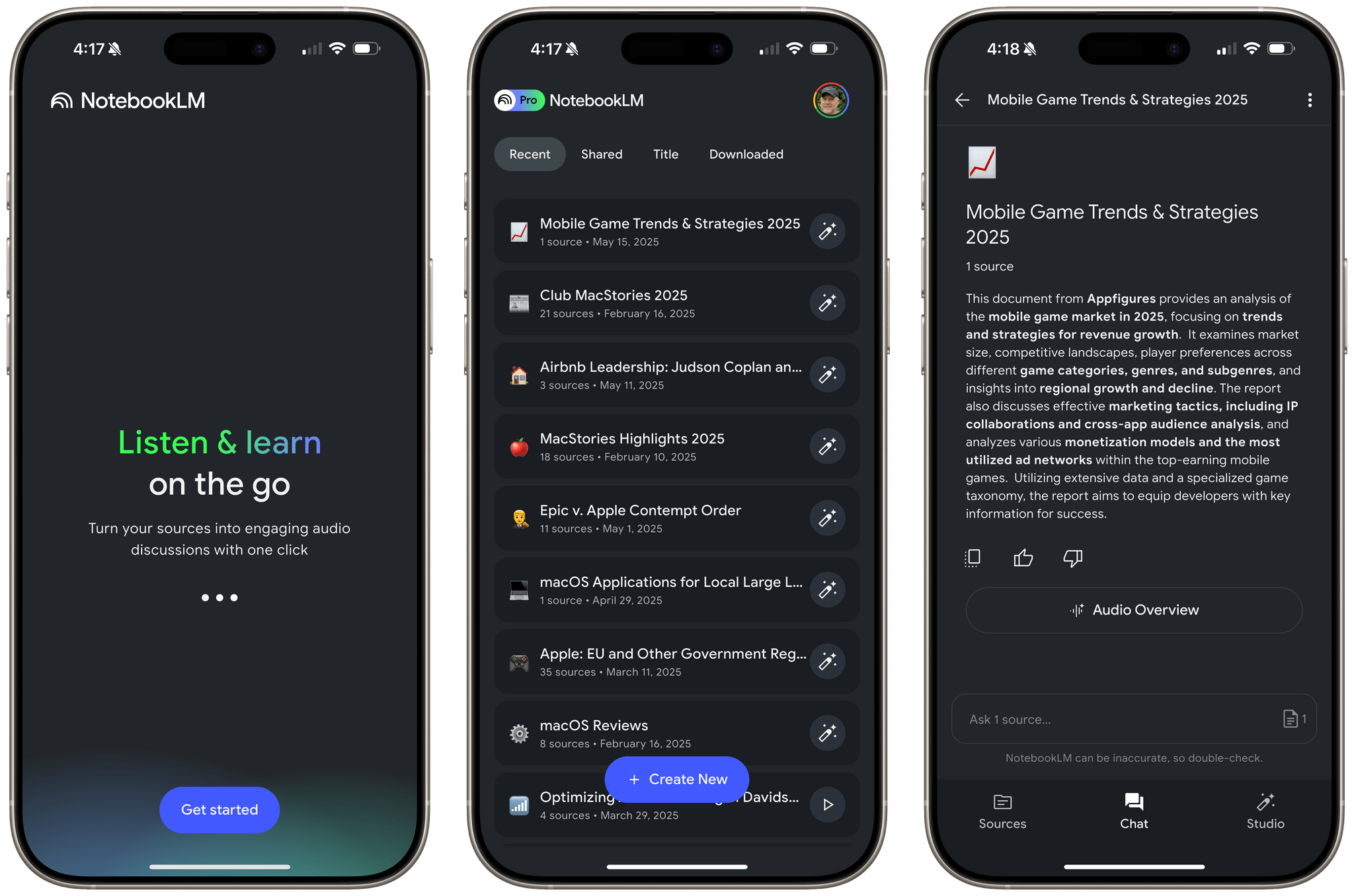
Google’s AI research tool NotebookLM dropped on the App Store for iOS and iPadOS a day earlier than expected. If you haven’t used NotebookLM before, it’s Google’s AI research tool. You feed it source materials like PDFs, text files, MP3s, and more. Once your sources are uploaded, you can use Google’s AI to query the sources, asking questions and creating materials that draw on your sources.

Of all the AI tools I’ve tried, NotebookLM’s web app is one of the best I’ve used, which is why I was excited to try it on the iPhone and iPad. I’ve only played with it for a short time, but so far, I like it a lot.

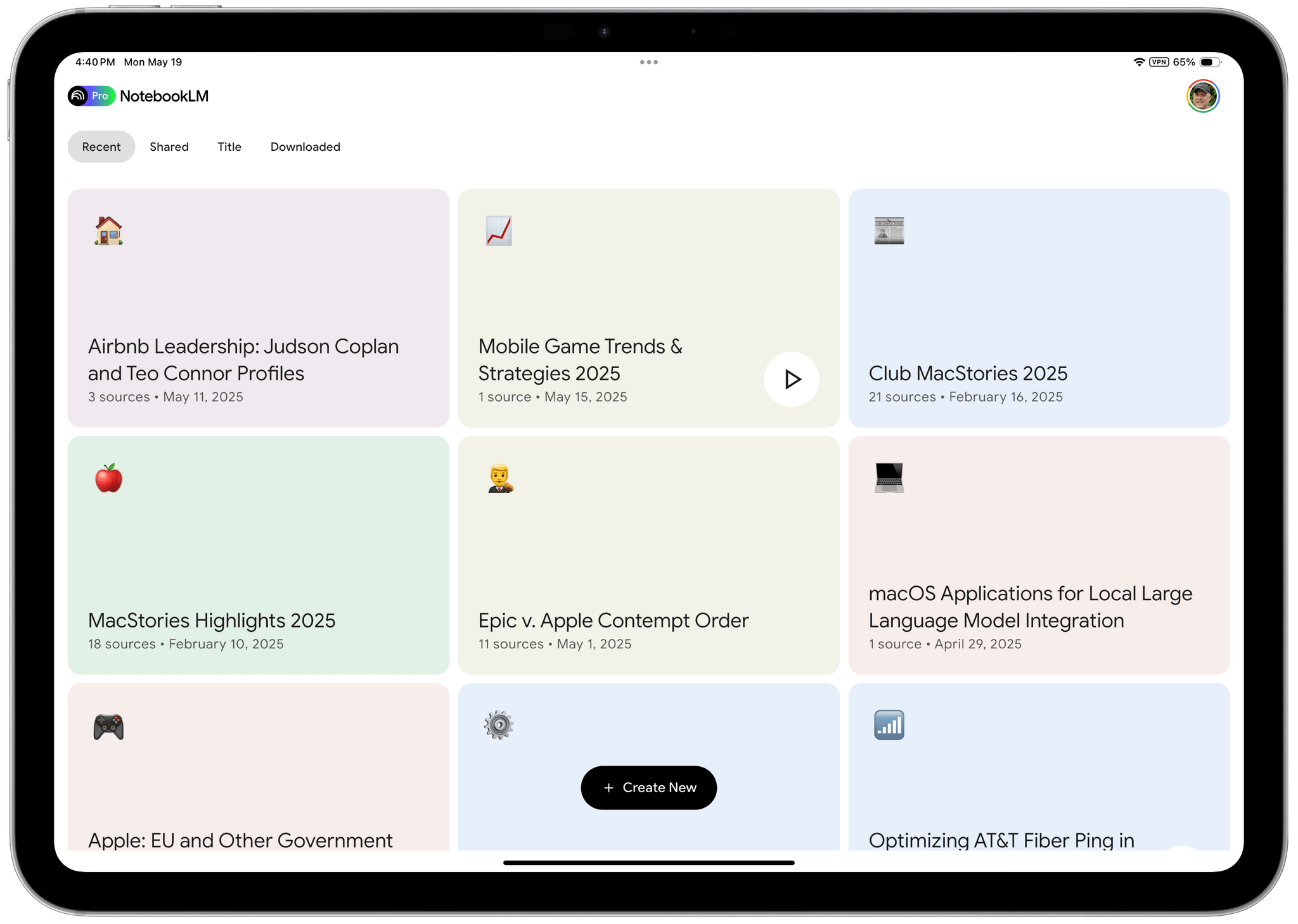
Just like the web app, you can create, edit and delete notebooks, add new sources using the native file picker, view existing sources, chat with your sources, create summaries, timelines, and use the Studio tab to generate a faux podcast of the materials you’ve added to the app. Notebooks can also be filtered and sorted by Recent, Shared, Title, and Downloaded. Unlike the web app, you won’t see predefined prompts for things like a study guide, a briefing document, or FAQs, but you can still generate those materials by asking for them from the Chat tab.

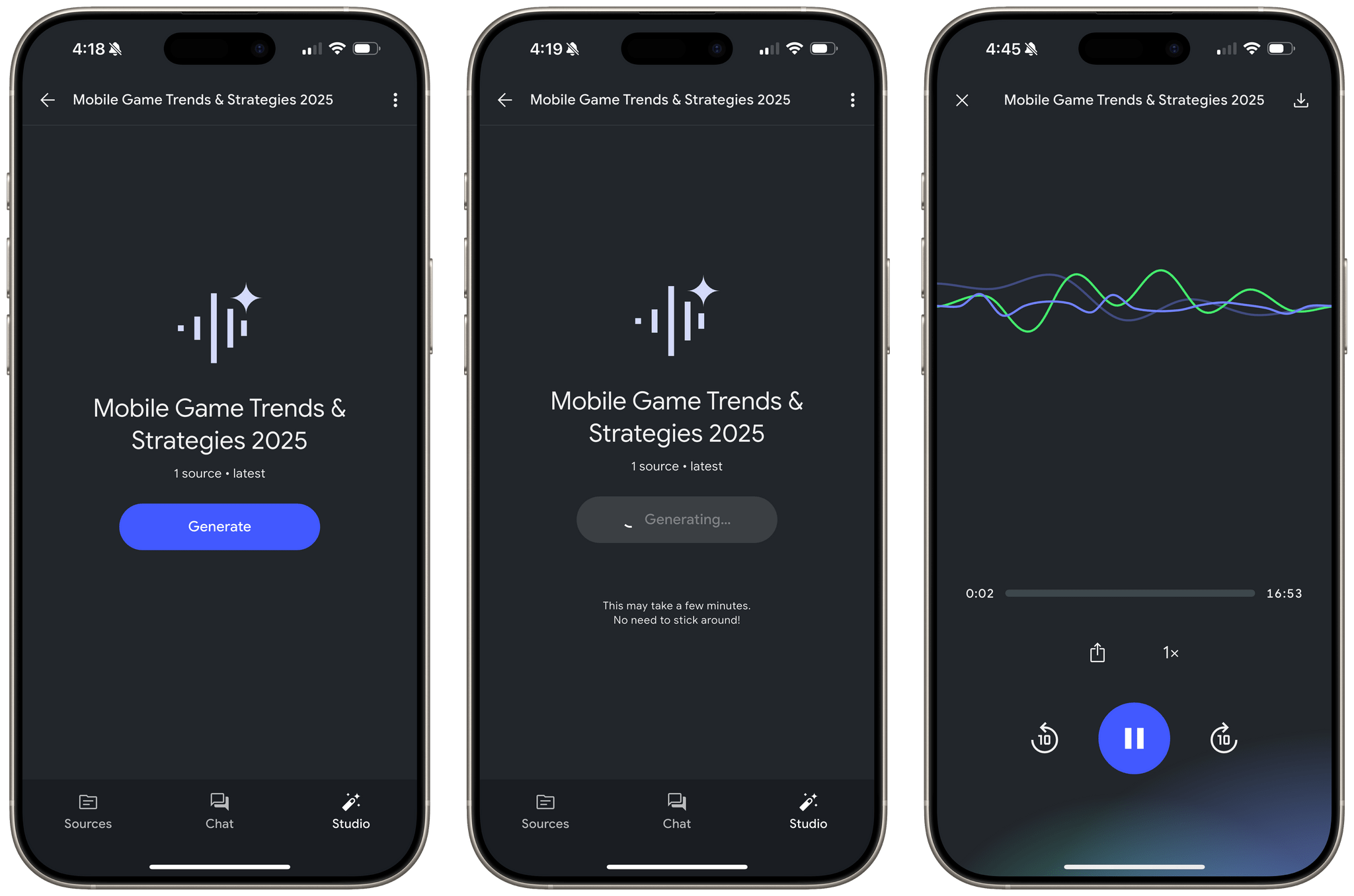
NotebookLM’s native iOS and iPadOS app is primarily focused on audio. The app lets you generate audio overviews from the Chats tab and ‘deep dive’ podcast-style conversations that draw from your sources. Also, the audio generated can be downloaded locally, allowing you to listen later whether or not you have an Internet connection. Playback controls are basic and include buttons to play and pause, skip forward and back by 10 seconds at a time, control playback speed, and share the audio with others.

Generating an audio overview of sources.

Generating an audio overview of sources.

What you won’t find is any integration with features tied to App Intents. That means notebooks don’t show up in Spotlight Search, and there are no widgets, Control Center controls, or Shortcuts actions. Still, for a 1.0, NotebookLM is an excellent addition to Google’s AI tools for the iPhone and iPad.

NotebookLM is available to download from the App Store for free. Some NotebookLM features are free, while others require a subscription that can be purchased as an In-App Purchase in the App Store or from Google directly. You can learn more about the differences between the free and paid versions of NotebookLM on Google’s blog.

Apple Previews a Wide Range of Upcoming Accessibility Features to Mark Global Accessibility Awareness Day

Source: Apple.

Source: Apple.

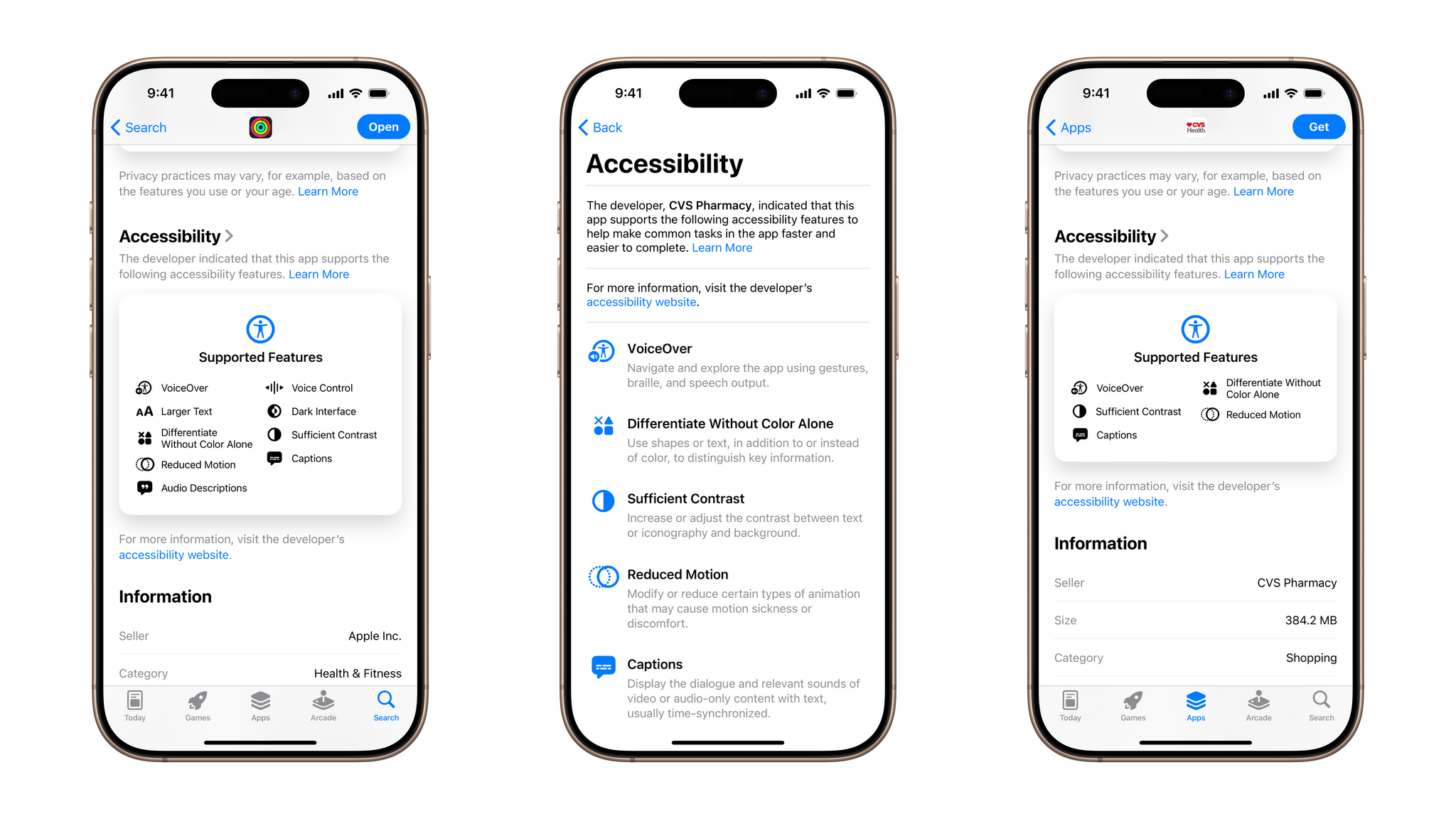
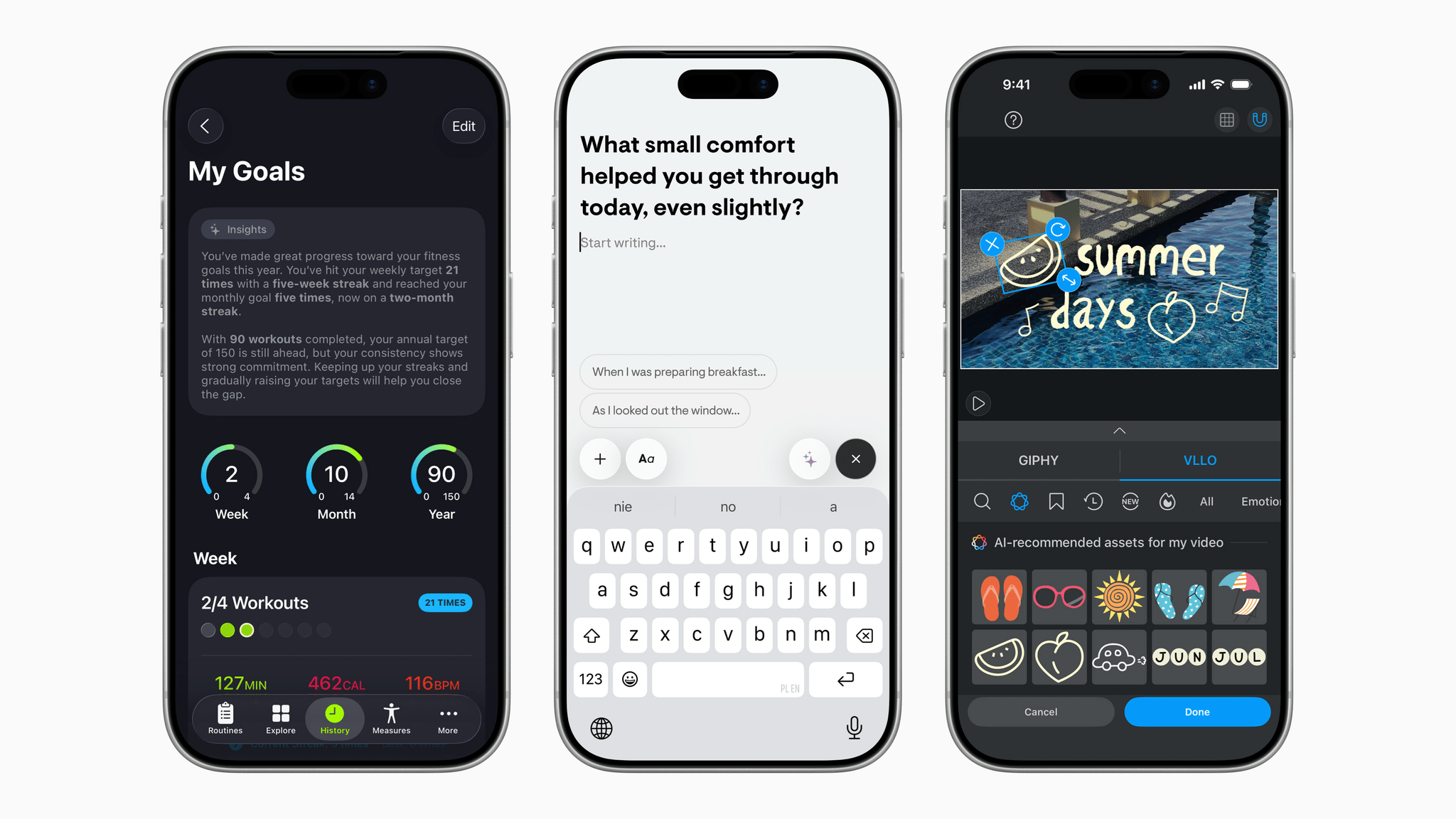
With Global Accessibility Awareness Day coming up this Thursday, May 15, Apple is back with its annual preview of accessibility features coming to its platforms later in the year. This year marks the 40th anniversary of the creation of the first office within Apple to address accessibility, and there’s no sign of any slowdown in the company’s development on this front. While no official release date has been announced for these features, they usually arrive with the new OS updates in the fall.

In addition to a new accessibility-focused feature in the App Store, Apple announced a whole raft of system-level features. Let’s take a look.

Read more


Amazon Adds Links to Purchase Books to Its Kindle App

As reported by Andrew Liszewski at The Verge, Amazon has updated the Kindle app to add a “Get Book” button, a direct result of last week’s contempt order entered by Judge Gonzalez Rodgers. When tapped, it takes users to the Amazon page for the book in Safari with the Kindle version selected. Before today’s update, you couldn’t purchase a book without going to Safari first.

In a low key statement to The Verge over email, Amazon’s Tim Gillman said:

We regularly make improvements to our apps to help ensure we are providing customers the most convenient experience possible. By selecting ‘Get Book’ within the Kindle for iOS app, customers can now complete their purchase through their mobile web browser.

I expect other companies will follow Amazon and Spotify’s leads in the coming weeks. Although Apple has appealed Judge Gonzalez Rodgers’ contempt order, the Judge declined to stay its enforcement during the appeals process. It’s always possible an appeal could force Amazon and others to undo changes like this, but I think a more likely outcome is that an appellate court allows Apple to charge a fee where Judge Gonzalez Rodgers wasn’t – one that’s lower than the 27% that got Apple into trouble in the first place.

Permalink

Developers and Platforms React as App Store Rules Change in the U.S.

On Wednesday evening, Judge Yvonne Gonzalez Rodgers held Apple in contempt, ordering, among other things, that it immediately drop the 27% fee it was charging developers who linked users to the web for purchases. As the judge put it:

This is an injunction, not a negotiation. There are no do-overs once a party willfully disregards a court order. Time is of the essence. The Court will not tolerate further delays.

(Contempt Order at pg. 3).

As Chance Miller reported at 9to5Mac, those changes are already reflected in Apple’s App Review Guidelines. In an email sent to anyone with a developer account, Apple explained:

The App Review Guidelines have been updated for compliance with a United States court decision regarding buttons, external links, and other calls to action in apps. These changes affect apps distributed on the United States storefront of the App Store, and are as follows:

  • 3.1.1: Apps on the United States storefront are not prohibited from including buttons, external links, or other calls to action when allowing users to browse NFT collections owned by others.
  • 3.1.1(a): On the United States storefront, there is no prohibition on an app including buttons, external links, or other calls to action, and no entitlement is required to do so.
  • 3.1.3: The prohibition on encouraging users to use a purchasing method other than in-app purchase does not apply on the United States storefront.
  • 3.1.3(a): The External Link Account entitlement is not required for apps on the United States storefront to include buttons, external links, or other calls to action.

(Source: Apple email to developers on May 1, 2025).

Notably, the changes affect only the U.S. App Store, further fragmenting App Store rules along geopolitical boundaries which began with regulations in China, South Korea, Japan, the Netherlands, and the EU.

Probably the best evidence that Apple’s former rules were restraining competition is the flurry of additional news since Judge Gonzalez Rodgers’ ruling:

  • As I predicted in my story, Patreon has said it will submit an update to its app to allow creators to accept payments outside its iOS app, something that was possible until last summer when Patreon was forced to retrofit its app to account for Apple’s In-App Purchases and payments through its website in what was an inelegant solution that forced creators to either charge more on iOS or absorb Apple’s fees on what are often small monthly payments to begin with.
  • Spotify posted on its blog that it has already submitted an update to its app that will let users see how much a Spotify subscription costs from inside the app and link out to Spotify’s website to upgrade or change their subscription plans.
  • Payment processor Stripe whipped up documentation guiding developers through the process of setting up subscription and digital goods sales outside their apps.
  • Beginning in June, the Epic Games Store will handle payment processing for developers at no cost up to the developers’ first $1 million of revenue. After $1 million of revenue the split will be the existing 88% to developers and 12% to Epic Games. In June, Epic Games will also offer developers the ability to set up their own webshops for ‘out-of-app purchases.’ The webshops will be available to iOS developers in the U.S. and EU and users making purchases in them will get 5% back in Epic Rewards for their purchases. Epic Games has not said how much it will charge developers who set up a webshop.

These moves by big players aren’t surprising, and I’m sure we’ll see more companies explore ways to take advantage of Wednesday’s ruling. Over time, though, the more interesting consequence of Wednesday’s ruling will be whether and how it changes the business models of indie developers and other small businesses that offer apps.


A Breach of Trust: Apple Held in Contempt Over App Store Rules

Late yesterday, U.S. District Judge Yvonne Gonzalez Rogers issued a blistering opinion, concluding that Apple had willfully disregarded the Court’s 2021 injunction, which found that the anti-steering provisions of the App Review Guidelines violated California state law. Judge Gonzalez Rogers also referred Apple’s conduct to the U.S. Attorney to investigate whether criminal prosecution of the company and one of its employees is warranted. For its part, Apple has said it disagrees with the decision and will appeal, but it will comply with the Court’s order in the meantime.

If that all sounds like it’s a big deal, that’s because it is. Judge Gonzalez Rogers’ 80-page opinion and order don’t pull any punches, painting a damning picture of Apple’s response to the Court’s injunction. It’s a unique and unflattering look behind the curtain at how Apple responded to the Court’s 2021 order that’s worth looking at more closely.

Read more


How Does This Keep Happening?

Today, Blue Prince, a critically acclaimed videogame appeared on Apple’s App Store. The trouble was, it wasn’t offered for sale by its developer, Dogubomb, or its publisher, Raw Fury. The real Blue Prince is only available on the Xbox, PlayStation, and PC.

What appeared on the App Store, and has since been removed, was an opportunistic scam as Jay Peters explained for The Verge:

Before it was removed, I easily found one iOS copy of the game just by searching Blue Prince on the App Store – it was the first search result. The icon looked like it would be the icon for a hypothetical mobile version of the game, the listing had screenshots that looked like they were indeed from Blue Prince, and the description for the game matched the description on Steam.

The port was available long enough for Blue Prince’s developer and publisher to post about it on Bluesky and, according to Peters, for the fake to reach #8 in the App Store Entertainment category. I feel for anyone who bought the game assuming it was legit given Peters’ experience:

I also quickly ran into a major bug: when I tried to walk through one of the doors from the Entrance Hall, I fell through the floor.

This isn’t the first time this sort of thing has happened. As Peters points out it happened to Palworld and Wordle too. Other popular games that have appeared on the App Store as janky scam ports include Cuphead, a version of Balatro that appeared before its official release on iOS, and Unpacking.

This seems like the sort of thing that could be fixed through automation. Scammers want users to find these games, so they can make a quick buck. As a result, the name of the game is often identical to what you’d find on the Steam, Xbox, or PlayStation stores. It strikes me that a combination of automated searching for the top games on each store, combined with an analysis of how quickly a game is moving up the charts would catch a lot of this sort of thing, flagging it for reviewers who could take a closer look.


By the way, if you haven’t tried Blue Prince, you should. It’s an amazing game and early contender for game of the year. You can learn more about the game and find links to where to buy it here. Also, Brendon Bigley, my NPC co-host, has an excellent written and video review of Blue Prince on Wavelengths.

Permalink

EU Fines Apple €500 Million for Digital Markets Act Violations

In a press release issued today, the European Commission (EC) announced that it has fined Apple €500 million for violations of the EU’s Digital Markets Act. The EC also fined Meta €200 million.

The EC’s press release explains that:

Under the DMA, app developers distributing their apps via Apple’s App Store should be able to inform customers, free of charge, of alternative offers outside the App Store, steer them to those offers and allow them to make purchases.

The Commission found that Apple fails to comply with this obligation. Due to a number of restrictions imposed by Apple, app developers cannot fully benefit from the advantages of alternative distribution channels outside the App Store. Similarly, consumers cannot fully benefit from alternative and cheaper offers as Apple prevents app developers from directly informing consumers of such offers. The company has failed to demonstrate that these restrictions are objectively necessary and proportionate.

In addition to the fine, the EC has ordered Apple:

…to remove the technical and commercial restrictions on steering and to refrain from perpetuating the non-compliant conduct in the future…

The Commission also closed its investigation into Apple’s user choice obligations under the DMA, finding that the company’s browser choice screen and interface for setting new default apps to satisfy the DMA’s requirements.

An unnamed Apple representative speaking to CNN criticized the fine:

A representative for Apple said the fine is “yet another example of the European Commission unfairly targeting” the company and forcing it to “give away (its) technology for free.” It added that it plans to appeal the decision.

We have spent hundreds of thousands of engineering hours and made dozens of changes to comply with this law, none of which our users have asked for. Despite countless meetings, the Commission continues to move the goal posts every step of the way.

The EC’s fines aren’t surprising given the long history and tenor of the investigation. What remains open as a point of potential future disputes is Apple’s compliance with the EC’s new order. As stated by its representative to CNN, Apple also plans to appeal today’s decision.