

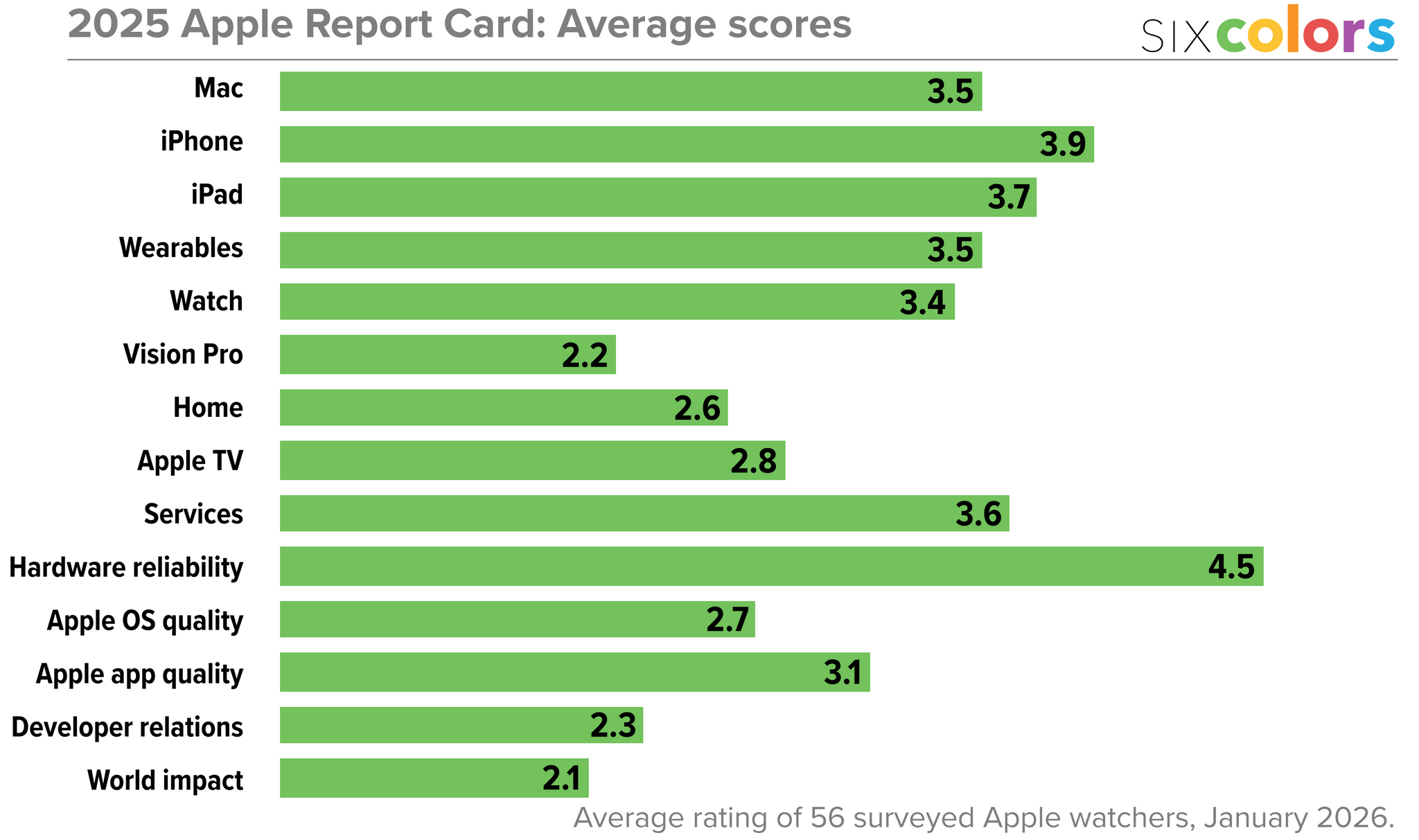
For the past 10 years, Six Colors’ Jason Snell has put together an “Apple report card” – a survey to assess the current state of Apple “as seen through the eyes of writers, editors, developers, podcasters, and other people who spend an awful lot of time thinking about Apple”.
The 2025 edition of the Six Colors Apple Report Card has been published, and you can find a summary of all the submitted comments along with charts featuring average scores for the different categories here.
I’m so grateful that Jason invited me, once again, to participate in the survey and share my thoughts on Apple’s 2025. As you’ll see from my comments – and as you know if you’ve been listening to AppStories or Connected lately – I’ve been focusing on AI agents, hybrid automation, and splitting my work between iPadOS and macOS for the past few months. The LLM takeoff in the productivity space is accelerating on a weekly basis, and modern AI tools are fundamentally changing the way I get work done. Case in point: this article was written before OpenClaw went viral, and the past month alone has seen so many of my habits and automations get upended by this incredible open-source tool. As I noted in my comments, however, one thing is not changing: iPadOS essentially gets no access to any of these modern AI tools, which are increasingly launching as Mac-only apps or features.
I’ve prepared the full text of my responses for the Six Colors report card, which you can find below.
The Mac
Rating (1-5): 4
Fun fact: I now own and regularly use two Macs (a MacBook Pro and M4 Mac mini) as opposed to the one iPad Pro I also use on a daily basis. Beyond hardware (which is excellent), the third-party Mac software ecosystem is living its own renaissance at the moment thanks to AI. Thanks to the major AI companies continuing to ship Mac-only features for their LLM clients (case in point: the new Claude Cowork for Mac) as well as third-party developers now being able to iterate faster than ever on their Mac apps thanks to AI-assisted coding, the result is a breadth of Mac apps and exclusive Mac app features that are nowhere to be seen on other platforms. One way or another, the Mac keeps going – despite the questionable “improvements” to macOS Tahoe.
The iPhone
Rating (1-5): 5
The iPhone Air, with all its compromises, is the best iPhone I’ve used in a long time. And by “best”, I don’t mean technically the best, because it’s not. I mean it in the sense that the iPhone Air is the sort of futuristic, forward-looking, almost impossible product that elicits the same sense of joy and wonder that the iPhone X made me feel in 2017. Only Apple could put a whole pocket computer in a camera plateau. I’m going to miss the iPhone Air when I eventually upgrade to an iPhone Fold (iPhone Duo?) later this year, but this device showed us that Apple is still capable of pushing the boundaries of what iPhone hardware can be, and I can’t wait to see where they take the lineup next.
The iPad
Rating (1-5): 4
If you told me at the beginning of 2025 that I’d end the year feeling enthusiastic about the future of the iPad’s platform and its operating system…I wouldn’t have believed you, to say the least. It was a relatively quiet year for iPad hardware (unless you really care about running local AI models on an iPad), but, for the first time in a while, it was the iPad’s software team that delivered a stellar year for iPad users. And it’s not just that: after doing so in September, they didn’t stop.
After years of minor updates following the confusing and bug-ridden rollout of Stage Manager in iPadOS 16, iPadOS 26 arrived as a massive update featuring Mac-like windowing, support for local audio and video capture, Files enhancements, and lots more. See, Apple could have stopped there, and we – where by “we”, I mean all of us who love the iPad, have been let down by it many times, and yet never fully stopped believing in it – would have praised the company for its return to form. Instead, they persisted: first they made local capture even better; then, they listened to user feedback and restored Split View and Slide Over functionalities that had been removed from the first version of iPadOS 26.
The result of all this is that, now a few months into iPadOS 26, I feel the pull of the iPad platform again and I want to work from it more and more. It’s good to be home. But:
I still can’t shake the feeling that, in spite of the outstanding improvements to the platform, the iPad’s app ecosystem ship has sailed, and it’s not coming back. I want to work from my iPad Pro more and more again, but, every day, I have to face a new reality: its multitasking flow is similar to my Mac now, but my Mac has so many more apps available for me to use and tinker with. This is especially true in the age of AI, assistive tools, and work agents: the frontier of productivity and artificial intelligence is very much exclusive to the Mac these days. Brand new iPad-specific app experiences are too few and far between at this point; unless you’re okay with using web apps with a subpar browser (no matter what Apple says, Safari for iPad still isn’t as good as Safari for Mac, let alone Chrome), if you want to work exclusively from an iPad these days, you’ll be looking at your Mac friends with a little bit of envy every single day.
Perhaps the solution, then, is to not try to be monogamously computing on an iPad, despite the great steps taken by Apple with iPadOS 26. Maybe Apple executives are right when they say that the best course of action is to have both a Mac and iPad, and take advantage of the strengths of each. And for the past year, I’ve been doing exactly that. But I’m not going to stop wishing for a future where a single, modular computer with a blend of macOS and iPadOS is all I need. Some habits never die.
Wearables
Apple Watch (1-5): 3
Vision Pro (1-5): 2
Apple seems pretty content with the state of their Apple Watch and AirPods lines of wearables, and that’s fine – but I wonder if the company could innovate more in this field at this point. The Apple Watch is more than a decade old, and save for the new design of the Ultra and a few new sensors over the years, it still pretty much does the same things that it did at launch. Which is, again, fine – but I’d love to see the company take more risks with design, customization, watch band design, and AI features. The new AirPods Pro 3 are great, but in the age of wearables that can proactively assist you with cameras, microphones, and AI, I wonder if there would be room for Apple to flex some new muscles in this area too.
And the Vision Pro? I basically never use it, and that’s a shame, because visionOS rocks. But until that operating system gets somehow miniaturized into glasses that I can wear without feeling neck pain, I don’t feel the urge to use it on a daily basis.
Home
Rating (1-5): 2
Is Apple still working on HomeKit? The past few years would suggest otherwise. I like my HomeKit setup…which I configured years ago, and it’s mostly stayed the same since. I’d like to see Apple make some new home-related hardware, but I’m not holding my breath.
Apple TV
Rating (1-5): 3
I don’t particularly care about my Apple TV. I don’t think about my Apple TV and tvOS much. If you ask me about it, though, I’ll say that I really like my Apple TV when I use it: tvOS is the most pleasant and nicest TV software platform I’ve tested in recent years, and that’s because Apple is the only company with a modicum of taste making software for TV-connected devices these days. Nothing else comes close to just how “nice” tvOS feels, even if Apple doesn’t seem to put much effort into it.
Services
Rating (1-5): 3
I love Apple TV the service, I think Apple Music is fine, iCloud Drive is passable these days, and I don’t use Apple Fitness, Apple News, Apple Arcade, or Apple Podcasts. I honestly think that Apple’s services are okay for most people (and the numbers seem to prove it). However, I think that they could be so much more with a healthy dose of AI integrations, especially when it comes to news summarization, music discovery and playlist creation, or an AI-based health coach. It sounds like the company is indeed exploring these areas, and I’m looking forward to that.
Hardware Reliability
Rating (1-5): 5
17 years into writing for MacStories, and I still haven’t had any major issue with Apple hardware in my life. They should promote the guy in charge. Oh.
OS & App Quality
OS Quality (1-5): 3
Apps (1-5): 3
I don’t hate Liquid Glass as much as others in our community do, but let’s face it: it hasn’t been a smooth rollout, especially on macOS. The thing that concerns me about Apple software and quality, though, is that I fear the company is falling behind other Silicon Valley giants in terms of reimagining the role of an operating system and apps in the age of AI. I also take another stance from most of my peers here: like it or not, generative AI and LLMs aren’t going away. Even if the “AI bubble” bursts, the technology will remain, and – guess what – people truly like that technology. So far, Apple has been incapable to deliver on their promise of a new kind of operating system, one where AI is woven through every interaction with apps and which can proactively assist us in our work, communications, and information recall. Will Google help? Let’s check back in a year.
