PolyFauna: An Audio and Visual Experiment from Radiohead for iOS and Android

Thom Yorke on Radiohead’s Dead Air Space:

PolyFauna is an experimental collaboration between us (Radiohead) & Universal Everything, born out of The King of Limbs sessions and using the imagery and the sounds from the song Bloom.

It comes from an interest in early computer life-experiments and the imagined creatures of our subconscious.

In some ways, PolyFauna reminds me of Proteus. The app is free to download in the App Store.

[Hat tip: Macgasm]

Permalink

Introducing Directional Podcast

Directional

Directional

Thanks to Jory Raphael for the awesome artwork.

In recording The Prompt every week, my friend Myke Hurley and I realized that we love talking about games. We love games and the community of game makers and players behind them. We’ve been playing games since we were kids, and whenever we touched upon the topic of mobile gaming, Nintendo’s history and current games, Sony and Microsoft, indie games, and everything in between on The Prompt, we felt that we could go on for hours with our discussions. Eventually, we knew that we needed a separate venue to properly dedicate ourselves to the topic.

Which brings us to today: Myke and I are announcing Directional, a podcast about games, gamers, game makers, and surrounding culture. Here’s how we like to describe Directional’s focus:

We reflect about past trajectories and current directions, old games and new hits. Directional focuses on the games that are paving the way, the games that laid the foundations and just how dedicated games consoles exist in the smartphone age.

I’m extremely excited and grateful for this opportunity, and I look forward to beginning this second podcasting adventure with Myke next week. The Prompt has been an amazing and rewarding success for us, and, again, I hope that Directional will distinguish itself for quality and opinion, not just what’s trending.

Directional will be a weekly show on 5by5, with the first episode airing next week. We have some great stuff planned, and I can’t wait to share what we’ve been working on. I think you’ll also like our music.

We don’t have a webpage or RSS feed yet, but you can follow @DirectionalShow on Twitter for updates.


Eric Pramono’s Tips for Threes

If you’ve been trying to get high scores in Threes, you’ll want to check out Eric Pramono’s tips and explanation of the point system.

The game score is determined by the numbers and types of tiles you have at the end of the game. Each white tile is worth three times the score of its previous number, for example the 768 tile is worth 19,683 points whereas the 384 tile is only worth 6,561 points.

Fair warning: this may require an even larger investment of your time to play Threes, which is a great game.

Permalink

Calzy 2.0

Calzy

Calzy


Calzy, one of my favorite iOS calculators, has been updated to version 2.0, which brings several new features and design changes over the old version. I reviewed Calzy in May 2013, shortly after the app had been released on the App Store, and I appreciated its clean design and gesture-driven interactions:

I use Calzy because it blends powerful features with delightful gestures and animations. For instance, the app comes with full undo/redo support: to activate this, you can swipe right or left, respectively. If you want to clear an entire expression quickly, you can tap & hold the backspace button. And – my favorite feature – if you need to edit, not just view, single items in the current expression, you can tap & hold on the display to bring up the expression editor (with another sweet animated transition). From the editor, you can swipe to delete numbers or use a button in the top left to achieve the same functionality.

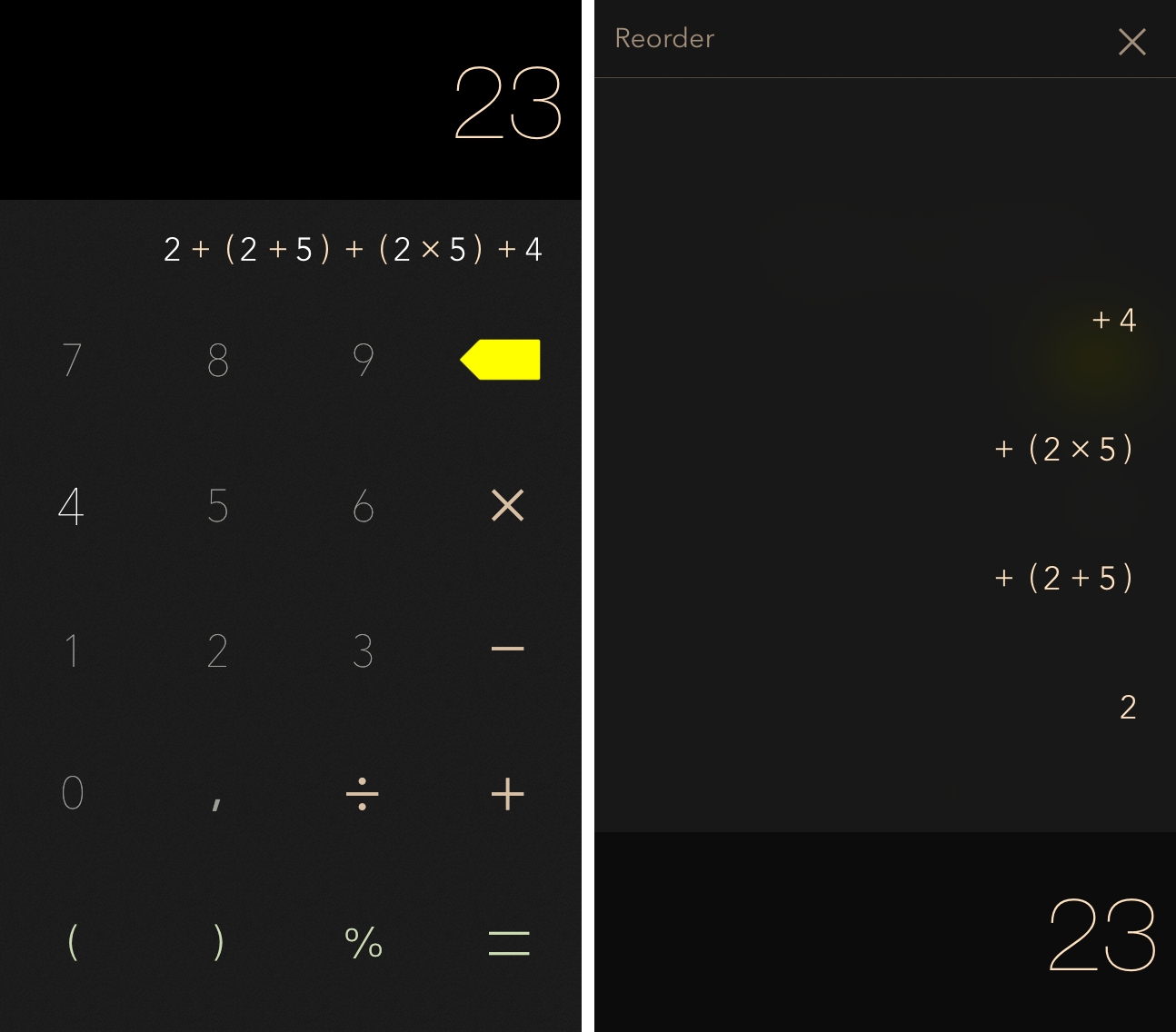
Calzy 2.0 is a free update that brings a new design for iOS 7, which isn’t dramatically different as it makes numbers thinner, brings some lightweight blurring in certain parts of the UI, and introduces themes – which I like (especially the Dark + Gold setting, pictured above). The expression editor has been revamped so you can easily reorder values in the expression, and the app has currency rounding available by tapping a button below the number pad. My favorite addition, though, is the ability to bookmark calculations with a note: tap & hold the equal sign, type a note, and a bookmark will be added (with a nice animation) and saved. Bookmarks have their own section in the History view, and I find this particularly handy to save how much I’ve spent while grocery shopping and access previous notes at any time.

Calzy 2.0 is a nice update that adds new functionality without compromising the app’s simple approach. Calzy is $0.99 on the App Store.

Permalink

logtempo

Our thanks to logtempo for sponsoring MacStories this week. logtempo is the easiest way to log time spent on any task: it only takes two taps.

Whether you’re a freelancer, consultant, or other professional who needs to account for time spent on client projects and tasks, logtempo removes all of the complexity and potential for error of time tracking tools and lets you focus on your work instead of your timesheet.

A natural progression from those hand-written notes and timesheets, with the reporting side already taken care of, logtempo takes a pragmatic approach: multiple tasks can be added to the app, and logged time can be added with another tap by choosing a time amount. When you don’t need a task anymore, you can remove it from your task list, but times logged against it are kept. Reports with times logged for the current day, working week, and last 7 days can be emailed or otherwise shared directly from the app, with an option to delete logged times from the summary report.

logtempo is a new approach to time tracking. Check out logtempo here, and subscribe for updates on Twitter and Facebook.

Permalink

Apple Adds Apple TV Channel To Celebrate The Beatles’ American Debut

As noted by MacRumors’ Richard Padilla, Apple today added a new channel to the Apple TV to celebrate The Beatles’ debut in the United States 50 years ago:

The channel allows users to view The Beatles’ groundbreaking performance on “The Ed Sullivan Show” for a limited time, and also offers download links to The Beatles’ U.S. releases, which are available digitally for the first time on iTunes.

The Beatles made their first appearance on American television on February 9, 1964, on The Ed Sullivan Show. From Ed Sullivan’s official website:

Never before had so many viewers tuned-in to a live television program, which with 73 million viewers, was three-fourths of the total adult audience in the United States. A music group from England had never crossed over into American culture in such a way, and, at the time, it wasn’t too common for a variety television show to book an English rock band. However, because Ed Sullivan traveled to England frequently, and had a great eye for talent, The Beatles caught his attention and earned a slot on his popular variety program on CBS.

After years of negotiations, The Beatles’ digital catalogue arrived on iTunes in 2010, with Apple celebrating the event with a press release and promotion on its website and iTunes’ front page. Apple has been adding standalone channels to the Apple TV in the past several months, including Yahoo Screen, PBS, Crackle, Bloomberg News, Vevo, Disney Channel, and The Weather Channel.

Permalink

Matching URLs In Editorial with John Gruber’s Regex Pattern

Editorial for iPad

Editorial for iPad

When I’m writing in Editorial, I often need to make sure I’m dealing with a valid URL in the system clipboard, the document editor, or in a variable. To do so, I’ve long employed John Gruber’s liberal, accurate regex pattern for matching URLs, which has reliably allowed me to confirm that a workflow is about to handle a proper URL rather than a string of text that contains something else. Gruber recently improved the regex pattern again, and that seemed like a good opportunity to briefly detail how I’ve integrated his pattern in my workflows.

The key to match URLs and provide error-handling features in Editorial is to use a conditional block based on a regular expression pattern. Editorial comes with this functionality built-in: given a regex pattern, a block of actions can be run only if a value (plain text or variable) matches the pattern. In this way, you can run a set of actions if you have a URL, and another set if you don’t have a valid URL.

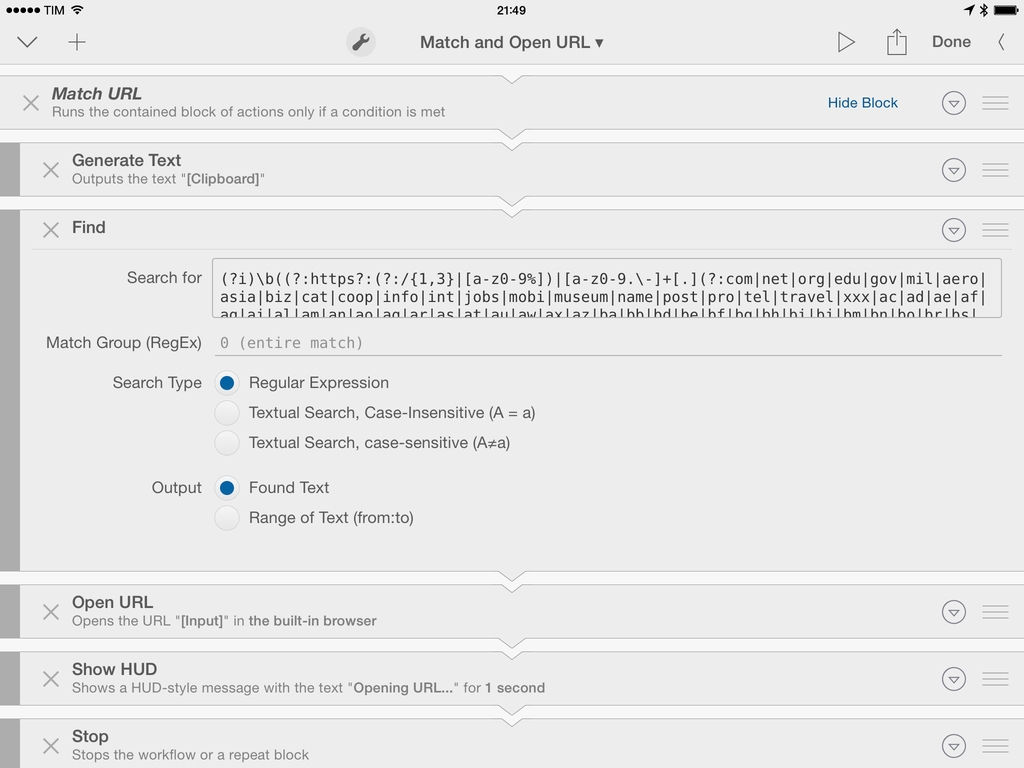
I’ve created a simple workflow that can be installed and reused as a preset in other workflows. The workflow, called Match and Open URL, consists of a single If block that checks for a URL contained in the clipboard. If you have a URL that matches Gruber’s pattern, the URL will be extracted from the clipboard and launched in the browser; if you don’t have a URL…it’s up to you to provide an alternative.

Editorial makes it extremely easy to build this kind of advanced workflow with just a few built-in actions. Gruber’s single-line version of the regex pattern can be pasted in Editorial’s If action with no modifications; inside the If block, the text in the clipboard is passed to a Find action that extracts a URL using the same, untouched single-line regex pattern. The extracted URL is opened in the browser and a HUD alert is displayed.

Combining Gruber’s regex pattern and Editorial’s workflow system can yield interesting results. You could use a variable instead of the system clipboard to match URLs; you could implement the pattern in a Repeat block that performs a set of actions for every matched URL found in the target text; instead of having my workflow inside an If block, you could match a URL among other bits of text, extract it, and do something with it. Editorial is a text automation playground and your imagination’s the limit.

You can download the workflow on Editorial Workflows’ website, and check out John Gruber’s regex pattern here.

Note: The screenshot above shows a beta version of Editorial, currently in testing.


Ending The App Store Top 200

Manton Reece thinks that Beats Music’s editorial curation efforts could work well as a template to improve how apps are discovered on Apple’s App Store:

The answer is in Beats Music. They have no overall top 200 list! Instead, they have a bunch of people — musicians and writers who deeply care about music — curating playlists. The top 25 playlists in a genre are so buried in the app that I had to search them out just to write this blog post, because they seem to carry no more weight than any other playlist. Much more common are playlists like “our top 20 of 2013”. That’s not a best-selling list; it’s based on real people’s favorites.

There are literally hundreds or maybe thousands of other playlists. Intro playlists for a band, related artists that were influential to a singer you like, playlists for a mood or activity, and more. This extra manual step makes it much easier for an algorithm to surface great music: just look for playlists that contain songs you already like, and chances are good that you’ll discover something new.

I’ve argued in favor of more editorial curation before, and while I’m a huge fan of what Beats Music is doing, it’s too early to tell whether the company will be successful or not.

I think there is merit to the idea of showcasing human-curated playlists in lieu of an automatic system (charts) that can be exploited with bots, paid installs, and other solutions. Beats Music’s curated playlists are updated every day, they are contextual to current events, and, more importantly, they are visible in search. Apple has been building a good collection of curated sections for featured apps and categories, but they are not regularly updated and they’re completely hidden from search.

Permalink

Wordsalad Generates Beautiful Word Clouds

If you want to present an idea or just create a cool word cloud, Wordsalad for iPhone and iPad takes a bunch of words and generates a beautiful image that you can export in full HD in PNG or PDF formats. The app is able to pick out the most important words and bring those forward, filtering out unimportant words like articles, prepositions, and pronouns. You can customize the result by changing fonts, colors, and word layouts. Great for posters, presentations, and brainstorming, Wordsalad is $2.99 in the App Store.

Permalink