


A new ad called “Strength” aired by Apple today shows off the iPhone as a fitness and health-tracking companion device capable of interacting with apps and accessories from third-party developers and hardware makers. Read more
Apple Airs New “Strength” iPhone 5s Commercial
Developer Christmas→
Bitter Medicine
Like many others, I’ve spent the past three days reading and thinking about Apple’s announcements at WWDC. OS X Yosemite. iOS 8. Swift. HealthKit and HomeKit. Improvements to the App Store and iTunes Connect. Continuity and Handoff. Extensibility. There are so many massive, far-reaching changes ahead, digesting the news out of WWDC 2014 will take time.
Continuity’s Statement→
From Shawn Blanc’s article on WWDC 2014, I particularly liked this bit about Continuity:
But I think Continuity is more than just a better implementation of a cool feature. I see it as a “philosophical” feature as well — it’s a statement that we use our devices for many of the same tasks, and that “work” is device agnostic. Continuity is a way of telling the Apple user it’s okay to expect their devices to always be in sync down to the very mid-sentence of an email in progress.
This is a great way to put it. Continuity is one of those features that “just make sense” – of course my activity should follow me around seamlessly – and it highlights an important point: devices and OSes are different, but the experience should always be consistent and natural.
With iOS 8, Apple Focusing on Discovery, Curation Improvements for App Store
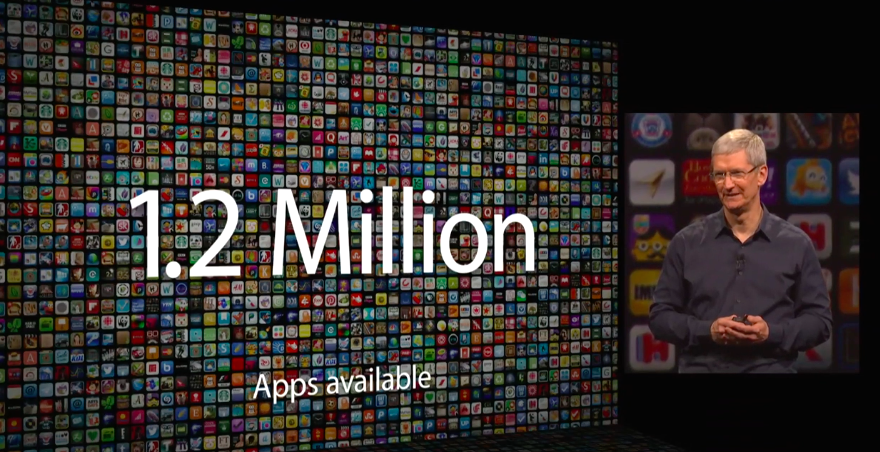
Announced during yesterday’s keynote, the App Store app in iOS 8 will focus on discovery and search result presentation, potentially bringing important and useful changes for the next five years of the App Store.
Swift Links→
The third big announcement that followed OS X Yosemite and iOS 8 yesterday was Swift, Apple’s new programming language meant to replace Objective-C.
From Apple’s website:
Swift is an innovative new programming language for Cocoa and Cocoa Touch. Writing code is interactive and fun, the syntax is concise yet expressive, and apps run lightning-fast. Swift is ready for your next iOS and OS X project — or for addition into your current app — because Swift code works side-by-side with Objective-C.
Swift has been in the works since 2010, as confirmed by Chris Lattner, Director of the Developer Tools (via John Siracusa):
I started work on the Swift Programming Language (wikipedia) in July of 2010. I implemented much of the basic language structure, with only a few people knowing of its existence. A few other (amazing) people started contributing in earnest late in 2011, and it became a major focus for the Apple Developer Tools group in July 2013.
The Swift language is the product of tireless effort from a team of language experts, documentation gurus, compiler optimization ninjas, and an incredibly important internal dogfooding group who provided feedback to help refine and battle-test ideas. Of course, it also greatly benefited from the experiences hard-won by many other languages in the field, drawing ideas from Objective-C, Rust, Haskell, Ruby, Python, C#, CLU, and far too many others to list.
One of the key features of Swift is interactive Playgrounds, which will allow you to type code and see the results appear immediately:
Playgrounds make writing Swift code incredibly simple and fun. Type a line of code and the result appears immediately. If your code runs over time, for instance through a loop, you can watch its progress in the timeline assistant. The timeline displays variables in a graph, draws each step when composing a view, and can play an animated SpriteKit scene. When you’ve perfected your code in the playground, simply move that code into your project.
As an introduction to Swift, Apple has created the Swift Programming Language guide, available as a free eBook on iTunes and on the web:
Swift is friendly to new programmers. It is the first industrial-quality systems programming language that is as expressive and enjoyable as a scripting language. It supports playgrounds, an innovative feature that allows programmers to experiment with Swift code and see the results immediately, without the overhead of building and running an app.
Over at The Verge, Ben Popper talked to iOS and OS X developers and collected their reactions to Swift:
The other big idea behind Swift is that programmers can write their code and see the results in real time. In the old paradigm, developers write line after line of code in a text box, then compile those results — sometimes a lengthy, painful, productivity-denting task — and wait to see the end result. The product and the process were distinct from one another. With Swift, they can tweak a parameter or algorithm and watch the changes happen right away in the same coding environment. Theoretically, this means developers can toy with concepts faster and make what they’re trying to make in less time.
Last, Tim Stevens has a good general overview at CNET, explaining the differences between various programming and scripting languages and Apple’s approach with Swift:
Scripting languages, like Python, tend to be easy to write and easy to test, but they aren’t particularly powerful and generally don’t perform well. Not ideal when you’re writing, say, a game that needs access to the full power of your device. Traditional programming languages, like Objective-C, give better access to the power of the device and enable the creation of more comprehensive apps, but are difficult to learn and tedious to compile and test.
Swift promises to have all the good with none of the bad. Apple promises that, at least in a few key benchmarks, it is considerably faster to execute than Python and faster even than Objective-C. But, despite that, the language supports what’s called “playgrounds” within the Xcode developer environment, visualizing Swift code in real-time, like a scripting language.
iOS 8 Lock Screen and App Shortcuts Based on Location→
Juli Clover, writing for MacRumors:
One new feature sees the iPhone displaying apps on the lock screen based on location. For example, MacRumors readers have seen relevant app icons pop up while at or near brick and mortar locations like Starbucks and the Apple Store. While at a Starbucks, for example, the Starbucks app icon is displayed in the lower left corner of the iPhone’s lock screen, which allows a Starbucks Passbook card to be easily accessed.
I haven’t seen this feature mentioned anywhere on Apple’s website, but I’ve read tweets from other users noting the same behavior for banks and other local points of interest and stores.
It’s interesting to think about this in combination with Near Me, an App Store section that was launched with iOS 7 to highlight relevant apps for your current location. Personally, I’ve never relied on Near Me because its recommendations were slim (I only get a single app for my town), but the idea of proactively injecting shortcuts in the Lock screen for apps based on location intrigues me.
I’d be curious to know if this feature will only work with apps that are already installed (thus simply launching them) or if it will also act as an extension for Near Me, allowing you to quickly discover relevant apps from the Lock screen.
Peer-to-Peer AirPlay in iOS 8→
From Apple’s Enterprise webpage for iOS 8:
With iOS 8, you can wirelessly connect iPad, iPhone, or iPod touch to Apple TV without first connecting to the organization’s network. Which means you can present or share your work even if you’re offline or the organization has a complex network.
AirPlay with no network connection will make it easier to beam presentations (and games) wirelessly to an Apple TV when you can’t connect to the Internet. Apple allowed Bluetooth-based setups for Apple TVs last year, and it’s good to see them extending AirPlay’s capabilities to make it more ubiquitous.
OS X Yosemite Will Feature Option to Record Real-Time Footage of iOS Apps
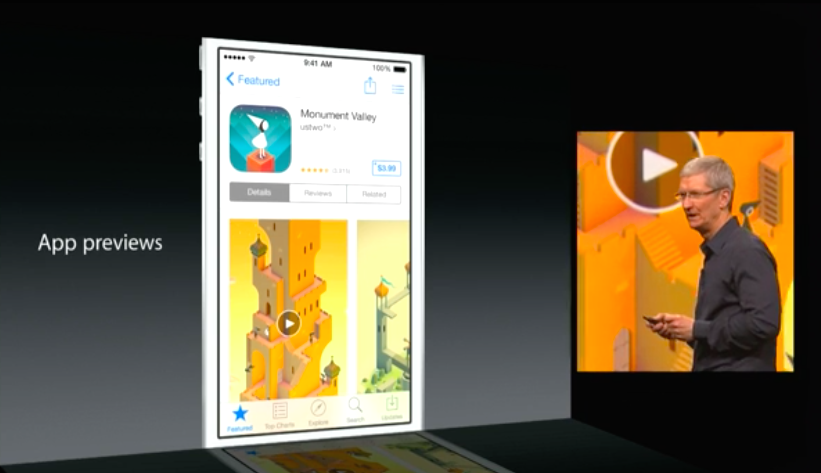
Apple will provide an easier and integrated way to create screencasts for iOS apps with the upcoming iOS 8 and Yosemite software updates, using a Lightning cable and QuickTime Player on OS X. As reported by Benjamin Mayo at 9to5Mac, the feature is primarily meant to let developers create App Previews for the improved App Store launching with iOS 8, but it’ll also come in handy for users willing to capture videos of iOS apps for screencasts, reviews, and other video content.