Researchers Look to Smartwatches to Prevent Strokes

Speaking of Apple Watch and heart problems, here’s the opposite end of the spectrum: the developers of Cardiogram are working with researchers of the UCSF Health eHeart Study to understand if heart rate data captured by smartwatches can generate insights to prevent strokes.

Heart researchers from the University of California, San Francisco as well as developers behind the heart rate-tracking app Cardiogram are teaming up to investigate if the tech built into smartwatches could be used to identify those at risk for a stroke or heart failure.

The research team will be honing in on one of the most commonly undiagnosed irregular heart conditions: atrial fibrillation, an irregular and often rapid heart rate also known as a type of arrhythmia.

Working within an observational study dubbed mRhythm, which kicked off on Wednesday, researchers will track data from participants using both the Apple Watch and Android Wear-based devices while looking for signs of irregular heart rates. These kinds of watches don’t have advanced electrocardiogram (EKG) machines inside. But they do include cheaper technology, such as LED lights, which can be used to measure blood flow in the wrist.

Like Apple’s ResearchKit, if these crowdsourced studies can lead to early diagnoses and better prevention, the impact of wearable devices on our lifestyle will be meaningful.

Those interested in the study can check out the details here.
Permalink

Kardia Band for Apple Watch

Interesting idea for an Apple Watch band by AliveCor: the Kardia band will allow users to capture EKG directly from their wrist by placing a finger on the band for 30 seconds.

Users can record a single-lead EKG by simply touching Kardia Band’s integrated sensor that communicates with the Watch app, Kardia by AliveCor. The Atrial Fibrillation (AF) Detector then uses Kardia’s automated analysis process (algorithm) to instantly detect the presence of AF in an EKG, the most common cardiac arrhythmia and a leading cause of stroke. Also included is the Normal Detector, which indicates whether your heart rate and rhythm are normal, and the Unreadable Detector, which tells you when to retake an EKG so physicians receive only the highest quality recordings.

Users can also record voice memos on their Apple Watch to accompany each EKG that give doctors and caregivers a clearer picture of what was happening at the time of the recording — describing symptoms such as palpitations or external factors like caffeine intake. Kardia also integrates seamlessly with Apple’s Health app to include EKG data with steps and calorie intake to provide richer, personal analysis over time.

The Kardia band isn’t meant for fitness aficionados – rather, it’s designed for people with heart-related problems who would benefit from medical-grade EKG and the ability to store detailed reports and notes (including voice memos dictated on the Apple Watch). I’m curious to see if more companies (including Apple) will come up with Apple Watch bands with embedded sensors that can transfer data directly to the Watch (there were some rumors about this last year).

Also worth noting: AliveCor is run by Vic Gundotra (former Google VP and head of Google+) and they have a whole line of Kardia products (which also include smartphone cases for similar measurements).

Permalink

Slack 2.8 Brings 3D Touch Support, Better Search Assist

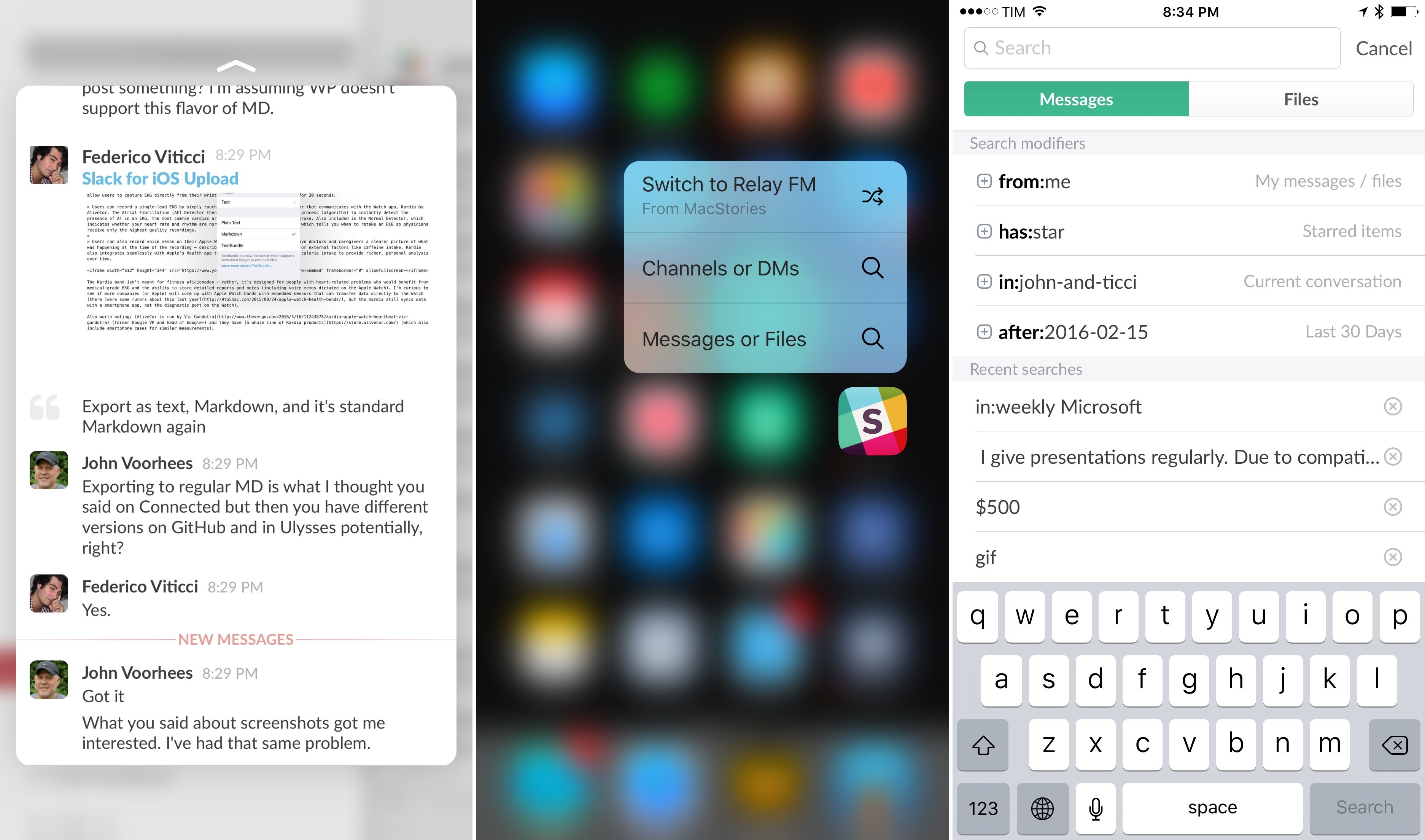
Slack has released version 2.8 of their iOS app today with some great changes to save time on the iPhone and iPad.

On the iPhone 6s, you can now use 3D Touch on the app icon to switch teams, open channels and DMs, and search for messages and files. While I would have liked to see the ability to pin specific channels and DMs to the quick action menu, the feature is welcome regardless as it cuts down the time I spend swiping to open the sidebar just to switch between teams (I think anyone who’s on multiple Slack teams can relate to this).

Read more


Apple Launches Advertising Campaign for Apple News

Speaking of Apple News, Peter Kafka of Re/code reports that Apple has started an advertising campaign focused on the iOS 9 app.

Remember Apple News? Figured. Apple would like to change that, so it’s launching an ad campaign promoting the news aggregator it launched, without much fanfare, last fall.

If you’re in San Francisco, Chicago or New York, you might see the ads on billboards and in airports; the rest of you will have to look for it online.

You can see two examples of the billboards in Re/code’s article, one featuring ESPN and the other featuring VICE – but Kafka notes that Apple is also working with Vox Media.

Permalink

Apple News Format Now Available for All Publishers

Emily Jane Fox, writing for Vanity Fair, yesterday reported that Apple has now opened the Apple News Format to independent publishers:

Apple News’s 40 million users are about to have a lot more articles to read. The iPhone maker announced Tuesday the launch of a new Web-based editing tool that will open its native iOS news platform to independent publishers of all sizes.

Since Apple launched the app in September, it has attracted more than 100 major publishers as partners, including this magazine’s Web site. What the new launch means is that anyone—from individual bloggers to smaller, independent news organizations—will be able to edit and deliver their stories, videos, galleries, and audio in the Apple News format, with Apple News’s reach.

Content can be published in Apple’s News app either via RSS or the Apple News Format. Up until now, the Apple News Format has been invitation-only and limited to large publishers such as Vanity Fair, Vox, and CNN. The advantage for publishers in using the Apple News Format is that it gives them greater control over the look of their stories in the News app, they get detailed analytics information, and can earn revenue through iAd.

Permalink

Connected: All Things Pizza

Federico weighs in on the great pineapple pizza debate, then the conversation moves to Android N, the future of the Mac and iOS text editors.

On this week’s Connected, I also continued my exploration of Ulysses for iOS and my changing text editor preferences. You can listen here.

Sponsored by:

  • Igloo: An intranet you’ll actually like, free for up to 10 people.
  • Relay FM Members: Help support this show by becoming a member!
Permalink

Apple Music to Offer Unlicensed Remixes and DJ Mixes

Glenn Peoples, reporting for Billboard:

Dubset Media Holdings has announced a partnership that will allow Apple Music to stream remixes and DJ mixes that had previous been absent from licensed services due to copyright issues. Thousands upon thousands cool mash-ups and hour-long mixes have effectively been pulled out of the underground and placed onto the world’s second-largest music subscription service.

Dubset is a digital distributor that delivers content to digital music services. But unlike other digital distributors, Dubset will use a proprietary technology called MixBank to analyze a remix or long-form DJ mix file, identify recordings inside the file, and properly pay both record labels and music publishers.

Remixes and mashups are a huge part of what my girlfriend and I listen to on a daily basis (she’s a dancer, and she often needs remixes for her choreographies; she usually finds them on YouTube and SoundCloud). This is a nice differentiator for Apple Music, though the article suggests more streaming services will follow.

Permalink

An Indie’s Guide to the Press

Club MacStories members know that ‘attention’ is a topic near and dear to my heart that I’ve been writing about for the past month or so in my MacStories Weekly column, Ongoing Development. One aspect of attention that I haven’t covered yet is media attention. Today, in An Indie’s Guide to the Press, Curtis Herbert, maker of Slopes, a GPS tracking app for skiers and snowboarders, shares his experience and tips for dealing the press as an indie developer.

Hundreds of “I have an app…” emails hit the inboxes of the Apple-centric press every day. You’re not only competing for attention with other indies that have just as much passion about their app, though, you’re competing with the day-to-day news the tech sites have to write about. Readers trust these sites to filter out as much noise as possible. That is their job.

The most important thing I’ve realized about working with the press is that it’s all about finding the story. You have to answer the question why will their readers care?

Curtis’ advice is applicable to anyone pitching an app, not just indies. Every publication has a sense of who their readers are and what interests them. If you want to stand a chance of being heard through the noise, you need to understand that too.

As a developer myself who now writes at MacStories, two things have really struck me – the volume of pitches that MacStories receives on a daily basis, and the poor quality of many of them. Developers should heed Curtis’ advice. Doing so isn’t a guaranty that your app will be covered, but you will stand out from the crowd, which is the attention that gets your foot in the door in a way that many developers never achieve.

Permalink

Thumb.Run Review: A Beautiful, Charming Racer

In a world of ever-increasing video game complexity, some games stand out as being ones that can captivate despite high-def graphics and intense gameplay. It’s certainly not easy, of course, and the ones that try have their work cut out for them.

After becoming addicted to Thumb.Run over the past week, the speedy racing game has caught my eye as a fulfillment of what’s mentioned above.

Read more