Why Chrome OS Will Fail

I have tested the developer build of Chrome OS. I’ve read many articles about Google’s latest creation. I tried to believe Google.

For me, Google Chrome will be a fail.

So, turns out Google wants to push all our computing life onto the web: every application is a webapp, you login with your Google ID. This is a good thing, everyone wants to be more connected with the internet, and this is where the industry will move. The problem is, what Google is developing and plans to launch next year, could only happen in a perfect world. In the real world, the world where many people still have a fucking dial-up connection, the world where my dad is barely able to open a Word document, the world where people believe the monitor is the computer, this is impossible. Well, not that impossible, it’s just a fail. Or at least, this could work fine for a few people.

Let me explain better. Say you’re a professional graphic designer who needs Photoshop to be open all day plus tons of other apps. Google wants you to push everything into the web. Google wants you to use an online image editor.

WTF.

Yeah, pretty much what I was thinking. Now, let’s calm down and think about: I don’t think Google is that stupid. They know that people who know how to use a computer will use Chrome OS. Just like the Nintendo Wii, their target are casual users, those who stand between my dad (total n00b) and my friends (average users). And obviously, Google fanboys (pretty much nerds). But let’s make a step backward: I said “I don’t think Google is that stupid.”.

Hmm.

What if Google actually believes Chrome OS will become the system of choice for everyone? Or , what if Google really believes the web OS can replace a desktop OS? Let’s quote this Mashable post:

“Google cares more about the browser becoming the OS than it cares about Chrome OS being the OS of choice on the computers of the world”

Indeed. They want the browser to become the OS. Ok then, this could be deinitely interesting, but it will fail. I told you before, this could happen in a perfect world where everyone has a 200Mbit connection and where webapps allow you to work with 2GB documents. Google is building a skyscraper upon a big foundation of mud. By mud, I mean Internet in 2009 (and it won’t be so different next year) where webapps (earth)  are good - no doubt about it - but they sure can’t replace desktop apps in most situations (water). I can surely send my invoices with Freshbooks, but I can’t manage MacStories with an online version of Coda (which by the way, doesn’t exist). I can manage my photos with Picasa, but I can’t work with Final Cut Pro Online. I could, with a faster connection and better webapps. Google seems to ignore that fast connections are not so common, that’s an elite thing. Maybe they have a blazing fast connection in Mountain View, but we haven’t.

So, who’s Google’s target?

Hope.

And ignorance.


How To: Launch Login Items Via Applescript and Avoid Login Delays

I stumbled upon this cool trick on MacOSXHints yesterday, and I believe it’s amazing: basically, it lets you open all your login items via applescript instead of saving them into your account Preferences. Many people reported issues with login items in Snow Leopard - me too - so this is just perfect.

Fire up Applescript editor and type:

tell application “Notify” to launch

delay3

Obviously, you can replace Notify with the app you like, be sure to write it between the quotes. Then, simply repeat those two strings for all your login items.

Here’s mine:

tell application “ClipMenu” to launch

delay 3

tell application “Caffeine” to launch

delay 3

tell application “Cloud” to launch

delay 3

tell application “Notify” to launch

delay 3

tell application “FastScripts” to launch

delay 3

Delay3 is useful for preventing the applications to launch at the same time. You can replace to launch with to activate if you’d like to bring the app to front.

And last, you can save the script as an application bundle and add it to your login items. But if you have problems with your login items (as I said before) you can put the app in your dock, or in a stack. It’s up to you.


BetaKit - Helps You Prepare Your App Before App Store.

Link

“The whole idea behind DemoKit and the bit I’m working on now, which is BetaKit, is a suite of developer libraries that help you prepare your application before app store. BetaKit, which I’m still writing consists of a floating invisible windows with buttons at the corners that let your beta testers send in screen shots, console logs, device details, feedback, etc. directly from within the application.

The idea is that you add this to any app you’re sending out for beta testing, allowing users to send you screen shots and feedback while they are using the app.”

If you’re a developer, or you simply beta test a lot of apps, you know how much this is important. The problem is, Apple completely ignores the “beta apps before the AppStore” scene.

The cool thing is, the make money with them later.


Parachute: Automated Backups the Easy Way

I’ve never used Time Machine.

Ok, this can sound crazy, but I never felt the need of goin’ through the whole Time Machine process to backup files I can manually backup when I want. But you know, everyone has his favorite tools, so the choice it’s up to you.

Anyway, I think developing a backup utility for Mac should be a very hard task: I mean, even if I don’t use Time Machine, the rest of the world seems to love it. For this reason, creating from scratch an application to backup your Mac files it’s definitely difficult: you have to create something unique and make people want it.

Today I’d like to talk about a beta application I discovered yesterday, Parachute.

Read more


Twitter Client Comes to Mac OS 9. Retroapps.

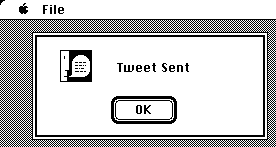
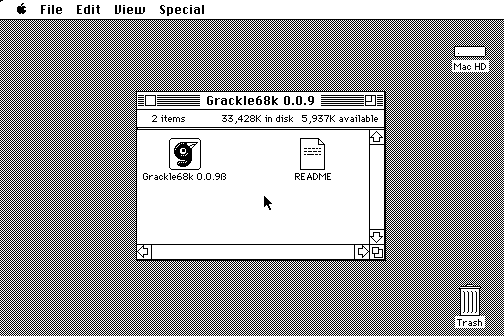
Grackle68k is a Twitter client which supports Mac OS 6 to Mac OS 9. Here are some screenshots:

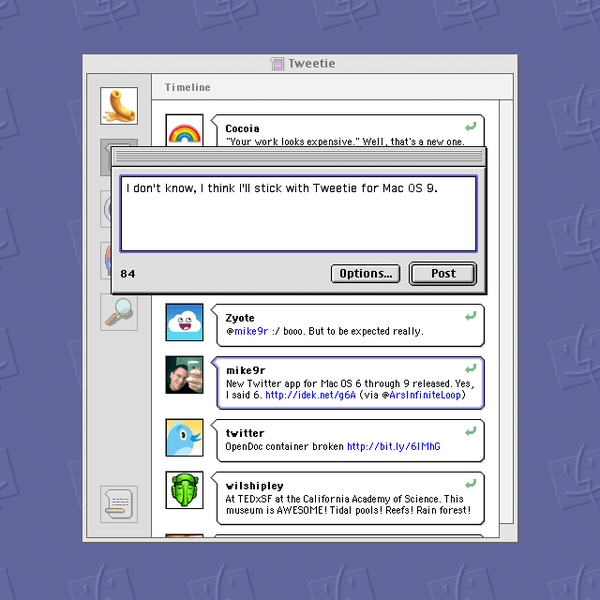
And here’s a mockup of Tweetie running on Mac OS 9:

I remember I heard of someone many years ago who was tryin’ to port Nintendo GC games to the old NES. They called him “crazy”.

Is this the beginning of retroapps?


MacRuby

Link

MacRuby is a version of Ruby 1.9, ported to run directly on top of Mac OS X core technologies such as the Objective-C common runtime and garbage collector, and the CoreFoundation framework. While still a work in progress, it is the goal of MacRuby to enable the creation of full-fledged Mac OS X applications which do not sacrifice performance in order to enjoy the benefits of using Ruby.

Hey developers, this seems interesting.


Camino 2.0 Available

Link

Firefox little brother for Mac, Camino, has finally reached version 2.0. There are many improvements, including a tab overview feature and a better Applescript support. I never used Camino for more than 2 hours, mostly beacuse it was just a little copy of its older brother.

I’m curious about this 2.0 update.

If you use Camino, be sure to check out these beautiful toolbar icons by Matthew Rex.