60 Percent Of Apple’s Sales Come From New Products

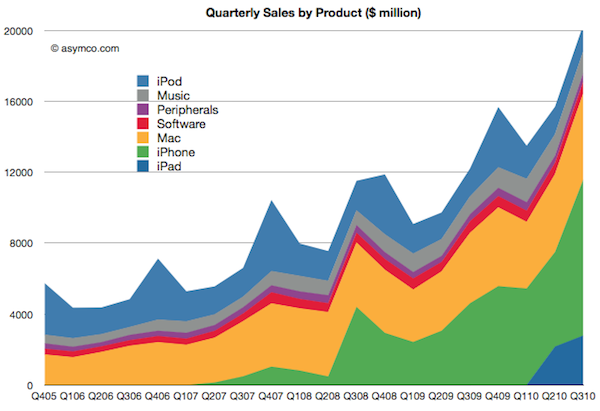
Oh, would you look at that. With blockbuster iPhone sales and more than $20 billion revenue in the last quarter, you would expect Apple to be happy about its latest product line. But the iPhone, iPod Touch and iPad to represent 60 percent of Apple’s sales?

As Horace Dediu of Asymco noticed, 60 percent of Apple’s sales come from products that did not exist three years ago. I guess that’s a good definition of “reinventing a company”.


“Integration” As A New Way To Define iOS

In case you missed it, Steve Jobs made a surprise appearance at today’s Apple Q4 earnings call. What he had to say about 7-inch tablets, Android, Nokia, RIM and Apple’s philosophy is all over the internet. You can read a full transcript here.

Reading between the lines, what strikes me is the focus Steve put on the word “integrated”. The iOS platform is integrated, Android is fragmented. With the iPhone, you get an integrated device. You don’t have to mess with hundreds of different devices running multiple versions and variations of the Android OS. But that’s not really the point, we get Steve’s thoughts on Android. Tweetdeck’s developers get them even more.

What interests me is the use of the term “integrated” as a new way of defining iOS, and thus the devices is runs on, against competitors. By definition, to integrate means to “combine two or more elements so that they become a whole”. So it’s clear that, in Jobs’ mind, Apple deeply integrated the hardware with the software to create a new, reliable, user-friendly experience. Read more


Complete Transcript Of Today’s Steve Jobs Statements

Complete Transcript Of Today’s Steve Jobs Statements

This one pretty much sums it all up:

Nokia makes $50 handsets, and we don’t know how to make a great smartphone for $50. We’re not smart enough to have figured that one out yet, but believe me I’ll let you know when we do. And so our goal is to make really breakthrough great products, make the best products in every industry that we compete in, and to drive the cost down while constantly making the products better at the same time. That’s what we did with iPod. We updated our products many times every year with better functionality, often times at same price and sometimes at a lower price. And it was the relentless improvement at in some cases a lower price, that was able to beat our competition and yield the market share that it did.

Permalink


At Apple’s Q4 Earnings Call, Steve Jobs’ Rant Sets The Record Straight

So here’s what happened: at the Q4 earnings call Steve Jobs grabbed the mic and started talking. No one expected Steve Jobs to be available at the conference, because Steve Jobs doesn’t usually attend earnings calls.

But it happened, and he went on a 10-minute long “rant” where he set the record straight about overly discussed arguments such as Google’s openness, Android’s sales numbers, Apple’s App Store and closed system and the rumored 7-inch iPad form factor. He’s still taking questions at the moment of writing this. Read more


Apple Low On iPad Sales in Q4 2010? 7.46 Million iPads Sold So Far

Once again, Apple’s quarterly fiscal results broke any record: $20.43 million revenue, 14.1 million iPhone sold (despite the whole Antennagate “thing”), 3.89 million Macs and 4.19 million iPads.

Looking at the numbers reported above, it appears that analysts this time almost got the whole situation right: they predicted 4 million Macs, 13 million iPhones and…6 million iPads. So is Apple low on iPad sales, with “just” 4.19 million units out from the shelves in Q4? Not really: of all the analysts Fortune contacted, only one placed his expectations above 5.95 million units sold. Nine of them went for a 4.00 - 5.00 million range. Not exactly “low sales”, but perhaps many expected record sales as the iPhone 4.

We have to look at the big picture, and not just the raw numbers. In two quarters, the iPad is already outselling the Mac. 7.46 million iPads are out in the wild, 5 months after its release date.

I think those are the numbers worth to be considered.