New Chrome Beta Is Faster, Includes Revamped Settings UI

Today Google released a major update to Chrome beta for Mac and Windows, which includes features that have been available in the developer channel for a few weeks. Namely, Chrome beta now comes with encrypted sync for passwords (sync happens through your Google account and can handle passwords, bookmarks, extensions, history and settings on every machine running Chrome), improvements in Javascript speeds and a completely redesigned settings UI.

The new settings sport a much cleaner design organized in three different tabs sitting in a vertical panel on the left. Most of all, the Settings now open as a new Chrome tab and not as a standalone popup window. Buttons have been redesigned as well and now look more in line with other Google products. You can search through settings items with a search field on the left, copy a direct URL to a specific settings page without having to re-navigate manually through menus and tabs.

As for Javascript improvements, the official Google Chrome blog reports:

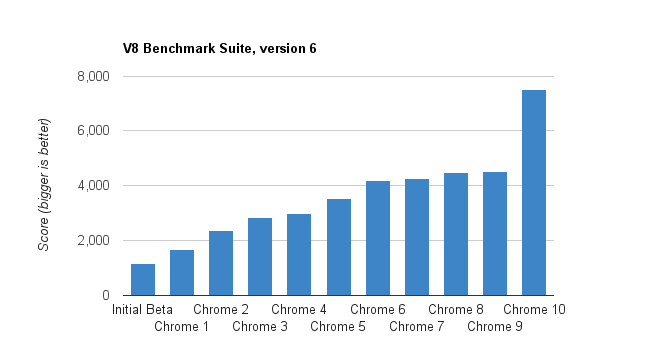
In our new beta release, JavaScript is as quick as a bunny. With a new speed boost that we previewed in December, Chrome’s JavaScript engine V8 runs compute-intensive JavaScript applications even more quickly than before. In fact, this beta release sports a whopping 66% improvement on the V8 benchmark suite over our current stable release.

The new beta also introduces preliminary support for GPU-accelerated video; Google claims content in full-screen mode should see a decrease of CPU usage “by as much as 80%”. Of course you’d have to be running compatible graphics hardware to see the benefits of GPU acceleration.

You can go download the Chrome beta for Mac here. Check out the demo video of the new settings UI below. Read more
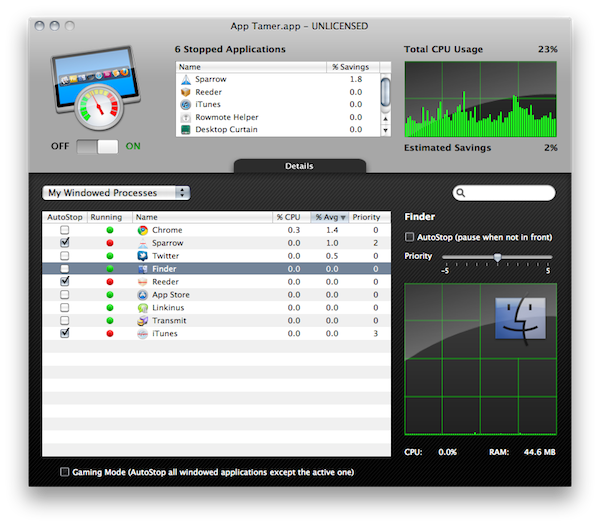


A Must-Have Mac Utility: App Tamer

Over the past weeks, I’ve noticed my MacBook Pro (unibody late 2008) has started feeling the weight of the years of intensive usage. I replaced my internal hard drive with an SSD last year, and while overall performances have increased (especially when open and closing applications or large files) clearly the computer’s fans aren’t the same anymore. I might hold to buy a new computer until this one really dies, but in the meantime I’ve begun looking out for some utilities that could help me better manage the software running on my Mac all the time. Read more


Facebook Messenger Brings Free VoIP Calls to Facebook Chat

Facebook Messenger, a new iPhone application by the Crisp App developers, promises to bring the ultimate Facebook Chat experience to iOS. The app, unlike several alternatives that use Facebook Chat to let you communicate with your friends in a native iPhone interface, doesn’t only provide a clean design for chat, conversation views and photo attachments, it also lets you receive and place free VoIP calls through Facebook. That’s right: Facebook Messenger leverages the Facebook contact list to allow you to call your friends, for free, over the Internet. Read more


New MacBook Pro Model Numbers Revealed? Launch Next Week?

Two reports posted today by Italian blogs SlideToMac and iSpazio suggest the new MacBook Pros might be released as early as next week, in five different models. The MacBook Pro line is due an update and several rumors in the past weeks pointed to a late February / early March release.

First off, SlideToMac [Google Translation] claims to have received exclusive information that the new MacBook Pros will be available next week, by Thursday or Friday. Five models will be available according to SlideToMac: two 13-inch models, two 15-inch models and one 17-inch model. SlideToMac also reports they’re not completely sure about the 17-inch version and that, according to their source, this won’t be a “simple upgrade” to the existing MacBook Pro family.

Similar information comes from iSpazio [Google Translation], which also posted model numbers received via email from an Apple employee:

  • MC720
  • MC721
  • MC723
  • MC724
  • MC725

iSpazio, however, reports the “new MacBooks” (most likely MacBook Pros) will be available “around the end of this month” and that shipments from Apple to retail stores will begin in the next few days. Currently, Apple is selling two MacBook Pro 13-inch models, three 15-inch models and only one 17-inch MacBook Pro.


Inside An Apple Store’s Briefing Room

Apple is having its well deserved success among enterprises and corporations alike, some say without even having a dedicated salesforce, but apparently that doesn’t stop the company from discussing iOS devices and Macs with interested business users in the so-called Briefing Rooms. What’s a Briefing Room, you ask? It’s a super-exclusive conference room that comes with high-end Mac gear, iPhone and iPad-controlled presentation monitors, large glass windows and lots of iPads on the table. The Briefing Room is typically located inside an Apple Store, but away from the chaotic showroom where consumers check out the latest iPhones and Mac accessories.

It appears that there are only five of these briefing rooms in the world, and Pioneer Press reporter Julio Ojeda-Zapata managed to interview Apple’s Vice President of retail operations in the one located in the Uptown Apple Store in Minneapolis. In the past year, Apple opened other Briefing Rooms to lure business customers:

Apple has also opened Briefing Rooms in retail stores in London, Paris, Philadelphia and Shanghai. The secluded spaces are intended to whisk small-business executives and technology coordinators away from the often-cacophonous consumer showroom for heart-to-hearts about how Apple can meet their needs (and get them to drop megabucks on shiny Macs and iOS devices, of course.)

It sounds intriguing, if you ask me – and personally, I’d be curious to know the apps that run on those iPads to power conference note-taking and management. You can check out the full Flickr set here, and the original blog post on Pioner Press here. [via TUAW]


App Store Far Ahead Of Competition, But Growing Slower

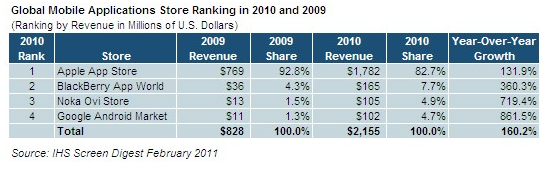
According to a study on mobile app marketplaces by IHS, Apple’s App Store is still far ahead of the competition in terms of revenue and share, but it’s apparently reaching a saturation point where growth has become slower than competitors like the Android Market and BlackBerry App World. The chart above, in fact, seems to prove that the App Store is sporting a 131.9% year-over-year growth, unlike Google’s platform that’s steadily growing at a 861.5% rate.

In January, Apple announced 10 billion apps had been downloaded from its App Store, which features 350,000 apps for iPhone and more than 60,000 for iPad. None of the competitors have similar numbers, but especially Android is growing faster thanks to the variety of devices available and the amount of units sold every month.

Looking forward, IHS expects the global market for mobile apps to rise by another 81.5 percent this year, reaching $3.9 billion in total sales. The Android Market and other rival stores are likely to further slice away at Apple’s leading share, but the iPhone maker will still take home at least half of all sales generated from the app store market through 2014.

So far, 2011 seems to be the year of new features in Apple’s App Store. In January the company launched the Mac App Store and earlier this week they introduced subscriptions for iOS apps – which will allow consumers to easily subscribe to content using their iTunes account. [CNET via Engadget]


Antitrust Enforcers “Looking At” Apple’s New Subscriptions

Apple’s recently announced subscriptions for content-based iOS apps have caused a stir in the publishing and development community due to the 30% cut the Cupertino company takes off every recurring payment and the impossibility for publishers to insert in their iPhone and iPad applications links to alternative web stores.

The Wall Street Journal reports U.S. and European antitrust enforcers “have begun looking at” Apple’s new subscription policy, and whether it may violate laws that regulate the sell of digital subscriptions in online marketplaces. This renewed interest in Apple’s iTunes payment platform may not evolve into a formal investigation or “action against the company”, the WSJ reports, but it appears that Apple has attracted regulators across the United States and Europe.

A spokeswoman for the European Commission, the European Union’s executive arm, said Thursday that the commission was aware of the new subscription service and was “carefully monitoring the situation.

Apple and representatives of the FTC and Justice Department declined to comment. The new subscription system, officially announced by Apple earlier this week, allows content publishers to set up recurring weekly, monthly or yearly subscriptions in their iOS apps. Users can subscribe with just one tap through their iPhones and iPads and manage subscriptions from their mobile devices and iTunes account, which relies on the same credit card information used to purchase songs, movies, books and apps sold by Apple in its iTunes Store. Several companies have expressed their concerns this week regarding Apple’s 30% commission on every transaction.

Antitrust officials in the U.S. and abroad may be hard-pressed to conclude that Apple’s 30% commission is excessive, antitrust experts said, partly because it will be difficult to determine a benchmark commission rate for digital subscriptions. “The European Commission has been reluctant in the past to second-guess pricing as it is a complex exercise, and the commission does not want to become a price regulator,” said Damien Geradin, a professor of competition law at Tilburg University in the Netherlands.

Last year, the FTC was reportedly looking into Apple’s App Store guidelines that forced developers to create applications for iPhones and iPads using only the provided programming tools, but no formal action was taken afterwards.


Fifth Beta of OS X 10.6.7 (10J858) Seeded To Developers

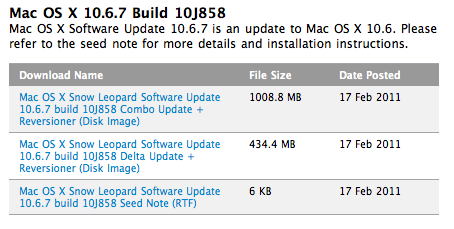
As noted by MacRumors, today Apple seeded the fifth beta of Mac OS X 10.6.7 to developers. Build number is 10J858 and, contrary to previous releases, Safari has been added to the focus areas for testing the new version of OS X, which already included Bonjour, Mac App Store, AirPort, SMB and Graphic Drivers. The new build is available now in the OS X Dev Center. No known issues have been listed in the documentation and the update weighs 20MB than the previous download.

Fourth beta of Mac OS X 10.6.7 (10J855) was released on February 11th. Apple has been seeding betas of 10.6.7 since January, and it is still unclear at this point when they’re planning on publicly releasing the update.


New York Times: There’s No iPhone Nano, New MobileMe Will Be Free

According to a report published tonight by The New York Times, Apple is not developing a smaller version of the iPhone. Rather, the report indicates Apple is looking for ways to make the iPhone cheaper by cutting the costs of internal iPhone components, like Flash storage. Like previous speculation, the NYTimes report, which cites people familiar with Apple’s plans, mentions that by reducing the capacity of the iPhone storage (one of the most expensive components in iPhone production) Apple is aiming at letting users store their information and media online, on Apple’s servers, through MobileMe.

The new MobileMe, according to the Times, will be free and will let users “synch their files without using a cable”. Apparently, the goal is to make MobileMe’s infrastructure fast and reliable enough to allow for photo, video and media storage so that users won’t have to do anything to find content synced across all their devices. The move to MobileMe as the primary way to store content online instead of Flash memory would let Apple launch a cheaper iPhone, but not a smaller one. An iPhone with a different screen resolution would force developers to “rewrite their apps” and “would be more difficult to operate”.

But contrary to published reports, Apple is not currently developing a smaller iPhone, according to people briefed on Apple’s plans who requested anonymity because the plans are confidential.

Apple’s engineers are currently focused on finishing the next version of the iPhone, which is likely to be similar in size to the current iPhone 4, said one of the people. The person said Apple was not planning to introduce a smaller iPhone any time soon. Analysts expect the new iPhone to be ready this summer.

The New York Times also mentions a senior Apple executive said during a meeting “that it did not make sense for the company to make multiple iPhone models”. Apple is very concerned about the fragmentation issue of multiple devices with different specs running the same operating system. The NYTimes report thus contradicts what has been said so far by Bloomberg and the WSJ, which confirmed through anonymous sources that Apple was planning on releasing a smaller version of the iPhone with a 2.3-inch screen.