Huadian Will Blatantly Rip Off iPad 2

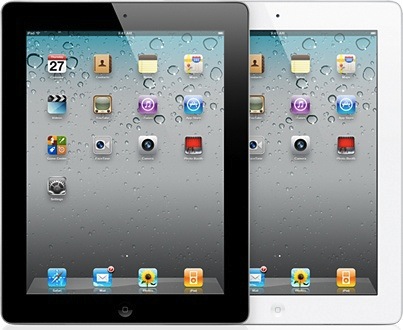
Given the popularity of the iPad, our accusations of Android competitors copying Apple’s trend setting designs are tossed out the window when Huadian shamelessly plans to copy everything. While the copycat doesn’t exactly look as pretty (where’s the Apple logo?), the knock-off wants to deliver a more powerful iteration of the aluminum frame while delivering lesser performance with an 800 MHz AMLogic CPU and only 8 GB of onboard flash storage. Already disappointing in features, the display and touch panel tech tossed inside Huadian’s solution can’t possibly be up to spiff to even what the best iPad competitors are currently offering, and GizChina reports that the device may be loaded with Android once it ships. It’ll have WiFi and GPS as well, but considering what the tablet is already packing, you’re better ponying up for the real deal instead of opting for this cheap knockoff.

[GizChina via CrunchGear, Electronista]


Wunderlist for Mac Gets Updated to 1.2

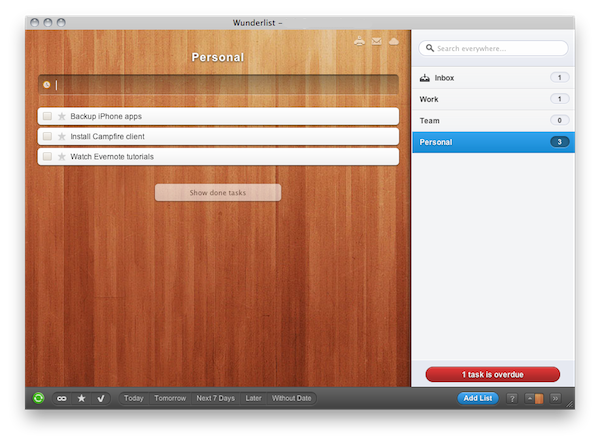
Wunderlist, the excellent task / list manager that works on the web, iOS, Mac and Android that we’ve reviewed several times in the past, got a nice update to 1.2 on OS X earlier today, bringing many features of the popular web application to the desktop. For those unfamiliar with Wunderlist, it’s a little app that leverages the power of cloud sync to make your lists and tasks always available on all your mobile devices, computers, and web browsers. Wunderlist comes with a variety of themes to choose from, and it’s clearly not oriented to OmniFocus power users that fiddle every day with large projects, AppleScripts and complex workflow. Instead, Wunderlist tries to be very simple, but always connected.

The Mac app (review here) was criticized by many for being not so “native” on the Mac platform, and I guess that’s because of the “accelerator” installer package that manages the installation process on OS X - admittedly, the app still doesn’t feel as native as OmniFocus or Things with their AppleScript integration and fancy Cocoa tricks, but version 1.2 is definitely an improvement. The app’s window can finally be closed with a CMD+W shortcut, and the sidebar can be moved on the left or right. The desktop app heavily resembles its web counterpart – more so that it even looks like the entire web app has been built into a Mac package. You can now drag files into the “notes” section of a task and have the path to the file saved in a clickable format; similarly, web links are now correctly recognized and synced to the cloud. Alongside bug fixes, real time search, speed improvements and better filters, the app comes with a shiny new icon and login screen.

Wunderlist may not be the ideal solution for OmniFocus geeks, but the team behind it is surely building a reliable solution that works anywhere at anytime, and it’s perfect for keeping lists of tasks always synced across different platforms and devices. Get Wunderlist here, for free.


Safari Books Online Releases New “Safari To Go” iPad App

Safari Books Online is a very popular service that, through a monthly or annual subscription model, allows you to access a vast catalog of design, development and business-related books and video trainings. Depending on your account, Safari Books Online lets you browse through a library of over 13,000 resources, and thanks to release of a brand new app today, this will also be possible directly from an iPad.

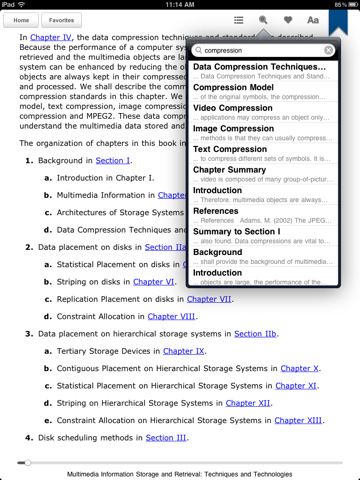
Safari To Go, available for free in the App Store, is a complete 2.0 rewrite of SBO’s previous App Store offering that provides a native interface for the iPad that follows Apple’s interface and usability guidelines, yet still enables you to enjoy the library of Safari Books Online, which includes ebooks from publishers like FT Press and O’Reilly. Safari To Go brings the functionalities you’d expect from a native iPad app: page swiping, offline reading mode and in-book keyword search. You can view your recently read books in a different view, mark items as favorites and create bookmarks. Additionally, you can watch videos in-app and perform a search by topic to find exactly what you’re looking for. Ken Yarmosh, one of the developers of Safari To Go 2.0, explains some of the technical decisions behind the app, such as why 3G connection only allows you to read an offline book:

As an example, notes and tags are not initially available in the application. Similarly, we found the performance on 3G to be sub-optimal due to the amount of content that transmits over the air. So, it was collectively decided that only an offline book should be accessible when on 3G for the first release of the v2.0 version.

Because of how we’ve built the app, we’re now in position to more quickly iterate on these and other features. In fact, we’re just now testing an update internally, which should be pushed to the App Store shortly. The Safari Books Online team also has a roadmap for upcoming releases with the expectation to update it and re-prioritize features based on customer feedback.

The free Safari to Go iPad app is available now in the App Store. You can sign up for a 10-day free trial on Safari Books Online here.


Labels Hoping Apple’s Music Service Will Launch at WWDC

According to a new report by Cnet, multiple “music industry sources” have told the publication the four major music labels in the US (Warner Music Group, EMI, Sony, Universal) are hoping Apple’s rumored cloud music service will launch next month during the WWDC. The labels, Cnet reports, are counting on Apple to provide a full-featured music service with iTunes Store integration that would force competitors like Amazon and Google to start paying licensing fees for their “music locker” services, which allow users to upload songs to the cloud, but have in no way official support or backing from the labels. The labels are seemingly unhappy with Amazon and Google services as users might be able to upload songs they illegally downloaded from the Internet, and it also appears that Google transcodes some uploads to a new format (making a copy), thus raising some questions on copyright issues as well.

Apple is in a strong position to deliver a cloud service that allows for both uploading and streaming of songs thanks to deals negotiated with the labels. Last month, it was indeed reported that Apple had inked a deal with the Warner Music Group, with more labels to follow soon or already signed according to other rumors.

But the services offered by Amazon and Google are not all that they can be because those companies had to tippy-toe around copyright issues. Since neither company was either able or willing to obtain licenses from the four major labels, neither of them could deliver the same range of options that Apple will be able to offer with its upcoming cloud service, according to multiple music industry sources.

Lots of people at the four major labels, however, now hope the service launch at Apple’s Worldwide Developer Conference on June 7. The risk for the record labels is that the services from Amazon and Google could prove good enough for most music consumers and that the companies don’t feel compelled to upgrade.

The WWDC ‘11 kicks off on June 6 in San Francisco, and previous speculation suggested it would be a software-focused event with on-stage demoes of iOS 5 and OS X Lion. iOS 5 has been in the middle of a debate recently, mainly as to whether Apple will really showcase its new cloud offerings revolving around a revamped MobileMe or other functionalities such as voice recognition, postponing the launch of all cloud services to this Fall. Reuters reported a few weeks ago that work on Apple’s new music service had been finalized on the technical side, and Apple was simply completing the process of signing deals with music labels to offer both upload features and streaming of songs you don’t own, likely through a subscription system. Google launched its new “Music Beta” service yesterday and, similarly to Amazon’s Cloud Player, it allows users to upload songs and albums to an online locker, but doesn’t provide any sort of subscription à la Spotify to enable users to listen to music without uploading it first.


Report: Buyers Go With Either The Most Expensive Or Cheapest iPad

Apple offers quite a number of variations on the iPad 2, you can get it in white or black, with 3G or just WiFi, and in sizes of 16GB, 32GB and 64GB. Well it turns out that the most popular model, according to research firm Context, is the 64GB 3G iPad.

The research was done by Context in Western Europe and it found that more than half of all iPad buyers would choose either the 64GB 3G model (also the most expensive), which accounted for roughly 33% of sales, or the 16GB Wi-Fi-only model (curiously the least expensive model), which received 22% of sales. On that evidence, as TheAppleBlog points out, consumers are going “all or nothing” – and many more seem to be saying “all”.

The report also discovered that the iPad represented 80% of tablets sold during the first quarter of 2011 – in line with a Nielsen report from last week. Yet this is a 5% drop from the previous quarter, a consequence of some take up of Android tablets. Curiously, one of the analysts from Context noted that it is likely that less publicised Android tablets such as the Acer Iconia will do better than the Xoom or Galaxy Tab. Nonetheless, Context has no doubts that at least by the end of this year, Apple will still hold top spot for tablet market share.


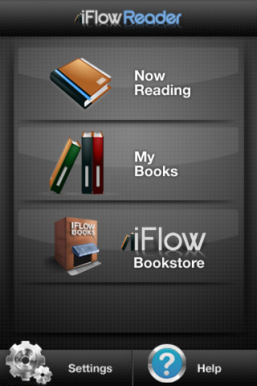
Apple’s In-App Purchase Policy Forces iFlowReader to Shut Down

BeamItDown Software, developers of iFlowReader, today announced that they will be forced to cease their operations at the end of this month. The move comes after Apple decided to enforce rule 11.13 of the ‘App Store Review Guidelines for iOS Apps’ – with Apple set to begin removing apps that do not conform to this rule by June 30. This means iFlowReader, which sold eBooks through an online store, would have to offer the same books within the app through In App Purchases – consequently meaning Apple gets its 30% cut of every sale made through the app.

In a statement on its website, BeamItDown Software makes it clear how if they went ahead and followed Apple’s guidelines, they would have to take a loss on every e-book sold – clearly not a sustainable business model. They explain that this occurs because the largest publishers (which account for more than 90% of the e-books they sell) have adopted an “agency model” in which means resellers, such as BeamItDown, receive a margin of less than 30% after paying the publisher. They say that the big publishers adopted this agency model after Apple negotiated with them over the iBooks deal. Prior to the agency model, resellers would typically receive a 50% discount on e-books.

The end result of BeamItDown Software and their iFlowReader, which had become quite a popular iOS e-reader with over six million downloads, is that it has, in essence, been shoved out of the iOS e-book market by the power Apple has over developers who rely on the iOS platform.

“We bet everything on Apple and iOS and then Apple killed us by changing the rules in the middle of the game.”

If you are a user of the app and its service, the short story is you will still be able to read your e-books, but you will have to jump through some hoops to ensure this. You will have until May 31st this year (the end of this month!) to do a few things related to back-up and downloading all your e-books from the site, which is shutting down. Jump to their statement for the details on this.

It was back in February when it was reported that Apple was tightening its hold on the iOS walled garden after it was revealed that Sony’s e-reader app was rejected for re-directing users to an online store for e-book purchases. Apple responded shortly after saying;

We have not changed our developer terms or guidelines,” Apple spokesperson, Trudy Muller, told The Loop. “We are now requiring that if an app offers customers the ability to purchase books outside of the app, that the same option is also available to customers from within the app with in-app purchase.

The impending shutdown of BeamItDown does raise the question over whether Apple is using monopolistic behavior to force out other e-book services. In their statement they highlight that with one swift change in policy application, Apple will be able to sell e-books at a cheaper rate than every other service on iOS and likely force a number of services, like iFlow Reader to completely shut down because they cannot afford that 30% cut.

What sounds like a reasonable demand when packaged by Apple’s extraordinary public relations department is essentially an eviction notice to all e-book sellers on iOS…They want all e-book business on iOS and since they have the unilateral power to get it, we are out of business and the iFlow Reader is dead.

In the face of such questions, many will argue that Apple deserves to have complete control over its own App ecosystem, and that Android and the Kindle offer strong competition to Apple and iBooks. However, at least in my mind, I get the sense that Apple, with it’s large user base, may have unfairly forced this company out of the e-book market to advance the use of iBooks.

Section 11.13 of App Store Review Guidelines for iOS Apps

Apps can read or play approved content (magazines, newspapers, books, audio, music, video) that is sold outside of the app, for which Apple will not receive any portion of the revenues, provided that the same content is also offered in the app using IAP at the same price or less than it is offered outside the app. This applies to both purchased content and subscriptions.



Cydia Tweak Lets You Backup & Restore App Data with Dropbox

One of the biggest annoyances of iOS is the impossibility to easily backup and restore application data to the cloud, without being forced to keep an app installed to not lose everything. This is particularly true for games: not only your Angry Birds record is always at risk of being erased because you might accidentally delete the app from your device or iTunes, there’s also no way to keep data synced between apps running on different devices. For example, it’d be nice to start playing Angry Birds on the iPhone and automatically continue the session (with the same data) on the iPad, or, why not, simply restore data and other settings with one tap from the Internet. This is one of the features Apple is rumored to be working on for the major revamp of MobileMe dubbed iCloud, and while it’d make perfect sense to let gamers restore data using Game Center, a wider implementation of backups and restores across the whole Apple cloud would be certainly more appealing to iPhone and iPad users.

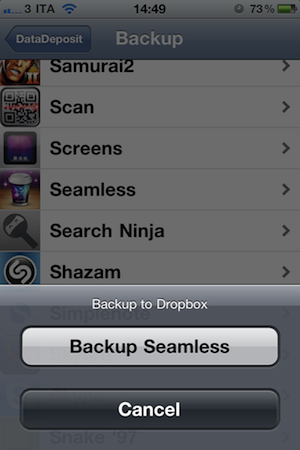
Several hacks in the past months allowed users to extract app data from non-jailbroken devices and back it up to a local computer. These solutions, however, didn’t provide the dead-simple approach of DataDeposit, a free app available in Cydia that backs up your app data to Dropbox, and even allows you to restore it with a single tap from your device, using the cloud.

Once installed, DataDeposit will look into your iOS Applications folder to see apps that can be backed up to Dropbox. This list includes apps installed from the App Store, not the system ones. More specifically, not an entire app will be backed up, just its saved data for your app specific settings and progress – like Angry Birds records or a 1Password local database. Once you hit Backup, DataDeposit will create a “DataDepositApp” folder in your Dropbox, with sub-folders inside it containing .zip archives of data. If you only use your iPhone, you won’t see any of this by default – just a progress bar and a confirmation dialog. When you want to restore, make sure the app is closed, hit Restore and wait for DataDeposit to move the data from the cloud to your device again. I tested this personally and it worked really well: I backed up my Angry Birds data and uninstalled the app; I installed the app again, made sure I had no progress in the game, then restored using DataDeposit. All my completed levels and stars were there, in a matter of seconds.

DataDeposit is free in Cydia, works great with Dropbox and it’s very easy to use. If you’ve been looking for a way to seamlessly backup your app data but you didn’t want to use a manual method, DataDeposit deserves a try.


iKeyboard Promises A Better Typing Experience On The iPad

I bought an original iPad last year, and an iPad 2 when it came out in the United States on March 11. If there’s one thing I had to get used to during this last year when using the tablet, that would be the virtual keyboard. Coming from an iPhone background the use of a virtual keyboard on the iPad instead of a physical one wasn’t a surprise (is there really anyone who thought Steve Jobs would accept keys on the iPad’s screen?), but still it required some serious exercise to get actual writing done. There’s no shortage of apps for writers and the iPad is also a great email machine, but getting used to fast typing on the large virtual keyboard was hard. Like most iPad users, eventually I managed to overcome my issues with ”hunt-and-peck typing”, and now I write any kind of piece or email message on my iPad just fine – perhaps not as fast as I could on my computer, but still fast enough to enjoy the experience provided by apps.

However, some people clearly couldn’t get to fully appreciate or get used to advantages offered by iOS’ virtual keyboard, opening the door to a plethora of alternative solutions like cases with built-in keyboards and external Bluetooth keyboards to carry around all the time. The iKeyboard, a Kickstarter project you can check out here, aims at offering a solution between virtual typing and external accessories, adding minimal weight and bulk to your iPad, still promising to dramatically improve your typing experience.

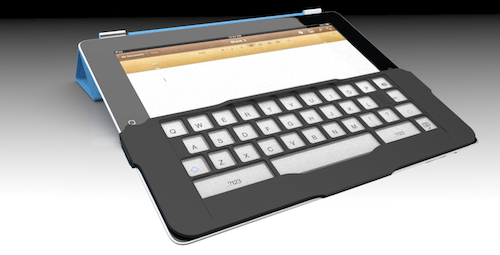
Once placed on top of the virtual keyboard, the physical iKeyboard will simply provide better tactile feedback and give you a sense of the distance between keys on screen. The creator explains:

My solution is to provide the feedback missing from a virtual keyboard by “grafting,” or piggybacking, a real keyboard onto the screen. My invention—the iKeyboard—will sit atop the virtual keyboard and be lightweight. It will add little bulk and not increase the footprint of the tablet. It will be easy and fast to deploy and remove.The iKeyboard will improve accuracy and typing speed, letting tablet users do real writing. It will set the brain free. In certain settings—the lecture hall, the library, the classroom—the iKeyboard will be an essential tool rather than just a useful accessory.

I’m not sure about the convenience of constantly adding and removing an accessory from your iPad’s screen, but I have to say this idea sounds more intriguing than stuffing your tablet into a bulky case or being forced to use an external keyboard for writing long documents. You can contribute to the project on Kickstarter, and check out the promo video below. Read more


Survey Shows iPad Still Primarily Used for Web Browsing, Email, Video

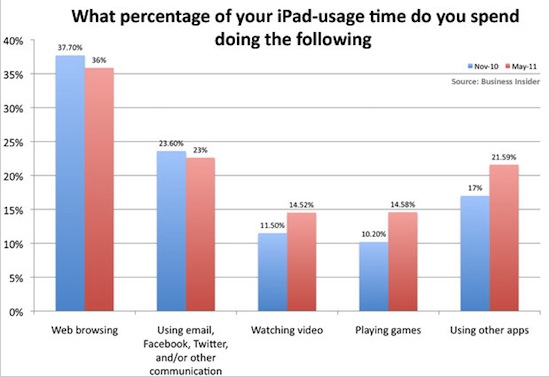
In an unsurprising turn of events following the launch of a survey among readers who own an iPad, BusinessInsider posts a chart detailing how people use an iPad. And unsurprisingly, the usual suspects are on top: the chart shows people use iPads to browse the web (36% in May 2011, 37.7% in November 2010), whilst 23% rely on the tablet for their email needs and communication skills happening on Twitter, Facebook, or other social networks that presumably have a native iPad app, otherwise that would count in the “web browsing” section, I guess. The iPad is also strongly used to watch videos (14.52% up from 11.50% in November 2010), play games and “use other apps.”

The end results of this survey don’t come as a surprise to anyone, but they confirm a widely popular theory – that Safari is the most powerful app Apple could have ever bundled with the iPad and iOS by default. Not only does Safari replicate most of the functionalities seen on the desktop, with the recent iOS 4.3 update it also got some nifty new Javascript engine that makes opening webpages blazing fast. That’s why every little feature that didn’t find its way into Safari and is requested a decent amount of users can become the reason to develop an alternative browser for iPad. The browser on the tablet is the best way to access the internet – it is for me, and clearly it is for other people, too.

What about those other apps? Watching videos with Plex or other media managers is a great experience, especially when combined with AirPlay and an Apple TV in your living room. Playing games? Between Angry Birds and Sword & Sworcery there’s plenty of choice to go by. Other apps? They must refer to things like OmniFocus, Simplenote, LogMeIn, Instapaper and Screens. It’s all about the apps, but Safari is still king when it comes to spending time with an iPad, browsing the web.