iOS 4.3.3 Users Reporting WiFi Issues on iPhones, iPads

According to reports surfaced on Apple Support Communities, many users are experiencing WiFi connectivity issues on devices running the latest iOS 4.3.3. These issues are nothing new to iOS – you might remember the problems with the original iPad and WiFi routers last year – but this time it appears they’re affecting iPhone and iPod touch models as well. The story is very similar to last year’s reports: a device fails to connect to a network or is unable to navigate; the WiFi icon doesn’t appear in the statusbar even if the device is actually connected; the device randomly disconnects from a network. You can read more about what users are reporting here, or here.

Personally, I did notice my iPhone 4 keeps disconnecting from my home network (running on an AirPort Extreme station) a few times every day. It’s kind of annoying as the disconnection lasts between 30 seconds and 1 minute, but like I said it’s not happening more than 3 or 4 times a day – surely not “all the time.” On my iPad 2, WiFi signal is stable (doesn’t drop) but it’s lower than before even a few meters away from my router. Again, these are issues I wasn’t experiencing on iOS 4.3.1 or 4.3.2 and definitely seem to fall in line with Apple Support Communities’ discussion threads.

Most of the times, though, there’s no need to panic. If iOS really has a WiFi bug, you can stay assured Apple will fix it soon with a software update – if the reports will get stronger in the next weeks, Apple will issue a new version of iOS like they did before. Several users, however, forget that having a proper network configuration helps a lot when having to deal with multiple mobile devices; if the issue is not in the network, resetting your iOS settings to factory usually helps in resolving all WiFi connectivity problems. If the issue persists (like on my iPhone), then it’s certainly something Apple will have to take a look at. [via ReadWriteWeb]


New iMacs Can Only Use Apple’s Hard Drives

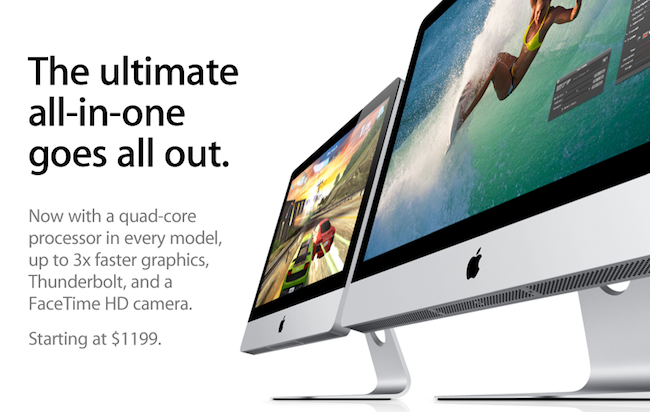
One of the perks of having an iMac, be it a 21.5-inch or 27-inch model, is that you’re signing up for an all-in-one solution that packs everything you need into a “screen” that only needs to be placed your desk, connected to a power source, and it’s ready to go. The iMac – certainly Apple’s top choice in the consumer desktop line – isn’t meant to offer “user serviceable parts”, meaning what you get with Apple’s standard configuration is what you’ll have to stick with until the end of the product’s life cycle. In the past years, however, users who wanted to customize their iMac experience with custom parts like, say, different internal hard drives or better RAM, were able to open an iMac (provided they followed the complex instructions that require to pay attention when disassembling the aluminum enclosure and display) and fit in compatible components to enhance the performances of the machine.

As noted by Michael at Other World Computing’s blog, however, the new 2011 iMacs – the ones with Thunderbolt, Sandy Bridge processors and better graphics – don’t allow you to use any other hard drive but Apple’s custom ones, which are running a custom firmware to provide temperature monitoring through a new 7-pin SATA connector.

For the main 3.5″ SATA hard drive bay in the new 2011 machines, Apple has altered the SATA power connector itself from a standard 4-pin power configuration to a 7-pin configuration. Hard drive temperature control is regulated by a combination of this cable and Apple proprietary firmware on the hard drive itself. From our testing, we’ve found that removing this drive from the system, or even from that bay itself, causes the machine’s hard drive fans to spin at maximum speed and replacing the drive with any non-Apple original drive will result in the iMac failing the Apple Hardware Test (AHT).

In examining the 2011 27″ iMac’s viability for our Turnkey Upgrade Service, every workaround we’ve tried thus far to allow us to upgrade the main bay factory hard drive still resulted in spinning fans and an Apple Hardware Test failure. We swapped the main drive out (in this case a Western Digital Black WD1001FALS) with the exact same model drive from our inventory which resulted in a failure. We’ve installed our Mercury Pro 6G SSD in that bay, it too results in ludicrous speed engaged fans and an AHT failure. In short, the Apple-branded main hard drive cannot be moved, removed or replaced.

To add insult to injury, the latest iMac EFI Update 1.6 unleashed 6Gb/s speeds on two internal ports – and naturally, one of them is the proprietary, firmware-limited, 7200RPM main drive that can’t take advantage of those speeds anyway.

Michael argues that by “closing” the system, Apple’s being evil in not allowing geeks and users who buy stuff on OWC or other Mac hardware shops to upgrade their iMacs to better configurations. As Marco Arment explains though (and I personally agree with him here), the iMac’s not really meant for fiddling and user customizations. Like I said above, when you purchase an iMac you’re signing up for the all-in-one idea of a machine that provides Apple’s latest and greatest innovations in desktop miniaturization technology – by using custom cables, firmwares and hard drives, Apple makes sure you get the best performances out of your iMac, with the “downside” of being unable to customize it. This aspect, of course, can also be seen a way for Apple to make sure that angry modders don’t queue up in the Apple Store asking for free replacements when they purposely opened an iMac to play around with its internals.

You can always find an old iMac online and make it your main machine to mod and improve over time, but you won’t be able to enjoy the improvements in Sandy Bridge architecture and Thunderbolt connectivity. And those, if you ask me, are pretty convincing reasons to get a 2011 iMac and stick with its default hard drives.



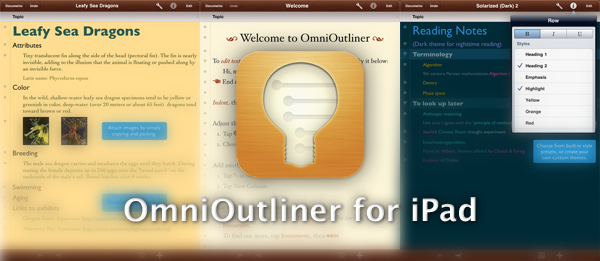
OmniOutliner for iPad Launch Overview

If I was limited to the number of applications I could install on my Mac, I would probably limit the bulk of that to those made by The Omni Group. From OmniFocus to OmniOutliner, I consistently am able to achieve a workflow standard that enables me to be agile when it comes to getting ideas off of my brain and onto virtual paper. In the case of OmniOutliner, a dated yet incredibly powerful application whose outline architecture is currently being introduced in apps such as OmniPlan, the amount of practicality it has brought to my idea well has been astounding. From typing on a blank slate to producing quick lists of app ideas, article drafts, and review checklists, the key tool in my workflow next to a good text editor has been OmniOutliner.

With a quick approval from Apple (Ken Case first announced the app last week), OmniOutliner for the iPad is now available on the App Store, bringing the quick and powerful features from the desktop app into a carefully handcrafted interface designed to be approachable and efficient. Repurposed to fit the finish and feel of iOS, OmniOutliner for iPad is imaginative in design, incredibly touch friendly, and extremely powerful for styling outlines and creating an experience that I’ve fallen in love with. I’d like to briefly cover just how The Omni Group made it all fit, and what you can expect diving into the app for the first time.

Read more


Bellevue Apple Store’s Relocation Pokes Fun At Microsoft Store

The retail shopping store war between Microsoft and Apple at Bellevue Square in Washington is heating up again with Apple’s plans to relocate its store. You may recall that the Bellevue Microsoft Store was built just a few doors down from the Apple Store that had existed for some time prior. Well now, Apple will be moving its store to a larger retail space on the second floor, but what is really interesting is where on the second floor it will be.

Yep, that’s right – directly opposite and above the Microsoft store. Just to make sure that those leaving the Microsoft retail store will be able to see the huge Apple store above them. I suspect that although increasing the store space from 4,600 square feet is the main goal of this move, Apple couldn’t resist taking a nice jab at Microsoft after they opened up shop so close to their original store. What better way to do that than let Apple customers look down upon Microsoft customers on the floor below and vice versa!

Apple’s move should be completed by the end of the year, probably by holiday shopping season.

[Via TUAW]


Alfred for Mac Adds Sync, Launches AppleScripts with Keyboard Shortcuts

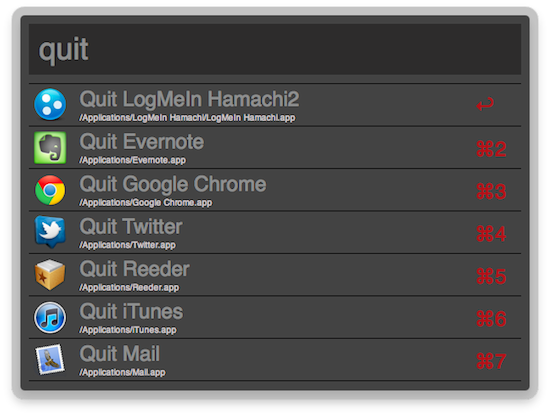
We’re huge fans of Alfred here at MacStories. The minimal launcher for Mac that was released as an alternative to Launchbar and Spotlight quickly evolved into a full-featured solution to browse files, play music from iTunes, manage your system clipboard and check on dictionary definitions. Alfred hasn’t officially reached the 1.0 status, yet the developers iterated so fast in the past months that Alfred has turned into a powerful application launcher packed with functionalities aimed at getting things done using only the keyboard. Looking back at previous Alfred releases, it’s amazing to see how the app went from being a simple way to launch apps to a tool tailored to both casual and power users, thanks to the possibility of creating custom searches, shortening links, browsing the filesystem, and more. The latest stable release of Alfred, 0.9, adds a number of improvements that greatly enhance the feature set of the app.

Alfred 0.9 can now launch any AppleScript on your Mac with a keyboard shortcut. Similarly to how the excellent FastScripts enables you to assign commands to scripts saved locally, the new Global Hotkeys section in the app’s preferences lets you assign a shortcut to a specific script, and run it when Alfred is open without seeing Alfred’s actual window. Just hit the shortcut anywhere on your Mac, and the script will execute. This is true for AppleScripts, files, and apps; being able to run AppleScripts through the app you’re already using for many other things is a very welcome addition, but it’s exclusive to those who bought the Powerpack, which is highly recommended if you want to get the most out of Alfred.

Version 0.9 also comes with Dropbox and iDisk sync, meaning you’ll finally be able to keep Alfred’s settings in sync between different Macs. The app can sync themes, snippets, scripts and custom sites. Alongside iTunes Mini Player improvements, a redesigned Preferences window and several performance enhancements, Alfred 0.9 also introduces new Terminal functionalities: you can run your Terminal commands “silently behind the scenes”, as well as add your own icons to make Terminal commands look like native Alfred actions.

Overall, it’s undeniable Alfred keeps getting better on each release. We don’t know what’s coming in the final 1.0 version, but if previous updates are of any indication I guess the developers are working on something big for the major 1.0 milestone. In the meantime, you can get Alfred here for free, and buy the Powerpack for £12 ($20). Check out more screenshots and the full 0.9 changelog below. Read more


iPad Cannibalization Of PC Market Slows

The iPad’s cannibalization of the PC market may have slowed if the latest NPD market research report is any sign of things to come. The report found that new purchasers of the iPad are less likely to have foregone purchasing a PC than the early adopters of the iPad. It found that of those who had purchased the iPad over the holiday season, 12% would have decided against a PC purchase when they bought an iPad. This is a 2% drop from the 14% of those decided against a PC amongst those who had owned their iPad for 6 months or more.

Netbooks were saved the most, with iPad cannibalization falling by 50%, which actually led the netbook market to grow by 21% between September 2010 and March 2011. NPD also believes that the slowing of PC sales over the past couple of months has more to do with Windows 7 than the iPad:

The explosion of computer sales when Windows 7 launched, as well as the huge increase in netbook sales at that time, are much more to blame for weak consumer PC sales growth than the iPad

The report contradicts what analysts were calling the “iPad effect” in the first quarter of 2011 when US PC sales fell 10.7%. In fact at least one analyst, including Katy Huberty of Morgan Stanley, revised her 2011 PC shipments down after predicting a tablet cannibalization rate of 29% - which is nearly 3 times what this NPD report says was the rate when it surveyed customers in March.

[Via AppleInsider]


Apple Patents Keyboard with Air Feedback Technology

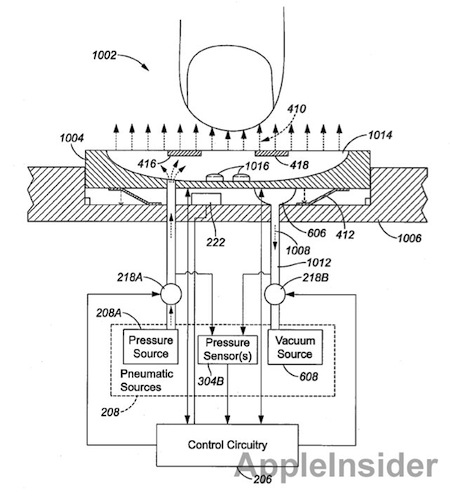
A new patent entitled ”Input Devices and Methods of Operation” uncovered today by AppleInsider reveals Apple has been experimenting with a new kind of desktop keyboard that, following the ongoing trend of reducing the size of keyboards to make them more compact and portable, allows users to receive tactile feedback upon pressing keys through an “air pressure” technology. As the patent notes, keyboards have become thinner and more compact over time, reducing the space between keys and the actual keyboard case design, thus preventing, in many cases, users from having proper feedback upon hitting keys with their fingers. The proposed keyboard design would use proximity sensor below each key to recognize the distance between a user’s finger and the key, allowing a built-in air system to apply a certain resistance or pressure, providing a way to receive tactile feedback on a slim and compact design.

The patent filing describes a system that would “flow air from the input device,” perhaps through openings in the surface of an individual key on a keyboard. This would provide tactile feedback to the user before they make physical contact with the key surface.

This air pressure could be used to apply air pressure against a user’s fingertips, giving tactile feedback even though the key may not move as much as a key on a more traditional keyboard.

Whilst this technology sounds like something Apple may not implement until 10 years from now (Apple, like many other companies, usually patents innovative designs and concepts that most of the times never find their way in actual products), it’s worth noting that a patent discovered earlier this year outlined a new type of keyboard capable of receiving multitouch input from the user thanks to cameras placed around the perimeter of the accessory. If Apple’s trying to reinvent the keyboard, these patents are certainly a starting point to keep in mind for the future.


Digital Downloads Drive A Music Industry Recovery

Well it looks as though things may be looking up for the music industry again, after its decade long slide in sales. A Nielsen Soundscan report yesterday said that US music sales (by unit) have increased by 1.6% over the course of this year.

The report gives the credit for the rise, unsurprisingly, to digital music sales, which in terms of albums was up 16.8% and in terms of individual tracks was up 9.6%. As for physical media, CDs were down by 8.8%, but Vinyl increased by 37%, although they only account for 1.2% of sales.

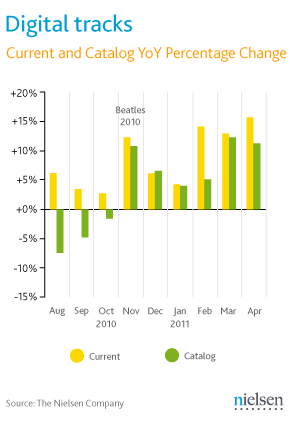
No one is exactly sure why digital is up dramatically this year, although Nielsen interestingly suggests the arrival of the Beatles on iTunes as a key reason, pointing to a dramatic increase starting from when it was released on iTunes (see graph above) – although this seems a bit of a stretch. That said, catalogue music sales have been on the rise by 5.4%, whilst current music is down 7%. As for the most popular genre’s, Rock had the greatest market share in album sales whilst Pop was the most popular for digital tracks.

[Via AllThingsD]


University of Delaware Says “Apple Store” Coming On Campus

According to a new report by ifoAppleStore, the University of Delaware has confirmed that, as part of new campus construction plans, an Apple Store will be located next to the new Bookstore, Starbucks, and other facilities. The website says the university’s Board of Trustees announced an Apple Store will open inside the new bookstore opening this fall, although it’s not clear whether the “store” will be a full-feature retail location, a “mini store”, an authorized reseller, or something else specifically tailored to students. Indeed, several rumors in the past years suggested Apple was planning campus-specific Apple Stores, but the plans were never finalized.

ifoAppleStore also mentions the University of Delaware extended a contract with Barnes & Noble for 15 years, allowing them to demolish multiple buildings in the campus:

The project will include a new 60,000 square-foot bookstore, a Starbucks and other concessions. At its meeting yesterday, the university’s board said the new B&N bookstore will open August 30th, but didn’t say if the Apple store would open at the same time.

Apple already has a full-size retail store about six miles away from the University of Delaware, and that’s a very trafficked Apple Store considering Delaware has no sales tax. Smaller retail stores on campus would certainly make sense for Apple to showcase products like iPads and MacBook Airs and promote them among students, though we can’t help but think those would also be the perfect way to launch and organize discount programs without forcing students to use the online store, or driving to another Apple Store.