Ranky Shows Beautiful iOS & Mac App Store Rankings for Developers

If you’re an iOS or Mac developer, or you handle the marketing for a development studio that has apps on Apple’s App Store, you know the importance of checking rankings for your application on all the international App Stores. It doesn’t matter if your app is the next Angry Birds (probably not, though The Heist managed to take the #1 spot in the iPhone App Store after months of Rovio dominance) or something that will be fine sitting between the #20 and #100 positions, checking rankings by country and category is a common practice that helps you better understand how well an app is doing, where, and quite possibly also why.

Ranky, a new app by Studio Dalton, wants to make the process of studying rankings extremely simple, focused and beautiful. The app provides real-time results for iOS and Mac App Store apps, a feature that’s surely welcome as it allows to check for any app distributed through Apple’s App Stores. Once you’ve entered any iPhone, iPad or Mac app to track, you’ll only have to select the countries you’re interested in to start analyzing the markets. After that, for each app you’ll get an overview by category or “overall” – the same applies if you filter down apps by country, you’ll get the same screen with “overall” and “category” screens to see how your app is performing. Ranky also comes with the possibility of displaying changes since the last time you checked the app, and email and Twitter sharing built-in.

With a beautiful interface and a simple, yet powerful feature set, Ranky is a neat little tool iOS and Mac devs should test right away. Go download the app here at $0.99.



Rumor: Apple Testing A5-powered MacBook Air

According to a new report by Japanese blog Macotakara, Apple is testing internally a new version of the MacBook Air powered by an ARM-based A5 processor and Thunderbolt connectivity. The website reports the machine is made by Quanta Computer, and this speculation comes amidst rumors of a MacBook Air refresh featuring Intel’s Sandy Bridge and Thunderbolt set for a June or July launch.

According to this source who saw live A5 MacBook Air actually, this test machine performed better than expected.

Though it’s not clear which Mac OS X or iOS is pre-installed on this A5 MacBook Air, iOS seems to have difficulty to use features of Thunderbolt without Finder. And even if Mac OS X is installed, developer should spend time to support A5 on Universal Binary Applications. As considering these situation, this A5 MacBook Air seems to be made just for experiment.

The shift to an ARM architecture on OS X would require Apple to rewrite parts of the operating system (though iOS, derived from OS X, runs on ARM chips) and, most of all, third-party developers to update their applications to be universal binaries capable of running both on Intel and ARM CPUs. This would be a resource and time consuming process according to many, similarly to when developers had to switch from PowerPC to Intel years ago, though a recent report claimed that Apple was willing to implement ARM on the desktop, perhaps also offering converting tools and other utilities to make the transition easier. Still, Macotakara seems to suggest this alleged A5-powered Air is being tested as an experiment, which, if true, wouldn’t come out at least until next year; the website correctly pinpointed many of the iPad 2 hardware and design features in the past months, offering credible mockups of the device ahead of its launch.


Fast Company: Our Interview With Dieter Rams, The Greatest Designer Alive

Fast Company: Our Interview With Dieter Rams, The Greatest Designer Alive

Here, Rams talks about being bum-rushed at a party by Philippe Starck, who exclaimed, “Apple is stealing from you!” But when it comes to Ive and Apple, Rams subscribes to the adage “Imitation is the sincerest form of flattery.”

Dieter Rams, perhaps the most inspiring creative mind of the pre-Jobs generation, makes a guest appearance in a fantastic series of video interviews via Fast Company. His designs, elegant and leaving only what’s necessary, have clearly been an inspiration in Apple’s products. If you’re at all interested in the creative genius of Dieter Rams, and his current thoughts on a variety of topics from sustainability to startups, the interview is a must read and watch.

Permalink

Group Plans Protests At Apple Stores Over Proposed Tax Breaks

On June 4, just days prior to WWDC, the US Uncut group plans to target Apple retail stores in protest against Apple’s support of the ‘Win America Campaign’ (WAC). The goal of the US Uncut organization is to fight companies that try to avoid taxes, and they are unhappy with what they claim is Apple lobbying Congress for a $4 billion tax cut. The group will be protesting for Apple to leave the WAC, cease such lobbying activities and to refrain from engaging in tax loopholes.

Apple plays huge games with their taxes. By disguising profits in the U.S. as foreign earnings in low-tax countries, Apple dodges billions of dollars of taxes they should be paying. We are all disappointed to see a great company like Apple participate in such a deceitful campaign that violates their commitment to operate in a socially responsible manner

The WAC group, which is supported by a number of other technology conglomerates including Microsoft, Google and Adobe, is currently lobbying Congress for the Freedom Invest Act of 2011 to lower taxes on American companies involved in selling goods and services overseas. The drafters of the bill claim the money companies save from taxes could be re-invested within the country.

Apple is US Uncut’s main target in the demonstrations on June 4th and has put together an “action kit” with signs, leaflets, chants and slogans. The group will even enter Apple Stores and perform a “dance-in flash mob”, audaciously planning to record the result on the Apple computers on display. CNet contacted Apple for comment, but they did not respond. Jump the break for a video from US Uncut campaigning against Apple and the WAC.

[Via CNet]

Read more


Echofon Releases Photofon: See Photos From Your Twitter Timeline

Released a few minutes ago in the App Store, Photofon is a new app by Echofon, makers of a popular Twitter client for Mac and iOS devices, that strips away all content from your Twitter timeline to display photos shared by people you follow. More often than not, especially if you follow hundreds of users, there’s a chance photos are skipped when checking out news on Twitter because either a) you don’t care about what people are eating or b) you’re just following that guy for the news he posts, and you don’t want to see his cat. For as much as we like cats (and puppies in general) here at MacStories, I agree that sometimes people I follow share photos I really don’t care about or don’t add anything to the experience of being on Twitter to discover interesting new content, and not kittens. But other times, these people share some beautiful iPhone photography that I don’t want to miss, yet I do because I don’t have a proper client that’s solely focused on media, rather than tweets.

Photofon is a Twitter client built around photos. Whether they’re shared on Instagram, img.ly, the omnipresent Twitpic, Flickr or yfrog (I haven’t been able to test other services), these photos will show up against a minimal dark background that doesn’t distract, and makes colors truly shine on the iPhone 4’s Retina Display. The original tweet is displayed alongside buttons to fave and retweet, so you won’t forget about sharing or saving that photo you really loved. Pinch and zoom gestures allow you to see a photo in greater detail, and pull-to-refresh at the top does just what you expect. I’ve noticed the app loaded around 30 photos from my timeline, and I’d definitely like to see a button to load more, because if I’m going to fire up a client only to see photos, I want to see them all.

Photofon is free and available here. It’s not universal, but it’s a neat way to check out Twitter’s photography on your iPhone without getting lost amidst news and trends.


OS X Lion Nearing Public Release?

According to a report from TUAW, Mac OS X Lion has gone “live for internal testing” at Apple last week. Whilst it’s not clear what that means, we assume Apple has begun widespread internal testing of a new build of the OS that’s nearing GM status. TUAW suggests Lion might see a public release at WWDC in two weeks, or at least sooner than previously expected considering many had pointed at Lion on track for a late July / August release:

This suggests the new OS might possibly ship as early as WWDC with an “available today” mention at the keynote – or it might not. But Lion is looking to be one step closer to availability for Apple customers.

The latest developer preview of OS X Lion brought minor graphical changes to apps Apple had already updated in previous DP builds, as well as tweaks and performance improvements to make the OS more stable and faster. Developer builds of Lion have been seeded through the Mac App Store with a redeem code system, though Apple is also believed to make the OS available on DVDs or portable USB keys for users with slow Internet connections, unable of downloading GBs of data from the Mac App Store.


iCloud Will Scan iTunes Libraries, “Mirror” Songs Online

In a post detailing the current state of cloud-based music services from Google and Amazon, Businessweek relays some information on Apple’s upcoming iCloud service, rumored to include streaming of iTunes collections to a variety of devices and computers and said to be formally introduced at the WWDC keynote on June 6. Similarly to a rumor posted a few months ago that indicated Apple was working on a solution to let users backup & upload their collections to the cloud directly from the desktop, Businessweek says “three people briefed on the talks” (between Apple and music labels) have suggested Apple will provide a scanning tool that quickly mirrors songs to iCloud’s servers, also offering a way to replace those songs with better-quality versions if quality is not deemed “good enough.”

Armed with licenses from the music labels and publishers, Apple will be able to scan customers’ digital music libraries in iTunes and quickly mirror their collections on its own servers, say three people briefed on the talks. If the sound quality of a particular song on a user’s hard drive isn’t good enough, Apple will be able to replace it with a higher-quality version. Users of the service will then be able to stream, whenever they want, their songs and albums directly to PCs, iPhones, iPads, and perhaps one day even cars.

Businessweek also briefly mentions Apple could use a subscription-based model to give users access to these functionalities and stream songs they purchased or uploaded. Whilst the general consensus among bloggers seems to be that Apple will either allow users to upload entire music collections or listen to songs they don’t own like Spotify enables subscribers to access the company’s online database with a subscription, the technical details on Apple’s iCloud service are still unclear. A patent design suggested Apple could make users sync small bits of music locally and fetch the rest online to avoid buffering between songs; others claimed it will be a simple system revolving around uploads and streaming like Amazon’s Cloud Player; several reports also pointed at Apple building a new service that combines subscriptions, partial uploads and scanning tools to reduce upload times on a user’s end. Businessweek seems to believe the latter option, with a subscription-based payment and a desktop utility that scans iTunes and somehow mirrors everything quickly to the cloud.


Instagram 1.8 Released: New Comment Screen, Autocomplete, Speed

A few days after announcing 4.25 million users in 7 months and roughly two weeks after the latest 1.7 update, Instagram just released version 1.8 in the App Store, adding the usual speed and stability optimizations and a couple of new interesting features. The app went under some speed-related updates before, but now it feels snappier than ever, really: I’m sure the future version 1.9 will make this statement obsolete, but Instagram 1.8 is fast at opening new screens, loading photos and comments. Speaking of which, the team reorganized the comment section to make it faster and more interactive – check out the screenshot above or simply try to leave a comment to a photo and see how it works for you. You get full access to a comment interface that, if you’re viewing your own photo, allows you to delete comment with a swipe or by hitting the gear icon in the upper right corner. In the text entry field, Instagram now comes with username autocompletion for faster writing and replies – just type the “@” symbol and Instagram will retrieve a list of users you can address a reply to. But more importantly, version 1.8 now lets me double-tap on photos to like them, which is incredibly more intuitive than hitting a dedicated heart-shaped button. Overall, it’s (once again) a nice update.

Get Instagram 1.8 in the App Store.


iChromy Wants To Bring The Chrome Experience To The iPad

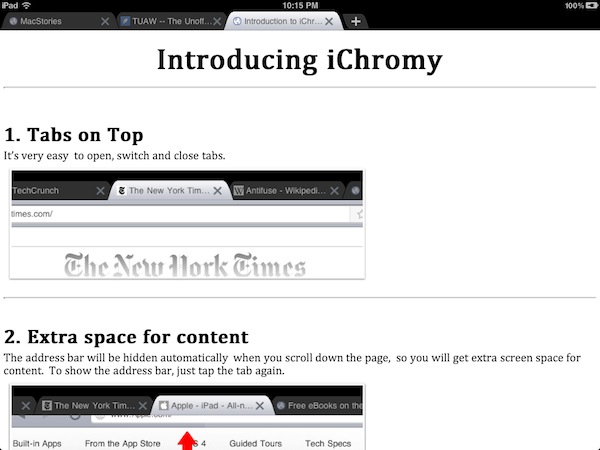
Released earlier today for free on the App Store and developed by the same folks behind web-based bookmarking service Diigo, iChromy is a new third-party iPad browser that aims at bringing the Google Chrome experience on the tablet, obviously without using Chrome’s underlying Chromium open-source project, which can’t be implemented by developers due to Apple’s restrictions. From the name of the app to the iTunes description, the developers of iChromy don’t hide their intentions of developing a heavily Chrome-inspired browser for the iPad; while it still might not look as beautiful as this mockup, I took the app for a quick spin to see whether Chrome (which I love and use on my Mac desktop) could have a proper, unofficial, lightweight counterpart on the iPad.

iChromy is free and the developers will likely introduce a Pro version with more features and deeper Diigo integration in the future, but right now what we have is a simple iPad browser that lacks several must-have functionalities (most of them also available in Safari and not necessarily in powerful alternatives like iCab Mobile) but it’s got tabs on top, a Lion-like Reading List (with the same eyeglasses icon) and decent memory management. More importantly, iChromy has an Omnibox that allows you to search and type addresses in the same bar, like Chrome. So while tabs on top and the Omnibox make for a nice Chrome-like experience that reminded me why it’s still possible to innovate in web browsers on any device, iChromy falls short in the details: you can’t re-arrange tabs, you can’t tap on the status bar to scroll a webpage to the top, you can’t pin tabs. The Omnibox is really, really nice, but the app’s keyboard doesn’t have a .com button and there’s no way to get search suggestions or modify the default search engine. Bookmarks and history are displayed in the Omnibox, but the lack of the .com button on the iPad’s soft keyboard is annoying. Similarly, you can create bookmarks by hitting the “star” button in the Omnibox, but you can’t organize these bookmarks in folders, sync them back to the cloud or import / export them. The Reading List, however, works fairly well in the way it makes entire webpages available offline. Too bad it doesn’t sync anywhere else either, which comes as a surprise considering Diigo’s cloud-oriented nature.

In spite of its missing features, I can’t say iChromy isn’t “nice” in how it mimics Chrome for Mac. The browser is very lightweight, it never crashed on me with multiple pages open in the background and, personally, I think it’s always great to see a browser with tabs on top (I was a huge fan of Safari 4 beta, until Apple killed that magnificent tab implementation). Overall, I see Chromy as an interesting experiment that a) needs some obvious adjustments like the .com button, top scrolling and search suggestions and b) with an upcoming Pro version could have a chance to become a Chrome-inspired, powerful competitor to my personal favorite iCab. We’ll see. In the meantime, go download the app here.