iOS 5: Tips, Tricks & Hidden Features

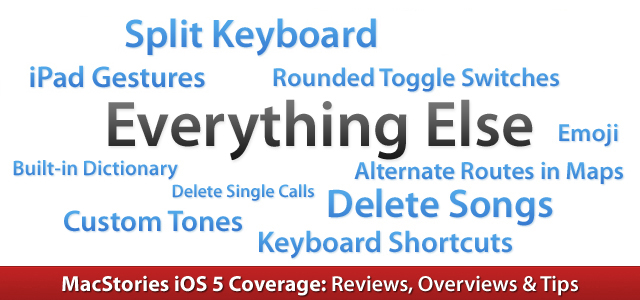
As exciting as every new major iOS release is, there’s just as much if not more excitement in finding the little things that no one knows about. Apple spends a lot of time creating major additions and changes for their releases, and then lets the users try to figure out all the small stuff. Well, not everyone has time to figure them out or doesn’t want to go through the effort to do so. This is where MacStories comes in. We know our readers are all about the details, so we went on to scan, search and pry our way through iOS 5 to find many of the hidden treasures that will make your iOS experience even better.

More iOS 5 coverage here.

Read more


Safari 5.1.1: iCloud Ready, Performance Heavy

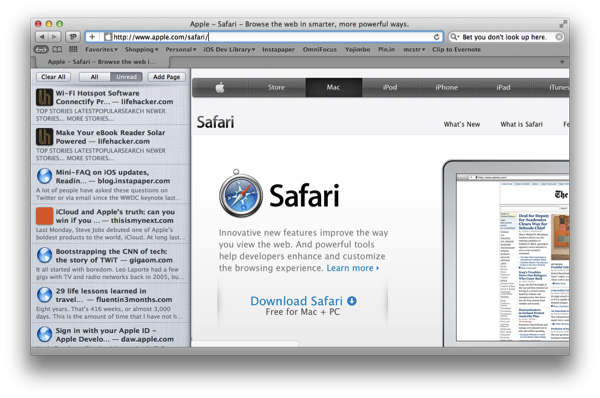
For persistent fans, it’s the features you likely already know about that make Safari a keeper. While I could blabber on about how Safari’s design far outpaces Google Chrome or Firefox in terms of both good looks and usability, Safari’s main assets are simply iCloud related.

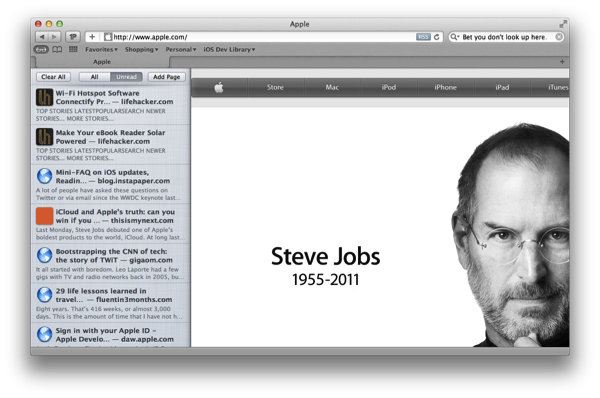
The Reading List, revealed as a hidden side pane coated with a fresh paint of white linen, syncs saved websites to your iOS devices almost instantly over iCloud. Added to Safari earlier this year, Reading List is a sort of quasi-replacement for bookmarks. Bookmarks are useful for certain things: recipes, websites with code snippets, or perhaps a photography tutorial you came across online. References. But for things like articles and news you intend to read later, saving those pages as bookmarks often means they’ll be forgotten about and get lost in the clutter. Reading List attempts to alleviate this problem. If you’re reading an article in Safari on the iPad on the train and need to jump off at the next stop, you can save the page to the Reading List and it’ll be available on your iMac once you reach the office. I’ve always said it wasn’t an Instapaper killer — it’s a temporary container for items I want to read now, but am expecting some sort interruption during. Instapaper items are of course read in the evening, either on the iPad or Kindle. Talking about bookmarks, those get synced over too.

One feature I do want to see in the future is the ability to sync open tabs across OS X and your iOS devices. This seems like a no brainer to me, especially if Apple can work their magic in remembering what tab you had open and your page position.

Outside of iCloud, it’s the same ol’ Safari you’re used to. Safari 5.1.1 includes a slew of stability fixes and improved javascript performance, alleviating a lot of the bugs introduced with Lion and 5.1. Still, there’s room for improvement. More importantly, Apple needs to kill automatic tab refreshing. There’s just no need for it on a desktop OS.

Safari has a warm place in our hearts as Mac users, but the recent iOS-ificiation of the browser is turning away once loyal fans. The animations are fluid, page sliding is unique and thoughtful, and iCloud integrations carry over bookmarks and ‘read later’ items for consumption on any device of your choice, but it’s the automatic tab reloading and poor performance that overshadows great features for fear of lost productivity. I was hoping that Safari, improved in 5.1.1 with several bug fixes, performance enhancements, and iCloud integration, would be worth returning to to take advantage of everything Apple has to offer between iOS and the desktop. Unfortunately, the basic problems (or perhaps principle) of Safari’s mirroring with iOS features remain.


iCloud: The Future of Apple’s Ecosystem

With the launch of iCloud, Apple is fundamentally challenging the old concepts of computing and “file”, changing the way people interact with computers and devices.

iCloud as a service presents itself as a very straightforward idea: iCloud stores your content and wirelessly pushes it to all your devices. iCloud works with the apps you use every day on your Mac, iPhone or iPad, so you don’t have to worry about syncing your music, photos, documents, contacts and calendars again. iCloud is the evolution of MobileMe, rebuilt from the ground up and re-engineered to take advantage of persistent connections and the concept of “push”, rather than visible, sometimes manual sync. iCloud is not just a big hard disk in the sky, as Steve Jobs joked at WWDC ‘11: iCloud is an invisible service that’s just there, and is now allowing Apple to virtually connect more than 200 million iOS devices.

It just works. Read more


iOS 5: iMessage

With today’s release of iOS 5, Apple has added a significant new feature to their Messages app with the introduction of iMessage. Seamlessly integrating into the existing Messages application, iMessage is a new service from Apple that acts as a replacement for the traditional text message service that comes with mobile phones.

In actual fact, a more accurate description of the Messages app with iMessage on iOS 5 would be that it improves on the traditional text messaging service whilst maintaining compatibility with it. The new iMessage service works by associating a person with an Apple ID - rather than a particular device or SIM card as the traditional text message service does. This is one of iMessage’s advantages, you are not restricted to a single device and you can now use your iPad or iPod touch (and hopefully Mac soon) for receiving and sending messages to other people.

Jump the break to read the rest of our iMessage overview.
Read more


Apple’s Cards Makes Sending Memories Simple and Easy

Send beautiful letterpress cards to your friends and family with your iPhone or iPod touch via Apple’s Cards, the surprise app unveiled last week during the iPhone 4S keynote. Cards, now available on the iTunes App Store, features a series of thankful, seasonal, celebrational, and  travel templates which you can browse via a carousel. New cards slide into view as you navigate the app with your finger, with incomplete cards being saved to a drafts area which can be accessed through the navigation bar.

Presented cards are customizable, enabling users to change the title information, the inside of the card, and the envelope before sending their card for $2.99 within the United States, and $4.99 internationally. Unique edit views make the customization process feel on par with the editing techniques seen in iWork. Pictures can be taken on the fly or chosen from your photo library, then cropped and resized on the card face. Text can be completely rewritten for a personal touch on the inside of the card you’ve chosen, allowing you to personalize messages for a truley unique card.

Cards is a free download in the iTunes App Store.


An Overview Of PC Free In iOS 5

A core focus of iOS 5 is the introduction of iCloud (be sure to read our overview of it here), and one could say that the fundamental goal of iCloud is to free the iPhone and iPad from its reliance on a Mac or PC, making them more independent and powerful devices. iCloud goes along way in achieving this and reducing the need to sync devices (through features such as Photo Stream, iCloud Backup, iTunes Match etc.), but it doesn’t completely remove the requirement of syncing - particularly for those in regions that don’t yet have iTunes Match or don’t have Internet speeds capable of utilising iCloud Backup.

To fully accomplish this goal of making the iOS devices independent, Apple has added two additional features that complement iCloud, even if they aren’t technically deemed to be a feature of iCloud. These features are PC-Free and Wi-Fi syncing with iTunes; jump the break to view our full overview of these features.

Read more


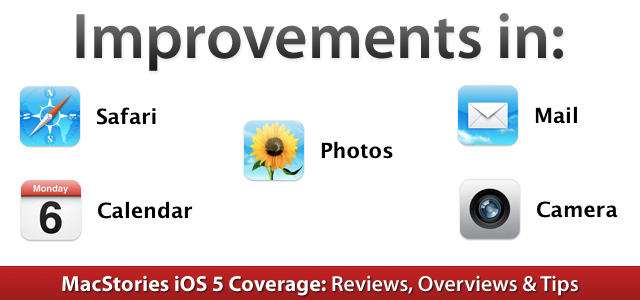
iOS 5: Improvements In Safari, Camera, Photos, Mail, Calendar, Music & Video

Today’s release of iOS 5 sees the inclusion of new apps such as Reminders, significant upgrades to existing apps such as the integration of iMessage in Messages and the introduction of iCloud, which is set to change the way we use our iOS devices. Yet amidst all these significant changes to the iOS platform, Apple hasn’t forgotten about the apps that have existed since day 1 of the first iPhone.

The Safari, Mail, Camera, Calendar, Music and Video apps have all received updates in iOS 5 and the updates range from addressing common complaints, tweaking the user interfaces, adding iCloud support to adding features that improve productivity and usability. Be sure to jump through the break to view the entire overview of changes to these apps.

Read more


Stream Wirelessly to Your HDTV with AirPlay Mirroring

AirPlay Mirroring is a new feature to iOS 5 that allows you to stream anything on your iPad 2 or iPhone 4S directly to your HDTV with the help of an Apple TV.

This feature will appeal to all types of consumers. Businesses will find great value in AirPlay Mirroring because of the versatility that it brings to presentations in the workplace. As someone that works in an office setting I can tell you that there are not many affordable and reliable wireless presentation options. At a price of only $99, the Apple TV is inexpensive enough that businesses can have one in every conference room readily available for employees to stream presentations, PDFs, and even multimedia files from their compatible iOS devices. Educational institutions will be able to provide an even greater and immersive learning experience for students. Gamers will enjoy their favorite iOS games on their big screen TVs. The list goes on and on.

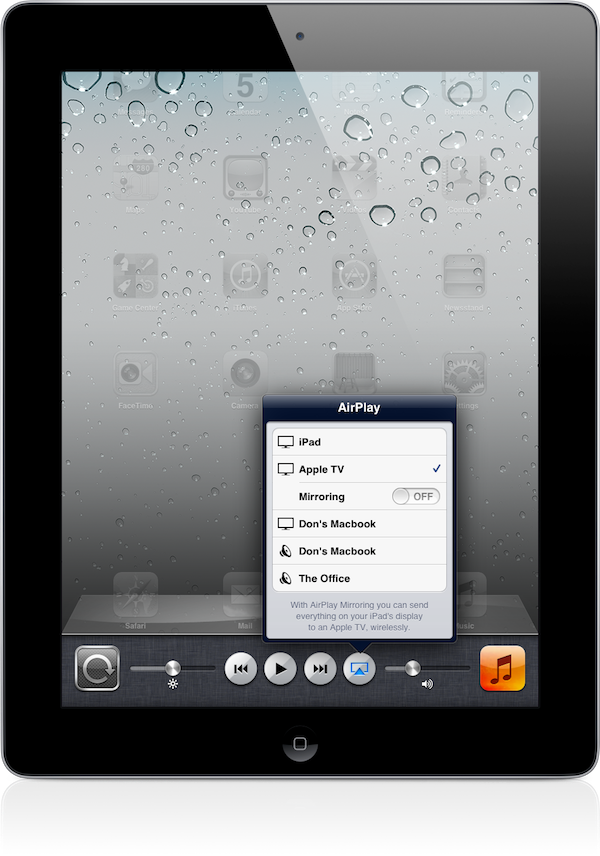
So how does AirPlay Mirroring work? First the iOS device and the Apple TV must be on the same wireless network. Then from the iOS device simply double tap the Home button and swipe all the way to the right. There you will find the AirPlay button that when tapped will display all of the AirPlay enabled devices on the network. As shown below, The Apple TV now has a new option labeled Mirroring. This option is off by default and you can actually continue to use AirPlay with no obligation to stream your screen to the television. Enabling the Mirroring option will immediately transmit whatever is on the screen up on to the television. The status bar at the top of the device will turn blue indicating that device is currently streaming to the Apple TV. When the device is rotated the image on the TV is rotated. When a key is pressed the software keyboard on the TV shows the key being pressed. It is quite impressive.

I found the performance of AirPlay Mirroring to be incredible. The setup I tested was an Apple TV connected over Ethernet to an Apple Airport Extreme and the iPad 2 obviously connected over WiFi. I immediately tried a few apps like Safari, FaceTime, and Photo Booth. All of them performed flawlessly on the HDTV. I remember thinking how impressive it was the first time I saw Photo Booth running on an iPad 2 and it had nine separate boxes each with a live video filter running. It was even more impressive to see the iPad mirror all of those live video filters wirelessly to my television. I also opened multiple types of files from my Dropbox app and they looked great on the big screen. When I started a video the iPad exited Mirroring mode and only played the video on the TV. When the video was stopped it switched right back in to Mirroring mode without any troubles.

Next I fired up ShadowGun to test the performance of a graphic intensive game. Once again AirPlay Mirroring did not dissapoint. It was difficult at first to look at the TV and use the controls on the iPad because they are not physical buttons but luckily you still see the controls on the television. It was a whole new experience to the play the game with audio booming out of my home theater sound system. I really enjoyed it.

AirPlay Mirroring unlocks a new array of uses for iOS devices and is a shining example of amazing integration between Apple’s products. It is just one of many new and exciting features that ship with iOS 5 for the iPad 2 and the iPhone 4S.


Apple Launches ‘iTunes Movie Trailers’ for iOS

No, not a website! Apple has released an app to preview upcoming movies in the vein of Movies Now. Featuring the same previews you’d find at iTunes Movie Trailers on the web, the iOS app allows you to preview beautiful movie posters, find movies at local movie theaters (either by theater or by movie), and check on upcoming releases by previewing a built-in calendar. Per trailer, movie details can be reveleaed that contains the cast and synopsis for the films you’re interested in seeing. You can tweet or email to share, or add the film to your favorites for later recollection.

You can download the universal application from the iTunes App Store for free. More screenshots past the break.

Read more