This Week's Sponsor:

Crickets

The first alarm app for families.


Posts in roundups

Our Favorite Indie Apps for iOS 27, Vol. 1

With our annual OS reviews out of the way, Federico and I will be covering our favorite indie apps that take advantage of Apple’s latest OS features. We have hundreds to draw from and instead of one big sweeping roundup, we’re going to do a bunch of smaller ones as we work our way through our lists.

To start with, we have six excellent apps that make use of Siri AI, Apple Intelligence, extra-large widgets, and more. There’s a lot of innovation packed into this group, so let’s dive into the details, and check back soon for more roundups.

Things

Cultured Code’s beautiful task manager is no stranger to supporting major Apple OS releases: while the company is keeping quiet on their plans for a possible Things 4 (Things 3 was released in May 2017), for the past nine years Things has regularly received support for new versions of iOS, iPadOS, and macOS on day one. The app’s iOS 27 update is no exception, and it makes for a great demo of some of the new features of Siri AI as well as XL widgets for iPhone. It also serves as an example of the limitations of Siri AI – and not because of Cultured Code.

The updated Things app integrates with Siri AI and Spotlight, allowing you to retrieve and open tasks from anywhere on iOS and iPadOS, as well as manage tasks with the assistant using its several input methods. In my tests, Cultured Code’s integration worked well, but Apple’s slow on-device indexing was the problem. Soon after installing the app, I was able to ask Siri to create a reminder, and it prompted me to pick a destination app again because I’d installed a few more task managers since I last confirmed my previous choice. After picking Things, I was able to create a task, which landed in the inbox, and then follow-up with Siri AI by saying “make it due at 3 PM”, and it worked.
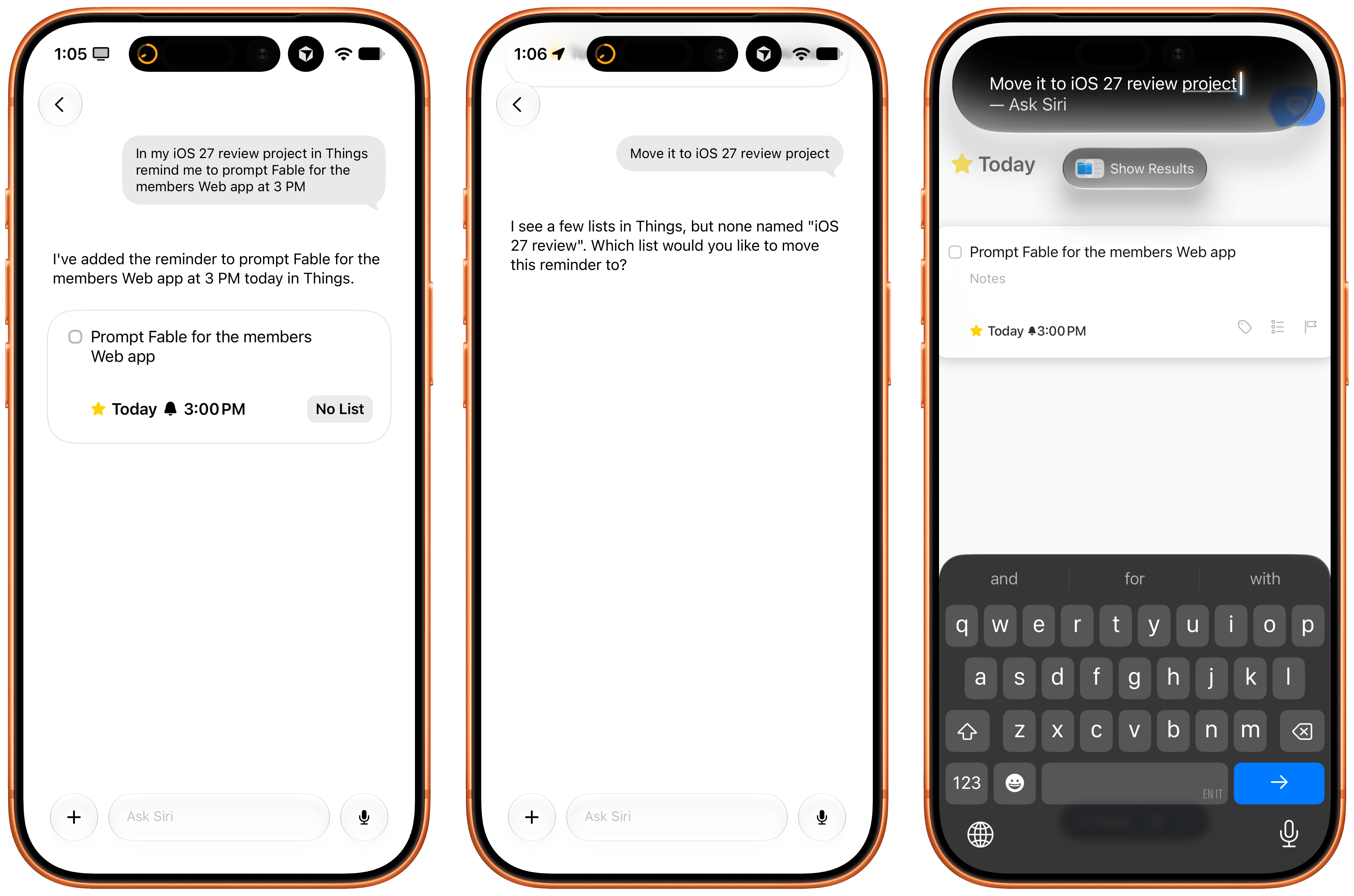
The issues I ran into, which are outside of Cultured Code’s control, are due to how long it takes iOS 27 and Siri AI to build an index of the app’s capabilities and data structure. For instance, I created an ‘iOS 27 Review’ list in Things, but, after three hours, Siri AI still can’t find it. As I noted in my review, I believe this is going to be a major challenge for most third-party apps in the short term as users download them, expect them to work with Siri, but the indexing isn’t going quickly enough.

Regardless of Apple’s technical problems, Things’ integration with Siri AI shows the path forward for third-party task managers on iOS. I also recommend reading the developers’ guide on how to prompt Siri AI for the app.
Locally AI

I covered the differences between Apple’s two flavors of local Foundation models (AFM 3 Core and 3 Core Advanced) in yesterday’s review, but there’s no better way to actually take the model for a spin than Locally AI.

The app, which is now part of the LM Studio family of products and can connect to a remote Mac using LM Link, now offers an ‘Apple Foundation Advanced’ model that, assuming you have a compatible device, lets you prompt Apple’s new on-device model.
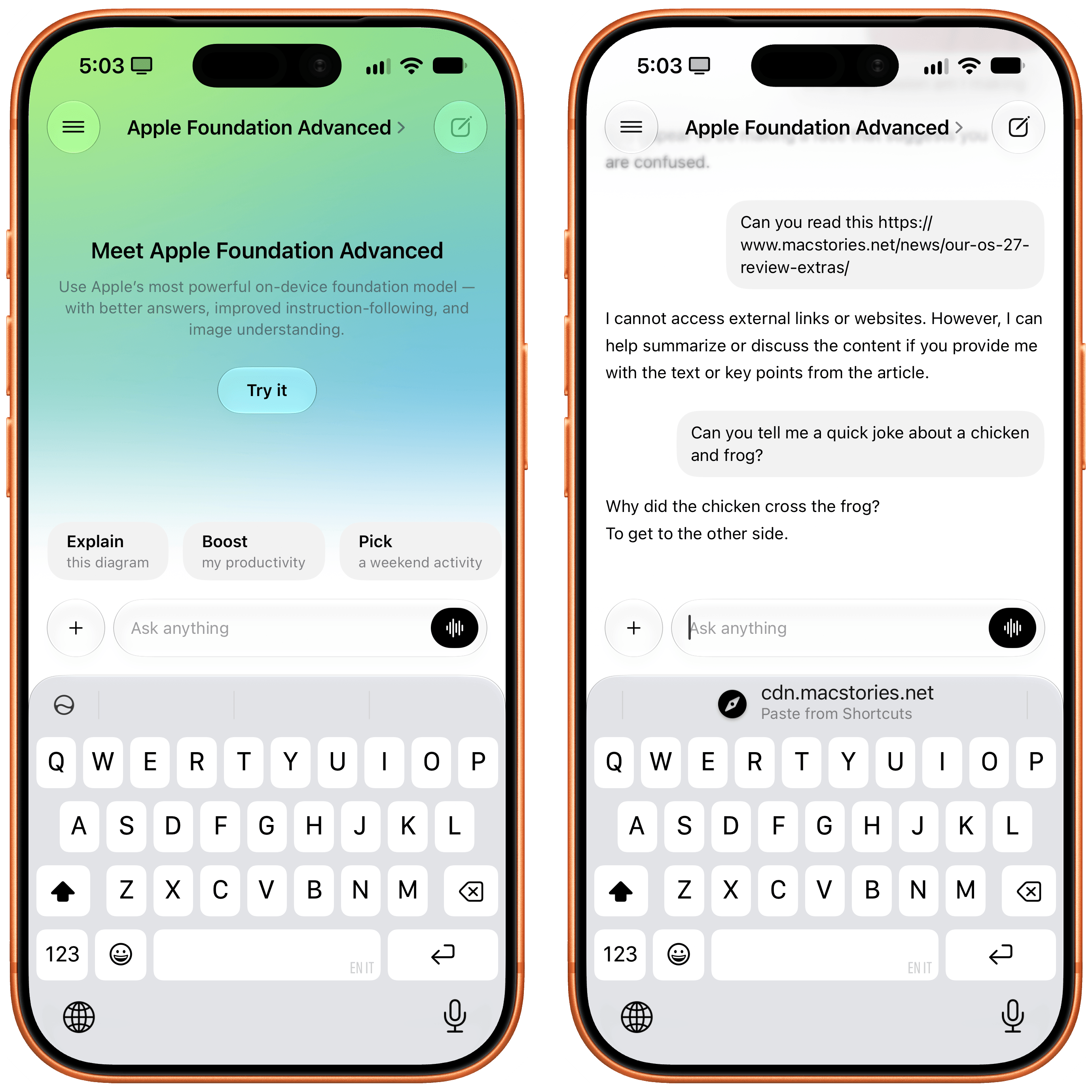
A good way to prompt this model is to give it an image: for the first time, a local Foundation model comes with vision capabilities, and I’ve found Core Advanced to be surprisingly strong at describing things like iPhone screenshots, selfies with different facial expressions, and more. Obviously, it comes with limits: Locally AI’s harness doesn’t expose tools to the model, which means it can’t fetch web content and, say, summarize articles for you in the app. Its knowledge and creativity are also quite limited, as you can see from the non-joke it created in the screenshot above.

Still, despite the limitations of the model itself, Locally AI is an excellent utility for running local models on iPhone and iPad, and if you’re curious to see what Apple’s bigger models feels like outside of Siri AI with your own prompts, I recommend checking it out.
Dark Noise

Charlie Chapman’s Dark Noise has long been my favorite utility to play white noise and other sound effects to relax or focus, and the app has received a substantial update for iOS 27 worth checking out.

First, there’s a good-looking new Liquid Glass player that fluidly morphs on-screen from a mini-player docked at the bottom of the app into a full-screen view that lets you control playback, volume, and set a sleep timer. On the Home Screen, there’s a (customizable) XL portrait widget for iPhone that lets you configure any combination of up to 24 distinct sounds and mixes that you can play with a single tap without opening the app.
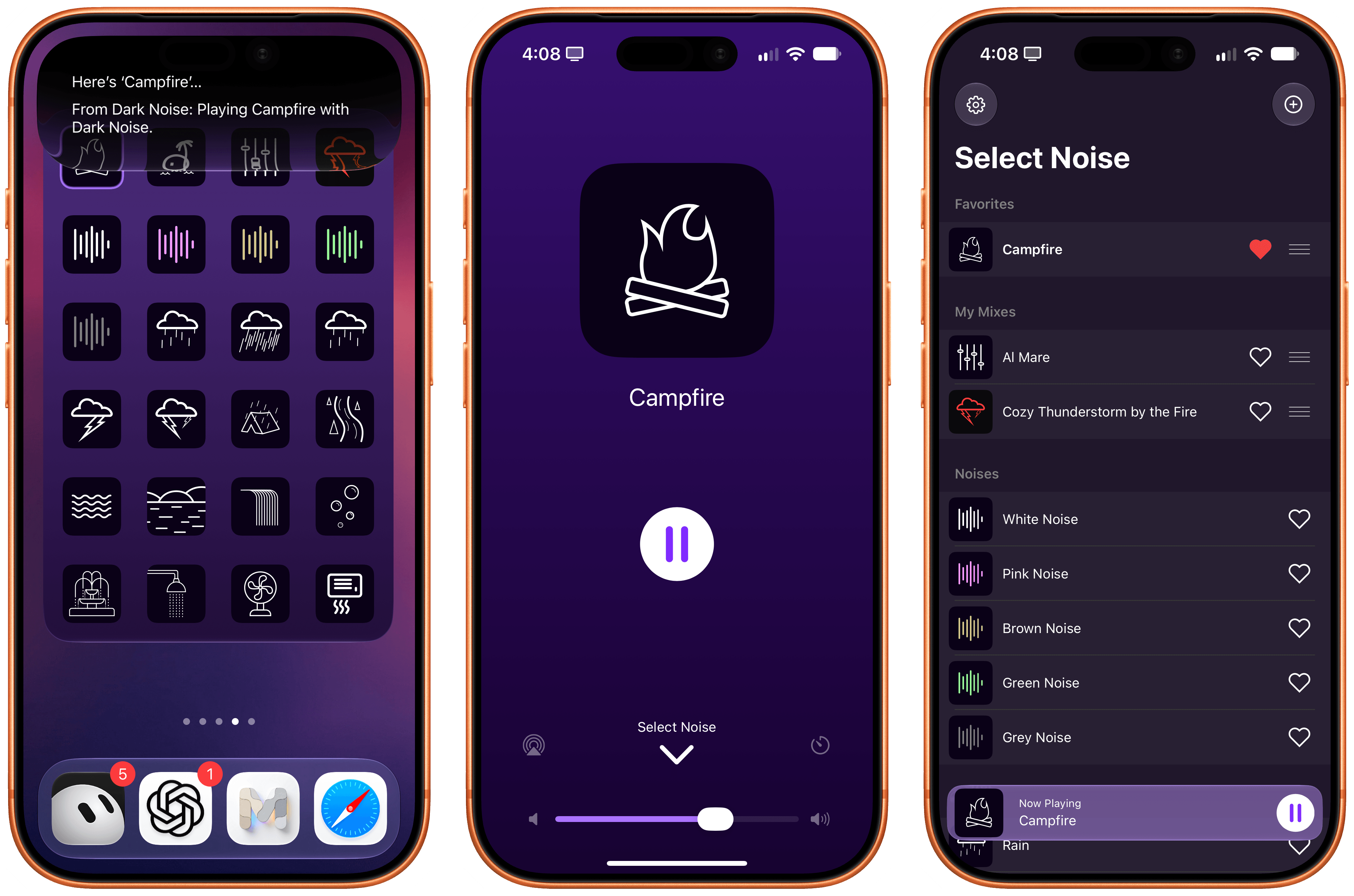
As you can imagine, the app also integrates with Siri AI now. Using Apple’s assistant, you can ask to play specific sounds from the app (make sure to add “…from Dark Noise” to your request) and you can also leverage on-screen awareness inside the app itself. While looking at your list of favorites and mixes, for instance, you can say something like “play the second mix”, and since Chapman has properly annotated the app’s views, Siri AI and Dark Noise will know what you mean.

If you, like me, struggle to get work done with music in the background but also do not appreciate complete silence, I recommend installing Dark Noise and creating a few mixes of your own.
AskPlay

I first covered Francisco Cantu’s AskPlay when it debuted on the Mac earlier this year in the App Radar for Club members, where I wrote:

Created by indie developer Francisco Cantu (a name that should be familiar to longtime MacStories readers!), AskPlay is one of the best new Mac apps I’ve tried in a long time, and we will properly review it on MacStories in the near future. The idea is simple: AskPlay gives you natural language control over Apple Music to play or queue songs. The app, which lives in the menu bar but can also be invoked with a system-wide hotkey, brings up a Spotlight-like floating search box where you can type or say things like, “Queue some ‘90s hip-hop,” or, “Play something like Oasis,” and have an AI carry out the request.

The app can build mixes for a mood or era, start stations, manage the queue (you can ask to move songs up or down), control playback, and add songs to your library or playlists, and it also answers questions such as, “Who sings this?” You can either type your requests or set a voice hotkey that summons the app already listening, pausing your music while you speak. AskPlay is a bring-your-own-key app, so you’ll need an API key from OpenAI, Anthropic, or OpenRouter in addition to an Apple Music subscription (and a subscription to the app itself).

AskPlay is now on iPhone too, and thanks to iOS 27, it’s become one of my favorite showcases of Apple’s Cloud Pro Foundation model running in Private Cloud Compute. Unlike the original version, AskPlay now lets you hand off prompt processing to a reasoning model in the cloud at no cost thanks to Apple’s PCC framework for third-party developers. And not only that, but AskPlay is also the first app I’ve seen that lets you choose between the three reasoning modes supported on PCC: light, moderate, and deep.
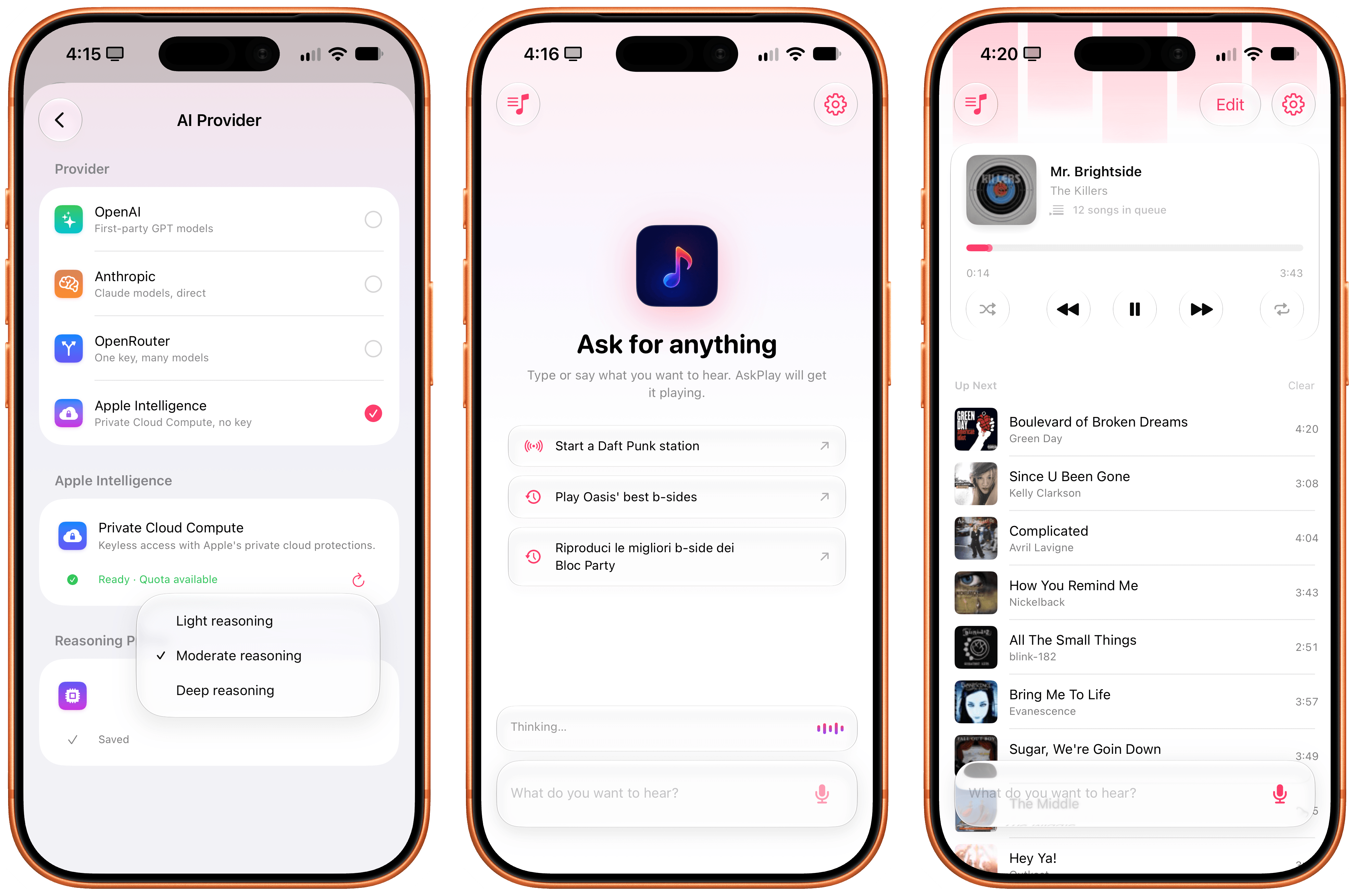
In my experience, I’ve had the best results with the PCC model set to “moderate” reasoning. What this means in practice is that with AskPlay for iOS 27, we now have a way to generate Apple Music-based mixes using natural language with a quality that I find superior to Apple Music’s own playlist generation feature.

AskPlay remains one of the best app debuts of the year, and if you want to demo the capabilities of Private Cloud Compute for third-party apps, you should start here.

LookUp 13

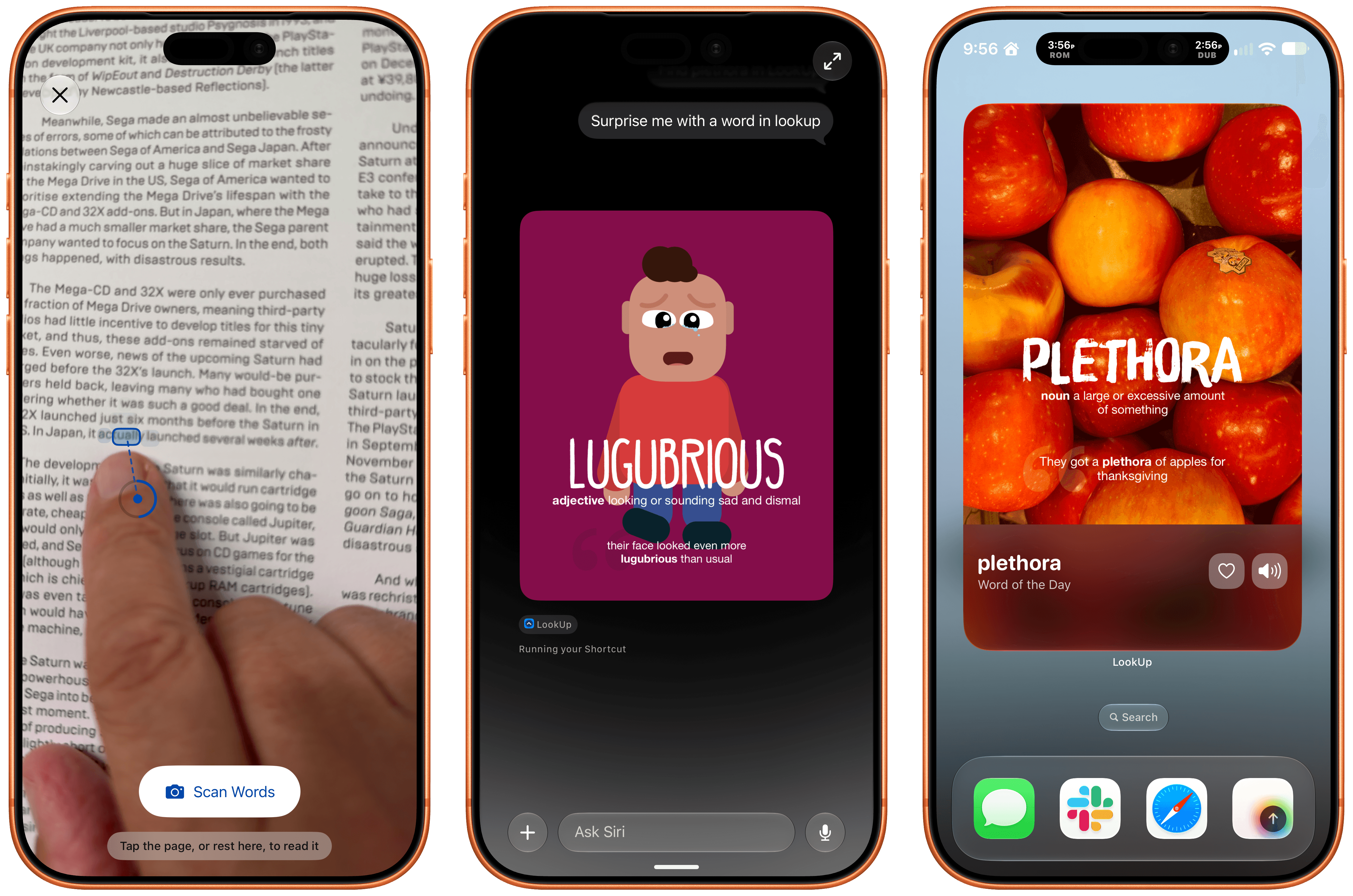
LookUp 13 from Vidit Bhargava has been released with a wide variety of features that make use of iOS and iPadOS 27. The app, which is available on the iPhone, iPad, Mac, Apple Watch, and Vision Pro, makes great use of Siri AI, allowing you to quickly ask Siri things like “Search the word plethora in LookUp,” which opens the app right to that word. Siri can also be used to find LookUp’s word of the day or a random word.
LookUp 13.

LookUp 13.

Beyond Siri, Vidit has added support for Apple Intelligence in the notes that can be tied to a word and combined Apple’s Foundation Models with the Vision framework and hand-pose tracking to let you scan a printed page for a word. Point at a word and the app’s scan mode uses your device’s camera to see which word you’re pointing at. It took a little practice to figure out the right distance from the camera to the page, but once I got that down, it felt like magic. The same feature can pick out other nearby words that might be difficult for the reader, too.

LookUp 13 also offers a Reading Mode that looks up words you speak as you read. The feature uses a Live Activity that listens to you speak, and returns a definition. Initially I ran into some trouble with Reading Mode, but when I tried again later, it worked every time. Also included in the latest release are interactive flash cards that ask for word definitions that are graded by Private Cloud Compute and new extra-large widgets for the word of the day and a shuffled word of the day.

LookUp is an excellent app. I love how Vidit continues to push the boundaries of Apple’s technologies every year, and while I hit a few rough spots in testing, which struck me as issues with Siri AI, not LookUp, I’m impressed by how much depth LookUp’s new Apple Intelligence features add to the app.
Play

The latest update to Play, the watch-it-later app from Marcos Tanaka that works on the iPhone, iPad, Mac, Vision Pro, and Apple TV, includes a bunch of great touches. There’s a new Channels Inbox for navigating saved videos by source. Play has also added Siri AI support allowing you to search for and open videos. Onscreen content is made available to Siri, so you can do things like ask it to remind you to finish a video later, and it knows what you mean. In my testing, all three features work well.
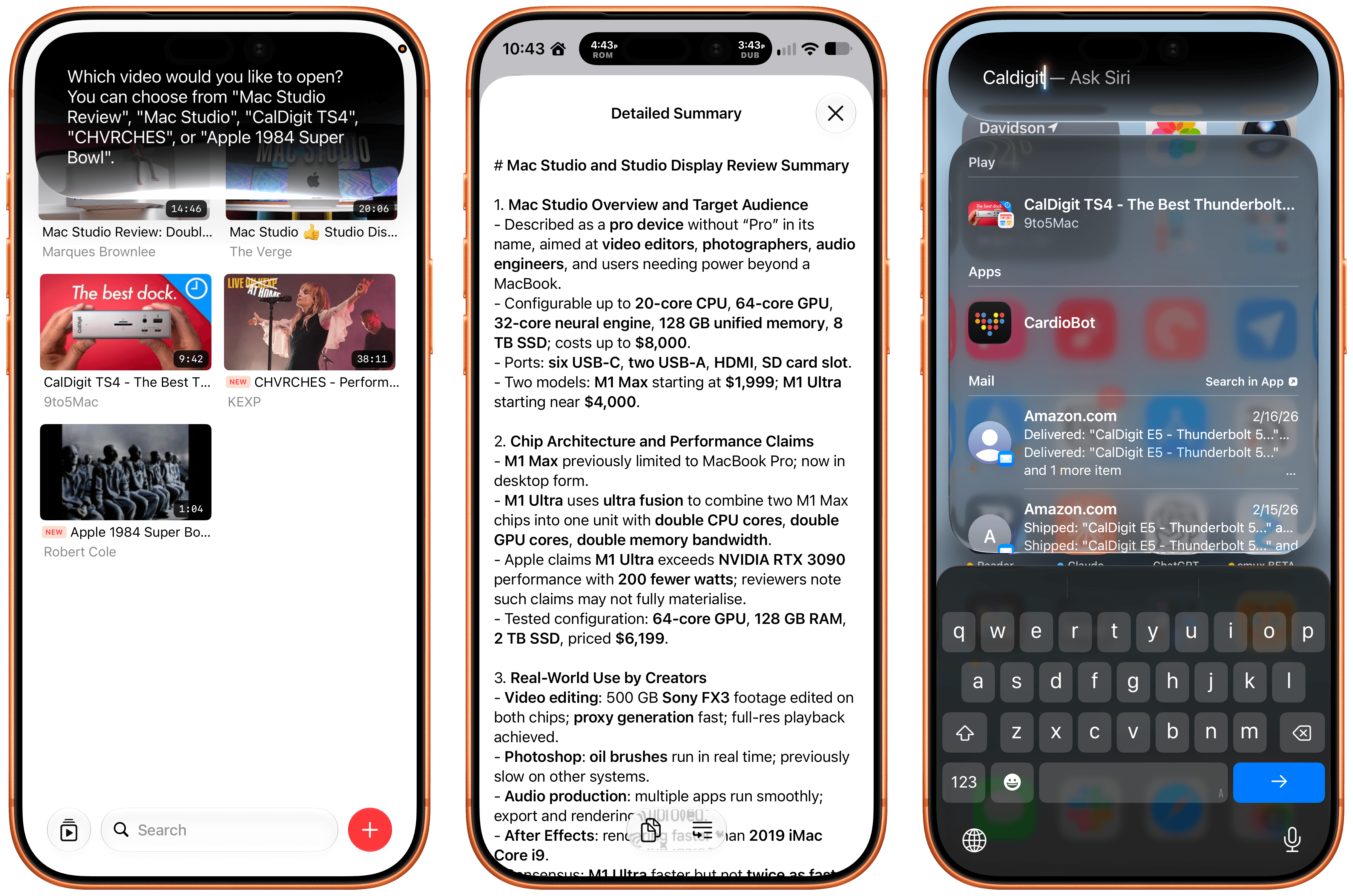
Also, on an individual video’s detail view, you can use Apple Intelligence to create a summary of a video. There are options ranging from a concise summary to a simple explanation. I ran into a roadblock when I tried to create a summary of a fifteen-year-old YouTube video, but more recent videos all worked well. Apple Intelligence can also suggest tags and icons for videos and lets you ask questions, with the answers drawn from the video’s transcript.

Beyond Siri AI and Apple Intelligence, Play adds an extra large widget, a refreshed Liquid Glass design that I love, and Spotlight search. It’s a fantastic update to my favorite way to save videos for later.
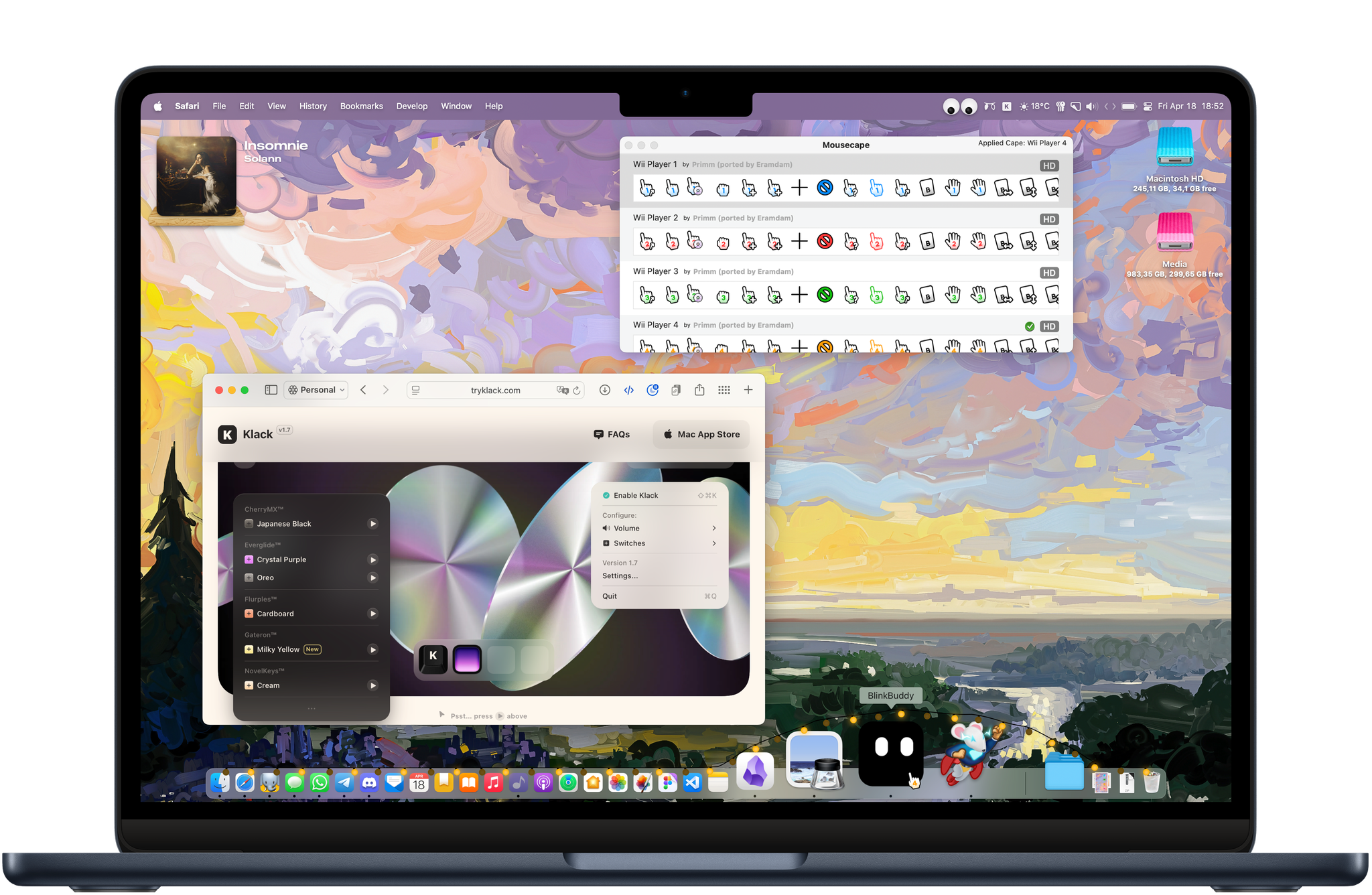
Whimsy Roundup: Six Playful Apps and Customizations for Your Mac

One aspect of macOS that I truly love is the level of customization that it allows for. Out of the box, Apple’s desktop operating system is easy to use, and its user interface has been streamlined over the years around its core principles: apps, windows, icons, and the mouse cursor. That being said, the Mac differs from Apple’s other platforms when it comes to third-party apps. Apps like BetterTouchTool, Raycast, Moom, and Bartender perfectly illustrate how developers are able to create far-reaching, advanced utilities for the Mac, sometimes to the extent of fundamentally changing how you use your computer.

But I’m not here to talk about these powerful apps today. Rather, I would like to highlight the other reason why I am so thankful for this ecosystem of third-party apps on the Mac: they can simply be a lot of fun. Over the past few months, I have collected and adopted a series of small, whimsical additions to my Mac’s user interface. Most of them are nothing short of pointless – except for the fact that they have made using my Mac an absolute joy, even if only in subtle ways.

From custom icons to unnecessary sound effects, here is a roundup of my favorite additions. My hope is that this can be a starting point for anyone willing to join me in the club of more whimsical Mac setups.

Read more


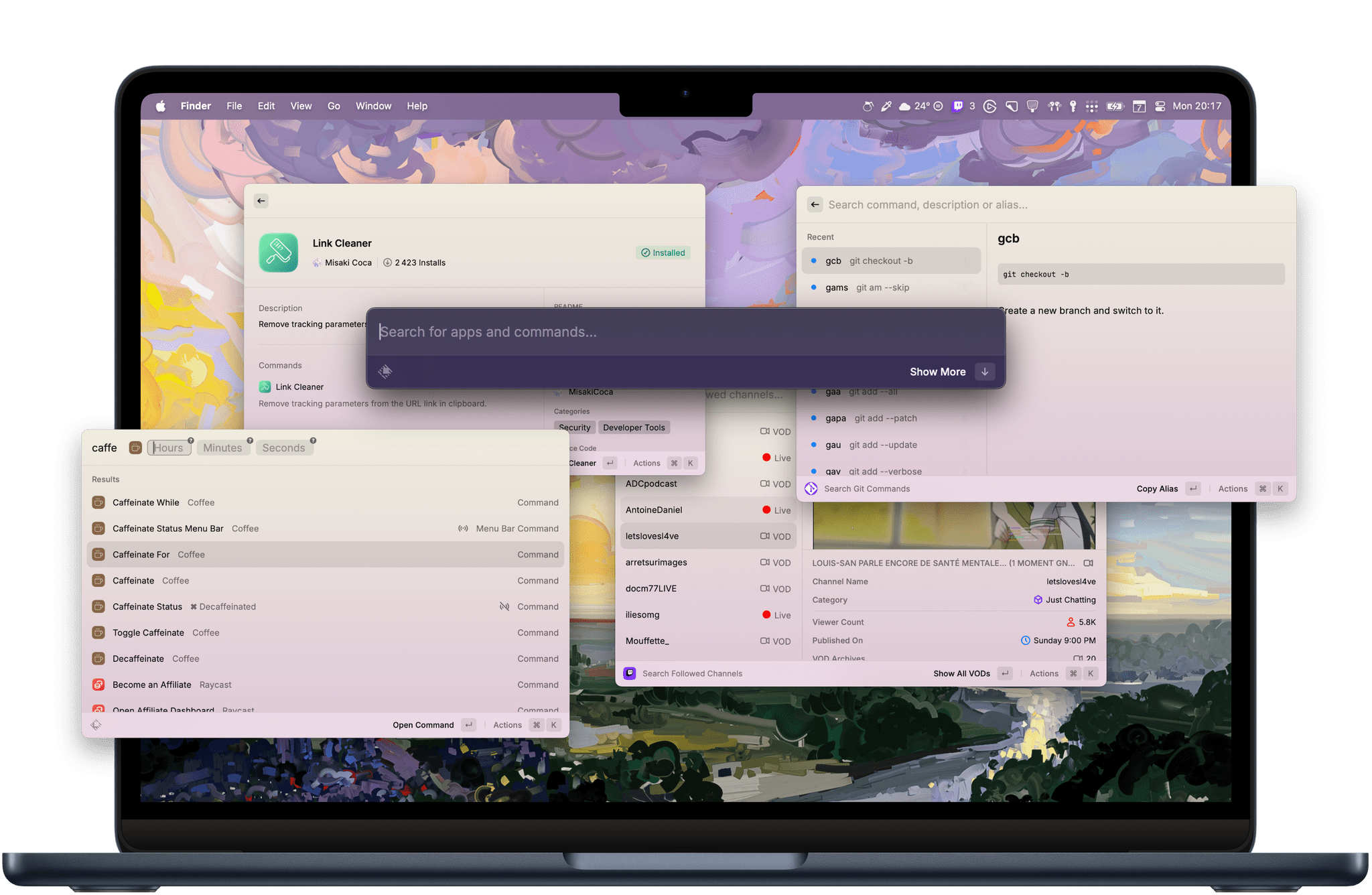
Adding to My Mac’s Swiss Army Knife: A Raycast Extension Roundup

If you have ever heard or seen me talk about my macOS setup, you’ll know that I’m a huge fan of Raycast. A few years ago, Raycast took off on the Mac as an incredible alternative to Spotlight and the long-time Mac power user favorite, Alfred. Today, it has cemented itself as an essential piece of software in my daily workflows.

Raycast’s main strength is that it’s fast. It lets you launch apps, run shortcuts, and manage your windows with straightforward commands, and it is extremely flexible in the way that it allows you to assign keyboard shortcuts and aliases to any command.

That being said, I believe the one aspect of Raycast that drives the tool to its maximum potential is its ecosystem of third-party extensions. Developers can build their own commands and offer them in the Raycast extensions store for free. The store, which users can access by typing “Store” directly in the Raycast search bar, has hundreds of extensions available that vary in functionality and quality. And while some of those optional extensions can be pretty simple or offer a single feature each, the way that they come together to turn Raycast into a Swiss Army knife for your workflows on the Mac makes each of them valuable in their own respect.

So today, rather than highlight Raycast’s well-known built-in features, I thought I would round up some of my favorite optional extensions instead. Here’s a word of warning: some extensions in this list are very specific. But at the same time, though, they’ve each become an integral part of my Mac’s Swiss Army knife.

Alright, let’s get into it.

Read more


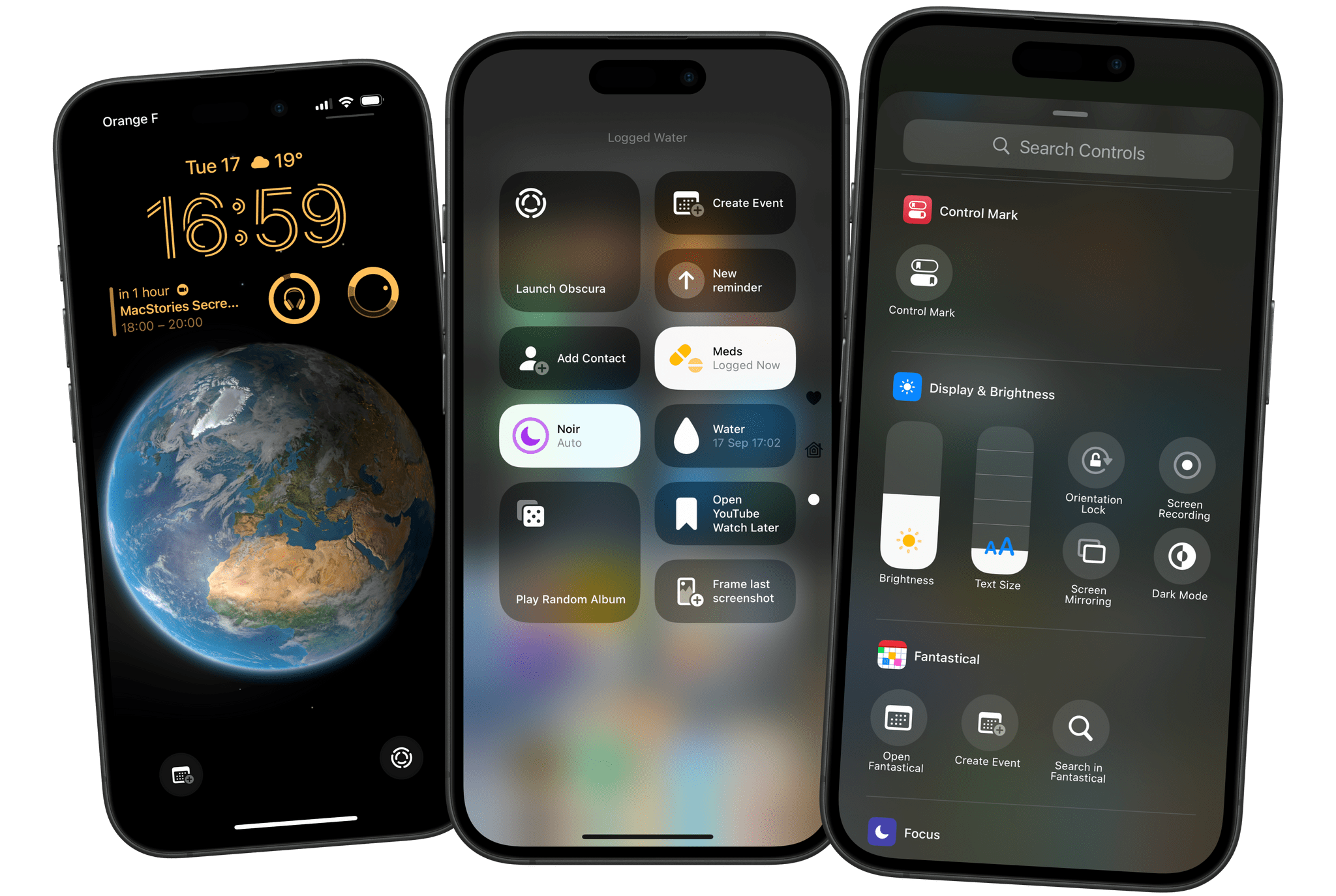
Control Center and Lock Screen Controls for iOS 18: A Roundup of My Favorite Indie Apps

This week, Apple released iOS and iPadOS 18 to the world. One of the main new features this year is the ability to fully customize Control Center. And not only is Control Center customizable, but it now also supports controls from third-party applications. If you open the new Controls Gallery in iOS and iPadOS 18, you will find controls and toggles from some of your favorite indie apps that have been updated to support the new release.

In addition to being available in Control Center, every one of these third-party controls can be mapped to the Action button on the iPhone 15 Pro or newer, and they can used to replace the two default controls at the bottom of Lock Screen – Flashlight and Camera – which have been there since the introduction of the iPhone X in 2017.

While you may think at first that there’s only so much you can do with a simple toggle in Control Center, the range of possibilities that this enables is actually pretty wide. That is why, today, I’m taking a look at a selection of apps that have been updated to offer their own controls for Control Center and the Lock Screen. They’re all unique, and some of them are unexpectedly powerful.

Let’s jump in.

Read more


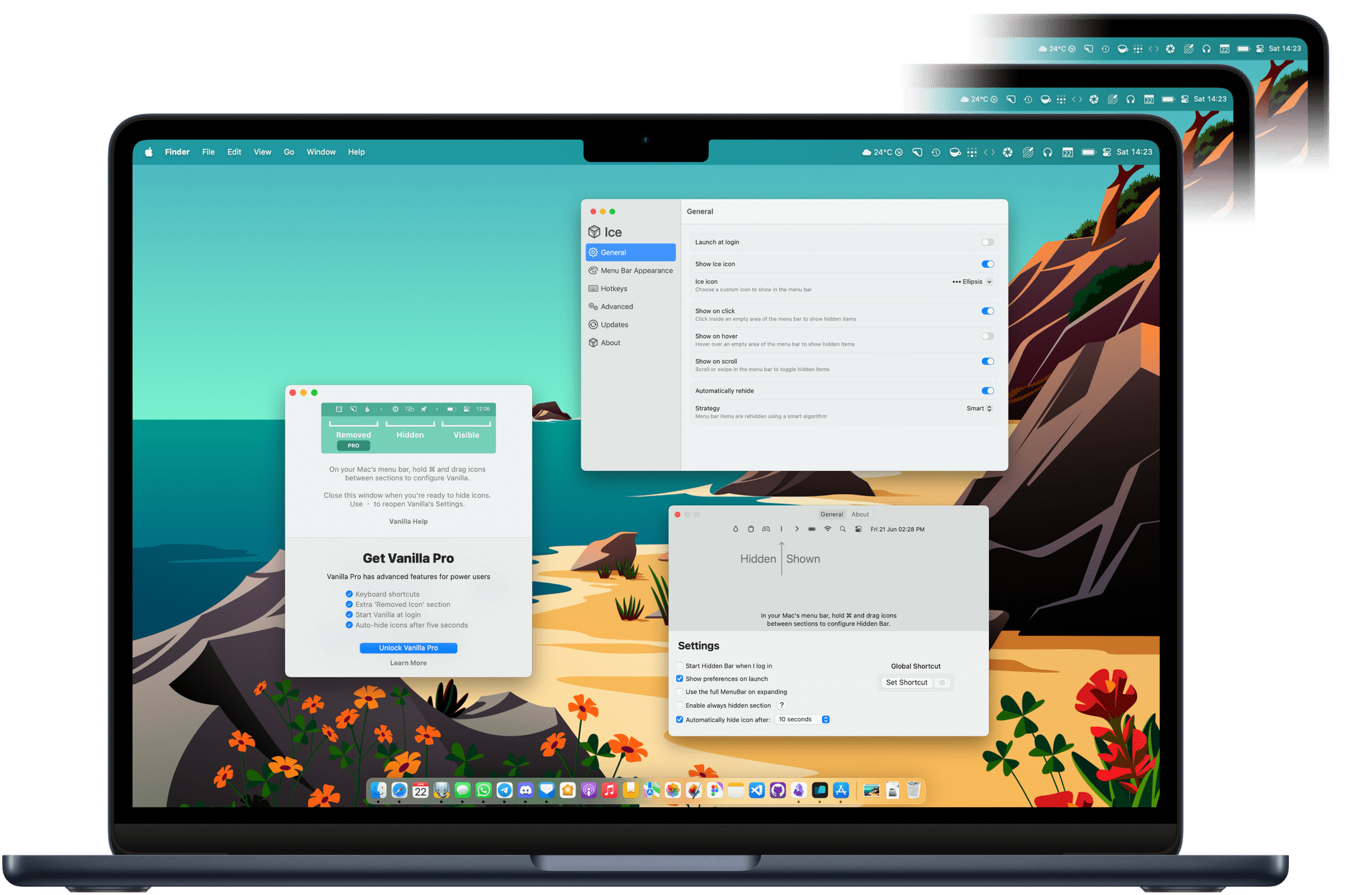
Managing Your Mac Menu Bar: A Roundup of My Favorite Bartender Alternatives

For years, Bartender has remained one of the best ways to manage the Mac’s menu bar, especially on newer MacBook models with a notch where menu bar real estate is even more valuable. I reviewed the great Bartender 5 last year and came away impressed. Unfortunately, though, my relationship with Bartender is not in a great place today.

Three months ago, the app was silently acquired by a company called Applause. Obviously, acquisitions happen, and often without any hiccups. In this case, however, users were caught off guard as the new owners had to renew all of Bartender’s certificates. This caused a permission reset for everyone who had the app installed on their Mac, prompting some understandable concern on Reddit, where the new owners finally started explaining what was happening. Up to that point, no one was even aware that the app had been acquired.

Apps like Bartender tend to require numerous sensitive system permissions to work. It makes sense: there are no native APIs provided by Apple to manage the menu bar, which is why Bartender has no choice but to rely on accessibility APIs and screen recording access to power its features. But this is exactly why a silent acquisition can be worrying. Even if both the original developer and the new owners have since clarified the situation, it’s hard to trust an unfamiliar company with all of these system permissions when they’ve already failed a necessary trust exercise on day one.

If your trust in Bartender has wavered as a result of this series of events, you may be looking for alternatives. I have been, too. So, I’ve rounded up some of my favorite menu bar management utilities available right now and even a couple of macOS tips to help manage the menu bar without having to install any third-party apps at all.

Let’s check them out.

Read more


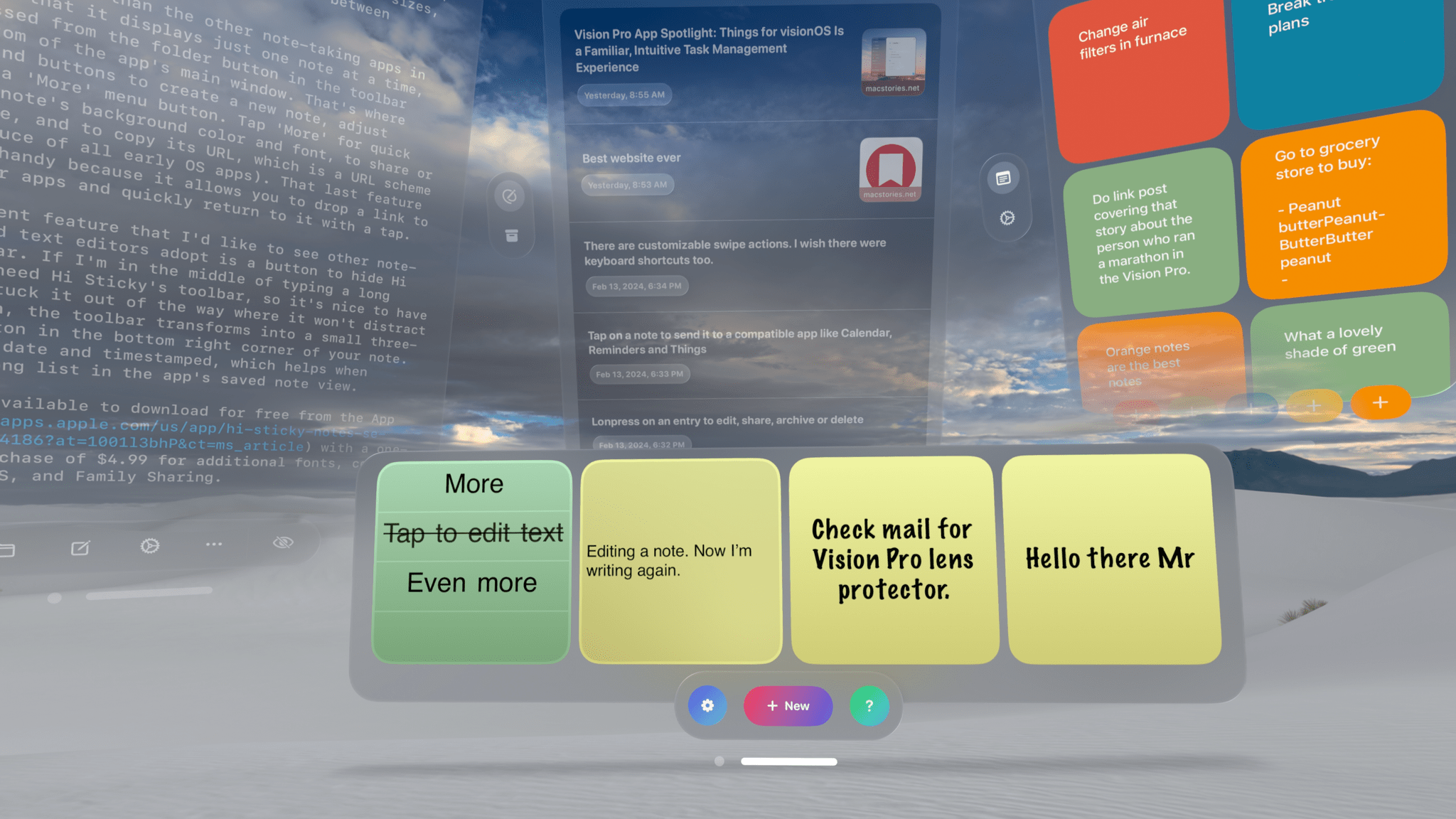
Vision Pro App Spotlight: My Favorite Ways to Take a Quick Note

One of the advantages of working with the Vision Pro is the flexibility of using your surroundings to spread out. Your entire room becomes your workspace, and if you’re in an Environment, your workable space expands even further. That makes it easier to keep a note-taking app open at all times than on any other device. In turn, that makes having an app to quickly jot down your thoughts all the more useful.

There are already quite a few interesting note-taking apps on the App Store, so I wanted to highlight a handful I like, each of which has something unique to offer.

Read more


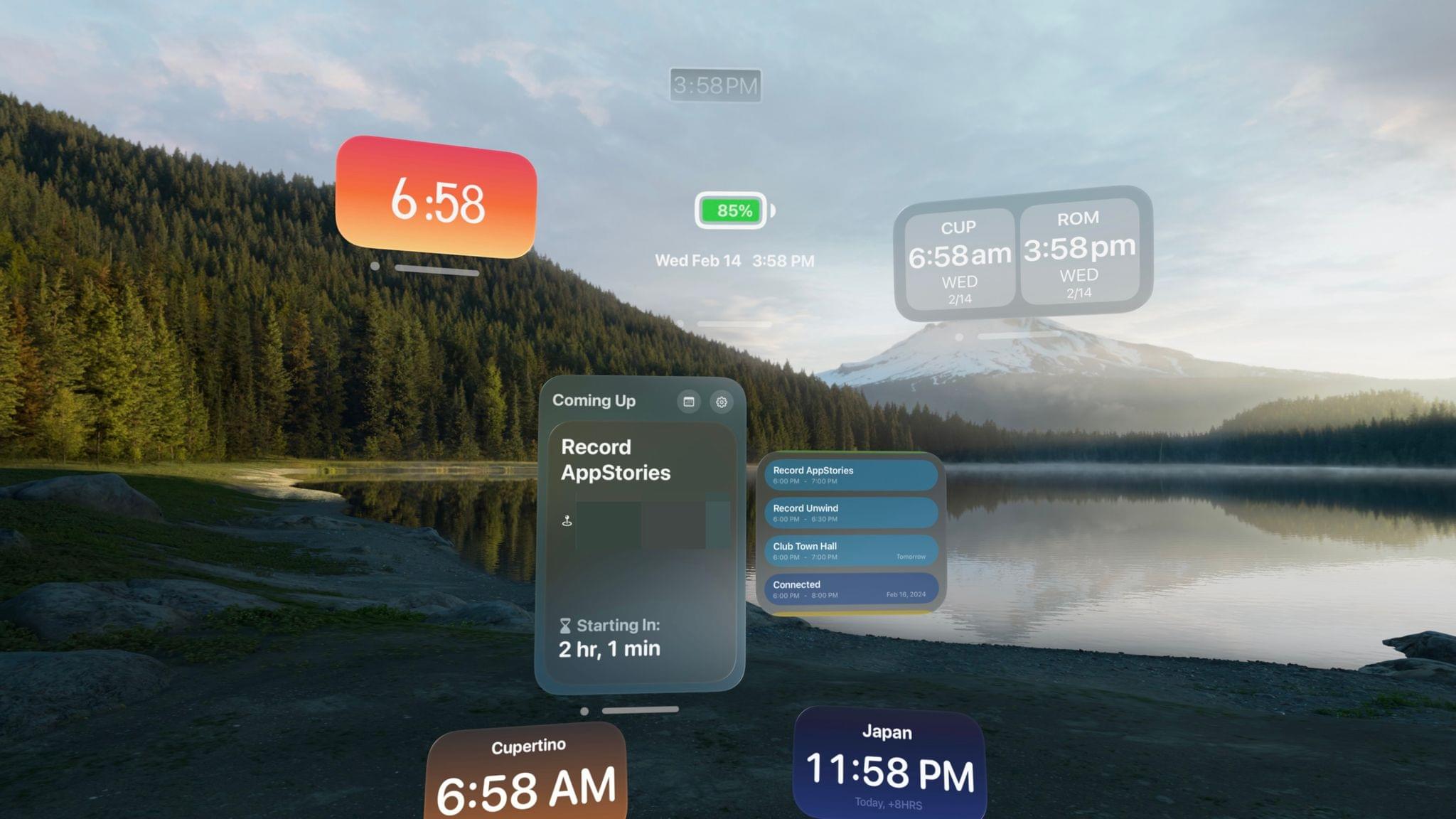
Vision Pro App Spotlight: My Favorite Digital Clock Apps for Vision Pro

It's clocks all the way down.

It’s clocks all the way down.

Who would have guessed that the category of visionOS apps I’d obsessively download from the App Store would be…digital clocks?

Hear me out: it’s very easy to lose track of time when using – and especially working with – the Vision Pro. It’s not just that the current time, in the absence of a status bar – is tucked away in Control Center, which requires you to look up and open a separate window; it’s that with this new platform, and with all these new apps, I want to try everything and my brain is reacting to dozens of stimuli every minute. Time flies when I’m wearing the Vision Pro, filling my workspace with windows and juggling multiple tasks, and that’s not even to mention when I’m in an immersive environment.

Which brings me to humankind’s greatest invention: the clock. Wouldn’t it be nice if you could always see a digital representation of the current time as a tiny window somewhere in your workspace? And wouldn’t it be even better if that digital clock had configuration options that, you know, a physical clock on a wall can’t offer?

For the past few days, I’ve been downloading essentially every clock app I could find on the visionOS App Store, and I’ve compiled a list of my favorite options so far.

Let’s dive in.

Read more


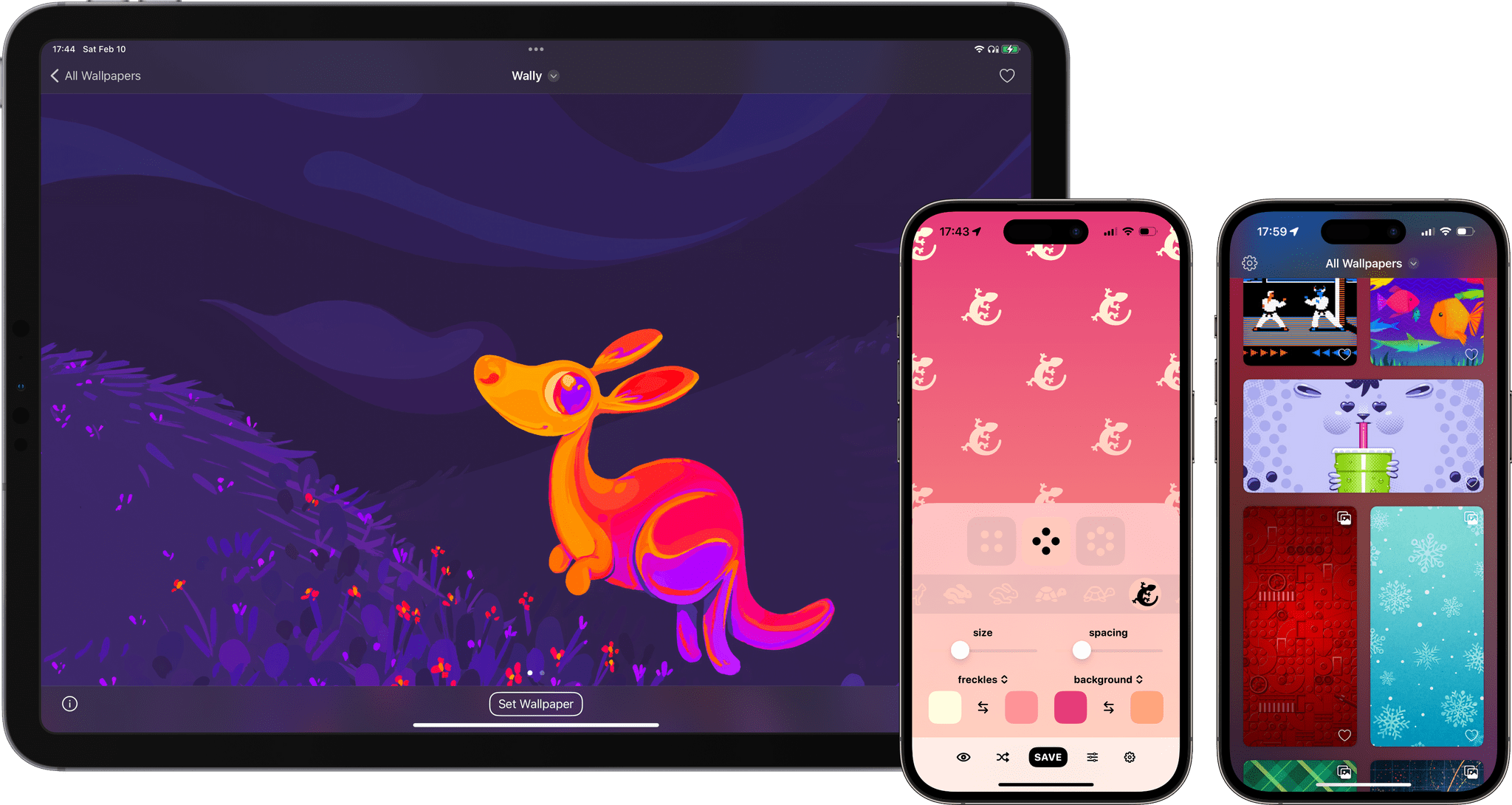
Wallpaper Frenzy: A Roundup of My Favorite Wallpaper Apps, Tools, and Artists in 2024

Wallpapers have always been a reflection of my often chaotic energy. I can sometimes spend months, or even years, without ever changing my wallpaper, and I can spend that same amount of time just frenetically changing it every day until I’m completely satisfied. A lot of that decision process is completely irrational, but I do know what I’m looking for when choosing a new wallpaper. It must be high-resolution, vibrant, colorful, and it mustn’t look too busy.

Early this year, I once again started going through a frenetic wallpaper-hunting phase. It turns out, high-quality wallpaper apps in the App Store are not that easy to find. I have frequently come across wallpaper apps that are filled with scammy ads, and sometimes even seem to contain stolen artwork. So I am seizing this opportunity to round up and highlight some of my favorite high-quality wallpaper apps, tools, and artists on Apple’s platforms in 2024.

Let’s check them out.

Read more


Fitness+ Review Roundup

Apple debuted Fitness+ yesterday alongside iOS and iPadOS 14.3. The service, which integrates tightly with the Apple Watch, offers workout classes on the iPhone, iPad, and Apple TV, and uses the Apple Watch to track your heart rate and other metrics. There are ten types of workouts available that are designed to accommodate beginners through experts. New workouts are recommended based on what you’ve done before and can be filtered by criteria like trainer, time, and music.

Apple invited a long list of press from health and fitness publications and a few from the tech world and other media outlets to try Fitness+ in advance of its launch. Here’s what some of them had to say:

Nicole Nguyen of The Wall Street Journal remarked on something that a lot of reviews highlighted:

What differentiates Apple’s app is its approach to workout newbies. There is a starter collection of videos designed for anyone who is “brand new to exercise,” as a sort of introductory course to each of the app’s disciplines. And even in the harder sessions, one of the trainers in the background offers a modified version for less-advanced practitioners.

Molly Ritterbeck appreciated the emphasis on beginners too in an in-depth review for Runners World:

This smart programming is not unique—there are competitor services that also do this well—but it is one feature that sets the service apart from the majority of apps out there in the oversaturated fitness category. There is a real risk of injury and getting in over your head for beginners, which can lead to decreased motivation or just quitting altogether, so this thoughtful approach is a highlight.

Read more