Posts in news

iKeyboard Promises A Better Typing Experience On The iPad

I bought an original iPad last year, and an iPad 2 when it came out in the United States on March 11. If there’s one thing I had to get used to during this last year when using the tablet, that would be the virtual keyboard. Coming from an iPhone background the use of a virtual keyboard on the iPad instead of a physical one wasn’t a surprise (is there really anyone who thought Steve Jobs would accept keys on the iPad’s screen?), but still it required some serious exercise to get actual writing done. There’s no shortage of apps for writers and the iPad is also a great email machine, but getting used to fast typing on the large virtual keyboard was hard. Like most iPad users, eventually I managed to overcome my issues with ”hunt-and-peck typing”, and now I write any kind of piece or email message on my iPad just fine – perhaps not as fast as I could on my computer, but still fast enough to enjoy the experience provided by apps.

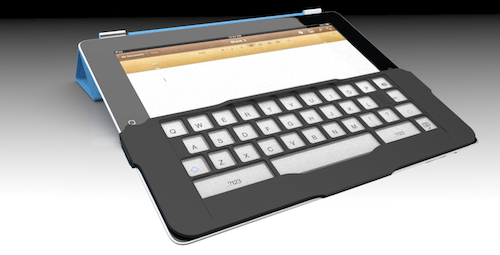
However, some people clearly couldn’t get to fully appreciate or get used to advantages offered by iOS’ virtual keyboard, opening the door to a plethora of alternative solutions like cases with built-in keyboards and external Bluetooth keyboards to carry around all the time. The iKeyboard, a Kickstarter project you can check out here, aims at offering a solution between virtual typing and external accessories, adding minimal weight and bulk to your iPad, still promising to dramatically improve your typing experience.

Once placed on top of the virtual keyboard, the physical iKeyboard will simply provide better tactile feedback and give you a sense of the distance between keys on screen. The creator explains:

My solution is to provide the feedback missing from a virtual keyboard by “grafting,” or piggybacking, a real keyboard onto the screen. My invention—the iKeyboard—will sit atop the virtual keyboard and be lightweight. It will add little bulk and not increase the footprint of the tablet. It will be easy and fast to deploy and remove.The iKeyboard will improve accuracy and typing speed, letting tablet users do real writing. It will set the brain free. In certain settings—the lecture hall, the library, the classroom—the iKeyboard will be an essential tool rather than just a useful accessory.

I’m not sure about the convenience of constantly adding and removing an accessory from your iPad’s screen, but I have to say this idea sounds more intriguing than stuffing your tablet into a bulky case or being forced to use an external keyboard for writing long documents. You can contribute to the project on Kickstarter, and check out the promo video below. Read more

Survey Shows iPad Still Primarily Used for Web Browsing, Email, Video

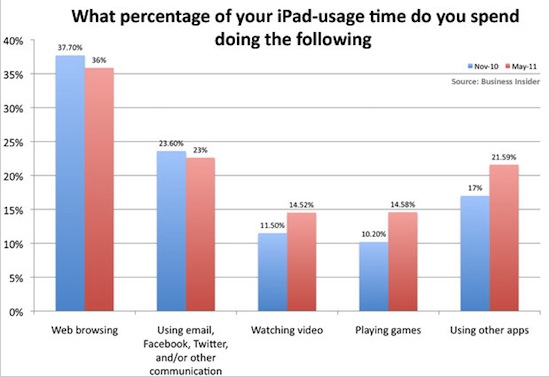
In an unsurprising turn of events following the launch of a survey among readers who own an iPad, BusinessInsider posts a chart detailing how people use an iPad. And unsurprisingly, the usual suspects are on top: the chart shows people use iPads to browse the web (36% in May 2011, 37.7% in November 2010), whilst 23% rely on the tablet for their email needs and communication skills happening on Twitter, Facebook, or other social networks that presumably have a native iPad app, otherwise that would count in the “web browsing” section, I guess. The iPad is also strongly used to watch videos (14.52% up from 11.50% in November 2010), play games and “use other apps.”

The end results of this survey don’t come as a surprise to anyone, but they confirm a widely popular theory – that Safari is the most powerful app Apple could have ever bundled with the iPad and iOS by default. Not only does Safari replicate most of the functionalities seen on the desktop, with the recent iOS 4.3 update it also got some nifty new Javascript engine that makes opening webpages blazing fast. That’s why every little feature that didn’t find its way into Safari and is requested a decent amount of users can become the reason to develop an alternative browser for iPad. The browser on the tablet is the best way to access the internet – it is for me, and clearly it is for other people, too.

What about those other apps? Watching videos with Plex or other media managers is a great experience, especially when combined with AirPlay and an Apple TV in your living room. Playing games? Between Angry Birds and Sword & Sworcery there’s plenty of choice to go by. Other apps? They must refer to things like OmniFocus, Simplenote, LogMeIn, Instapaper and Screens. It’s all about the apps, but Safari is still king when it comes to spending time with an iPad, browsing the web.


15% Of App Launches Happen Offline

According to a recent study by mobile analytics firm Localytics, 15 percent of applications for mobile devices (we assume these include iOS and Android handsets) are launched while a phone is offline, out of 3G / 4G / WiFi range. By analyzing data sent to their servers by apps that integrate Localytics’s framework in their code and comparing the app’s launch time with the delay in receiving the data (Localytics works in real time), the firm came to the conclusion 15% of apps are opened while a device can’t connect to the Internet.

Localytics records if the app is used while offline or online and can report if the connection is via 3G, Edge or WiFi. Localytics is also able to determine whether an app was actually used while online or offline by looking for large differences in the time between an app being opened and analytics data being uploaded. Having done so across the thousands of phone and tablet apps using Localytics, with over 10 million app starts per day, we found that about 15% of all app launches were made without Internet access–customer engagement that would be missed using web-centric analytics tools.

This, of course, is a major problem for app developers and something that will, once again, sparkle the discussion between evangelists of mobile web apps and those who believe native apps are the future of smartphones and tablets. A native app’s obvious advantage, in fact, should be the possibility to always display some kind of content even when in offline mode, as the app doesn’t run in the browser and thus shouldn’t require an internet connection to visualize information on screen. Indeed, several apps make great use of local caching systems – such as Instapaper and Spotify – that allow users to “download” content to consume later when the device will likely be offline – for example, during a subway trip or on an airplane. Many times, however, I’ve stumbled upon applications that in spite of their “native” nature are unable to meet these basic requirements of always-available offline access; too many iPhone and iPad apps are effectively nothing but local interfaces to web apps and tools that can’t display content without an internet connection. On the other hand, there are also applications that don’t let users cache content (presumably the best way to access anything, anywhere at anytime), but still visualize content while offline and transmit changes back to their servers when the device comes back online.

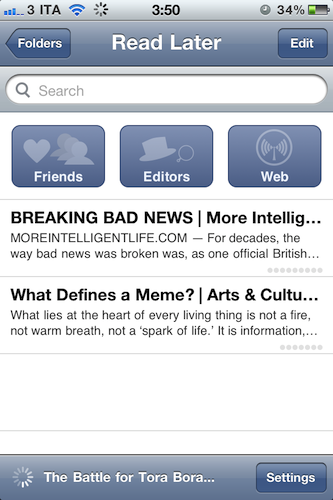
15 percent is a big number, and I’d be curious to know the detailed percentage of iOS apps by device Vs. Android apps by device –if Localytics will ever release it. On a broader level, it’s undeniable developers should do more than throw up a blank page on screen when the Internet fails. Apps like Instapaper, The New York Times, Spotify and Read It Later are great examples; others should do more, too. [via GigaOM]


Apple I Comes Back To Life In Italy

Remember the Apple I that was auctioned off at Christie’s in London last year, and was sold for roughly $220,000? It turns out, the machine was bought by Italian entrepreneur Marco Boglione, a long-time Apple user and fan who spent €150,000 to buy the #82 copy of the original Apple I – a computer that back in the 1970’s was sold by Steve Jobs and Steve Wozniak in Jobs’ garage at $666.66, and was the first machine to come with 8K of RAM. The item sold at Christie’s to Boglione included the original motherboard, manual and a letter from Steve Jobs, but no screen or keyboard.

The computer was rebooted for the first time in years today at the Politecnico di Torino university in front of a large crowd and Boglione himself. Italian website Macity, which was there to cover the event, reports [Google Translation] after an initial technical issue that was fixed in a couple of minutes the Apple I was able to start up, display its usual list of random characters upon booting (while connected to an external display and keyboard this time), the typical blinking cursor and then, after running a simple BASIC program, a sort of “Hello World” message appropriately changed to “Hello Polito” in honor of the school that hosted the event.

Boglione and other attendees went on to stress the importance of the Apple I, and the revolution in the computing space Jobs and Wozniak started 35 years ago in a garage in California. Apple has become the tech giant we all know today, but the very first computer produced by the “visionary and the engineer” is still here to remind us how great ideas and technology survive through time.

Check out a video of the booting process and a photo of the motherboard below. Read more


Apple Stops Serving iAds In Apps Targeted To Kids

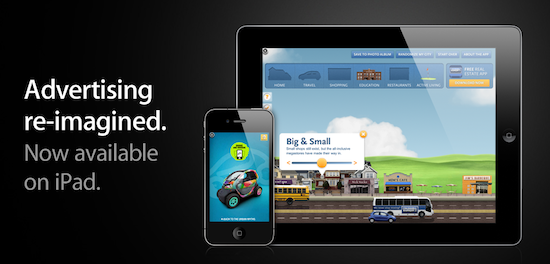
Since its introduction last year, Apple’s iAd advertising network has been off to a somehow rough start: touted as the best way for advertisers to build interactive campaigns to deliver effortlessly to iOS users, the service was repeatedly criticized by advertisers and ad agencies due to Apple’s strict design requirements and control, expensive minimum buy and low fill rates compared to Google’s AdMob network. In the past months, Apple tried to address several issues reported by iAd’s initial partners: they released a desktop tool to design iAds visually on a Mac, they cut the minimum buy in half from $1 million to $500,000, and rolled out fullscreen ads with even more interactivity on the iPad. They updated the official iAd website to display more information and details, and released an iPhone app entirely focused on showcasing experiences built for the iAd network.

A change in the way Apple chooses the apps that can display iAds, however, might cause a little bit of confusion among developers that, until now, have relied on iAds as the sole source of income for their free apps. Mike Zornek, developer of the free Dex app for iPhone and iPod touch (a Pokèmon browser application), relays an email from the iAd Network Support team in which an Apple employee explains how iAds may not be displayed anymore in apps targeted to “young children” because of the advertisers’ preference to not show ads to this particular audience. Read more


IM+ 5 Updates to 5.0 With Neighbors Location Service

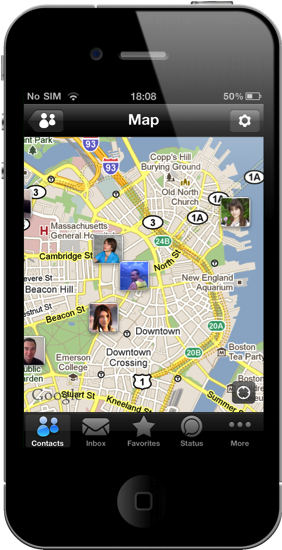
ShapeService’s popular instant messaging app for iOS, IM+, has updated to version 5.0 today bringing a neighbors location service for chatting with friends and persons in your vicinity. IM+’s new Neighbor enables persons to find friends and chat with people whom have similar interests nearby. It isn’t too dissimilar from something like Google Buzz, with the exception that your location can be tightly controlled by exact, approximate, or city based positioning accuracy. While I see a service such as this being useful for natural disasters or emergencies, Neighbors is advertised as a way to initiate conversations, make new friends, and find people of interest using the IM+ service in your local city. Merchants looking for an alternative to Craigslist may find great use in Neighbors, updating their status to include products being sold while giving them the opportunity to talk with customers in real time. Friends and neighbors are displayed on a map with their respective avatar, giving users an overview of those that are nearby.

Version 5.0 also includes the ability to delete your account history, fixes numerous bugs, and includes some visual tweaks to the service icons. IM+ has long been known as the instant messaging client that does it all on the iPad and iPhone, and is available for free on the App Store or you can pick up the Pro version for $9.99 as a universal app.


Music Beta by Google: Mac Uploader, Flash, iOS Safari Playback

At its I/O conference earlier today, Google officially announced a new cloud service called “Music Beta” which, similarly to Amazon’s Cloud Player, allows users to upload their music collections and playlists to the company’s servers, and play them back anywhere on a web browser, tablet or smartphone. Like Amazon, Google’s service has a few limitations for now: it doesn’t come with a native iOS app as it’s only got an Android app for compatible smartphones and tablets, it requires Flash in some sections of the website and it’s restricted to US access only. Music Beta is, well, a beta product by Google, and it’s free for now – Google didn’t mention how much uploading and streaming 20,000 songs once the service hits stable status will cost you.

As detailed by MG Siegler at TechCrunch, Music Beta comes with a native Mac uploader that can look through your iTunes library and playlists or hard drive contents to find songs and albums to upload. On desktop browsers, MG Siegler says Flash is required for playback as indeed a screenshot of a technical error seems to prove, whilst Cnet claims Music Beta can stream songs on iOS devices as well, without Flash, using Mobile Safari. It was discovered a few days ago that Amazon’s Cloud Player quietly rolled out iOS Safari support, and it’s unclear at this point whether Music Beta really works on iPhones or iPads, meaning Flash is only required for some transitions and animations. As more users are invited to try the product, we’ll make sure to check Mobile Safari compatibility. Read more


Photo of Clipless Next-Gen iPod Nano with 1.3 MP Camera Surfaces

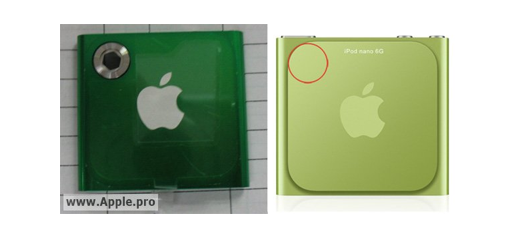
MacRumors points to a photo posted by Taiwanese website Apple.pro [Google Translation] of what they claim to be a seventh generation iPod nano featuring a 1.3 megapixel rear camera. The website, often a reliable source of Apple rumors and product leaks, posted a similar picture of the iPod nano’s case back in early April, but the photo detailed the internals of the device showing a hole for the alleged camera, failing to explain,however, how the camera would be placed externally considering the clip Apple places on the iPod nano’s back. Today’s photo seems to confirm previous speculation that, in order to make room for the camera, Apple would have to ditch the clip entirely, although it doesn’t make much sense considering Apple has been heavily touting the iPod nano as a sport accessory that can easily clip to your shirt or trousers – it’d be a curious choice for the company to revert to a clipless design to make room for a camera on such a small screen.

It’s unclear whether this new photo belongs to an iPod nano prototype Apple has been testing, or the final version of the next-generation model as Apple.pro claims. A 1.3MP lens would make for some decent photography on the nano’s screen, and indeed previous generation models featured a camera for shooting flicks and applying effects – although on a bigger screen and different case design. Since its introduction last year the 6th generation iPod nano has become an incredibly popular accessory thanks to the inclusion of a clip by default, and it’ll be interesting to see if Apple is really going to change the design for a rear camera. An announcement will likely be made in September at Apple’s usual music event, leaving plenty of room to speculation and rumors in the next months.


Apple’s Guy L. “Bud” Tribble Explains Location Tracking at Senate Hearing

At a U.S. Senate hearing this morning entitled “Protecting Mobile Privacy: Your Smartphones, Tablets, Cell Phones and Your Privacy”, Apple’s Vice President of Software Technology Guy L. “Bud” Tribble offered his remarks about Apple’s privacy policy, location tracking system implemented in iOS devices and App Store app control, reiterating many of the points already explained by Apple two weeks ago in the Q&A on Location Data.

As summarized by AppleInsider, Tribble testified before Senate members that Apple doesn’t collect personal information about its users nor does the company share any information with advertisers – rather, the cache file that was discovered by security researchers (which was incorrectly large in size and backed up to a computer during the sync process) is meant to store information about nearby cell towers and WiFi hotspots to enable iPhones and iPads 3G to quickly get signal without having to rely on real-time GPS data all the time. This is a crowd-sourced database that Apple keeps in a small amount on every device as an offline cache – personal data and device identifiers are never sent to Apple, Tribble explained.

Sen. Al Franken also asked both Apple and Google representatives at the hearing whether the two companies could add a fixed privacy policy to their app marketplaces to ensure users always know how their personal data is being treated, and what’s going on behind the scenes of an app. Tribble replied a privacy policy in App Store apps wouldn’t be enough as users are likely to skip that every single time – and that’s why Apple believed that adding actual graphical elements to the user interface would be a better, and more elegant solution to inform users about the usage of Location Services. In iOS, an icon in the status bar indicates when an app is sharing your location; every app must ask a user to share his location through a dialog box; in the Settings, users can revoke location access on app-by-app basis and manage other location preferences as well.

Tribble also went on to explain Apple does random audits on App Store apps and follows the tech press and iOS community to find out which apps are violating the privacy rules:

The Apple executive also detailed how his company conducts random audits on applications to make sure they’re playing by the rules. He admitted that Apple does not audit every single one of its 350,000 iPhone applications, just like it would be impossible for the federal government to audit every single taxpayer. Apple also keeps an eye on blogs and its “active community” of application users for potential violations. If a violation is discovered and the issue cannot be resolved, applications will be removed within 24 hours and the developer will be notified.

In most cases, Tribble said, developers quickly correct the issue, as they want to keep their application available in the App Store.

Tribble was joined today by Google’s Alan Davidson. A video of Senator Franken’s opening statement is embedded after the break. Read more