Posts in Linked


Xconomy Gets Hands-On With Automatic for the iPhone

Currently available for pre-order at $69.95 and now shipping in August is Automatic, a combination of a smartphone app and OBD sensor for your car that tracks your driving economy, helps you diagnose problems with your vehicle, and helps you find where you parked. An iPhone app is launching first, with an Android app coming this fall. While it’s only available in the United States, Automatic makes for an attractive alternative against Verizon’s expensive Vehicle Diagnostics by Delphi, which includes a subscription and a whopping $249.99 up front,  or Torque, which works with some Bluetooth OBD sensors but requires drivers to have more intimate knowledge of their vehicles to get the most out of the Android app and web interface.

Xconomy has a short write up and under 15-minute video on the sensor and iPhone app, featuring a test drive with Automatic Chief Product Officer Ljuba Miljkovic.

If these screen shots remind you of the jogging maps and calorie counts you get with a fitness app like RunKeeper or Runmeter, it’s not a total coincidence. You might think of Automatic as one harbinger of a “quantified car” movement paralleling the quantified self craze. Now that our phones have become so powerful—able to communicate with many different kinds of sensors, and full of sensors of their own—it makes sense that they’re becoming the information hubs for all of our daily activities, from exercising to eating to driving.

Automatic is interesting — at a least from a glance, the company isn’t just throwing a slew of information at consumers on a screen, but rather presenting relevant information in an interface that’s understandable and useful. Automatic knows that not everyone is a mechanic, putting the power of diagnostic information at our fingertips. Automatic’s goal is to improve upon driving efficiency, and Xconomy’s look gives a little bit of insight as to what you can expect if you have or will pre-order the much talked about smart assistant for your car.

Permalink

Happy Birthday iTunes Store

Good roundup of iTunes Store numbers (with subsequent inferences) by Horace Dediu.

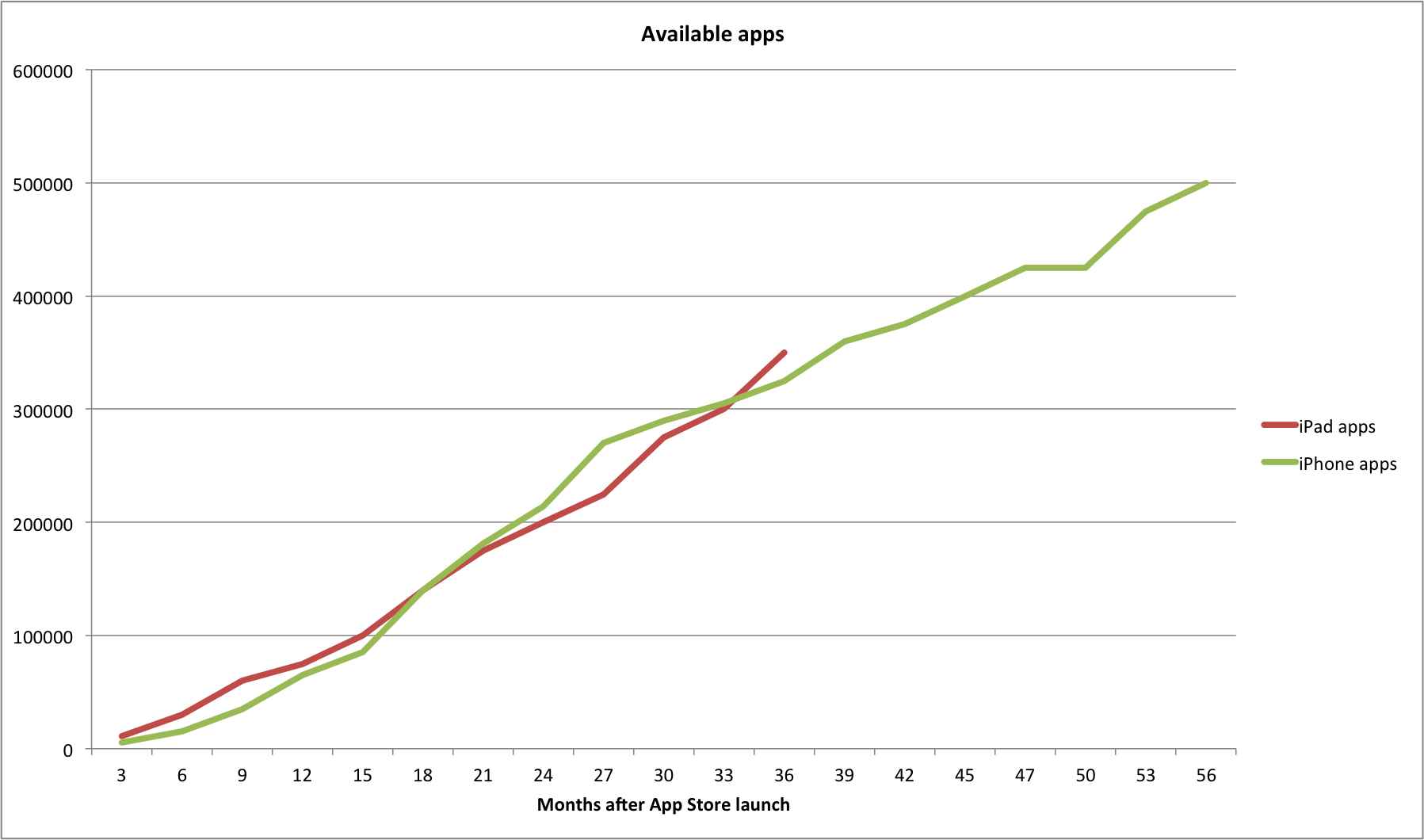
I meant to include the following chart in our Q2 2013 overview, but I didn’t have time to create it. Below, you can see how the 850,000 App Store apps Apple touted last week are divided across the iPhone and iPad after the launch of each device’s App Store (July 2008 for iPhone, April 2010 for iPad).

The increase you see after the iPad’s 30th month corresponds to October 2012 – when Apple unveiled the iPad mini.

(click for full size)

Permalink

Lessons From The Yahoo Weather App

Dan Frommer:

“Do we really need another weather app?” Actually, if it’s better, we do. Imagine if they’d stopped making new search engines after HotBot or new smartphones after the Samsung BlackJack.

I couldn’t agree more.

For free/inexpensive apps, the traditional rules of market saturation allow consumers to more comfortably try new apps; at the same time, annual OS updates enable developers to constantly experiment with more powerful technologies to fix problems consumers didn’t even think they had.

Apps are not refrigerators. With software, the diffusion of innovations is cyclic, and that’s why, as far as the App Store is concerned, editorial curation, smart recommendations, and new discovery algorithms will be key areas of improvement. We should never stop thinking about tomorrow.

Permalink

Why Are Calendar Apps Dumb?

Smart piece by Jason Snell.

There are two key factors involved here: old interface patterns and constant data collection. New designs can be experimented with; parsing data introduces layers of complexity that go deeper than providing a new month view.

Google is working on this kind of technology with Now. It’s plausible to assume Apple is, too.

Permalink


Exploring The Pros and Cons of Freemium Gaming On iOS

Great article by Craig Grannell, who interviewed several game developers.

In particular, this part:

More often, though, you hear about, as Ismail puts it, games specifically designed to be “less fun unless you pay, but just addictive enough that you want to play”. Money and research is poured into analytics, metrics, monetisation and behavioural targeting. “The difficulty for me is you’re then no longer designing the most engaging experience for a player, and are instead designing mechanics around getting people to drop money as often as possible,” says Perrin, who likens this system to the gambling industry.

As a long-time gamer, I still find myself wondering whether In-App Purchases will eventually prove to be a healthy model for the quality and economic viability of games. I like to think that it’s possible to use IAPs without being evil, but that far too many companies are exploiting them. Keep in mind, though, that I’m biased.

Our previous articles on games and IAPs still hold true today: there’s a conflict between economics and goodwill, but I’d argue that, ultimately, value is what truly matters.

Permalink