


That gorgeous app up above? That’s the next-generation Twitter app. Twitter 4.0 melds Twitter’s brand new web experience with your mobile phone, making it easier to discover and share information that matters most to you. Conversations, your activity feed, stories and trends have now been given focus in four new tabs that make Twitter more accessible than ever before.
Posts in reviews
Review: Twitter 4.0 for iPhone
Sparrow 1.5 Hits the Mac App Store with Dropbox Integration and Search Tokens
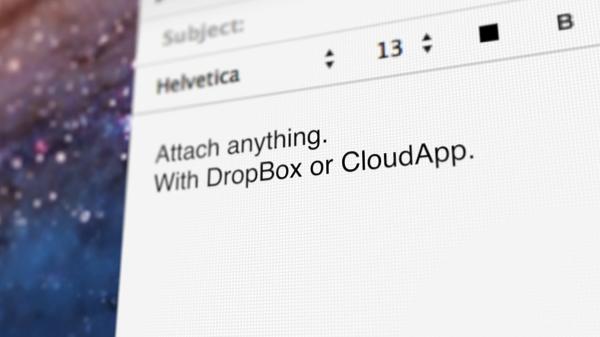
Sparrow, last updated with CloudApp integration (for large email attachments) and pull-to-refresh with version 1.4, has reached a milestone this morning with their 1.5 update now available on the Mac App Store. In this release, Sparrow continues to integrate Gmail natively with optional loading of remote images and token based searching for messages.
Flud 2.0 Brings Social Interaction with a Revamped Interface

While I’ve taken a look at Flud before, its initial resemblance to Pulse left me uninterested. Flud, in their attempt to meld the news you were interested in with social media, never quite stood out enough from the competition or encouraged me to actively share articles with my friends. That was the case, but like Flipboard, Flud has a substantial update with a second version of their social news reader.
Flud 2.0 throws out its sharp-edged interface for an elegant carousel, containing the subscription’s headlines which scroll vertically to reveal more content. The interface, fluid and responsive when article images don’t need to be cached, differentiates itself from the likes of Flipboard and Pulse — sidestepping a magazine or traditional RSS-like experience — by presenting an open canvas (or in other words a very fancy grid) to discover content. There are some similarities with services like News.me in the updated Flud, with the main focus revolving around following your friends or idols who will curate interesting content.
MarkdownMail 3 Adds Mail Templates and Signatures
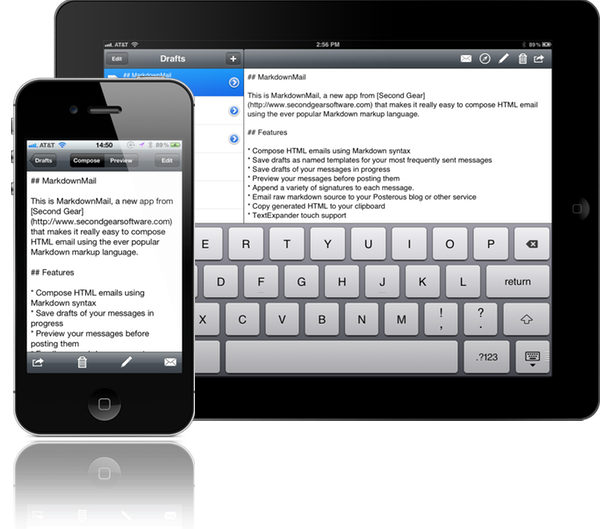
Formatting emails can be a chore if you’re using Mail’s standard RTF text selectors, but it doesn’t have to be. While MarkdownMail is niche tool of choice when it comes to composing messages — after all not many people write in Markdown as a second language — our audience of geeks will love having an outbox where they can quickly program their documents into to something presentable without going through three taps and a popover.
MarkdownMail allows you to draft and compose HTML emails on your iPhone or iPad using the Markdown markup syntax. New users unfamiliar to the formatting won’t be lost thanks to a syntax reference sheet available in the app. If you’re second guessing yourself, HTML output can be previewed before sending the message. Power users can take advantage of TextExpander integration for easily expanding snippets, addresses, and names into their emails. And for those emails that are often sent, MarkdownMail 3 adds a couple new features that make life even easier.
Email templates are great if you’re constantly sending announcements are messages from MarkdownMail to your coworkers or clients. Templates can be saved and used as a base for formatting your emails. Combined with TextExpander, shooting off important information will be done faster than ever. MarkdownMail 3 also introduces signatures support so you can maintain various business, personal, and family identities in the app. The iPhone interface gets an overhaul as well, enabling you to dynamically swap between preview and compose views. The updates address
MarkdownMail 3 is a universal application available on the App Store for only $2.99.
App Journal, Episode 9: The World In 2012, Infinity Blade II, Stamped, VNC Viewer
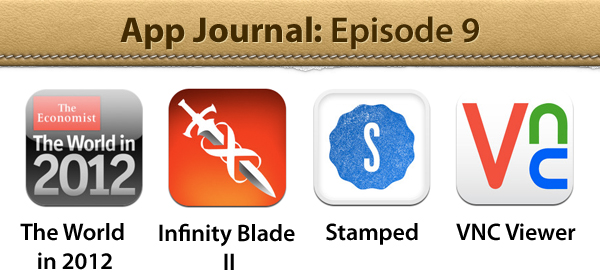 App Journal is a new series aimed at showcasing apps we have enjoyed using on our iPhones, iPads, and Macs, but decided not to feature in a standalone, lengthy review here on MacStories. App Journal is a mix of classic reviews, weekly app recommendations, and a diary of our experiences with apps that still deserve a proper mention.
This week’s App Journal doesn’t really have a central theme, except for the fact that all these apps were either released or updated in the past week. This journal is written by Cody, Don and myself (Graham) with Federico taking a break from the App Journal this week.
The Economist: The World in 2012

It feels like just yesterday that I was celebrating the start of 2011, and yet we have already entered the final month of the year. Being December also means the start of reflecting upon the year that was, and what next year will hold for us all. As part of that, The Economist is publishing a special ‘The World in 2012’ magazine this month and has also released a companion iPad app which includes some of those articles plus a number of videos and other interactive features.
There isn’t anything amazing about the app, it’s just a standard magazine app for the iPad (in other words mostly just static images that you swipe to and from) but its the content that matters. The Economist is a favourite publication of mine that deals with a whole range of economic, political, social and technological issues in an informed and intelligent manner - this special edition is no different. Some of the feature articles included cover the technological battlefields of 2012 (they believe it could be mobile payments, location and augmented reality), the continued rise of social (particularly for the US 2012 Presidential Election), the ‘Arab Spring’ heading further south and political change in China amongst a few other articles.
Interspersed between the feature articles are these panels which review some of the people to watch in 2012, events that are set to occur in 2012, economic figures for 2012 and what each month of 2012 will bring. Most articles also come accompanied with video as well as a few standalone pieces of video interviews with a range of people from different parts of the world - asking them what they think 2012 will bring.
Even if you’re not a fan of ‘magazines’ for the iPad, this free app from The Economist is well worth the download - it’s got great content that will give you something good to read and watch over breakfast for the next week.
The Economist: The World in 2012 is available for free in the App Store.
By Graham
Twitterrific 4.4.3: With More Polish!

It’s been a while since we’ve covered what Ollie’s been up to in his spare time. Twitterrific 4.4.3 — a combination polish & maintenance release — launched this afternoon on the Mac and iOS App Stores. There’s a couple of new improvements here, especially in the iOS edition that’ll delight some and confuse others. So what’s in the rundown? Lots of stuff.
Instacast HD Review: It’s Incredible
I remember when I first reviewed Instacast for the iPhone back in March, declaring it the Twitter of Podcast apps. While possibly dramatized, what Instacast has done for mobile podcasts is what Loren Britcher did for Twitter apps. The interface, lightweight and smooth, capitalizing on common sense gestures and thoughtful design elements, quickly made Instacast one of my favorite iPhone apps. Instacast is the only non-Apple app that has a spot on my iPhone’s dock. An intelligent conversation, a good laugh, and Geek Friday are always just a tap away.
Instacast got smarter. Sure there were times when enhanced podcasts didn’t work or a wonky update caused weird crashes, but they were fixed and plenty of new features were added. Continuous playback always kept a friendly voice on the loudspeaker. Later, iCloud syncing was added in preparation for future updates. Future updates that of course would finally see Instacast taking on bigger endeavors.
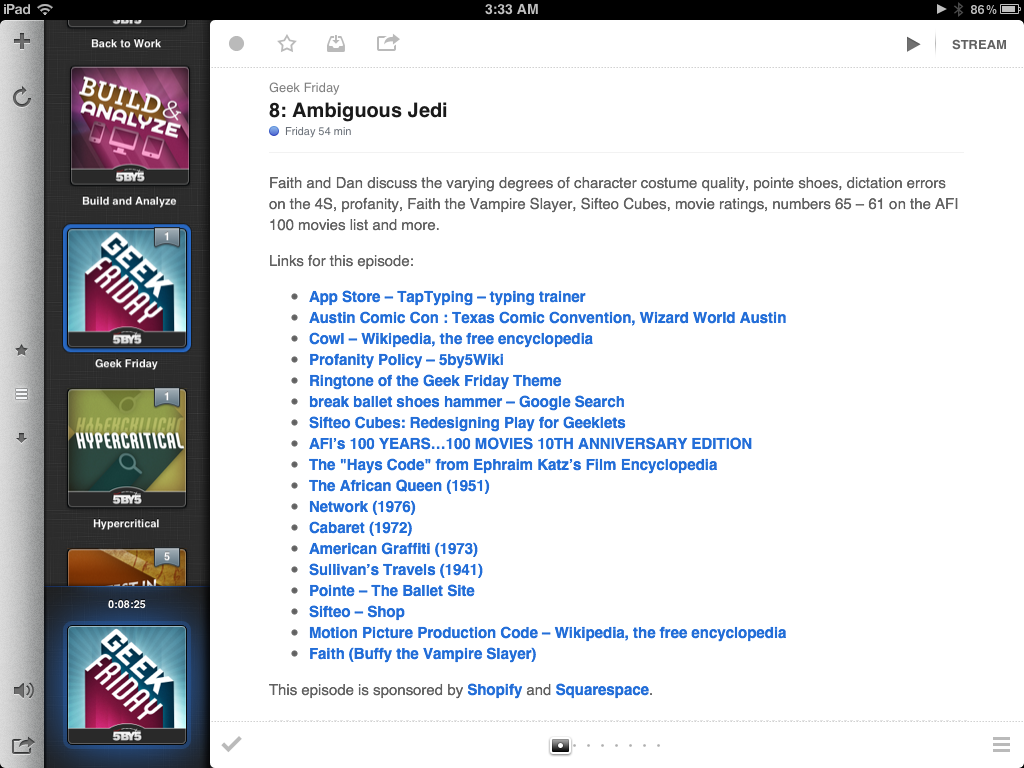
There were lots of days on the couch when I thought about Instacast coming to the iPad. Until recently of course, I hadn’t known what to expect before I was invited to take a look at the first beta. I imagined that Instacast, containing a library of podcasts, would take on a form similar to iTunes. I imagined the interface as a grid, where you would easily scroll through podcast cover-art and see badges revealing the number of unplayed episodes. How silly!
Martin Hering first hinted at the design in September, and I later had the privilege of revealing more of the interface near the end of October. An excited Joshua Schnell and Myke Hurley have also been eager to share the new interface, giving it due praise on the App Orchard and at Macgasm. The hype around Instacast HD for the iPad has been astounding, and for good reason. Instacast HD is incredible.
MacStories Product Review: AViiQ Portable Charging Station

It’s true that we can’t leave home without our myriad of chargers and gadgets, loosely stuffed into any available backpack pocket and bundled with the endless length of cords required to recharge such devices. Every charger, every USB cable, and every associated gadget can take up an amazing amount of space, and while I’m careful not to lose anything, keeping track of everything you bring with you becomes a drag. And if those Cables get entangled together? Game over.
Instead of taking four different individual chargers for our iPads, iPods, and Bluetooth headsets, what if we reduced that to one item that could contain all of our cables and smaller gizmos that we don’t need immediate access to? Wouldn’t it be nice if we could unfold a mat and have all of our cables neatly presented for immediate charging? Past the break, we’re taking a look at something as convenient, and we advise everyone that this could possibly be on your holiday wish-list by the time you’re done reading this review.
LogMeIn Ignition Adds Direct Integration with Dropbox, Google Docs, WebDAV Servers
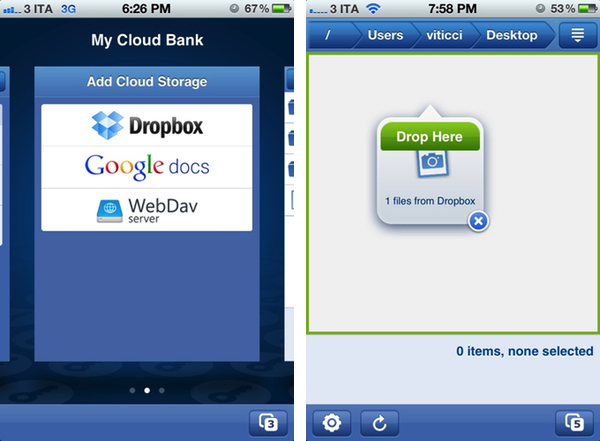
In the past months LogMeIn, makers of the Ignition app for iOS, have released a series of updates to enhance Lion compatibility on the desktop and improve the file sharing capabilities of the iOS client, which, as we detailed in our various reviews, is a great way to remotely access computers (Macs and PCs) over the air. LogMeIn Ignition isn’t the cheapest app on the App Store, but its rich set of features and support from LogMeIn (a company that, among other things, also produces a free VPN tool for OS X) make it a worthwhile purchase for those looking for a complete solution to control a computer’s screen and access to its files.
The latest version of Ignition, released today, adds a single, yet important feature called Cloud Bank that brings direct integration with Dropbox, Google Docs and any WebDAV server to the iOS app. LogMeIn Ignition was already capable of moving files between computers and iOS’ local document manager with an intuitive drag & drop menu and copy/move functionalities; nowadays, however, users are more likely to keep their documents in the cloud, rather than physically stored on a computer’s drive, and LogMeIn’s move towards integration with cloud-connected services is certainly welcome as a way to get files from the cloud and onto a computer remotely.
My Cloud Bank allows LogMeIn Ignition users the ability to take full advantage of being remote by connecting them to their files no matter where they are. We’ve extended the functionality of our File Manager feature and given users the benefit of using cloud storage services in conjunction with remote access and local file storage on their devices.
Think of Ignition as a bridge between the cloud and a remote computer. With Cloud Bank, Dropbox and Google Docs are easily accessible through Ignition’s usual interface, with the same copy menu from computer-based remote connections. You’ll be able to move files between Dropbox and a computer you’re remotely connected to, or get a spreadsheet from your Google Docs account into a computer without, say, giving the person that’s using the remote machine access to your Google credentials. With WebDAV support, users will be able to configure services like DropDAV, which turns Dropbox into a WebDAV server and works out of the box with apps like Pages and Keynote.
I look forward to seeing whether LogMeIn will ever consider adding support for iCloud files, as that seems the most logical step to seamlessly fetch an iOS user’s cloud documents. In my tests, Cloud Bank has been extremely reliable in dealing with large Dropbox transfers from the cloud to a computer I was remotely connected to via 3G.
LogMeIn Ignition is available at $29.99 on the App Store.